
Living, breathing human trials
Study shows that freezing embryos increases cancer risk, and we won’t know the full, long-term danger for years
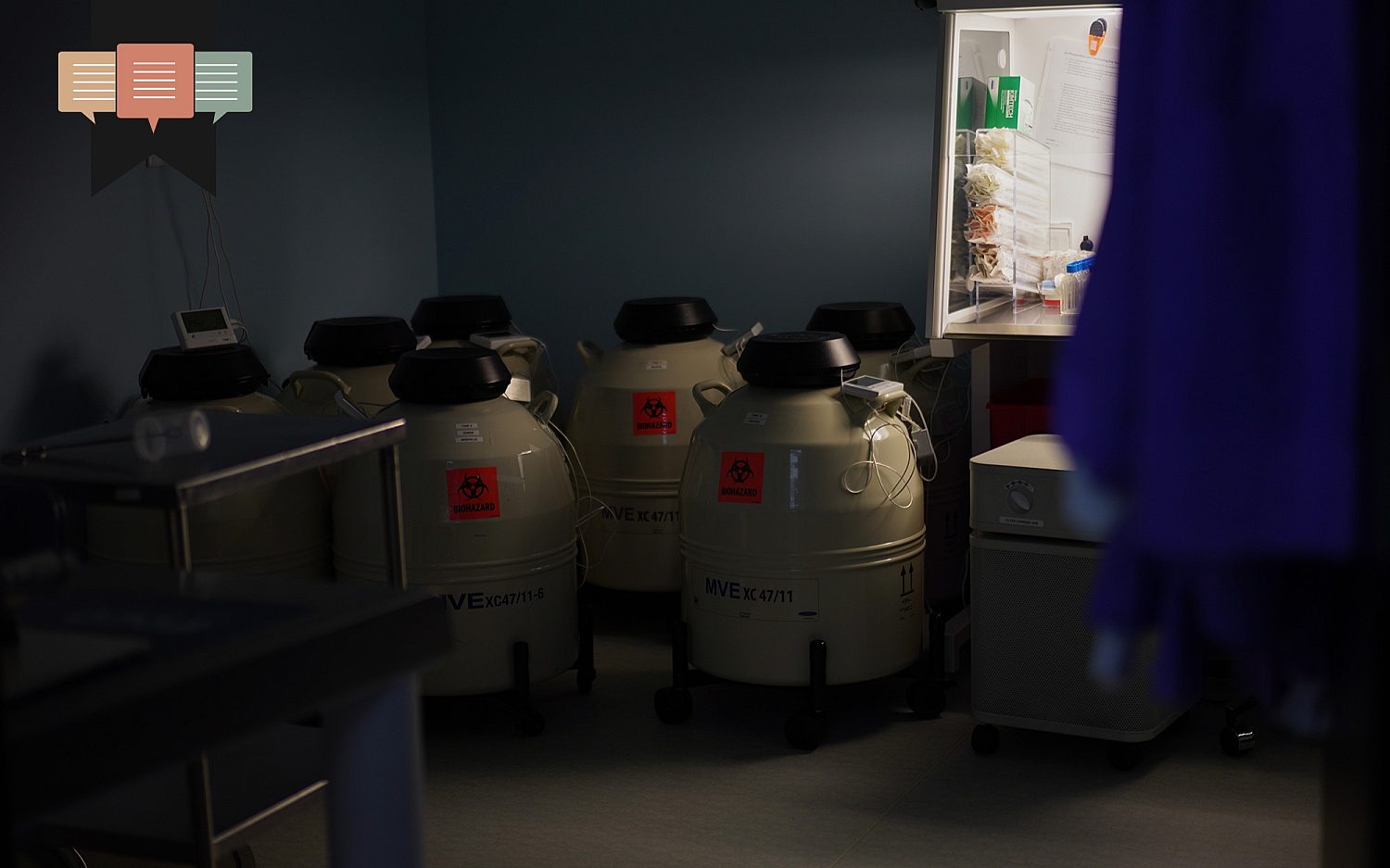
Tanks containing frozen eggs and embryos preserved in liquid nitrogen are stored in Knoxville, Tenn. Associated Press / Photo by Jessie Wardarski
Full access isn’t far.
We can’t release more of our sound journalism without a subscription, but we can make it easy for you to come aboard.
Get started for as low as $3.99 per month.
Current WORLD subscribers can log in to access content. Just go to "SIGN IN" at the top right.
LET'S GOAlready a member? Sign in.
In a groundbreaking study published last week in the Journal of the American Medical Association, Danish researchers who followed over one million children for 20 years found that children conceived using assisted reproductive technology (ART, specifically those frozen as embryos) developed cancer at twice the rate of children conceived naturally.
They found that children conceived without ART received a cancer diagnosis at an average rate of 18.3 per 100,000 children each year, while children conceived by frozen embryo transfer developed cancer at an alarming 41.1 per 100,000 children each year (in layman’s terms, a little more than double the risk).
They also found that Intracytoplasmic Sperm Injection (a process through which the egg does not naturally select the sperm but is instead injected with a sperm by doctors) was also associated with a higher cancer rate of 27.9 per 100,000 children each year. That matters, because ICSI is no longer the exception: in 2021, it was used in 77.9 percent of U.S. embryo transfers.
Only one form of IVF showed no increase in this particular study, and that was the method where an embryo is transferred fresh rather than frozen and does not use ICSI. That cancer rate was 18.5 per 100,000 children each year, which relatively matched that of children conceived naturally.
This is not the first study to find this link. In 2022, a study of 2.3 million Taiwanese children found those conceived through ART had a 58% higher risk of childhood cancer. Additionally, a 2024 study of 8.5 million French children found no overall increased risk, but did find, for frozen embryo transfers, a 61% higher risk of acute lymphoblastic leukemia. The children in that study born after frozen embryo transfer had been followed for a median of only 4.4 years, likely too early to see the full effects yet.
Three things follow from this data:
First, the chance any child is ever diagnosed with cancer is small, and the study’s authors say plainly that “absolute risks were low.” However, doubling is doubling, and a small absolute risk is still a lot of children, roughly 23 more children every year. For the parents of each of those children, the risk is no abstraction, and they are left to reckon with whether a fertility clinic’s freezer played a part in their child’s cancer. Parents should be informed, as they consider these different procedures, of the risks they confront.
Second, if the risk lies in freezing, we have a massive (and growing) problem. The fertility industry has moved more and more embryos to the freezer. In 2021, 83.8% of U.S. embryo transfers used a frozen embryo. The shift has been dramatic: in 2009, U.S. clinics performed 102,478 cycles using fresh embryos from a patient’s own eggs and 26,069 using frozen eggs or embryos. By 2021, it was 55,287 fresh and 162,548 frozen. Genetic testing is one reason. In 2021, more than half of transfers involved an embryo tested with PGT, or preimplantation genetic testing, a eugenics-like process that screens embryos for chromosomal abnormalities and inherited genetic conditions so that the “undesirables” can be eliminated.
Because the results take weeks, the embryos are frozen while the lab waits. Yet the industry’s own professional body, the American Society for Reproductive Medicine, says, “The value of PGT-A as a routine screening test for all patients undergoing in vitro fertilization has not been demonstrated.” In other words, many couples are delaying their child’s transfer, and subjecting him to the freezer, for a test that is unnecessary, unproven, and in worst cases the cause of mistaken destruction of a healthy embryo.
Finally, the authors of the latest study note that ART practices have continued evolving, so findings “may differ for contemporary protocols.” Depending on how you look at it, this can be encouraging or terrifying. What we do know is that those first few days of life are critical for the way a child’s body develops. IVF handles the embryo during a period that, as one 2022 study put it, “coincides with the extensive epigenetic remodeling occurring between fertilization and embryo implantation”—stated plainly, a very important time. While technology continues to change, and some would say we are getting “better,” we don’t know the impact these so-called improvements are having on the children. And we will not know for a long time. Those conceived with today’s methods won’t have 20 years of data until the 2040s. That makes today’s children conceived through assisted reproductive technologies a living, breathing human trial.
The researchers who published the Taiwanese study concluded with this: “Our findings suggest that couples seeking ART treatment need to be informed of the low but significantly increased risk of childhood cancers.”
They are right, but informing parents is only the beginning. The real suffering couples face when dealing with infertility is heartbreaking, and our desire to help is noble. But I’m afraid our eagerness to help has led far too many to embrace procedures whose risks are neither explained nor understood, and whose long-term effects we are only now beginning to measure.
That leaves two questions the fertility industry has rarely had to answer. First, who carries the burden of proof? Right now, we must see harm to a child 20 years after the fact before anyone reconsiders the procedure that created him. It should be the other way around: a procedure (especially an entirely unnecessary one like freezing) performed on a child should have to show it is safe for that child before it becomes standard practice. Second, who gives consent? Parents sign the forms, but the child, the one who will carry the risk, never can.
If the industry is going to keep doing this, then it must be required to track the long-term health of the children conceived through it, so that we are not left waiting decades for studies from other countries to tell us what our own clinics are doing. And if we truly want to help couples struggling with infertility, we should commit to investing in restorative reproductive medicine that actually heals the underlying causes of infertility instead of working around them at a child’s expense.


These daily articles have become part of my steady diet. —Barbara
Sign up to receive the WORLD Opinions email newsletter each weekday for sound commentary from trusted voices.Read the Latest from WORLD Opinions
David Closson | Four states will vote tomorrow on whether to protect women’s sports

Lael Weinberger | Colorado finds itself at the Supreme Court (again) in a dispute about religious freedom

J.K. Wall | In the national spotlight, its faculty call for “productive disagreement in the scholarly process”

Hunter Baker | Blatant corruption takes center stage in midterm races

Please wait while we load the latest comments...
Comments
Please register, subscribe, or log in to comment on this article.