
Did Cornell get one thing right?
In the national spotlight, its faculty call for “productive disagreement in the scholarly process”
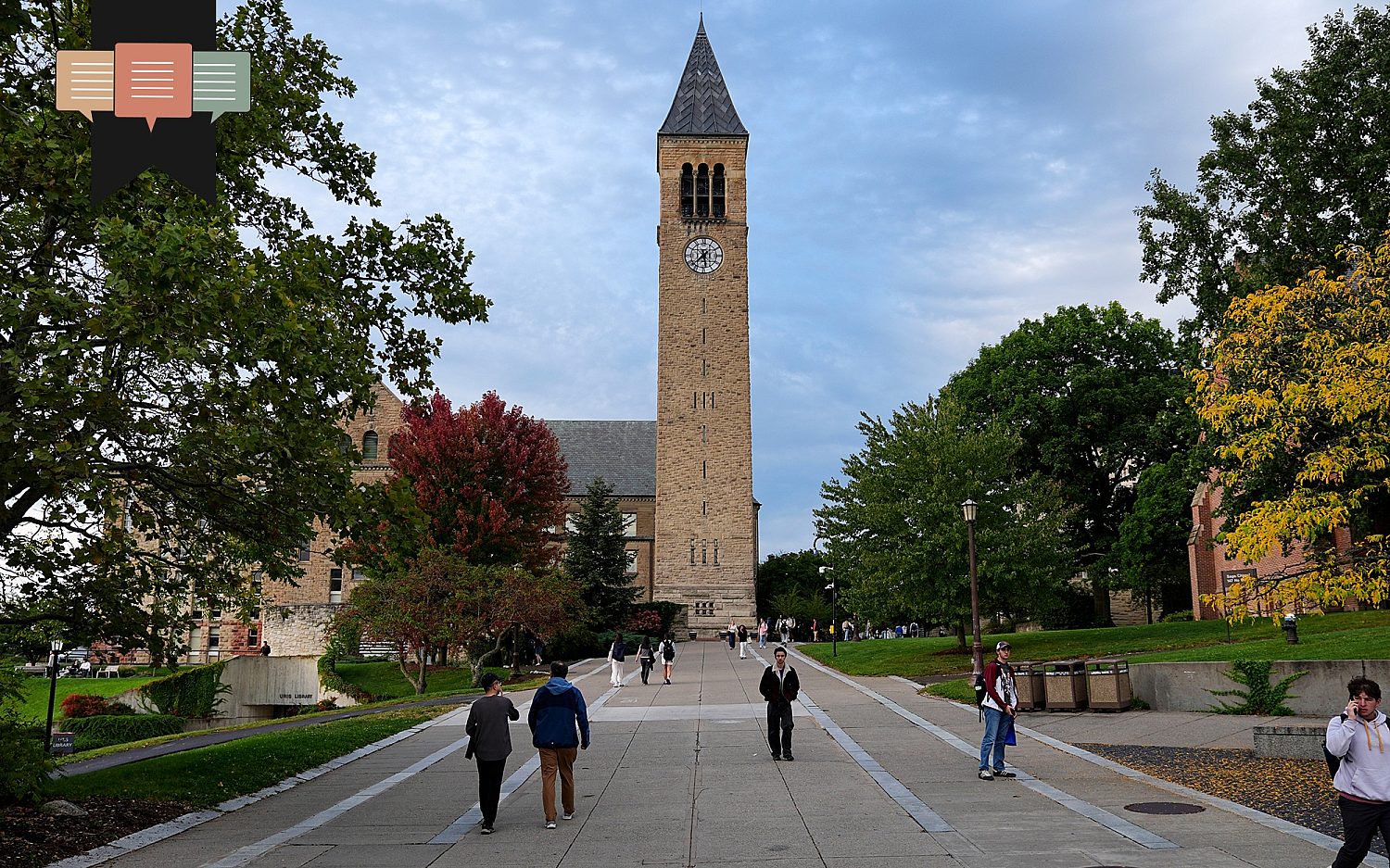
Cornell University in Ithica, N.Y. Associated Press / Photo by Matt Rourke
Full access isn’t far.
We can’t release more of our sound journalism without a subscription, but we can make it easy for you to come aboard.
Get started for as low as $3.99 per month.
Current WORLD subscribers can log in to access content. Just go to "SIGN IN" at the top right.
LET'S GOAlready a member? Sign in.
Amid the firestorm centered on Cornell University this fall, you might have missed what may be a small piece of good news emerging from Ithaca.
A Cornell faculty committee issued a 17-page report with a strong vision for how to improve American universities. The committee recommended—wait for it—that U.S. universities renew their core purpose, which the committee defined as promoting “an ecosystem to cultivate sound judgment.”
After years of universities being ground zero for wokeism, anti-Semitism, cultural revisionism, careerism, and many other concerning isms, such a call is a small but hopeful step in the right direction. It’s not quite a return to the literal meaning of “university”—one truth—but it could be a significant break with the past.
“Sound judgment” as a goal seems especially relevant coming at the same time Cornell was engulfed by national news coverage of former students who engaged in a drug- and alcohol-fueled orgy that one woman’s lawsuit says turned from consensual to coerced.
Cornell’s is the latest in a string of introspective reports coming from higher education in the past year and a half, sparked by plummeting public support, funding cuts and legal threats from the Trump administration, and now declining enrollment due to the baby bust that started during the Great Recession.
The Cornell faculty committee acknowledged all of those challenges, including affordability, and concluded they are here to stay: “the pressures threatening universities will not resolve themselves and must be proactively addressed,” the committee wrote. “Indeed, many of the critiques of America’s universities are strikingly bipartisan, drawing left and right into alignment like few other issues.”
Two specific challenges drove the Cornell committee’s call to focus on sound judgment: the “diffusion of AI” and the “narrowing of discourse in academia.”
“In an increasingly divided society inundated with unverified and often inaccurate information,” the Cornell committee wrote, “universities must reclaim their role as a place for rigorous learning and discernment based on the best scholarship available and not on pre-existing worldviews or untested assumptions.”
So, does the Cornell faculty know how to make that vision a reality? Not really. The faculty issued 14 recommendations, ranging from “promote whole-person education” to “design spaces and artifacts for transformative education.”
If the Cornell faculty really want to change the “narrowing of discourse” across American universities, they need to look closer to home. U.S. universities have hired professors that are overwhelmingly liberal in their views, creating a culture that in many places shames or shouts down those with conservative or traditional perspectives.
According to a 2020 survey of more than 12,000 tenure-track professors by the National Association of Scholars, there were 8.5 registered Democrats for every registered Republican. And left-leaning faculty were more politically active: professors who donated to Democrats outnumbered their colleagues who donated to Republicans 95 to 1.
Across disciplines, the ratio of professors registered as Democrats versus Republicans ranged from a low of 3-to-1 among economists to an astounding 42-to-1 among anthropologists. Even among chemistry professors—a seemingly apolitical field—the ratio was 4.5-to-1 in favor of registered Democrats.
This is in stark contrasts to similar research in the late 1960s, when social scientists were predominantly liberal but there was roughly equal split between Democrats and Republicans, at least in the natural sciences and fine arts.
This lack of balance has real consequences on campus. One study found that the American public identifies as evangelical at three times the rate of U.S. university faculty members.
And a 2024 survey of nearly 6,600 university faculty by the Foundation for Individual Rights and Expression found that only 20% think a conservative would fit in well in their department. Also, 35% reported toning down their written work to avoid controversy—roughly four times the percentage who said the same in 1954 during the height of McCarthyism.
To its credit, one of the Cornell faculty committee’s 14 recommendations was to “promote productive disagreement in the scholarly process.” But the first step toward such a vision is to hire people who actually disagree with the ideologies that brought universities to this point of crisis.
If American universities truly want to change their cultures, they need to employ people with different ideas—and then listen to them.


These daily articles have become part of my steady diet. —Barbara
Sign up to receive the WORLD Opinions email newsletter each weekday for sound commentary from trusted voices.Read the Latest from WORLD Opinions
Hunter Baker | Blatant corruption takes center stage in midterm races
Ray Hacke | Kallie Keeler’s case is the ultimate argument against allowing boys in girls’ sports

Daniel R. Suhr | Higher education became much worse after William F. Buckley’s critique, but is it beginning to turn a corner?
Randall E. King | Does the reporting of a fake poll reflect bias or bad journalism?
Please wait while we load the latest comments...
Comments