
Discrimination by another name
Colorado finds itself at the Supreme Court (again) in a dispute about religious freedom
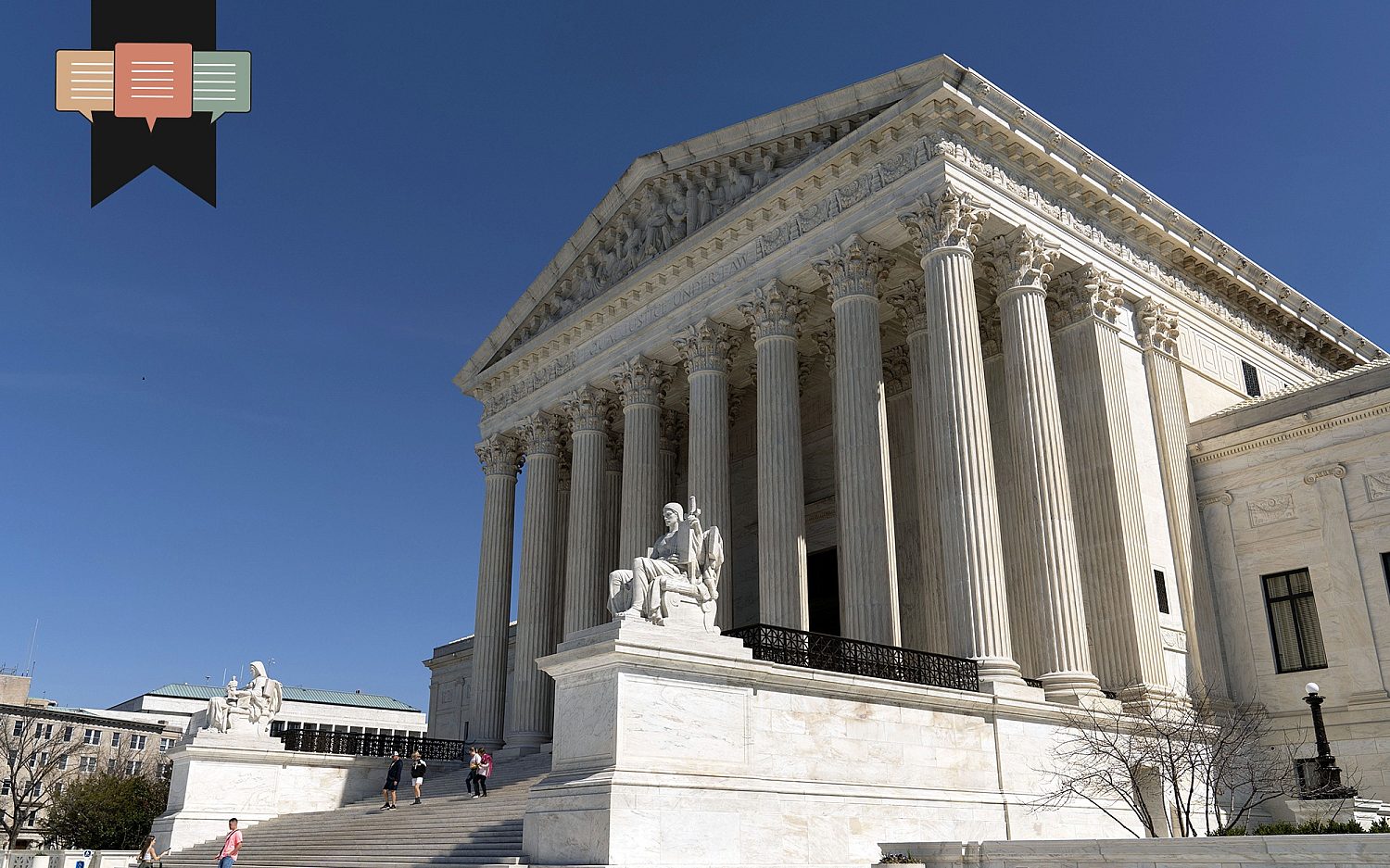
The U.S. Supreme Court building in Washington, D.C. Associated Press / Photo by Jose Luis Magana
Full access isn’t far.
We can’t release more of our sound journalism without a subscription, but we can make it easy for you to come aboard.
Get started for as low as $3.99 per month.
Current WORLD subscribers can log in to access content. Just go to "SIGN IN" at the top right.
LET'S GOAlready a member? Sign in.
On Tuesday, the Supreme Court will hear arguments in a religious liberty case worth watching. It has the potential to set an important precedent about the scope of religious exercise protected by the First Amendment.
The case comes from Colorado, the source of multiple high-profile disputes involving religious exercise and expression in recent years. This time, the case is about preschools.
Colorado has a program designed to make preschool more affordable to families across the state. Families that receive tuition assistance can use it for any licensed preschool, public or private. But to participate in the program, preschools must comply with a nondiscrimination rule that covers sexual orientation and gender identity.
Catholic preschools, which hold to Catholic teachings on marriage and sexuality, say their policies conflict with Colorado’s requirements. Parents who want to send their children to St. Mary’s in Denver are required to sign a statement that includes a commitment to respect “Catholic teachings on sexual identity, marriage, family, and parenting.” As a result, state officials argue that the Catholic school cannot participate in the Colorado preschool funding program. St. Mary’s brought a suit to challenge the state’s conditions on funding.
The case lies at the intersection of two different lines of Supreme Court decisions, and that’s what makes it interesting.
First, the Supreme Court has said in a series of cases that governments can’t discriminate against religion when they offer generally available public benefit programs. In Trinity Lutheran Church v. Comer, for example, Missouri offered grants to help make playgrounds safer. But the state excluded religious organizations from the program. Trinity Lutheran Church operated a preschool with a playground that otherwise would have been eligible for a grant. Missouri said no, because Trinity Lutheran was a religious organization. The Supreme Court held that Missouri’s discrimination against religion was unconstitutional.
In two more cases, Espinoza and Carson, the Court reiterated: The First Amendment prohibits the government from discriminating against religion when it makes benefits generally available to the public.
In light of these cases, St. Mary’s has a strong argument that Colorado cannot exclude St. Mary’s from a grant program on the basis of its religious exercise.
But Colorado says there is a difference: In the earlier cases, states expressly singled out religion for exclusion. But Colorado says that its funds can go to any preschool, including a religious preschool, as long as the school does not discriminate on certain prohibited grounds—in this case, sexual orientation and gender identity.
Colorado therefore points to a different Supreme Court precedent. In Employment Division v. Smith, the Court held that the First Amendment permits laws that burden religion, so long as the law is (1) neutral toward religion and (2) generally applicable—that is, a law that applies to everyone, not just religious people. Colorado argues that Smith is what matters here—because Colorado’s rule applies to everyone.
When Smith was first decided, its requirements were not applied in a very demanding way. Most courts thought most laws were “neutral and generally applicable” so long as they didn’t specifically single out religion for worse treatment. But in recent years, the Court has put some teeth in the “neutral and generally applicable” standard. (I’ve previously written about that.) And this makes things harder for Colorado.
Start with the requirement of “neutrality.” Imagine that a state wanted to discriminate against religion but looked for a way to do so without saying so expressly. Suppose a state wanted to exclude observant Jewish schools from a grant program. Rather than saying that Jewish schools could not participate, the state passed a law excluding schools run by men who wear hats at all times. This, of course, is designed to discriminate against observant Jews, but on the face of it, the rule is neutral and applies to everyone. Yet such gamesmanship surely can’t be permitted. Such a law wouldn’t really be “neutral” as to religion. States can’t discriminate against religion by proxy.
St. Mary’s says that’s what Colorado is doing here: discriminating against religious schools, not by expressly singling out religion but by excluding schools that follow traditional religious beliefs. For St. Mary’s to win on this argument, the court will have to flesh out what it means to show lack of neutrality. If the Supreme Court does so its ruling will be a very important decision.
Another possibility would be for the Court to rule for St. Mary’s on narrower grounds, finding that Colorado’s rule is not generally applicable. The Supreme Court has held that the government cannot prohibit religious conduct while permitting comparable secular conduct. If the government makes exceptions for secular reasons, it may have to make exceptions for religious exercise too.
The Catholic schools note that Colorado’s program has some exceptions from its nondiscrimination rule. It permits preschools to give enrollment preferences for all sorts of reasons, such as being “part of a specific community.” Yet Colorado won’t accommodate religious admissions policies. St. Mary’s argues that this means that Colorado is applying the law so as to give religious preschools worse treatment—meaning the law isn’t “generally applicable” on equal terms.
A ruling on this basis would be relatively easy under existing precedent. The important issue to watch if the Court goes this route is how the Court compares the exceptions that Colorado is currently offering with the exception it would have to give to accommodate St. Mary’s. That’s also an important issue that lower courts have struggled with in applying the “general applicability” standard.
Colorado won in the court below, and the Supreme Court agreed to take the case. That suggests at least some justices are skeptical of the lower court’s decision; the Supreme Court more often takes cases to reverse than to affirm. Colorado also has a track record of losing in the Supreme Court when its regulations have come into conflict with religious exercise and expression. St. Mary’s has a good chance of prevailing here.
How the Supreme Court decides to rule will be important for the future of religious free exercise. The November argument will be worth watching for clues about which path the justices are inclined to take.


These daily articles have become part of my steady diet. —Barbara
Sign up to receive the WORLD Opinions email newsletter each weekday for sound commentary from trusted voices.Read the Latest from WORLD Opinions
J.K. Wall | In the national spotlight, its faculty call for “productive disagreement in the scholarly process”
Hunter Baker | Blatant corruption takes center stage in midterm races
Ray Hacke | Kallie Keeler’s case is the ultimate argument against allowing boys in girls’ sports

Daniel R. Suhr | Higher education became much worse after William F. Buckley’s critique, but is it beginning to turn a corner?
Please wait while we load the latest comments...
Comments
Please register, subscribe, or log in to comment on this article.