
Biological reality is on the ballot
Four states will vote tomorrow on whether to protect women’s sports
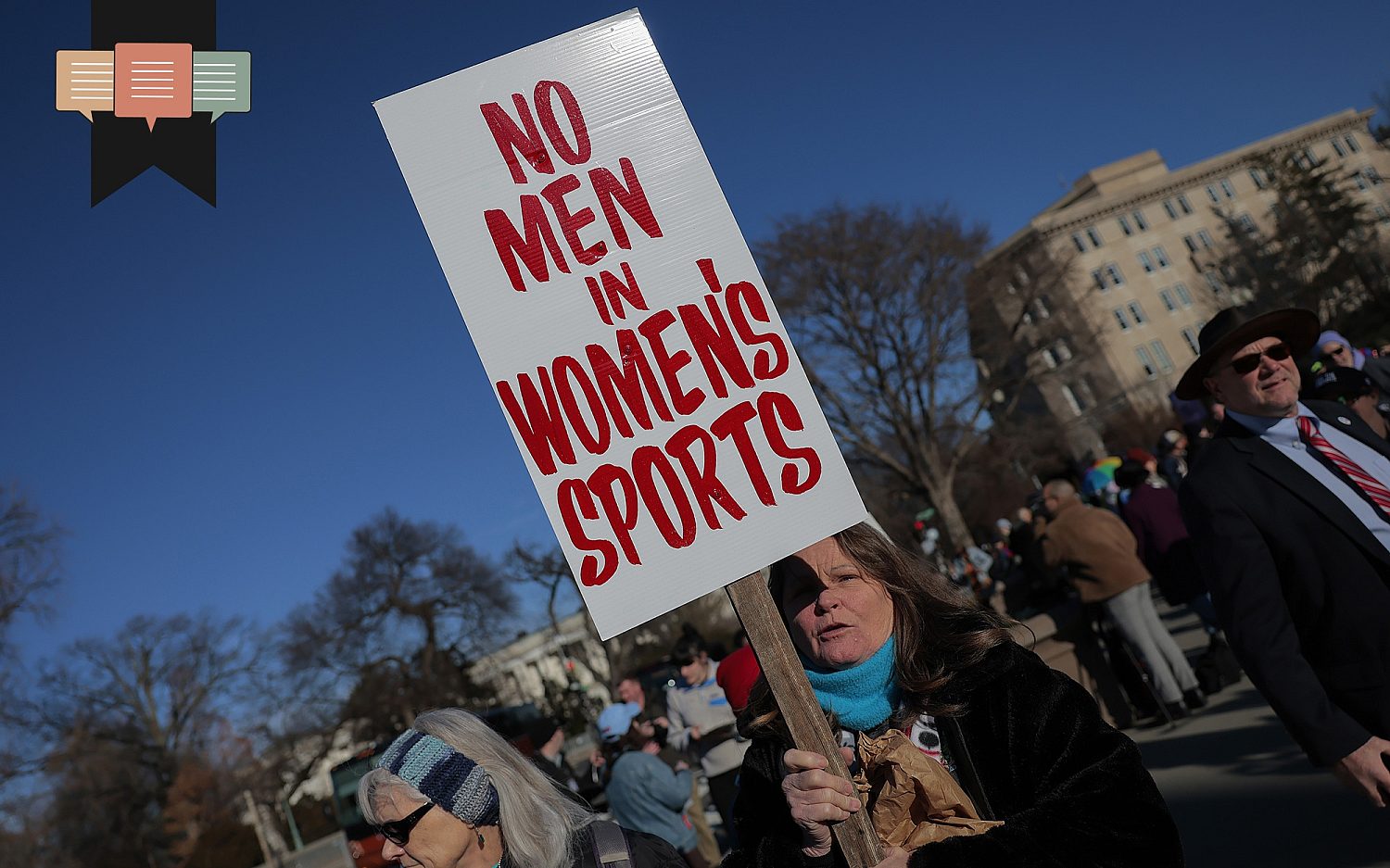
Protesters for protecting women’s sports rally outside the U.S. Supreme Court on Jan. 13. Getty Images / Photo by Heather Diehl
Full access isn’t far.
We can’t release more of our sound journalism without a subscription, but we can make it easy for you to come aboard.
Get started for as low as $3.99 per month.
Current WORLD subscribers can log in to access content. Just go to "SIGN IN" at the top right.
LET'S GOAlready a member? Sign in.
Millions of Americans will soon vote in the 2026 midterm elections. Most urgently at stake is control of the U.S. Senate and House of Representatives, where Republicans currently hold narrow majorities. While pundits are closely tracking the races that will determine who controls Congress, four states will also be voting on first-of-their-kind ballot initiatives concerning women’s sports eligibility. The outcomes of these initiatives may provide a preview of the cultural issues that could retain political potency leading into 2028.
In Arizona, Colorado, Nebraska, and Washington state, voters will decide whether to adopt statewide initiatives prohibiting males from competing in women’s athletics. The partisan leanings of these states differ widely. Colorado (+11 D in ‘24) and Washington (+18 D in ‘24) are blue, Arizona has become a perennial battleground (+5.5 R in ‘24; +0.3 D in ‘20), and Nebraska is reliably red (+20.5 in ‘24). Thus, while polling consistently shows that a sizeable majority of Americans nationwide oppose males competing in women’s sports, voters in these four states will have the opportunity to contradict or corroborate the emerging consensus on this issue.
Arizona’s Proposition 318 would prohibit schools and athletic associations from authorizing “a student, athlete, employee, or other individual” to use a “restroom, locker room, shower room, or other private space that is not designated for their sex.” According to the ballot summary, a “yes” vote will require schools to “designate every athletic team as male, female, or coed/mixed based on sex and to prevent males from joining female teams.” If adopted, state law would define sex as “an individual’s biological status as male or female as recorded at birth on an original birth certificate.” Additionally, the measure would authorize athletes to sue schools and athletic associations that knowingly violate the law.
Similarly, Colorado’s Proposition 134 would require K-12 and collegiate athletes to compete on teams that match their sex. The initiative would define “female” in state law as a person “whose biological reproductive system is organized around the production of ova.” “Male” would be defined in terms of the male biological reproductive system. Notably, Colorado voters will also decide Proposition 135, a measure that would prohibit healthcare professionals from providing sex-rejecting procedures for minor children.
In Nebraska, legislators passed a bill to protect girls’ sports in 2024. However, these protections are statutory, not constitutional. Thus, because the state allows citizen-initiated constitutional amendments, those concerned with the integrity of girls’ sports collected the necessary signatures to put a constitutional amendment before voters. If passed, Initiative 442 would amend the state’s constitution to require schools to designate athletic teams based on sex. Moreover, the measure states, “Athletic teams or sports designated for females, women, or girls … shall not be open to students of the male sex.”
Washington state’s Initiative 638 would require school districts and athletic associations to prohibit male students “from competing in certain athletic activities intended for female students only.” Significantly, if passed, the measure would also require verification. As the ballot summary states, “Students who choose to participate in such activities must provide a statement from the student’s healthcare provider verifying the student’s biological sex, based on reproductive anatomy, genetic makeup, or normal endogenously produced testosterone levels.”
Earlier this year, the U.S. Supreme Court upheld state laws designed to preserve the integrity of women’s sports. In the landmark case (Little v. Hecox and West Virginia v. B.P.J.), Justice Brett Kavanaugh explained, “[W]omen and girls should be allowed to compete for … life-changing opportunities on an equal playing field, without fear of physical injury from biological males or being forced to compete against biological males.” According to the Court, “[States] may determine eligibility for women’s and girls’ sports based on biological sex.”
Currently, 29 states have laws or regulations that limit participation in women’s or girls’ school sports teams to females only. However, 21 states do not provide any protections for female athletes. Although federal legislation to protect women’s sports passed the U.S. House of Representatives in 2025, Democrats in the Senate have repeatedly blocked it. As a result, federal protections for women’s sports remain on hold.
On Nov. 3, voters in four states can enshrine safeguards for women’s and girls’ sports into state law. In two of these states, Colorado and Washington, female athletes do not currently have legal protection. If recent polling is accurate, these measures have a chance to pass. If so, women and girls in these states will receive long overdue legal protection.
Only a few years ago, these measures would have been deemed unnecessary because our society recognized that women and girls deserve their own spaces, teams, and opportunities. While public opinion polling indicates that Americans support laws protecting women’s sports, there is still work to be done, especially in jurisdictions where the LGBTQ lobby holds significant sway. If these measures pass, it will represent the latest and much-needed victory for biological reality.


These daily articles have become part of my steady diet. —Barbara
Sign up to receive the WORLD Opinions email newsletter each weekday for sound commentary from trusted voices.Read the Latest from WORLD Opinions
Lael Weinberger | Colorado finds itself at the Supreme Court (again) in a dispute about religious freedom
J.K. Wall | In the national spotlight, its faculty call for “productive disagreement in the scholarly process”
Hunter Baker | Blatant corruption takes center stage in midterm races
Ray Hacke | Kallie Keeler’s case is the ultimate argument against allowing boys in girls’ sports

Please wait while we load the latest comments...
Comments
Please register, subscribe, or log in to comment on this article.