
God and Man at Yale, then and now
Higher education became much worse after William F. Buckley’s critique, but is it beginning to turn a corner?
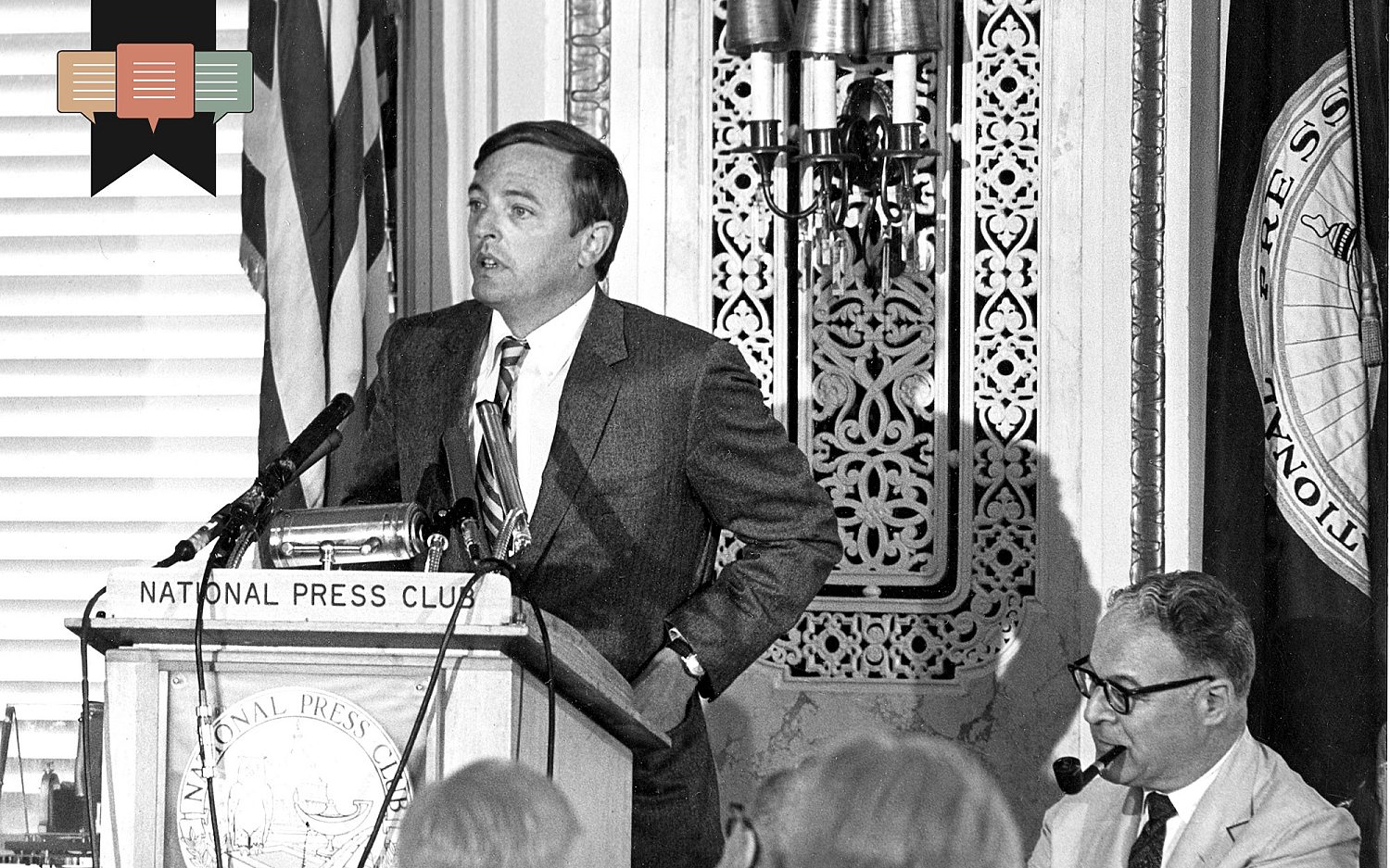
William F. Buckley Jr. addresses the National Press Club on Aug. 4, 1965. Associated Press
Full access isn’t far.
We can’t release more of our sound journalism without a subscription, but we can make it easy for you to come aboard.
Get started for as low as $3.99 per month.
Current WORLD subscribers can log in to access content. Just go to "SIGN IN" at the top right.
LET'S GOAlready a member? Sign in.
The amazing thing about William F. Buckley’s God and Man at Yale, first published in 1951, is that it caused a scandal at all. Buckley, a young graduate of Yale, accused the prestigious university of trying to force a left-wing ideology on its students. McGeorge Bundy, future national security adviser to President Kennedy, wrote in The Atlantic that Buckley’s book launched “a savage attack on that institution as a hotbed of ‘atheism’ and ‘collectivism.’ I find the book is dishonest in its use of facts, false in its theory, and a discredit to its author.”
From the New York Times to America to the Yale Law Journal, the annals of the intelligentsia were filled with rejections of Buckley’s charges. The WASPs were aghast at Buckey’s critique and rallied to the banner of their alma mater to prove its commitment to principles, proclaiming Yale a bastion of tradition, civility, and The Establishment.
Writing a new preface for the book’s reissuance on its 25th anniversary, Buckley observed that “25 years later, references to religion and politics that were then eyebrow raising seem utterly bland, almost conservative in a way.” The Keynesian economics he observed at the time, for instance, pale next to the sexual revolution of the 1960s. And that, in its turn, seems bland next to trangenderism and the other woke imperatives of our own day.
Buckley, at the suggestion of his mentor Willmore Kendall, had written the two most memorable lines in the book: “The duel between Christianity and atheism is the most important in the world, and the struggle between individualism and collectivism is the same struggle reproduced on another level.” Certainly, the duel between Christianity and atheism remains a primary concern of the world today, with the popularity of Christopher Hitchens, Richard Dawkins, and the New Atheism. And the struggle between individualism and collectivism remains pressing in our modern age, as collectivism has moved from the Soviet Union to New York City’s Gracie Mansion via the Democratic Socialists of America.
And yet, we may have turned the corner, ever so slightly and most optimistically, in higher education. The trends highlighted by Buckley continued for decades, accelerated by the Vietnam War and the 1960s. They puttered along contentedly through the years from Reagan to Obama, content in the cultural dominance they exercised. Then came wokeism and DEI, paired with the widespread demand to forgive all college debt. Militant unionization also rose on campuses—there are now more members of the United Auto Workers at the University of California than at General Motors.
These excesses crashed into three countervailing forces: the Supreme Court’s decision in Students for Fair Admissions, the widespread national revulsion to the campus takeovers following Hamas’s attack on Israel, and the reelection of President Trump.
Recognizing the crisis in confidence facing America’s elite universities, Yale’s current president commissioned a report on “trust in higher education.” The report’s verdict was not good—the American people’s attitude toward higher education, especially at the elite level, is significantly lessened compared to our historical respect for such institutions (much like our decline in trust in the national news media). Yale President Maurie McInnis said that Yale needed to “take responsibility for our role in the erosion of public trust. I accept this judgment fully. This decline did not come out of nowhere, nor did it happen overnight. And we were certainly more than mere bystanders.” If only the president of Yale in 1951 had reacted with similar openness and honesty when Buckley’s book came out.
Dr. McInnis is an art historian, and she weaves that background into her job. Her website highlights three of her favorite pieces from Yale’s Gallery of Art, one selected in honor of the nation’s 250th birthday.
In her Baccalaureate Address to the Yale College Class of 2025, President McInnis reflected on John Trumbull’s The Battle of Bunker’s Hill. She told the students, “Ours is an institution that predates the Revolution, and many Yalies played pivotal roles in the nation’s founding. This history matters not only because of Yale’s age, but also because of the leadership we’ve shown in pursuit of the ideals that shaped this country—chief among them the pursuit of liberty.”
Buckley called on Yale to again shape students who pursue liberty. I have no doubt that Yale graduates will continue to play pivotal roles in our culture and country—let us hope they again do so in the service of our founding ideals.


These daily articles have become part of my steady diet. —Barbara
Sign up to receive the WORLD Opinions email newsletter each weekday for sound commentary from trusted voices.Read the Latest from WORLD Opinions
Ray Hacke | Kallie Keeler’s case is the ultimate argument against allowing boys in girls’ sports

Randall E. King | Does the reporting of a fake poll reflect bias or bad journalism?
Ted Kluck | AI and the Christian university, a faculty hand-wringing barometer

Daniel Darling | School district’s agreement with ministry will benefit students and schools
Please wait while we load the latest comments...
Comments
Please register, subscribe, or log in to comment on this article.