
Mental health mayhem
Discussion of Lindsey Clancy and her copycats often leaves out the matter of justice
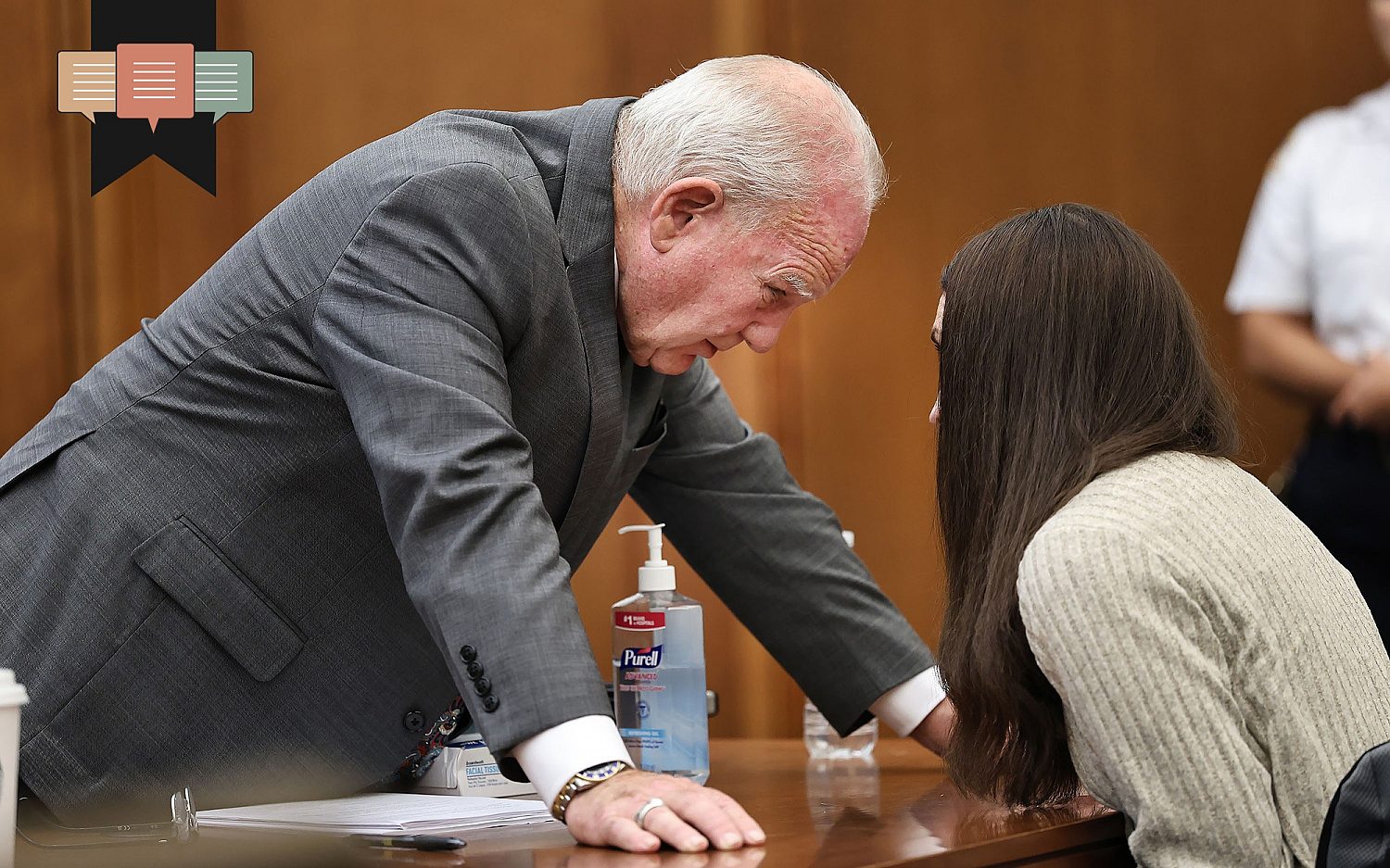
Defense attorney Kevin Reddington talks with Lindsay Clancy during her trial in Plymouth, Mass. Associated Press / Photo by Greg Derr / The Patriot Ledger, pool
Full access isn’t far.
We can’t release more of our sound journalism without a subscription, but we can make it easy for you to come aboard.
Get started for as low as $3.99 per month.
Current WORLD subscribers can log in to access content. Just go to "SIGN IN" at the top right.
LET'S GOAlready a member? Sign in.
It is the issue that simply will not go away. How will civil society respond to the murder of fellow human beings? Cold-blooded capital crime is continually in the news. And this, wholly apart from atrocities linked to international terrorism.
Americans are presently commemorating the 250th anniversary of our nation’s founding, and this very fact should humble us, both with gratitude—where we were—and sobriety—where we are. Benjamin Franklin is not infrequently quoted as saying, at the 1787 Constitutional Convention, that ours is “a republic, if you can keep it.” While there is more truth packed in that quip than we care to consider, at the very least the founding fathers’ commitment to “self-evident truths,” “nature and nature’s God,” “unalienable rights” (even of the unborn or newborn), and “endowment by the Creator” would have precluded even the remotest possibility that mental derangement might excuse the premeditated killing of innocent human beings. Much less, the premeditated killing of one’s own children.
Fast-forwarding to the present we find ourselves as a culture confronted with the extraordinarily sad case of Lindsay Clancy, accused of killing her three young children: five-year old Cora, Dawson, and Callan, just eight months old—in her basement home in Duxbury, Mass., in January of 2023. Following the killings, Clancy allegedly attempted suicide by leaping out of a second-story window. Unsuccessful in that attempt, she is presently confined to a wheelchair. Clancy pleaded not guilty to three counts of first-degree murder. Her case ended in a mistrial on Sept. 4 after jurors were unable to reach a unanimous verdict. Clancy’s lawyer didn’t contest the fact that she killed her three children, nor that she attempted suicide in the awareness of guilt. Rather, his argument was that her mental illness was so severe that she simply could not be held criminally responsible.
But this is not all. We have also learned of a second and third instance of child murder, both of which claim inspiration from Clancy. While jurors were deliberating in the Clancy case, a 40-year-old Frankfort, Ill., woman was charged with the murder of her two-year-old son on Sept. 1. Police arrived at the home of Corie Walsh to find a neighbor performing CPR on two-year-old Barrett Walsh, whom the neighbor, before calling 911, found hanging from a rafter in the basement of Walsh’s house. According to court records, Walsh had been “actively discussing” the Clancy case in a group text earlier in the day. The neighbor also told police that she had found Walsh upstairs in the bathroom “trying to kill herself.”
Walsh’s attorney, in a statement to ABC News, said that her client was suffering from a “psychotic episode” and concluded: “It is our hope that through a thorough presentation and investigation of the facts, that all of us will come to see this heartbreak for what it is.”
Yet another Clancy-inspired “victim” is Janette MacAusland of Wellesley, Mass., who confessed to killing her two children—six-year old daughter Ella and seven-year-old son Kai—in April of this year. Following the killings, she is said to have gone to her aunt’s home in Vermont and confessed, “I wanted the three of us to go to God together, but it didn’t work.” Although her attorney has argued, “This is not Lindsay Clancy 2.0,” he then declared “there’s been a discussion, a discourse, that’s opened up in this country about whether or not we want to criminalize mental illness.” His prognosis was that it is “too soon to say if he’ll pursue an insanity defense for MacAusland.”
Indeed, this seems to be the choice before us in the case of murder: post-partum psychosis or insanity. And notice what it is not. It is not a matter of justice or desert. Nor is it a question of right and wrong. Only a denial of good and evil and the grotesque conflation of guilt and victimhood. We must then ask ourselves: What should be civil society’s response to horrendous evil?
Common sense, religious conviction, and human nature all compel us to distinguish between just and unjust, between good and evil. Classically understood, justice requires rendering that which is due. The distinction between right and wrong, justice and injustice, cannot be reduced to “mental health,” which is a strictly modern invention and in the context of criminal behavior a perversion of human personhood.
Take, for example, the biblical rationale for capital punishment in the case of premeditated murder: “Whoever sheds the blood of man, by man shall his blood be shed, for God made man in his own image" (Genesis 9:6). And consider that the moral law distinguishes between murder that is premeditated and manslaughter (Exodus 21, Numbers 35, and Deuteronomy 19). For this reason, there existed in ancient Israel “cities of refuge” to which the manslayer could flee; there the judges, based on the evidence from multiple witnesses, would adjudicate over the defendant’s motive. Murder is never a matter of “mental health.”
There is moral wisdom in an argument offered by C.S. Lewis. In his incisive essay “The Humanitarian Theory of Punishment,” Lewis insisted that a “therapeutic” response to criminal behavior is neither just nor compassionate. We do not “dignify” fellow human beings by offering them excuses for their criminal conduct. Quite the opposite. Precisely because we are fashioned in the image and likeness of God, Lewis argued, we hold one another accountable for our actions, as any parent well intuits.
If justice is not rendering what is morally due and hence what is deserved, then we shall need to acknowledge that there is no such thing as justice, and no need to punish. In that case, “civil society” as we know it collapses. Does just punishment, including capital punishment in the case of premeditated murder, constitute an “uncivilized” societal response, as abolitionists and “mental-health” experts maintain? The answer depends fundamentally on how we as a society understand the morality of crime and punishment.
A society unwilling to impose just punishment on those who murder in cold blood is a society that has abandoned its responsibility to uphold the sanctity of human life. In the end, civilized culture will not tolerate murder. An uncivilized culture, on the other hand, will.


These daily articles have become part of my steady diet. —Barbara
Sign up to receive the WORLD Opinions email newsletter each weekday for sound commentary from trusted voices.Read the Latest from WORLD Opinions
Carl R. Trueman | The spirit that negates stands behind the riots in France, and it also exists right below the surface in the United States
Glenn T. Stanton | New research shows the secret to having more kids is having friends who like kids

John D. Basie | What a 1975 animal cruelty statute reveals about November’s ballot in the Commonwealth of Virginia

Jim Campbell | The Supreme Court justice’s new book provides insight on his judicial philosophy

Please wait while we load the latest comments...
Comments
Please register, subscribe, or log in to comment on this article.