
It can happen here, too
The spirit that negates stands behind the riots in France, and it also exists right below the surface in the United States
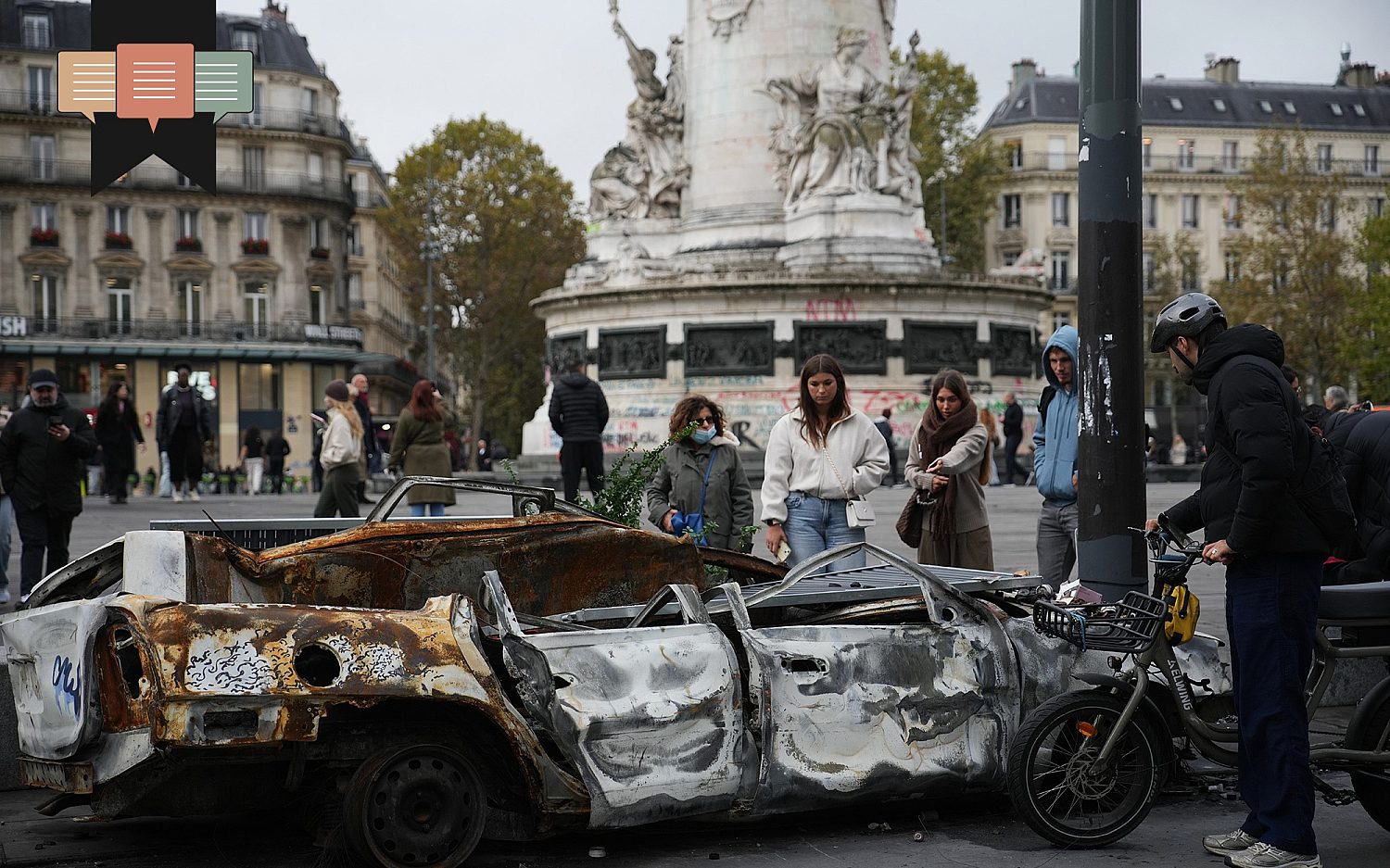
People look at a burned-out car after riots in Paris. Associated Press / Photo by Christophe Ena
Full access isn’t far.
We can’t release more of our sound journalism without a subscription, but we can make it easy for you to come aboard.
Get started for as low as $3.99 per month.
Current WORLD subscribers can log in to access content. Just go to "SIGN IN" at the top right.
LET'S GOAlready a member? Sign in.
As numerous countries in Europe experience riots, many in America are asking, “What on earth is happening on the continent that was, in many ways, the cradle of Western civilization?” As historic buildings, places of worship, and commercial properties combust before our eyes on the nightly news, how are we to make sense of this?
One danger is that we adopt the classic stance of the Pharisee: “We thank you, Lord, that we are not like other men, such as these crazy Europeans who are destroying everything good and beautiful about their culture.” That would be a mistake, not simply on the grounds that self-righteous preening when confronted with the evil of others is never a good strategy, but it also fails for a number of other very significant reasons.
First, it shows remarkable cultural amnesia. The United States itself has been subject within the last decade to seeing the streets of major cities like Portland seized by violence and destruction. We cannot dismiss those as the acts of a small, unrepresentative but highly organized and intentional minority and not extend the same grace to Europe, where the majority of people (as was the case in the United States) are not turning city streets into bonfires of the vanities.
Second, we need to understand that these European rioters have emerged from a culture whose basic dynamics are present in the United States. Their world, as ours, is one where social media incentivizes (and even monetizes) outrage, thereby degrading discourse and rewarding stupidity and valorizing extremism. Reducing other human beings to the sum total of views they express online is now rife, fueling a world made up of simplistically conceptualized friends and enemies.
Remember the way in which critical race theory became a shibboleth of many who had never read a word of its sophisticated advocates, or those, like Ibram X. Kendi and Robin DiAngelo, who had vulgarized it for popular consumption? Some were no doubt hapless dupes who did not understand how the language of liberal Western values had been colonized by the radical philosophies underlying critical theory. After all, what sane person wants to be a racist? But others were attracted by the spirit of CRT. That is the spirit that negates, the spirit of our age that wants to rid itself of all that previous generations considered sacred, perhaps as an act of childish rebellion, more likely as an outworking of the nihilism of this age.
That became very clear after Oct. 7, 2023. Even before the Israeli military response, there were celebrations in the streets of the USA and Europe of the rapes, murders, and kidnappings that marked that day. Weird alliances between the hard left LGBTQ activists and groups such as Hamas (not exactly the most progressive group on issues of sexuality and gender) emerged. What unites them? The spirit that negates, in this case the negation of the idea that Israel is a good, albeit flawed nation. The arrival of the keffiyeh as a designer uniform for privileged kids at Ivy League schools takes performative righteousness to a new level. And the emergence of mayors elected to make sure their cities’ trash is collected on time but using their office to pontificate on Middle Eastern politics is further evidence of the category confusion fostered by the spirit that negates.
And none of this is the preserve of the left. The emergence of Hitler fandom on the right is merely another function of the same spirit. Find what the previous generation held sacred and then spit on it. Freud would have had a field day, seeing the Oedipus complex everywhere in today’s adolescent political discourse. And it is hard not to sympathize: The childishness of the online edgelords is remarkable. More seriously, it serves to further weaken those bonds that have held our societies together.
One might summarize by saying that Europe is currently facing catastrophe because its adults—those who understand that the past, while often ambiguous, is yet a source of some wisdom and who have respect for their cultural institutions and for those things that preserve rather than destroy—are in short supply. The nihilists are rampant and are thus vulnerable to becoming the useful idiots of ideologues and radicals. Vladimir Lenin once commented that the middle classes would sell the communists the rope with which the latter would hang them. Our performative radicals are giving it away for free.
Europe may—or may not—survive. But make no mistake, the same spirit that animates the current crisis moves only just below the surface in the United States. This is not a time for congratulating ourselves on not being French or Italian but rather for calling out to God to be merciful to us who are also sinners.


These daily articles have become part of my steady diet. —Barbara
Sign up to receive the WORLD Opinions email newsletter each weekday for sound commentary from trusted voices.Read the Latest from WORLD Opinions
Glenn T. Stanton | New research shows the secret to having more kids is having friends who like kids

John D. Basie | What a 1975 animal cruelty statute reveals about November’s ballot in the Commonwealth of Virginia

Jim Campbell | The Supreme Court justice’s new book provides insight on his judicial philosophy

Daniel R. Suhr | A U.S. House race raises questions about whether a background in pornography should disqualify a candidate

Please wait while we load the latest comments...
Comments
Please register, subscribe, or log in to comment on this article.