
SCOTUS greeted with landmark climate case as new term starts
This drawing by court artist Dana Verkouteren depicts the scene in the Supreme Court as attorney Kevin Russell, standing right, representing the interests of Boulder, Colo., and other local governments. Associated Press / Image by Dana Verkouteren
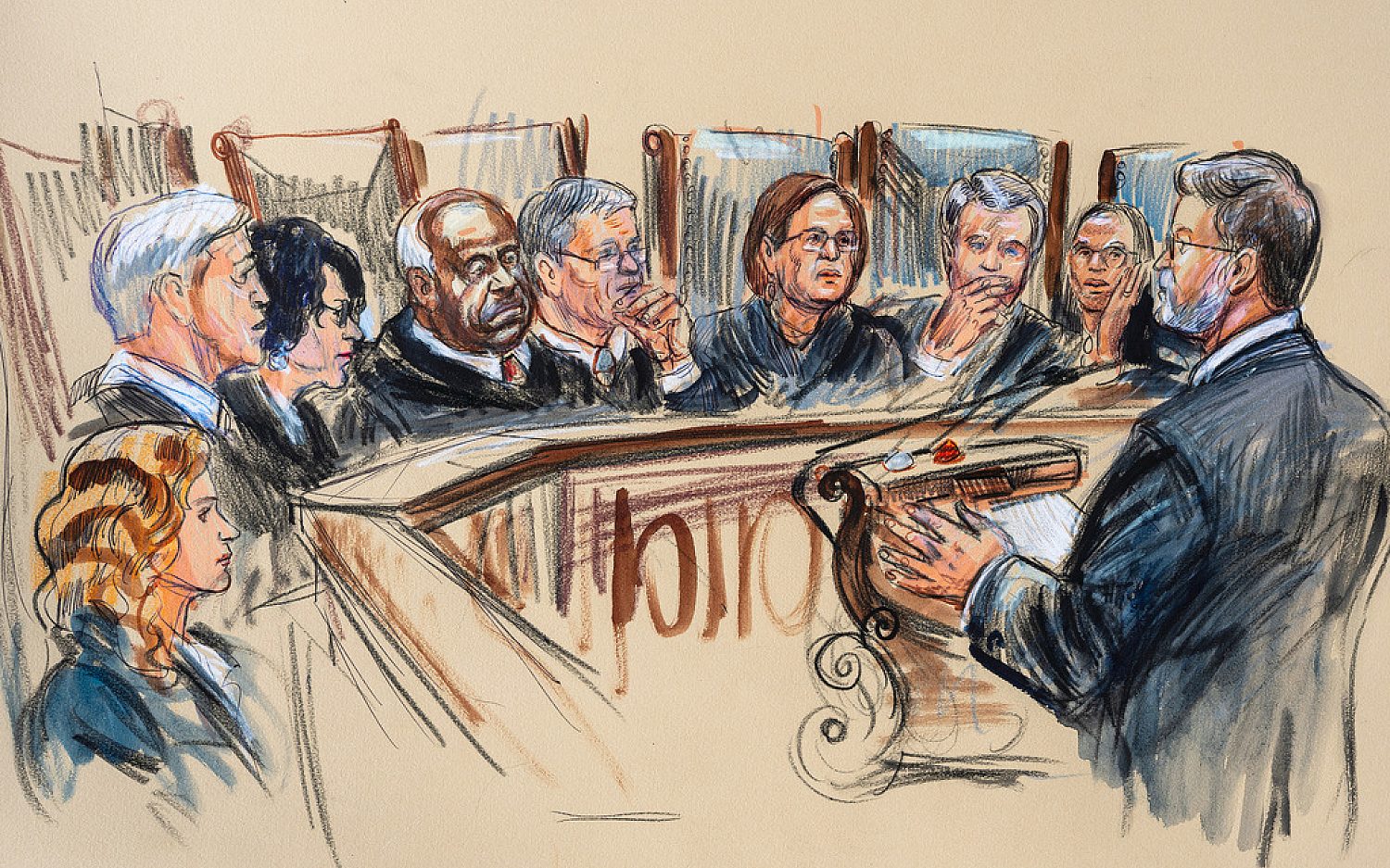
The United States Supreme Court returned to Washington, D.C., on Monday after its month-long recess. One of the first items on the justices’ Monday docket was a major climate change case: Suncor Energy Inc. v. County Commissioners of Boulder County.
Two energy companies, Suncor and ExxonMobil, appealed to the high court in August 2025 after a series of lawsuits from Boulder, Colo., sought to hold them liable for damage supposedly related to climate change. The companies asked the Supreme Court to weigh whether federal law prohibits state-level lawsuits seeking relief for alleged global climate injuries. The damages are alleged to stem from interstate and international greenhouse gas emissions.
Where do things currently stand? In oral arguments on Monday, Chief Justice John Roberts asked Kevin Russell, the attorney representing the Boulder County commissioners, what should practically happen. He asked Russell to consider that “there’s always going to be greenhouse gas emissions affecting every state.” Russell responded, “We’re going to have to prove proximate cause, which they [the energy company defendants] say we cannot prove.”
As of Sept. 28, Justice Samuel Alito is no longer participating in the case. Reports hypothesize that his recusal is connected to personal holdings in individual oil and gas companies. Without Alito, the court could come to a 4-4 split, which would send the case back to the state court. But whatever the court decides, there will likely be implications for future climate cases—including ongoing litigation in California, New York, and Texas.
What does the White House think? In a brief to the Supreme Court, the Trump administration offered its support to the energy companies and argued that states’ powers to regulate should be restricted to their own borders. “No one state can superimpose its own regulatory preferences on the rest—least of all to address a global problem that exists almost entirely outside its borders and affects the world at large,” the brief reads.
Dig deeper: Read my report on the Trump administration’s recent greenhouse gas policy rollbacks.


An actual newsletter worth subscribing to instead of just a collection of links. —Adam
Sign up to receive The Sift email newsletter each weekday morning for the latest headlines from WORLD’s breaking news team.


Please wait while we load the latest comments...
Comments
Please register, subscribe, or log in to comment on this article.