
Unmanned NASA observatory to plummet after robot rescue fails
Katalyst Space employees working with NASA in attempts to rescue the Swift Observatory stand next to their spacecraft at NASA's Goddard Space Flight Center in Greenbelt, Md., April 17, 2026. Associated Press / NASA / Photo by Sophia Roberts, file
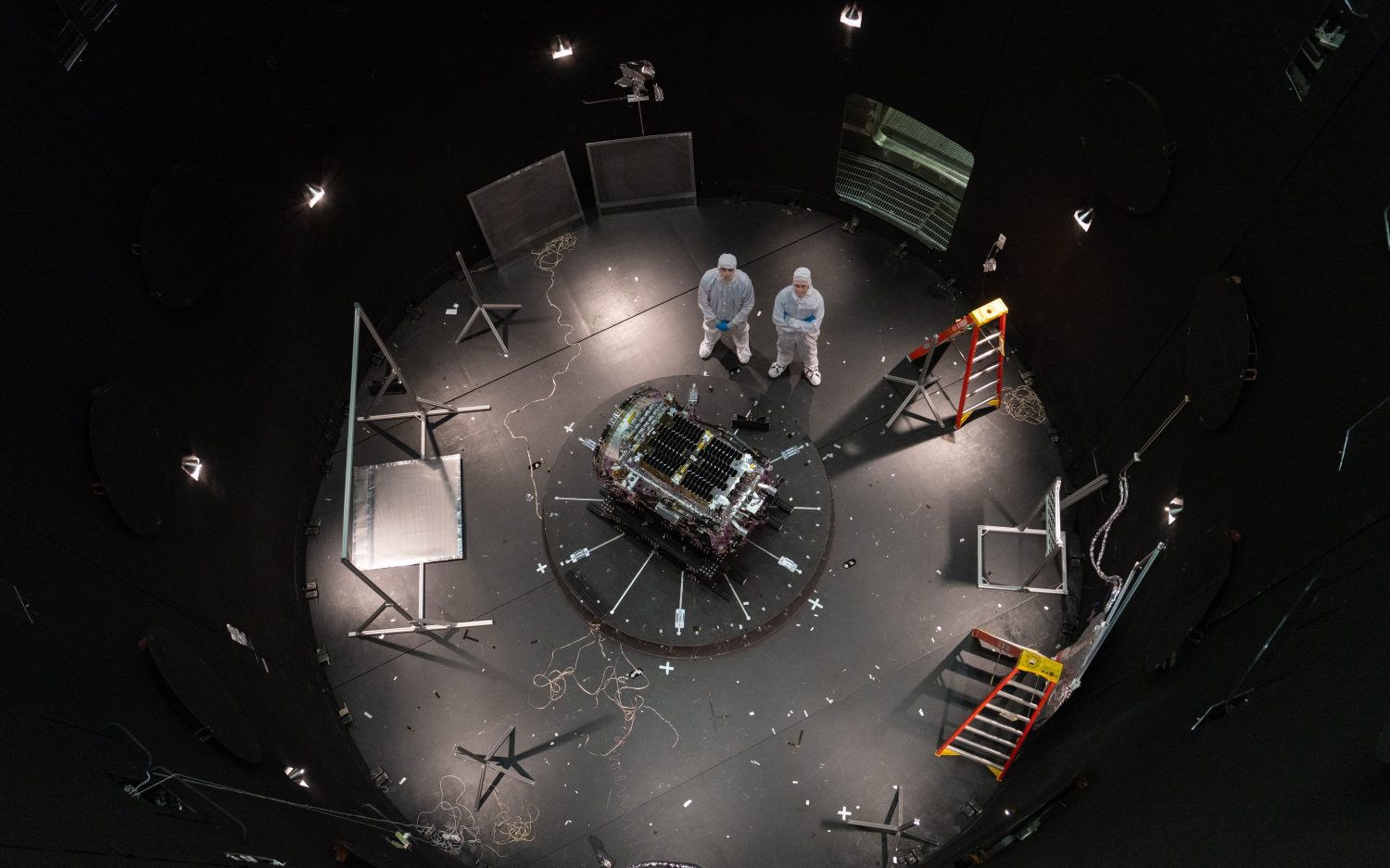
Neil Gehrels Swift Observatory, which has orbited the Earth since 2004, is expected to begin falling through Earth’s atmosphere within weeks. NASA recently shut it down as the observatory dropped to 171 miles above Earth’s surface because it could no longer fight atmospheric drag, the space agency said. The space agency didn’t say whether the observatory is expected to mostly burn up during reentry or where its remains might land.
The problem stems from solar activity that caused the Swift observatory’s orbit to decay faster than expected. NASA in July launched a mission to adjust Swift with a robotic spacecraft, keeping it from crashing. However, that mission failed in August due to problems with controlling its spacecraft. NASA turned off the observatory’s science instruments for a while to reduce atmospheric drag, but after the rescue mission failed, the space agency turned them back on. Before switching into safe mode on Oct. 20, Swift observed hundreds of targets, including the remnants of stellar explosions and active supermassive black holes in distant galaxies, according to NASA.
What has the Swift Observatory accomplished during its time in space? During more than two decades in space, Swift observed more than 2,000 powerful gamma-ray bursts and studied over 1,400 supernova explosions, according to NASA. It also observed black holes, asteroids, comets, and galaxies far from the Milky Way. It also conducted an X-ray survey of the whole sky. Scientists used data from Swift in roughly 7,000 published scientific papers, according to NASA.
Dig deeper: Read my previous report on the plan to save Swift.


An actual newsletter worth subscribing to instead of just a collection of links. —Adam
Sign up to receive The Sift email newsletter each weekday morning for the latest headlines from WORLD’s breaking news team.


Please wait while we load the latest comments...
Comments
Please register, subscribe, or log in to comment on this article.