
Defense Department unveils religious office, drone plans
Secretary of Defense Pete Hegseth gives a State of the Force address at Marine Corps Base Quantico, Wednesday, Sept. 30, 2026 in Quantico, Va. Pool photo via Associated Press / Photo by Alex Wong
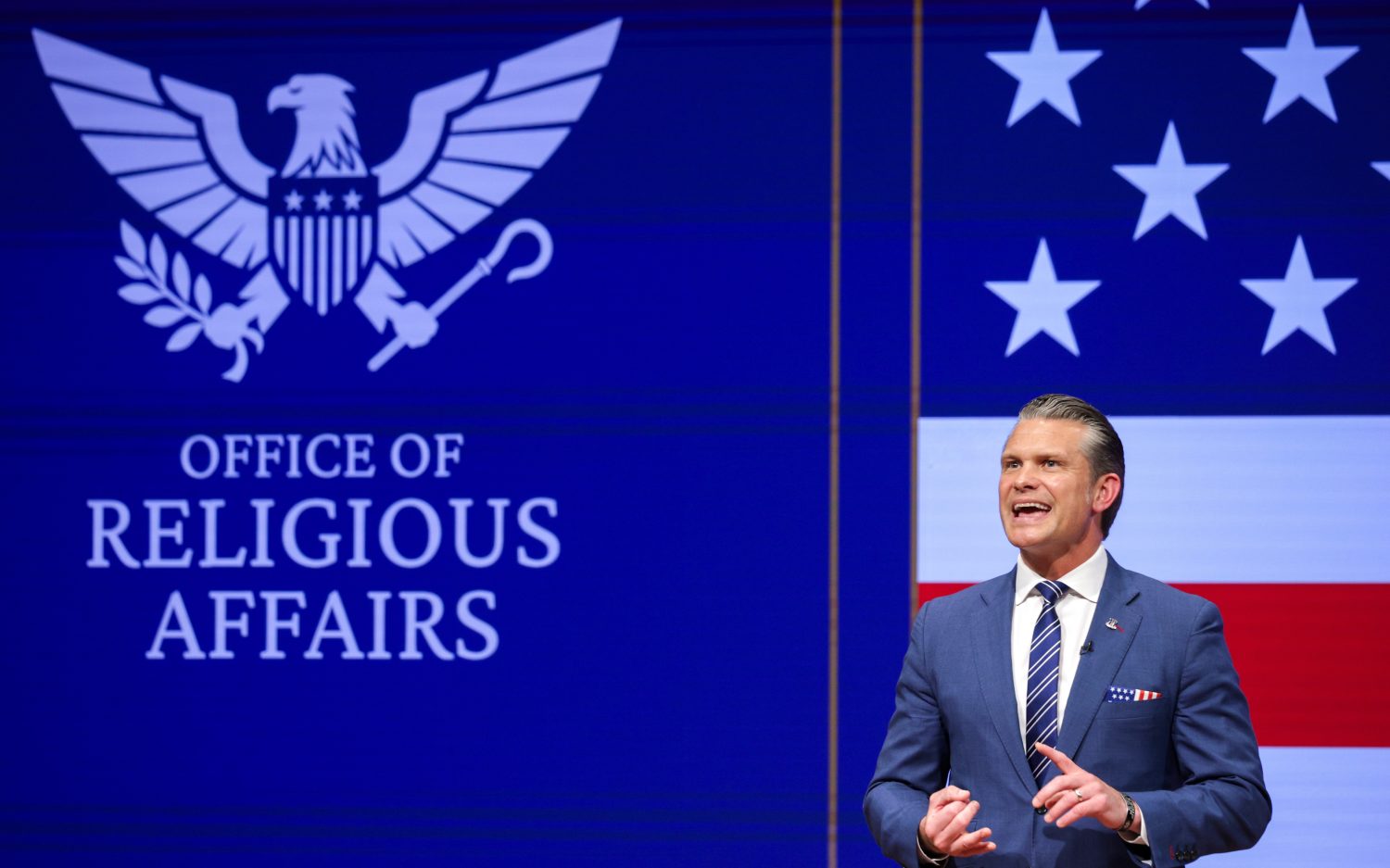
Defense Secretary Pete Hegseth introduced six new military initiatives in an address to hundreds of U.S. troops Wednesday evening. He outlined plans for an Office of Religious Affairs, a drone command, and an installation that would be the United States’ first new military base in 40 years. The Pentagon will also launch studies on the future of warfare, led in part by SpaceX CEO Elon Musk and former Republican House Speaker Newt Gingrich.
Hegseth spoke to mid-ranking officers and enlisted leaders at the Marine Corps Base Quantico in Virginia. Last year, he gave a similar speech, discussing policy changes aimed at keeping U.S. armed forces effective and lethal.
What exactly is the Office of Religious Affairs? The Defense Department has a sacred duty to provide its troops with first-class religious support, Hegseth said. This office seeks to work around past decisions where secularists cut resources for faith and religion at the department, he said. Pentagon spokesman Sean Parnell described the office as having a direct line to the secretary himself. The office will protect religious budgets, demand faith infrastructure, and strengthen religious efforts across the force, Parnell said. Earlier this year, Hegseth rolled out some reforms of the chaplain corps and reduced the number of religious affiliations recognized by the military.
What about the other five initiatives?
Hegseth shared plans to create a new four-star command focused on developing autonomous warfare, such as drones and defense robotics. The command should be operational within a year, he said. Hegseth pointed to Ukraine’s use of drones to combat Russian forces and said it demonstrated a need for multi-purpose, adaptable drones.
Musk and Gingerich, along with a co-founder from the defense company Anduril, will lead an effort to study the future of warfare, Hegseth said. They will focus on discovering, developing, and fielding the weapons and systems that future generations need, he said. These weapons should dominate any future battlefield, from under the Earth to beyond the moon, Hegseth added.
Hegseth called on all states to compete for the chance to host a new military base.
He also introduced a plan to make every military base self-powered. The bases would generate their own power, independent of the civilian grid, Hegseth said.
Additionally, the Pentagon will partner with five colleges to broaden the corps of cadets, Hegseth said. The schools included Louisiana State University, Liberty University, Tuskegee University, Mississippi State University, and Hillsdale College.


An actual newsletter worth subscribing to instead of just a collection of links. —Adam
Sign up to receive The Sift email newsletter each weekday morning for the latest headlines from WORLD’s breaking news team.


Please wait while we load the latest comments...
Comments
Please register, subscribe, or log in to comment on this article.