
White House refugee cap maintains focus on Afrikaners
Refugee advocates say the Trump administration policy ignores persecuted Christians and U.S. allies
Deputy Secretary of State Christopher Landau greets Afrikaner refugees from South Africa at Dulles International Airport in Virginia, May 12, 2025. Associated Press / Photo by Julia Demaree Nikhinson, File
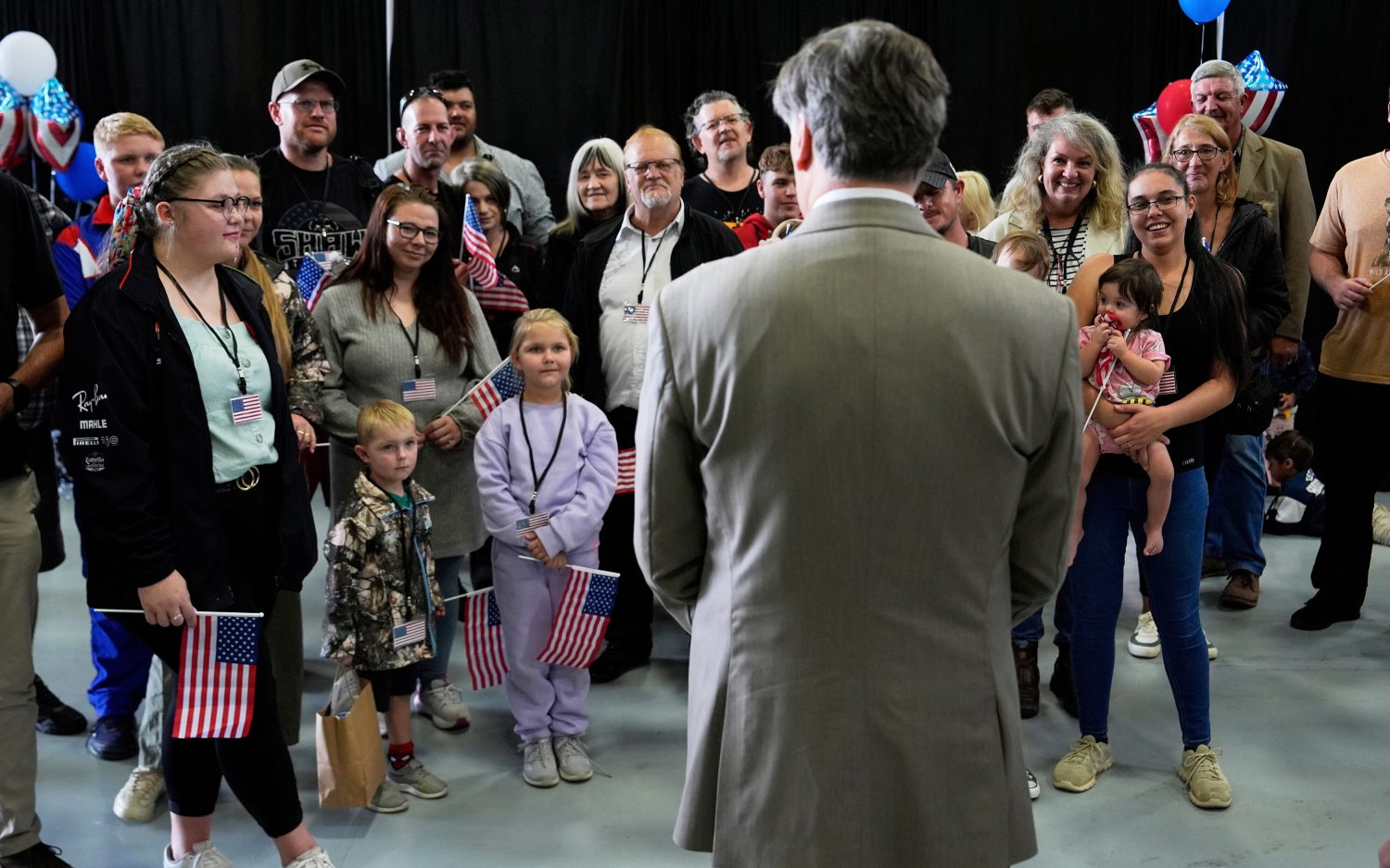
The U.S. State Department reported on Monday that just 16,292 refugees entered the United States during the 2026 fiscal year that ended last month—the third lowest total in the U.S. refugee program’s history.
Five of the refugees came from Afghanistan. The others came from South Africa. None of the 16,292 individuals were Christians fleeing persecution, according to the Christian advocacy group World Relief, which recently analyzed resettlements under the U.S. Refugee Admissions Program.
“September’s refugee arrival numbers confirmed what we believed and feared to be true: Fiscal Year 2026 was the first year on record in which the U.S. failed to resettle any Christian refugees fleeing persecution,” said Aerlande Wontamo, senior vice president of U.S. programs at World Relief, in a statement. “For a country founded by immigrants fleeing oppressive regimes to worship freely to shut the door on refugees with a credible fear of persecution on account of their faith, we have reached a milestone of which we must be ashamed.”
The Trump administration signaled last week it was doubling down on its choice not to prioritize admitting refugees fleeing religious persecution. The White House published a Federal Register notice saying that President Donald Trump had determined that the United States would accept a maximum of 17,500 refugees during the 2027 fiscal year. It also stated it would again prioritize resettling Afrikaners from South Africa fleeing discrimination in their homeland.
Critics of the move argue that the choice to prioritize white Afrikaners over the religiously persecuted—or over old U.S. military allies—is a betrayal of key American values. Meanwhile, supporters argue the move entails an understandable response to the chaos of the Biden administration’s refugee and asylum policies.
Last year, President Trump announced the United States would admit only 7,500 refugees during fiscal year 2026. He later raised the number to 17,500. Both times, the administration stated the program would prioritize resettling Afrikaners from South Africa. The move marked a departure from both the refugee admissions posture of the Biden administration—in which refugee ceilings consistently sat at around 125,000—and a departure from the refugee admissions posture of Trump’s first administration.
“President Trump was the first and only president to say we should highlight and prioritize those fleeing religious persecution,” said Hannah Daniel, director of government relations at World Relief. She pointed to the presidential determination for the 2021 fiscal year, wherein Trump allotted 5,000 of the 15,000 total refugee slots specifically for individuals fleeing religious persecution.
Ahead of last week’s 2027 refugee ceiling announcement, World Relief had lobbied the White House to return to its policy of resettling those fleeing persecution because of their faith. “Our advocacy really was saying, ‘You’ve already done this. You are leading the way in many ways on religious persecution around the world,’” Daniel said.
Others in the refugee advocacy space have also argued for expanding the pool of refugees beyond people from South Africa. AfghanEvac, an organization advocating for Afghan allies of the United States, criticized Trump’s 2027 refugee policy.
“It does not include a single word about the Afghans who fought, bled, and served alongside American troops for twenty years,” said Shawn VanDiver, the group’s president. “That silence is a choice, and it is the wrong one.”
AfghanEvac has asked for at least 5,000 refugee slots for Afghan mission partners and the families of ethnically Afghan U.S. service members. VanDiver noted the administration did bring in a handful of Afghans through the refugee program during the past fiscal year. That showed Afghan allies of the United States could use the program to come stateside under the Trump administration.
“Now make the exception the rule,” VanDiver said. “The same authority should be applied to every eligible Afghan, including nearly 3,000 family members of U.S. service members, family reunification cases, Afghans waiting at Camp As Sayliyah, those facing deportation from Pakistan, and the partnered units Secretary Mullin’s own team has identified as a priority.”
But Simon Hankinson, a senior research fellow at the Heritage Foundation, argued that the Trump administration may be limiting refugee numbers because it doesn’t see the current circumstances as conducive to resettlement.
“I think they’re keeping it low because we haven’t even begun to work through the 5 to 10 million people who were let in under the Biden administration who, in theory, were all qualified for asylum,” Hankinson said. “If you listen to the Biden staffers—you know, Mayorkas on down—they were saying that these people are all fleeing persecution and should be paroled into the country.”
While many of the individuals who arrived in the United States didn’t meet the legal definition of refugees—they hadn’t applied for refugee status before coming to the country—they still came with claims that their home countries were too dangerous. But many of those claims were not valid, Hankinson argued. Yet the federal government’s legal immigration processing systems still had to deal with their asylum applications—and deport those who didn’t qualify. Hankinson said the administration likely reasoned, “Why would we want to take in 140,000 more people while we’re still dealing with 5 to 10 million others?”
Hankinson added that the cost of taking on 100,000 refugees or more is not nonexistent.
“As a general rule, they tend to be less educated, less skilled, don’t speak English, and so will end up costing the host country money,” Hankinson said.
But Hannah Daniel from World Relief argued that refugees in the United States follow a similar economic trajectory as U.S.-born children.
“When you first have them, you’re spending a lot of money to clothe them, feed them, educate them, all of those things,” Daniel said. “But that’s not the snapshot in time that we use to consider a person’s economic value in our country. We look at it over a longer period of time. And, obviously, over time people are contributing way more in taxes and in what they are putting into the economy than what they receive in that early kind of initial time.”
Both Hankinson and Daniel agreed it was unlikely President Trump would raise the refugee ceiling during either of the next two fiscal years. Daniel said World Relief would continue to highlight the issue while lobbying for changes.
“There is precedent of presidents revising a presidential determination after a significant outcry,” she said. “So we want to continue to advocate on this to spotlight this issue as much as we can.”


You sure do come up with exciting stuff to read, know, and talk about. —Chad
Sign up to receive Compassion, WORLD’s free weekly email newsletter on poverty fighting and criminal justice.
Please wait while we load the latest comments...
Comments
Please register, subscribe, or log in to comment on this article.