
Advocates call on White House to bring more Christian refugees to the U.S.
A new report on U.S. refugee admissions comes ahead of an expected Trump administration announcement on 2027 refugee policy
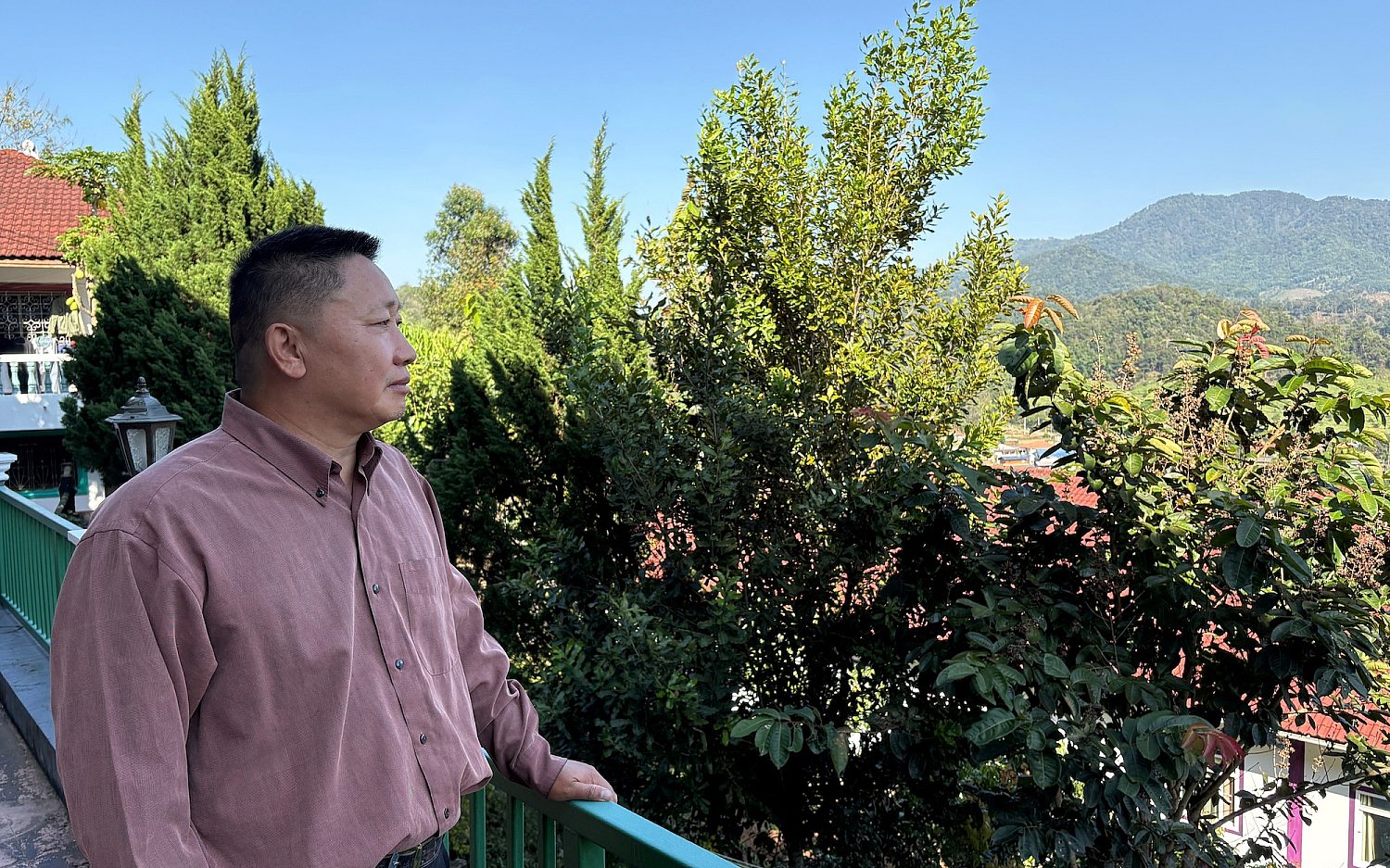
In this Nov. 27, 2025, file photo, Lu Taizhi, a Chinese Christian waiting to be resettled in the United States, stands outside his dormitory in Ban Wawee village, Chiang Rai Province, Thailand. Associated Press / Photo by Tian Macleod Ji
WASHINGTON—At a gathering of congressional aides, reporters, and interested members of the public in a conference room in the basement of the U.S. Capitol, Matthew Soerens, World Relief’s vice president of advocacy and policy, shared sobering statistics about global persecution.
Since 2020, the number of Christians worldwide living at risk of persecution has grown by nearly 50%, Soerens told attendees at the “State of the Golden Door” event last week. Today, about 388 million—or roughly 1 in every 7 Christians worldwide—face possible persecution, he said, adding that hundreds of thousands of Christians have had to flee their homes.
“We’ve seen these dramatic increases in both religious persecution and displacement just over the last few years,” said Soerens. But that isn’t the only problem facing persecuted Christians, according to Soerens. He said that the United States—and much of the world—has turned a blind eye to their plight.
“With less than a month remaining in the federal fiscal year, fiscal year 2026 is on track to be the first year on record in at least a quarter century—for which we have data—when not a single Christian refugee has been resettled to the United States from the 50 countries … where we know that Christians face the most severe persecution in the world,” Soerens said.
Even Christians who escaped persecution by coming to the United States are now seeing their odds of obtaining asylum in immigration court drastically decrease. In 2023, persecuted Christians from the 50 countries that the advocacy group Open Doors lists as the most dangerous for Christians had an almost 60% chance of obtaining asylum—or freedom from deportation, according to Soerens. But this past year, he said, they had about a 10% chance of obtaining that outcome.
Late last year, the Trump administration said it would review the cases of refugees who have already resettled in the United States. Federal court decisions from earlier this year prevented the Trump administration from arresting and detaining lawfully admitted refugees who hadn’t yet obtained lawful permanent resident status.
As the White House considers how many people to admit to the United States through the U.S. Refugee Admissions Program during fiscal year 2027, advocates are raising concerns about religious persecution internationally and calling for the United States to resume its role as a global leader in refugee resettlement. They argue that President Donald Trump should return to the strategy he held during his first administration of using the USRAP program to provide a haven for religious minorities who have to flee their home countries.
On Trump’s first day in office last year, he suspended the U.S. refugee program. The program allows thoroughly vetted individuals who’ve fled their home countries to escape persecution based on their race, political views, or religious beliefs by entering the United States.
Trump said America would not accept any more refugees until doing so “aligns with the national interests of the United States.” Less than 10 months later, Trump announced that the United States would admit a maximum of 7,500 refugees through USRAP during fiscal year 2026—the lowest refugee ceiling on record—and prioritize resettling Afrikaners from South Africa.
Refugee advocates—including Soerens at World Relief—criticized Trump’s low refugee cap. Refugees coming into the country through USRAP have undergone the most rigorous vetting process in the United States’ immigration apparatus and don’t pose a security risk to the country, according to advocates. They also criticized the decision to prioritize Afrikaners for resettlement. Even though many Afrikaners had experienced hardship, most hadn’t fled their home country to escape persecution, advocates argued.
But some administration supporters countered that President Trump’s decision to limit the number of refugees coming into the United States made sense. They argued the administration had a vested interest in ensuring as few foreign citizens as possible came into the United States while immigration enforcement authorities try to remove illegal immigrants.
In May, the Trump administration increased the maximum number of refugees who could come to the United States by 10,000, raising the total to 17,500. But the administration maintained that it would still prioritize resettling Afrikaners. As of July 31, the United States had admitted 10,255 refugees from South Africa and three from Afghanistan in fiscal year 2026, according to a report from Pew Research Center.
Because of the focus on resettling Afrikaners, the United States hasn’t resettled a single persecuted Christian in fiscal 2026, Soerens said. And with less than a month to go in the federal government’s fiscal year, that situation appears unlikely to change.

Afrikaner refugees from South Africa holding American flags arrive at Dulles International Airport in Dulles, Va., in May 2025. Associated Press / Photo by Julia Demaree Nikhinson
Through the USRAP program in fiscal year 2025, the Biden administration admitted to the United States an estimated 9,916 persecuted Christians from the top 50 countries of concern for religious persecution, according to a report conducted by Open Doors and World Relief. In fiscal year 2024, the Biden administration admitted almost 30,000 such Christians into the United States.
Many of the Christians who would be fleeing to the United States in fiscal year 2026 are coming from horrific and violent circumstances, said Ryan Brown, president and CEO of Open Doors. He said sub-Saharan Africa has become a particular hot spot for religious persecution.
“We have seen a continued surge of the ways that violence is characterizing the ways that persecution is being experienced by Christians on the ground there,” Brown said. “Some of the stories coming out of there are horrific and things that I think many of us even shudder to think about.”
In China, authorities have exponentially upped their digital surveillance against churches, Brown said. And in Central America, drug cartels are starting to persecute the church on the basis that it’s bad for their business—sometimes issuing threats of violence against pastors’ family members.
World Relief said it’s clear that no Christians fleeing persecution for their faith from the 50 countries on the Open Doors World Watch List arrived in the United States during fiscal 2026. But it’s as yet unclear how many Christians fleeing persecution entered the United States as refugees in 2025. World Relief and Open Doors had to estimate those figures in their report.
Myal Greene, president and CEO of World Relief, said the U.S. government made such numbers available until last year. “We had to go through attempts of FOIA requests to access that data, and that was unsuccessful,” he said. “The researchers on this project were unable to do that.”
Similar uncertainty surrounds the number of persecuted Christians who’ve applied to come to the United States as refugees but haven’t yet received permission. Soerens said that World Relief is unsure how many persecuted Christians are applying to come into the country right now through USRAP, but he estimated that the number could be as high as 37,000.
The U.S. State Department did not provide WORLD with a specific answer for how many USRAP applicants still abroad are Christians fleeing religious persecution.
President Trump is expected to announce his administration’s refugee cap for fiscal year 2027 sometime in the next several weeks. The State Department said that Trump would make the determination “at the appropriate time,” and it directed WORLD to the White House for more information. The White House did not respond to a request for comment about when the presidential determination would appear or whether it would prioritize resettling persecuted Christians.
Simon Hankinson, a senior research fellow at the Heritage Foundation’s Border Security and Immigration Center, told WORLD that he doesn’t expect the White House to raise the refugee cap far above the fiscal year 2026 figure.
“I would expect the number to be fairly low, chiefly because we’re still nowhere near going through the backlog of, what is it, 8 million, give or take, cases of people who were just released into the country,” Hankinson said. “What the Biden administration said at the time is that they’re all fleeing poverty, fleeing for reasons that would qualify them for asylum.”
Myal Greene of World Relief explained that he wasn’t optimistic that the Trump administration would allow many persecuted Christians to come into the United States in 2027.
“That said, we’re people of faith, and we’re committed to being faithful in our advocacy and being consistent in bringing these causes to light. And we wouldn’t be issuing this report if we didn’t believe that there are Christians and people close to the administration who have a deep desire to see these policy changes,” Greene said. “We recognize it’s an uphill battle.”
Greene noted that other countries take their cues on refugee admissions from the United States. If U.S. leaders prove reluctant to take in refugees, other countries are also likely to excuse themselves from admitting them, he said.
Still, Soerens offered reasons to be optimistic that the Trump administration might choose to orient USRAP around persecuted religious minorities in fiscal year 2027.
“What gives me some hope is actually what President Trump did in his first term. He was actually, I think, the first president to make individuals who are fleeing religious persecution a priority,” Soerens said. “Our ask of him is, essentially, ‘Just do that again.’”
A majority of Americans support the idea of the United States accepting refugees fleeing religious persecution. Late last year, World Relief and Lifeway Research published polling indicating that roughly 70% of evangelicals believe the United States had a moral responsibility to resettle refugees fleeing their home countries due to persecution because of their ethnicity, political viewpoints, or religious beliefs.
In 2018, during the first Trump administration, a poll from Pew Research Center found that just 51% of all Americans thought the United States had a responsibility to accept refugees into the country. But in a Pew survey from last November, 70% of respondents conceded it was “important” to take in refugees from countries where people are trying to escape violence.
“I think it would be good to maybe concentrate on a population that’s been largely ignored,” Hankinson said. “There are loads of countries where Christians are persecuted at a rate we’ve never seen before. The thing is, though, with refugees, they’re a cost-producing population. They’re a revenue-taking population, not a revenue-paying population. So every refugee you bring in on average is going to cost money.”
While some organizations such as the American Immigration Council have argued that refugees generally pay more in taxes than they receive in benefits over their first 20 years in the United States, especially if they arrived as minors, other research supports Hankinson’s point. The Center for Immigration Studies published a report in 2020 that estimated that the average refugee’s lifetime contributions to the U.S. economy were about $60,000, while the cost to admit a refugee into the country was roughly $133,000.
Hankinson asserted that Americans are beginning to note, following the recent attention given to allegations of rampant welfare fraud in Minnesota and California, that refugee and asylum admissions don’t always lead to good outcomes—and that certain groups of people have more trouble assimilating than others.
But Soerens argued that returning to the first Trump administration’s prioritization of persecuted religious minorities would still align with most Americans’ desires.
“It does seem like this would be sort of the low-hanging fruit of where a very large percentage of Americans would agree that the U.S. should continue to be a refuge for people who were persecuted on account of their faith,” Soerens said.


You sure do come up with exciting stuff to read, know, and talk about. —Chad
Sign up to receive Compassion, WORLD’s free weekly email newsletter on poverty fighting and criminal justice.
Please wait while we load the latest comments...
Comments
Please register, subscribe, or log in to comment on this article.