
Wearing the message: A Q&A with Jennifer Sey
The founder of XX-XY Athletics speaks about her sports apparel line, protecting female athletes, and influencing the cultural conversation
Jennifer Sey speaks at the 2024 Young Women's Leadership Summit in San Antonio, Texas. Wikimedia Commons / Creative Commons / Photo by Gage Skidmore from Surprise, AZ
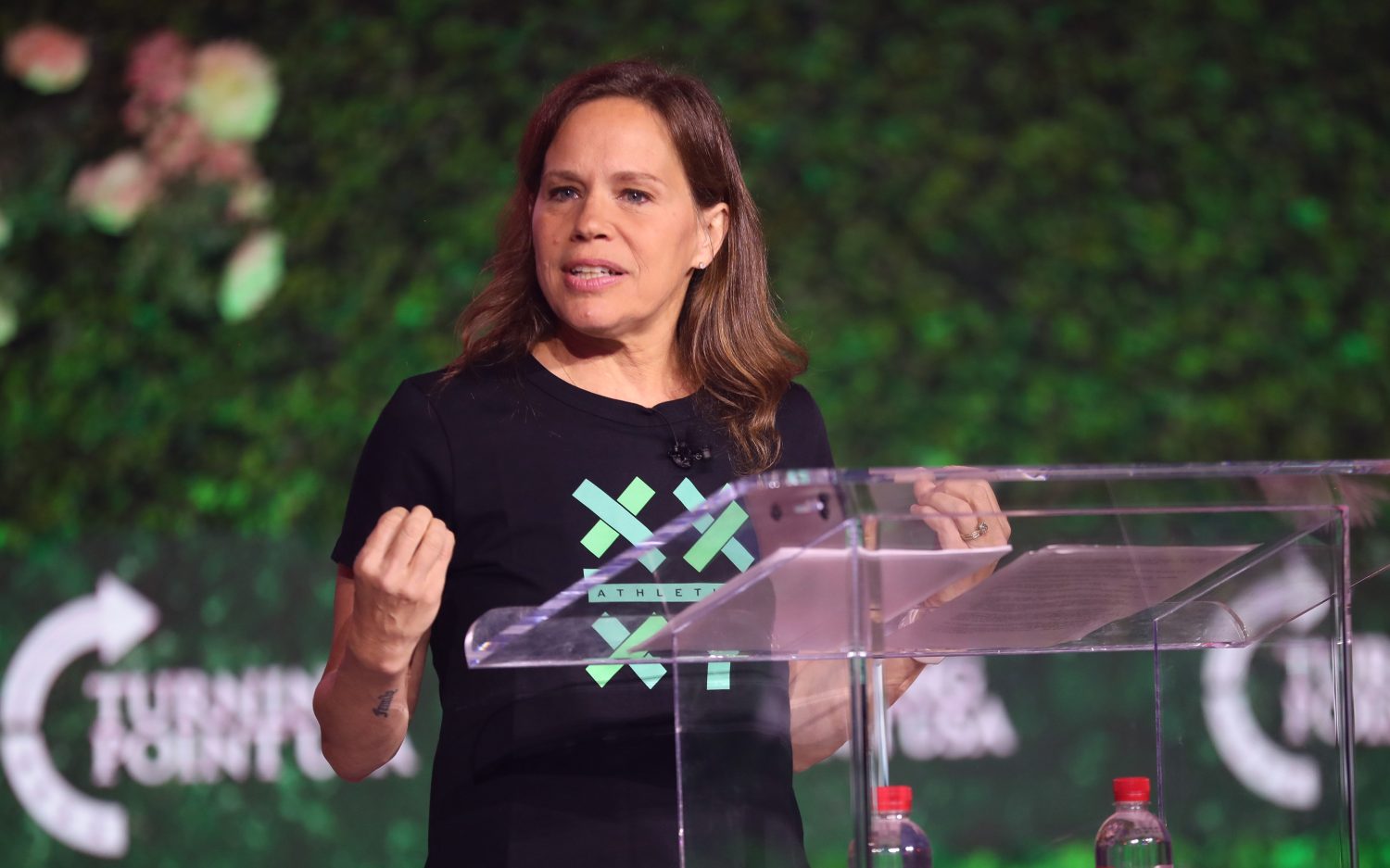
Author, filmmaker, athlete, and defender of women’s sports Jennifer Sey was a 1986 USA Gymnastics National Champion who competed internationally for the U.S. national team for around eight years. Her 2008 book Chalked Up exposed abusive coaching in the world of gymnastics. More recently, she’s become known as the founder of the controversial sports apparel brand XX-XY Athletics.
Team USA’s coach during the ’80s was Don Peters. Under Peters’ tutelage, Mary Lou Retton won a gold medal in the individual all-around competition at the 1984 Summer Olympics in Los Angeles, becoming the first American woman to achieve that feat.
But USA Gymnastics in 2011 banned Peters for life and removed him from its Hall of Fame in response to allegations that he sexually assaulted underage gymnasts.
“People kept saying, ‘He’s a really good coach. You don’t want to harm his reputation,’” Sey told an audience earlier this month at a rally for a Washington state ballot measure aimed at keeping boys out of girls’ sports. “Just don’t let him into your hotel room.”
Sey believes state and local officials tasked with governing interscholastic athletics are sending a similar message today by turning a deaf ear to the complaints of girls who don’t want to compete against boys who claim to be girls—or deal with those boys’ presence in their locker rooms.
“We’re telling girls that boys matter more than they do,” said the 57-year-old New Jersey native, who now lives in Colorado—which, like Washington, has its own vote looming this November on a ballot measure aiming to protect girls’ sports. “This is 2026. It’s madness.”
A Stanford University graduate and a former executive with the iconic jeans brand Levi’s, Sey started XX-XY specifically to spread what should be an uncontroversial message—that biology matters when it comes to girls’ and women’s sports and changing spaces. She spoke to me after the October rally in Vancouver, Wash.
How does launching an apparel brand help the cause of protecting girls’ sports? Brands can influence culture just like movies and music do. Look at Nike. Other brands have also influenced our culture in a negative way. I worked 23 years for Levi’s. This is my skill set. I’m not a lawyer. I’m not a legislator. I’m not a politician. Helping people push back from a policy standpoint didn’t suit me. This is what I can do.
Do you think your side is winning? There’s been a ton of progress, but there’s a lot more work to do. Right now, we’ve only got one active female pro athlete in America (Indiana Fever guard Sophie Cunningham) who’s openly come out and said there are men and there are women, though Belarus’ Aryna Sabalenka, the No. 2 women’s tennis player in the world has basically made her feelings known, too. I want young female athletes to have the same opportunities that I had growing up. We don’t allow performance-enhancing drugs in sports. The male advantage is greater than that for women who use such drugs.
Earlier this summer, the co-owner of the Seattle Storm screamed at girls wearing XX-XY gear at a basketball game. At an Atlanta Dream game, a mother and daughter were told to take their XX-XY gear off, or cover it up, because it was making people uncomfortable. Did you expect your brand to inspire this level of vitriol? Sadly, I did. Over time, I hope we can correct that and it will be a totally normal thing. There’s been some incredibly toxic discourse, and it’s gotten violent. But I’m proud of the way women and girls have shown up for our brand.
Your story about having to train under a troubled male gymnastics coach and “avoid harming his reputation” is powerful. What is the biggest parallel you see in that situation and boys competing in girls’ sports? The people in charge of girls’ sports are prioritizing boys’ feelings over the rights of young girls, and I’m not going to stand for it. Just so I’m clear, the boys who are being told lies by adults about being born in the wrong body deserve empathy—they’re children who are confused about who they are. But our empathy should not override our support for women and girls.
This summer, the Supreme Court ruled in Little v. Hecox and West Virginia Board of Education v. B.P.J. that states can maintain sex-segregated interscholastic sports programs. Do you believe that decision goes far enough? No. The Supreme Court in that case held that 27 states may protect girls’ and women’s sports. Not all 50 have to—that’s why we’re now seeing state-by-state legislation. We live in an upside-down world where the left insists that men who think they’re women are women. We have to change the cultural conversation so that it’s totally unacceptable for that boy to join the girls’ soccer team. Even if we have laws protecting girls’ sports, if the cultural conversation doesn’t change, the same thing will keep happening.


Thank you for your careful research and interesting presentations. —Clarke
Sign up to receive Relations, WORLD’s free weekly email newsletter on marriage, family, and sexuality.
Please wait while we load the latest comments...
Comments