
Appeals court upholds New Hampshire parents’ right to silent protest
Court rules school officials discriminated against parents’ views on protecting female players in girls’ sports
A parent shows a pink wristband worn at the game. Photo courtesy of The Institute for Free Speech
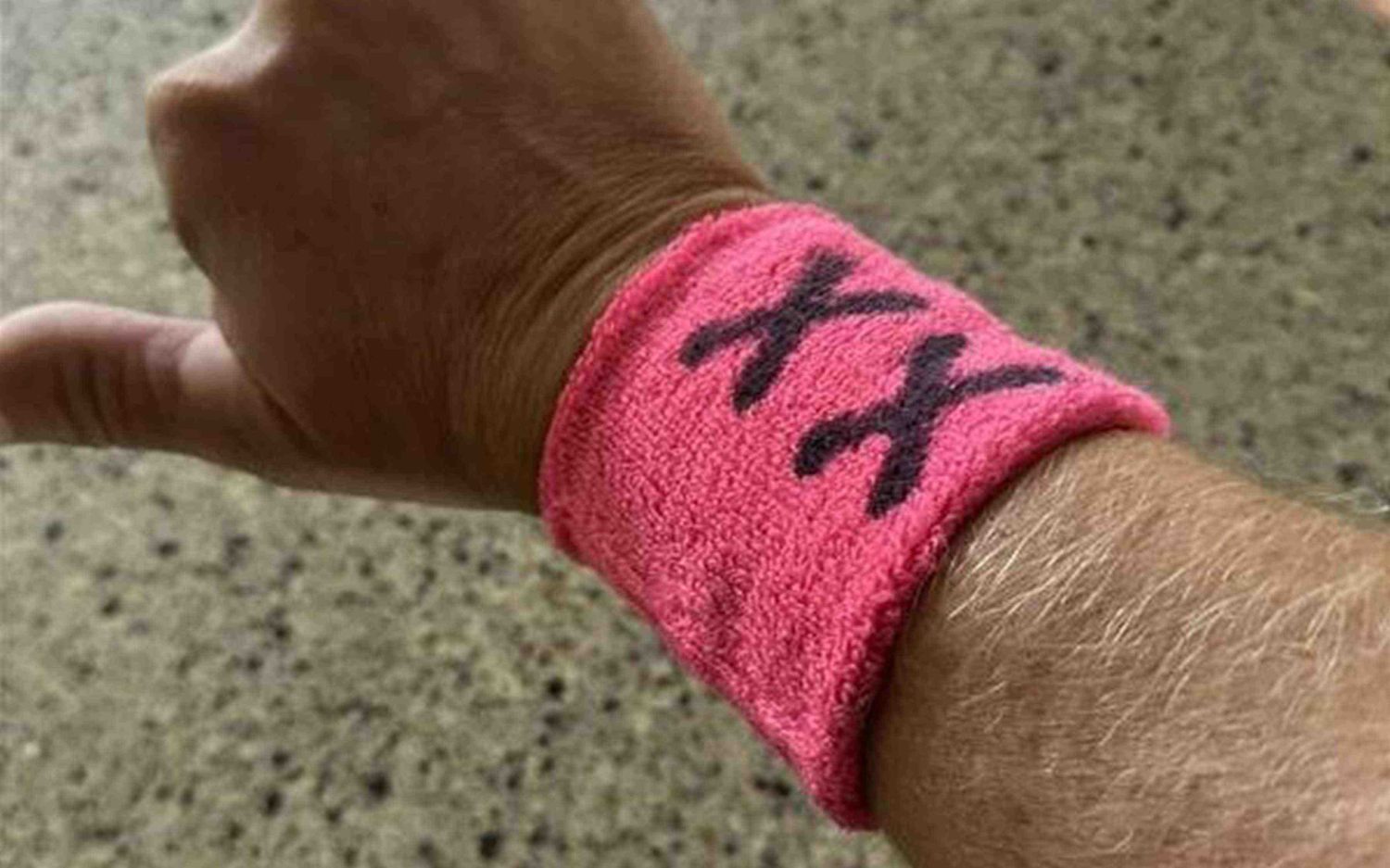
Last week, a federal appeals court upheld New Hampshire parents’ and grandparents’ right to silently protest against rules allowing male students to play on girls’ sports teams. Nearly two years earlier, high school officials threatened some soccer spectators with arrest and kicked Kyle Fellers out of his daughter’s soccer game for wearing pink wristbands that read “XX.”
A three-judge panel of the 1st U.S. Circuit Court of Appeals ruled last Wednesday that school officials clearly engaged in viewpoint discrimination by favoring one side of a debate on “an issue of prominent public concern.” Constitutional experts agree the ruling marked a win for free speech rights.
“It validates our beliefs,” Fellers said. “Not only for our beliefs on girls’ sports, but just that the First Amendment protects our peaceful protests, and I couldn’t be happier with that.”
The silent protest occurred at a Bow High School home game in Bow, N.H., in September 2024. One week earlier, a federal district court had issued a temporary ruling allowing two boys to play on girls’ teams. The boys and their families had sued over a New Hampshire law that allowed athletes to only compete on teams that aligned with players’ biological sex. One of the players was slated to play against the girls’ soccer team at Bow High the night of the protest.
(The male players later dismissed their lawsuit following the Supreme Court’s June ruling in West Virginia v. B.P.J., which upheld state laws that keep biological males off female athletic teams.)
Fellers said he and other parents worried about their daughters’ safety competing against the male player. Fellers, along with fellow Bow High soccer parents Anthony Foote and his wife, told some school officials about their concerns. But officials said they had to respect the court’s ruling and proceed with the game.
To respectfully voice their displeasure at the game, Fellers said, the parents decided to wear pink wristbands marked with “XX,” referencing female sex chromosomes.
Ahead of the game, Foote posted on Facebook, urging others to wear the wristbands. He passed out bands to a handful of people at the game, and, around halftime, he, Fellers, and half a dozen other spectators donned the wristlets, according to the lawsuit. Bow High School’s athletic director soon asked Foote and Fellers to remove the bands, stating that the parents weren’t allowed to protest at the game. Foote eventually complied.
But Fellers refused to take off the band, citing his right to free speech. The school principal said Fellers would have to leave the game if he didn’t remove the wristband, and officials threatened to have him arrested for trespassing.
Fellers removed the band, but his father-in-law put it on in his place. As officials argued with the father-in-law, the game’s referee stopped the game and said the game couldn’t resume until the man removed the band. Bow High School would forfeit if the game didn’t continue, making it ineligible for the playoffs, according to the lawsuit. Fellers’ father-in-law removed the contested attire.
After the game, Fellers stood by his car and held a sign protesting men in women’s sports. School officials issued Fellers and Foote no-trespass orders banning them from games or school property for part of the remaining soccer season, saying the two violated the school’s policy on conduct and civility.
Three parents and a grandparent sued the school district at the end of September, contending that the school weaponized its student protection policies to censor free speech. Fellers said that while waiting for input from the court, his story gained national attention. Some news reports made it appear like he was harassing the male players, he said, which he added affected his work as an investment adviser.
“My reputation took a hit in the media. My business was impacted. I lost clients over this whole thing,” Fellers said. “It sends a very chilling message to others in the community, who may agree with my position, [and can keep them] from speaking out.”
The U.S. District Court for the District of New Hampshire ruled against the families in 2025, finding that the school could suppress their speech to protect students from “harassment, intimidation, and anxiety.”
But the appeals court disagreed last week, instead finding that the wristbands were a “passive, silent gesture of protest.”
“The appellants did not stage any pregame demonstrations; did not march, shout, chant or otherwise disrupt the game; and did not confront [a male playing at the game] or any other player,” Circuit Judge Sandra Lynch wrote. “There was no disruption until school officials chose to intervene.”
The school’s actions were likely based on unconstitutional viewpoint discrimination and not out of concern about harassment, Lynch said, citing officials’ remarks calling the “XX” message “hateful,” “anti-trans,” and “exclusionary.” Officials can’t favor one viewpoint over another in this issue, especially when parents believe it concerns their children’s safety, the judge said.
Lynch ordered the district court to reconsider the case in light of the appeals court’s ruling. WORLD reached out to Bow School District officials and their attorneys for comment but did not hear back prior to publication.
Del Kolde, an attorney for the Institute for Free Speech, which represents the families, said school officials could choose to resolve the dispute before it goes back to the district court or let the case continue with proceedings.
“I would hope that this decision would make school districts more hesitant to censor adult speech, particularly adult speech that is passive and silent at school sporting events,” Kolde said. “This was a peaceful, silent, nondestructive protest, and the school district aggressively overreacted because they disagreed with the viewpoint that was being expressed.”
The U.S. Constitution bars the government from targeting one opinion or view over another, said Laura Hernandez, an attorney at the Robertson Center for Constitutional Law at Regent University. “This is a clear win for the First Amendment, especially on this whole gender fluidity issue,” she said.
Officials’ viewpoint discrimination was so “egregious” that the court didn’t even wade into whether school grounds counted as a public forum for speech regulations, Hernandez noted. School officials can restrict certain kinds of speech on school grounds if the speakers are disruptive, but because of the silent nature of the parents’ protest, the 1st Circuit avoided wading into this area. In a concurring opinion, one of the judges argued that the court should have addressed this question further.
Fellers said his daughter is now in college but that he has a son attending Bow High School, where he said this issue is still a “touchy subject.”
“It hasn’t been easy,” he said. But he urged that parents in similar situations “should speak out. They should do it respectfully; they should do it peacefully. But if you have an opinion about something, especially [regarding] an institution that’s educating your children, you do have a moral obligation to express that opinion.”


I value your concise, accessible reporting. —Mary Lee
Sign up to receive Liberties, WORLD’s free weekly email newsletter on First Amendment freedoms.
Please wait while we load the latest comments...
Comments
Please register, subscribe, or log in to comment on this article.