
A religious right to kill?
A Jewish group argues for a religious right to abortion before Indiana’s Supreme Court
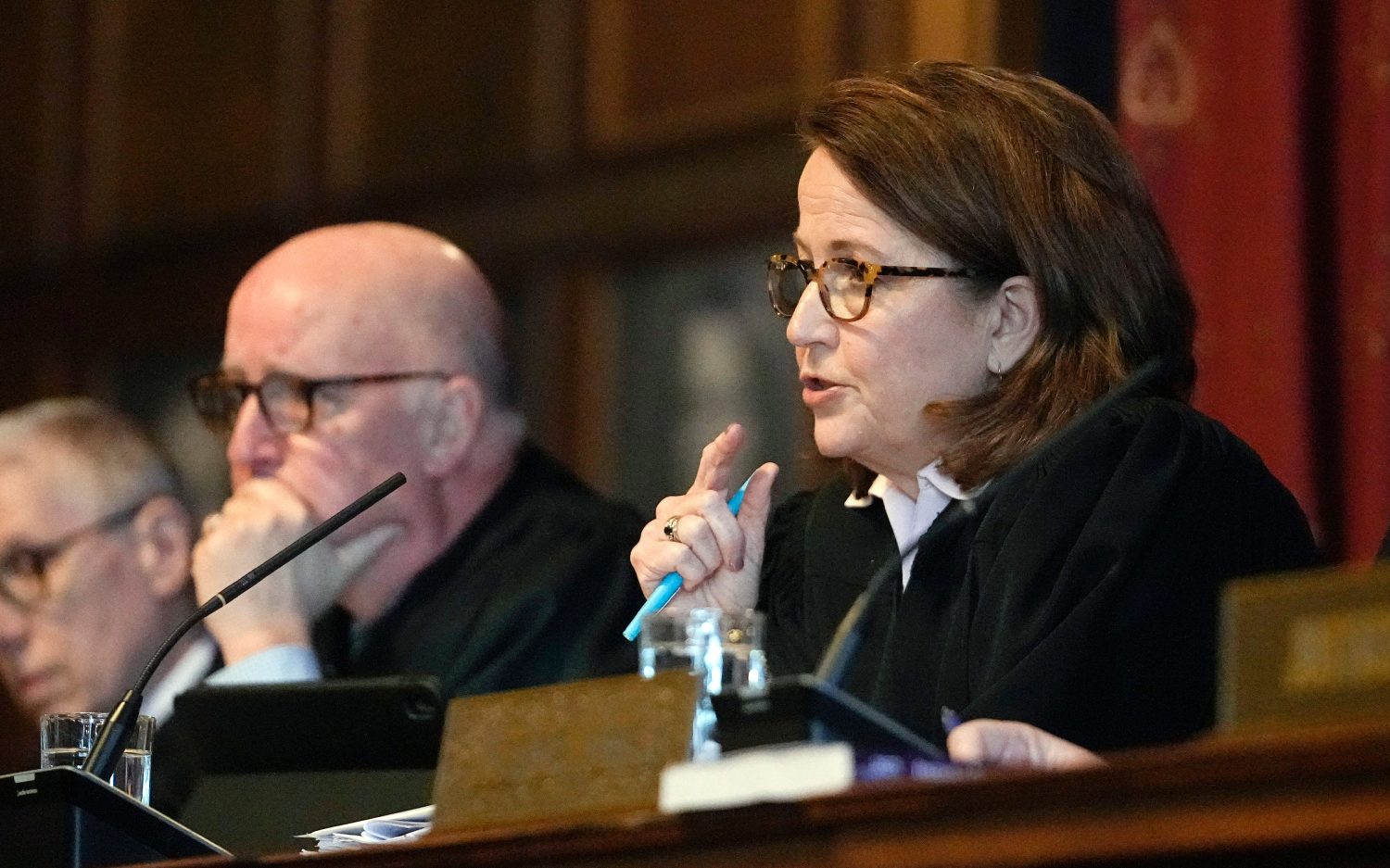
Indiana Chief Justice Loretta Rush speaks during a Supreme Court hearing on Jan. 19, 2023, in Indianapolis. Associated Press / Photo by Darron Cummings, Pool, File
A small crowd backed by the American Civil Liberties Union of Indiana gathered outside the Indiana Statehouse last Thursday. The demonstration was ostensibly in support of religious rights—the supposed religious right of women to abort their babies.
Inside the building, the state’s Supreme Court weighed the unprecedented challenge to Indiana’s pro-life laws from Hoosier Jews for Choice and two women. While the plaintiffs claimed religious beliefs entitled them to exemptions from the state’s near-total abortion ban, the state countered that nothing permits the taking of a life.
Melanie Lyon, the executive director of Voices for Life in Indiana, sat in the courtroom, listening while justices pressed both the state and the ACLU. Lyon said she and others peacefully prayed that “truth would win out” in a case with national implications.
“This is the first case of someone trying to use religious freedom to liberalize an abortion law,” she said. “If the ACLU is successful, then I think it’ll result in copycat cases in other states.”
Hoosier Jews for Choice first sued Indiana officials in 2022 in a class-action lawsuit represented by the ACLU. The suit claimed that many women hold sincere religious beliefs that require access to abortion in circumstances not allowed under state law. Indiana allows abortions in limited cases, such as if it will save the mother’s life, if the baby was not expected to survive the pregnancy, or in cases of rape or incest.
The lawsuit alleged that a myriad of beliefs, from Islam to paganism, hold that life does not begin at conception. While the original suit listed five female plaintiffs, only two of these were still part of the case brought to the Indiana Supreme Court.
One anonymous plaintiff is a Jewish woman who previously aborted her baby with a life-threatening genetic condition. She said her decision stemmed from a Jewish belief that a baby only attains the rights of a person at birth. Additionally, she said her religion requires her to protect her physical and mental health, which she argued were threatened by the pregnancy.
Although the woman wants to have another child, she said she has a 1 in 30 chance of conceiving a child with the same life-threatening condition. She claimed Indiana’s pro-life laws are dissuading her from becoming pregnant because she has no option to obtain an abortion.
Jewish views on abortion vary, with some rabbis taking strongly pro-life views and others saying that abortion can be done to save a mother’s life or physical and emotional health. Some Jewish scholars say that under Jewish law a baby is considered mere fluid until after 40 days in the womb. The Jewish plaintiff in this case adheres to the belief that a baby is not a life until he or she takes his or her first breath after birth.
The other anonymous plaintiff in the case said she does not follow a specific religious tradition but said personal spiritual beliefs guide her life. According to the lawsuit, she believes that a supernatural force endows people with bodily autonomy. To infringe on this autonomy “constitutes a spiritual and moral wrong” for her, the lawsuit claims.
The plaintiff said she has a spiritual obligation to determine whether to remain pregnant, stating that “if a pregnancy or the birth of another child would not allow her to fully realize her humanity and inherent dignity, she believes that she should terminate the pregnancy.” She has ended the life of her unborn child in the past for this reason, according to the lawsuit.
The women, along with plaintiff Hoosier Jews for Choice, argue the state’s pro-life laws force them to act against their beliefs, violating their rights under Indiana’s Religious Freedom Restoration Act. Enacted in 2015, the state law mandates that the government must have a compelling interest to restrict an individual’s exercise of their religion.
A full five-justice panel weighed the details of the case in hourlong arguments Thursday morning.
“Our nation’s long tradition of respect for religious exercise has never been understood to encompass a right to intentionally destroy human life, any more than a right to abusively punish children,” Indiana Solicitor General James Barta told the court.
Barta called the ACLU’s claims a “chain of speculation,” relying on a series of hypotheticals, including if the women “become pregnant, if they want an abortion, if their religious beliefs direct them to terminate, if there’s no viable alternative, and if [state law] would prohibit the abortion.”
The state justices questioned Barta on how this case compared with the 2014 decision from the U.S. Supreme Court in Burwell v. Hobby Lobby. There, the high court found that Hobby Lobby’s religious beliefs exempted it from complying with insurance mandates to pay for employees’ contraceptives.
“Isn’t this just a flip side of that?” asked Indiana Supreme Court Chief Justice Loretta Rush. Barta said no, as Hobby Lobby faced an “imminent deadline” for significant financial penalties.
Rush pressed Ken Falk, an attorney with the ACLU of Indiana, on whether the women, who are not currently pregnant, had standing to sue. “I’m really troubled by the layers of hypotheticals in here,” Rush said.
Falk said that Indiana’s law has still altered the women’s lives. “They have been forced to change their behaviors today, in the most personal and fundamental ways, to avoid pregnancies they would not be able to terminate even when religiously required,” he said.
The justices also expressed concern about the class designation in the case and what women it did or didn’t include. They said it was unclear who exactly would have a religious exemption under the ACLU’s arguments.
Lyon from Voices for Life noted that the justices focused primarily on the question of whether the ACLU’s plaintiffs had sufficient legal standing to sue. She speculated the eventual ruling might focus on that issue, instead of delving into the merits of the religious claims. The Satanic Temple previously challenged Indiana’s pro-life laws under a similar religious claim, but that case was shut down earlier this year over a lack of standing.
If the justices do rule in favor of the plaintiffs in this case, it could potentially create a “blanket exception” for abortion due to the lawsuit’s class-action status, she said. Under the reasoning of the woman who was nonreligious and spiritual, “you could pretty much justify anyone” as having a religious exemption, Lyon said.
A lower court has previously ruled for the ACLU. After the case made its way up and down the state court system on a temporary ruling, a Marion County court issued final judgment in favor of the plaintiffs in March of this year. The court ruled that because the state allowed some secular exemptions for abortion, it should also allow religious ones.
After Indiana appealed that ruling, a myriad of organizations jumped in with supporting or opposing briefs. The National Council of Jewish Women, along with 39 religious organizations, filed an amicus brief advocating for abortions. The council’s CEO asserted the state forces women to comply with a “narrow, Christian belief.” But multi-religious constitutional groups filed briefs in support of the state, including the Becket Fund for Religious Liberty, representing a Catholic group; Thomas More Society, representing Voices for Life; and First Liberty Institute. Additionally, the Jewish Coalition for Religious Liberty said the ACLU’s argument would ultimately hurt religious freedoms.
Hiram Sasser, an attorney at First Liberty Institute, said the government has a compelling interest to protect the lives of the unborn in a case that falls clearly under Indiana’s religious laws.
“There’s never been any kind of religious claim that anyone has ever had that they have a right to kill a child,” Sasser said. “If this kind of nutty challenge goes forward … it’s going to do great damage to religious liberty, or it’s going to open up the floodgates for people to try and make these claims to be able to kill their unborn children.”


I value your concise, accessible reporting. —Mary Lee
Sign up to receive Liberties, WORLD’s free weekly email newsletter on First Amendment freedoms.
Please wait while we load the latest comments...
Comments