
9th Circuit to weigh parental rights and gender ideology
Advocates rally in support of teachers and parents suing over California’s gender secrecy policies for schools
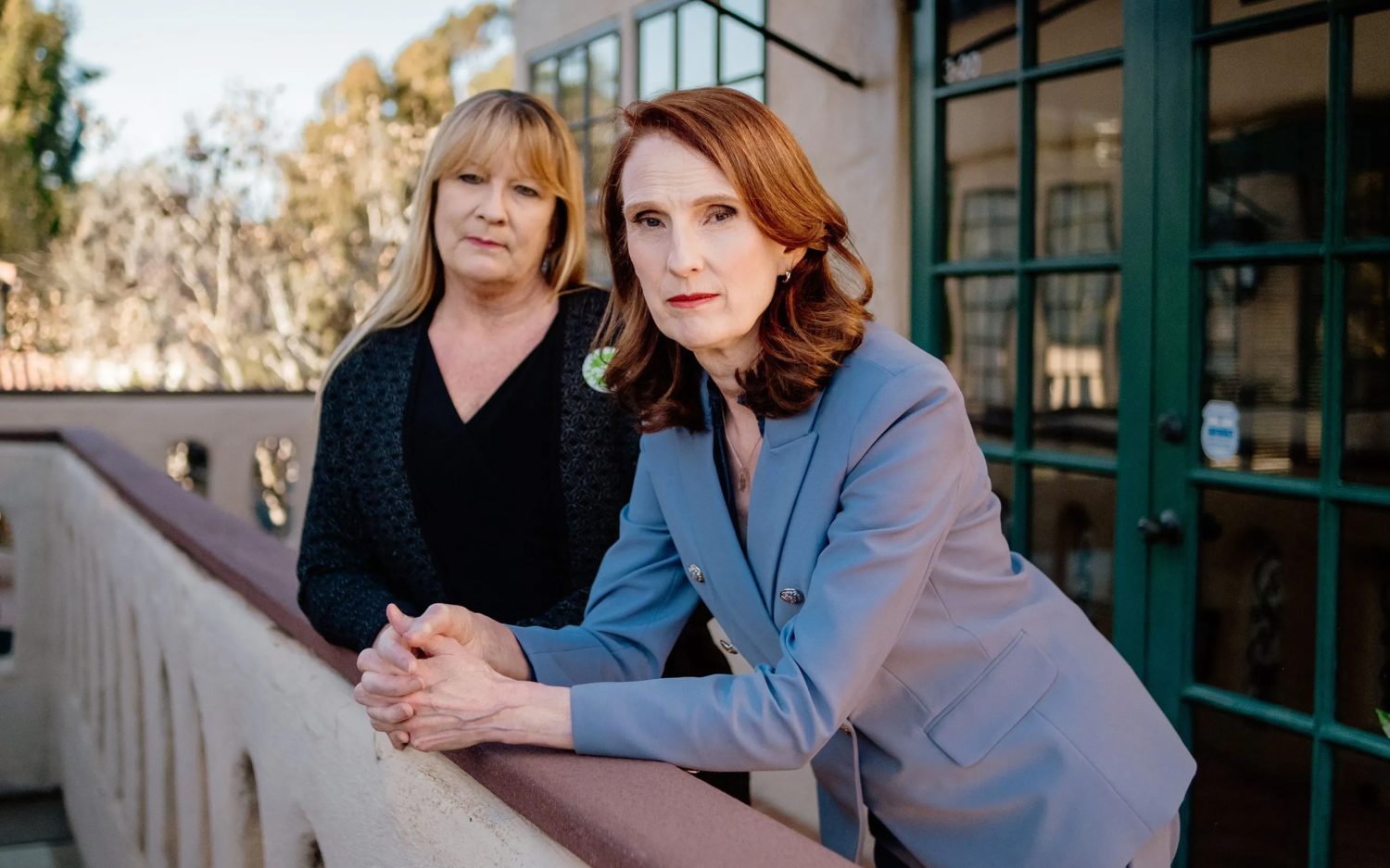
Lori Ann West, left, and Elizabeth Mirabelli are two of the teachers contesting California’s gender secrecy policies. Photo courtesy of Thomas More Society
A high-stakes case before a federal appeals court in California is drawing attention nationwide for its implications for parental rights.
Dozens of individuals and groups, including U.S. senators, medical experts, and a coalition of states, filed 12 friend-of-the-court briefs last week on behalf of parents and California teachers in the case. They contend that a statewide law violates parents’ constitutional rights by requiring school staffers to conceal students’ attempts to reject their biological sex. Though the Supreme Court already issued a ruling in the case affirming parents’ rights, California officials are pushing the San Francisco-based 9th U.S. Circuit Court of Appeals for a workaround.
“The question here is, how much power do government-run schools have to restrict parents?” said Lori Windham, vice president at the Becket Fund for Religious Liberty, which filed one of the amicus briefs. “Are you allowed to know what’s happening with your child at school, or can a school deliberately hide it from you?”
The case started in 2022 after officials at Escondido Union School District in Escondido, Calif., gave a videoconference on the “rights of diverse students.” An official instructed staff to treat students as the gender they identified as, not as their biological sex. Officials required staff to use any requested pronouns or names and allow students access to restrooms or locker rooms based on their preferred gender. The school district did not require parents’ consent before instituting these changes, and it did not allow staff to tell parents without first getting the students’ permission.
“The student’s assertion is enough,” the official said, according to the lawsuit. “There is no need for a formal declaration. There’s no requirement for parent or caretaker agreement or even for knowledge for us to begin treating that student consistent with their gender identity.”
The school district said its policy adhered to guidance that California’s Department of Education issued more than a decade ago. According to Becket’s amicus brief, California has argued that the rules ensure parents do not invade the privacy of students as young as 2 years old and that the parents have no “legitimate need for the information without the student’s consent.”
Four middle school teachers attending the 2022 meeting later contested these instructions, stating that following them violated their religious beliefs. English teacher Elizabeth Mirabelli said it is morally wrong to conceal students’ information from parents. Eighth grade P.E. instructor Lori Ann West said the policy required her to allow boys into the girls’ locker room, going against her biblical beliefs that God creates people as male and female.
In 2023, the school district denied West’s and Mirabelli’s requests for an accommodation that would allow them to inform parents, citing the guidance from California’s Department of Education. The pair soon filed a lawsuit against the district, arguing that officials violated their religious and free speech rights. Two other anonymous teachers later joined the lawsuit.
Two Catholic families also joined the lawsuit, using pseudonyms. John and Jane Doe contend that California’s guidance allowed their fifth grade daughter to socially transition without their consent while attending Pasadena Unified School District. Their daughter requested a different name and pronouns each year of middle school without her parents’ knowledge, despite their repeated requests for notifications.
According to court documents, the parents asked their daughter’s school principal if school officials were facilitating the girl’s attempts to identify as another gender. The principal said no but added that even if that was the case, staff could not tell the parents of it under California’s law.
The other anonymous couple joining the suit, John and Jane Poe, did not know that their seventh grade daughter had been transitioning at Clovis Unified School District until after she attempted suicide. During the girl’s recovery, medical professionals informed the Poes that their daughter had gender dysphoria. But even after she returned to school, and despite her parents’ repeated requests for information, officials at two different online schools continued to refer to her by an alternate name and pronouns.
A U.S. District Court judge ruled against the state’s policy in 2023 and later broadened his order through a class action ruling in 2025, protecting parents’ and teachers’ rights across California. But the 9th U.S. Circuit Court of Appeals temporarily put a hold on the district court’s order.
Earlier this year, the Supreme Court set aside the 9th Circuit’s stay and allowed the district court’s order blocking the policy to go into effect. The high court said in its March unsigned 6-3 opinion that parents are the “primary authority” in the upbringing and education of children, including in decisions regarding their children’s mental health.
But since the Supreme Court did not issue a final ruling on the merits of the case, California has continued to push for its policy. In its latest brief, filed in May, the state argues for a narrow interpretation of the high court’s ruling.
According to the state, the Supreme Court’s opinion does not bar officials from concealing information from parents who haven’t asked what pronouns and names staff use for their students. Also, parents can’t compel teachers to call their students certain names or pronouns, the state argued.
“If parents have a right to compel teachers to address a student with a name and pronouns that do not reflect the student’s gender identity, parents could effectively require teachers to enforce all manner of parental philosophies or religious beliefs in the classroom—such as controlling what students eat, what they wear, and who they associate with,” the state wrote.
The state also argued that school staff members can withhold gender transition information if they suspect parents may engage in undefined abuse.
California has essentially asked the 9th Circuit to throw out the Supreme Court’s decision, argued Paul Jonna, an attorney at Thomas More Society, which represents the parents and teachers. “We’re all scratching our heads about it over here. The Supreme Court really did decide the case,” Jonna said. “California is trying to essentially undo the very significant protection that the Supreme Court enforced.”
While the Supreme Court did not explicitly address teachers’ rights, it clearly protected parents’ rights, which protects teachers from having to lie to parents, Jonna noted.
It’s vital that the 9th Circuit reaffirm well-established parental rights, said John Ketcham, an attorney at the Manhattan Institute, which signed on to one of the briefs. A favorable opinion from the court could “carry persuasive weight elsewhere,” he said. But, if the 9th Circuit rules against parents, the case would likely end up back in the Supreme Court.
Parents and Trump administration officials have fought gender secrecy policies across the country. Last week, the U.S. Department of Justice filed a lawsuit against a similar policy at Kansas City Public Schools in Kansas City, Kan., and in August, Moms for Liberty sued over another gender-secrecy policy in New Jersey.
Becket’s Lori Windham said the 9th Circuit will likely rule in the next few months. She noted that America has a long tradition of upholding the rights of parents to oversee the upbringing of their children.
“California is the one trying to do something new and radical here,” Windham said. “The parents are just asking for the same rights the parents have had all along.”


I value your concise, accessible reporting. —Mary Lee
Sign up to receive Liberties, WORLD’s free weekly email newsletter on First Amendment freedoms.
Please wait while we load the latest comments...
Comments
Please register, subscribe, or log in to comment on this article.