
A war of inches
America’s two political parties fight for razor-thin majorities in a perpetually gridlocked Congress
Illustration by Krieg Barrie

Full access isn’t far.
We can’t release more of our sound journalism without a subscription, but we can make it easy for you to come aboard.
Get started for as low as $3.99 per month.
Current WORLD subscribers can log in to access content. Just go to "SIGN IN" at the top right.
LET'S GOAlready a member? Sign in.
The Republican Party holds majorities in both the U.S. House of Representatives and the Senate, but that appears likely to change after the midterm elections in November. Polls indicate the Democratic Party is on track to win a slim majority in the House. It also has a realistic path to gaining a majority in the Senate, but that will be more of an uphill battle.
Like most recent presidents, Donald Trump relies heavily on unilateral executive action—instead of congressional legislation—to enact his agenda. That means the outcome of the midterm elections is less important than it used to be. But Democratic victories have the potential to create significant headaches for the final two years of the Trump administration and may influence the 2028 presidential election.
The Republican Party doesn’t have much momentum going into the midterms. “Presidential popularity is low. The economy is not exactly doing well. We’re still involved at some level in what I think is an unpopular war in Iran,” said Mark Caleb Smith, director of the Center for Political Studies at Cedarville University.
The current GOP majority in the House of Representatives is razor-thin, with Republicans holding 218 seats and Democrats holding 212. If Democrats take the majority, it would likely also be with a slim margin. Thanks to congressional redistricting over the past two years, “the Republicans built a good firewall,” said Henry Olsen, a senior fellow at the Ethics and Public Policy Center. Many seats are in safe red districts.
But winning a majority in the House, even a tiny one, would give Democrats control of committees, and that comes with subpoena power. “They’re going to start subpoenaing for documents and testimony, and they’re going to start trying to investigate things in the Trump administration aggressively,” Smith predicted.
And they may go further than investigating. During Trump’s first term, when Democrats took control of the House in the midterms, they proceeded to impeach him—twice. Removing a president from office requires a two-thirds majority vote to convict in the Senate. Neither vote came close to reaching that threshold, and any future impeachment attempts seem certain to end the same way.
But given the vehemence of anti-Trump sentiment among Democrats, many political commentators think a third impeachment is likely. “If you painted him as sort of a fascist for the last 10-plus years, and if you don’t impeach him, I just don’t know how you’re going to get away with that,” Smith said.
Olsen thinks a third Trump impeachment would actually benefit Republicans. “One of the charges Trump is going to make is, ‘If you’re going to turn it over to the Democrats, they’re going to be crazy left wing, and they’ll go on an orgy of hatred,’” he said. Another impeachment would play into that stereotype. “I don’t think it sets them up well for 2028,” Olsen added.
Olsen thinks Democratic leaders would be smarter to attempt to impeach other members of the administration. “If their investigation found something in ICE, for example, I could imagine them wanting to impeach Tom Homan,” he said. “That wouldn’t be as high profile, so it wouldn’t cause as much downward damage for them.” Though Olsen thinks such efforts would also fail in the Senate.
Despite its apparent advantages heading into the midterms, the Democratic Party is struggling with internal divisions. A new group of far-left candidates, some of whom are endorsed by the Democratic Socialists of America, are poised to win elections in November. These candidates tend to be strongly opposed to U.S. military aid to Israel. Joseph Postell, associate professor of politics at Hillsdale College, expects that to be a major flash point. “Those must-pass bills on military funding will be places where you’ll see the Democratic Party potentially break apart,” he said.
Rep. Hakeem Jeffries, the current minority leader, is likely to be elected Speaker of the House if Democrats win a majority. But Postell thinks he may face a leadership challenge: “There are people in the Democratic Party in the House who are highly critical of Hakeem Jeffries, particularly on the question of the war in Gaza.” Those divisions give Jeffries an incentive to shift the focus to Trump. “He will be at his best when he can just make every decision about Trump and unify the Democratic Party against him,” Postell added.
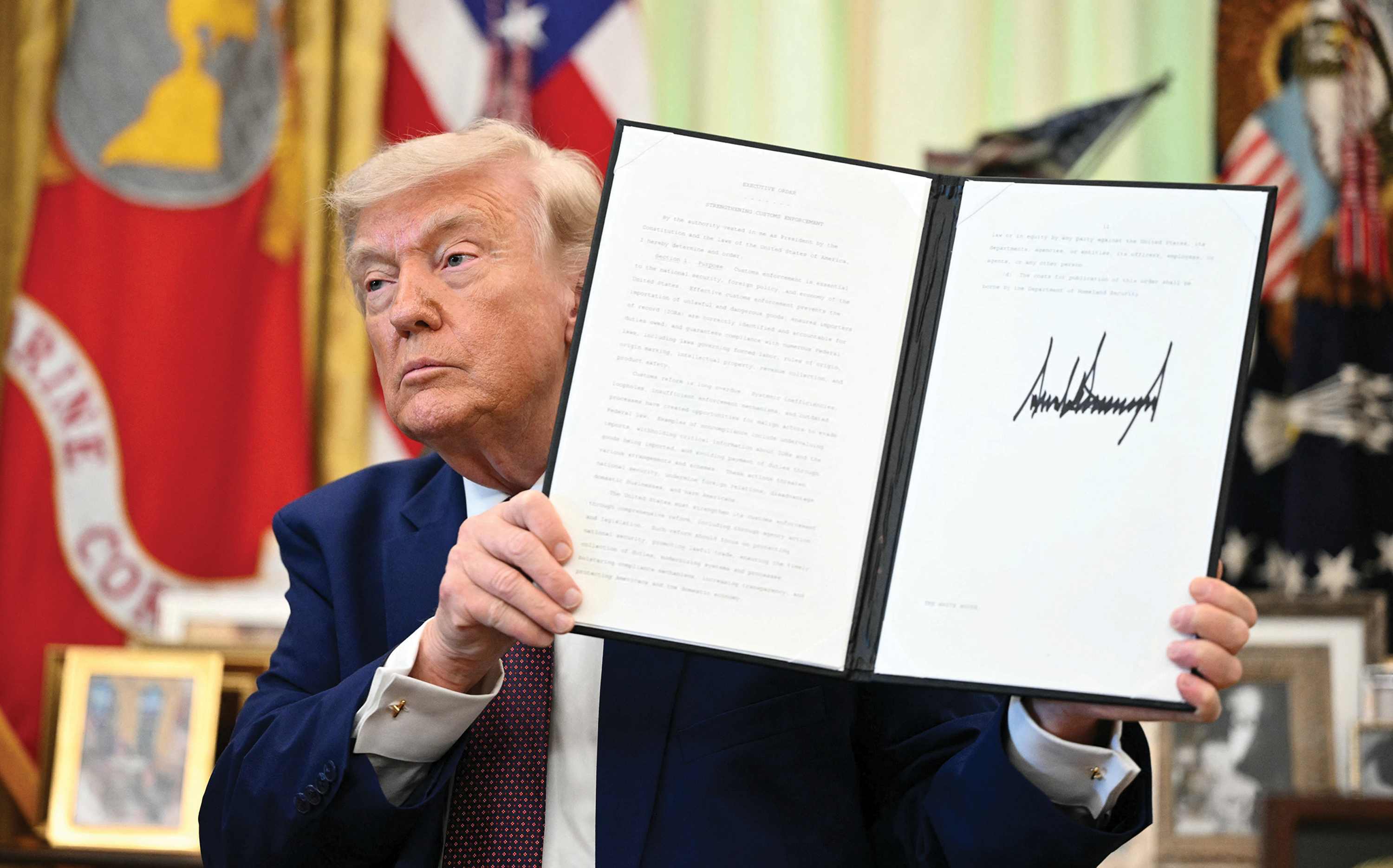
President Trump shows an executive order he signed in the Oval Office. Mandel Ngan / AFP via Getty Images
IN THE SENATE, Republicans currently have 53 seats and Democrats have 45 plus two independents who caucus with them. The chances of Democrats taking a majority are slim, but not nonexistent. Moreover, a 50-50 tie is also possible, which would give Republicans a slight edge. Under the Constitution, when a Senate vote is evenly divided, the vice president holds the tie-breaking vote.
A Democratic majority in the Senate would become very significant if a vacancy opened on the Supreme Court. Senate Democrats would make it nearly impossible to confirm a nominee. And Trump’s nominations for the lower federal courts would also grind to a halt. “President Trump has been very effective at filling spots on the judiciary in these first couple of years,” Postell said. “So, I think you’d probably see a stalemate for the next two years.”
Trump’s nominations for the Cabinet and other executive branch positions would encounter opposition, but Postell thinks that would be less intense. Unlike the Supreme Court, those positions are not lifetime appointments. “The stakes are a lot higher with the Supreme Court,” he said. The president also has workarounds for filling executive branch vacancies. “Trump will probably just try to do interim appointments and sort of cycle through people if he has to,” said Cedarville’s Mark Caleb Smith. “But that’s not ideal.”
When it comes to enacting legislation, a Democratic majority in the House or Senate would not differ much from the status quo. The Senate filibuster is a procedural rule that effectively requires 60 votes to advance most legislation, giving the minority party the power to block bills. “The filibuster renders Congress irrelevant,” Olsen said. As a result, Trump has already been governing mostly through executive action.
Up to now, Trump has been able to enact budget reconciliation bills, a special type of legislation allowing Congress to make changes to federal spending, revenues, or the debt limit that is not subject to the filibuster. The One Big Beautiful Bill Act in 2025 is one example. If Democrats get a majority in the House or the Senate, that option would also be closed off to the Trump administration.
But Olsen thinks the pain of that loss would be relatively minor because “there’s only a limited number of things you can put into a reconciliation bill. Anything substantive cannot move in this environment because Democrats will fight anything Trump proposes, and Republicans will fight anything Democrats propose.”
Once the midterms are done, national attention will shift to the 2028 presidential election. On the Republican side, the two current front-runners are Vice President JD Vance and Secretary of State Marco Rubio. Since they both serve in the executive branch, Postell thinks the outcome of the midterms won’t have much effect on their prospects.
But he believes the midterms do have the potential to influence the Democratic presidential race. A newcomer who runs an exceptional campaign could vault to national fame. Postell is keeping an eye on James Talarico, a Texas Democrat running for Senate. “Texas has been the big prize that Democrats always try to win,” Postell noted. “If you have a Democratic senator from Texas, that would be an interesting vice presidential candidate.”
He does not believe Talarico’s youth and inexperience would be an impediment. “We’ve seen that you don’t need to have a lot of experience in politics to be catapulted immediately,” Postell said. “JD Vance barely served a little bit of time in the Senate before he became vice president.”
See our Election Day guide for races to watch: Senate, House, and state showdowns.

Please wait while we load the latest comments...
Comments
Please register, subscribe, or log in to comment on this article.