
Founder of Ark park voices skepticism over claims of Noah’s Ark discovery
Answers in Genesis CEO and founder Ken Ham speaks at a ribbon cutting at Ark Encounter July 5, 2016 in Williamstown, Kentucky. Getty Images / Photo by Aaron P. Bernstein
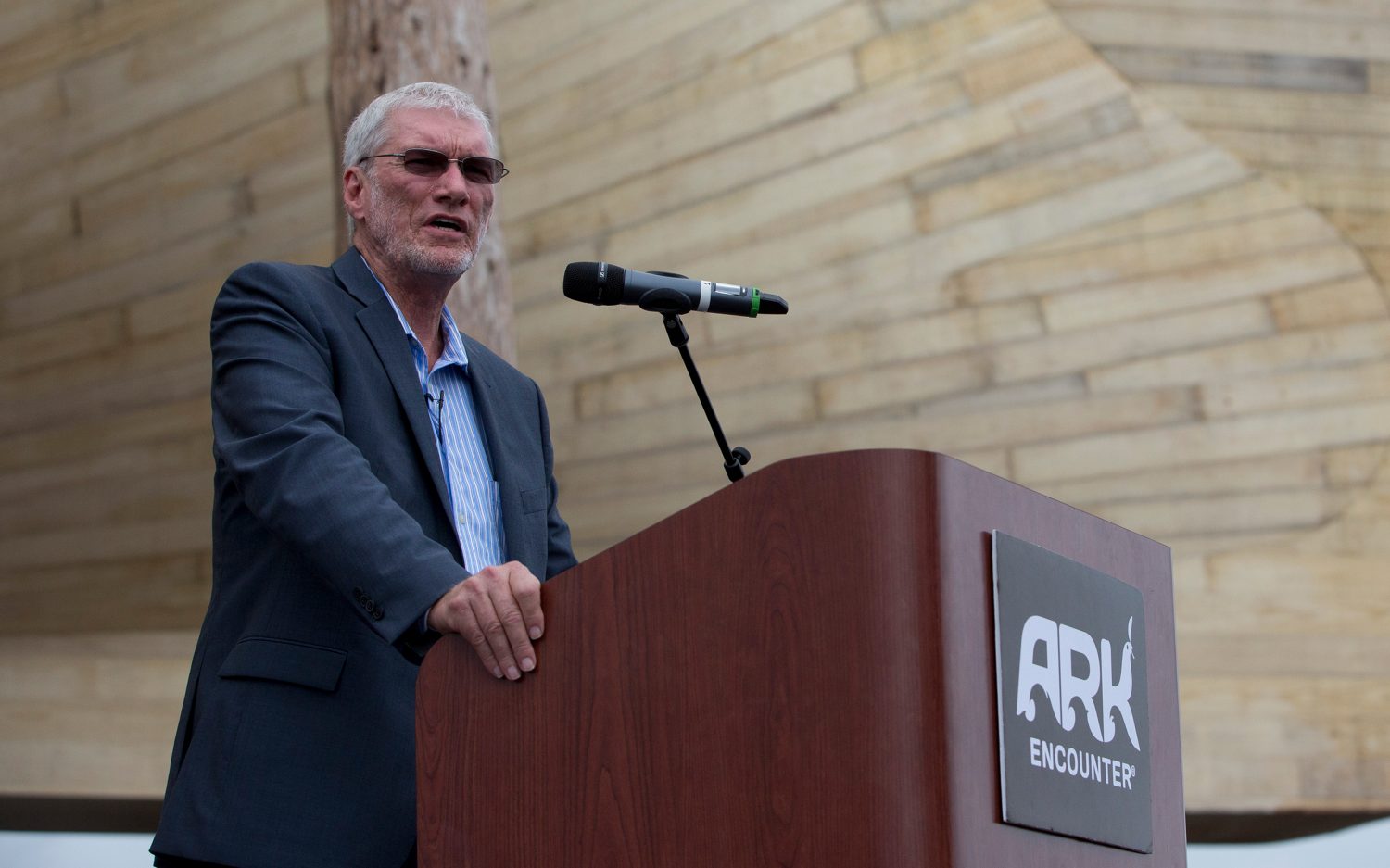
Ken Ham, founder of Ark Encounter, released a video Monday pushing back on new claims that the original Noah’s Ark had possibly been discovered. Ham urged caution amid those claims, made by Noah’s Ark Scans, an American Christian research company, arguing that Christians risked their own credibility when they exaggerated evidence.
Who is Ken Ham? Ken Ham is the founder of Answers in Genesis, the popular Creation Museum, and the world-renowned Ark Encounter in Kentucky, which displays what he says is a full-scale replica of Noah's Ark designed to showcase the historical reliability of the Bible and young Earth creationism.
In his recent video, Ham said as a Bible-believing Christian, he believed Noah was a real man and there was a real physical Ark as described in Genesis. He said he would be thrilled if someone genuinely found the remains of Noah’s Ark, adding that it would be one of the greatest archaeological discoveries. However, he said Christians needed to be careful about sensational claims—like those made by The Daily Star which reported that the discovery was 100% confirmed—particularly when they have already been both made and refuted many times.
For decades there have been claims about radar imaging, metal objects, petrified wood and supposed ship structures, Ham said. He added that Answers in Genesis geologist Dr. Andrew Snelling published a detailed investigation about these claims back in 1992.
What did Noah’s Ark Scans claim to have found? The site making headlines is known as the Durupinar Formation in eastern Turkey, which is about 18 miles south of modern Mount Ararat. Researchers for Noah’s Ark Scans have begun deep core drilling and said that they found organic-rich material and cavities below the surface. Last Wednesday, Noah’s Ark Scans announced that in one drill hole 4-5 meters below the surface, the drill hit something hard and broke, which they said might be petrified wood. The researchers themselves said that petrified wood was only a possibility rather than a lab-tested fact, and they vowed to seek third-party lab testing.
Ham said that samples such as these ought to be tested in a qualified independent laboratory to confirm their speculated findings, rather than jumping to unverified conclusions. Good science, he said, welcomes careful investigation. He argued that Christians, of all people, should not exaggerate evidence, but rather be people of truth. They can become like the boy who cried wolf and undermine Christianity’s credibility when they make claims that are repeatedly proven false, he said.
How did Noah’s Ark Scans respond? Andrew Jones, the vice president of Durupınar Noah’s Ark Research Project, told WORLD that his organization’s findings also needed to be described accurately. He said the preliminary observations are not, by themselves, a scientific identification of Noah’s Ark. He added that the fact that previous claims were disputed or overstated was a reason to conduct more rigorous research rather than a cause to stop asking questions. Past claims do not prove this was the Ark, he said, but past controversies do not prove there was nothing worth investigating.


An actual newsletter worth subscribing to instead of just a collection of links. —Adam
Sign up to receive The Sift email newsletter each weekday morning for the latest headlines from WORLD’s breaking news team.



Please wait while we load the latest comments...
Comments
Please register, subscribe, or log in to comment on this article.