
White House to shake up legal representation for immigrant kids
Child advocates argue against changes that the Trump administration calls much-needed reforms
A 13 year old unaccompanied minor is transported to a processing center after he illegally crossed the Rio Grande from Mexico into the United States. Getty Images / Photo by John Moore
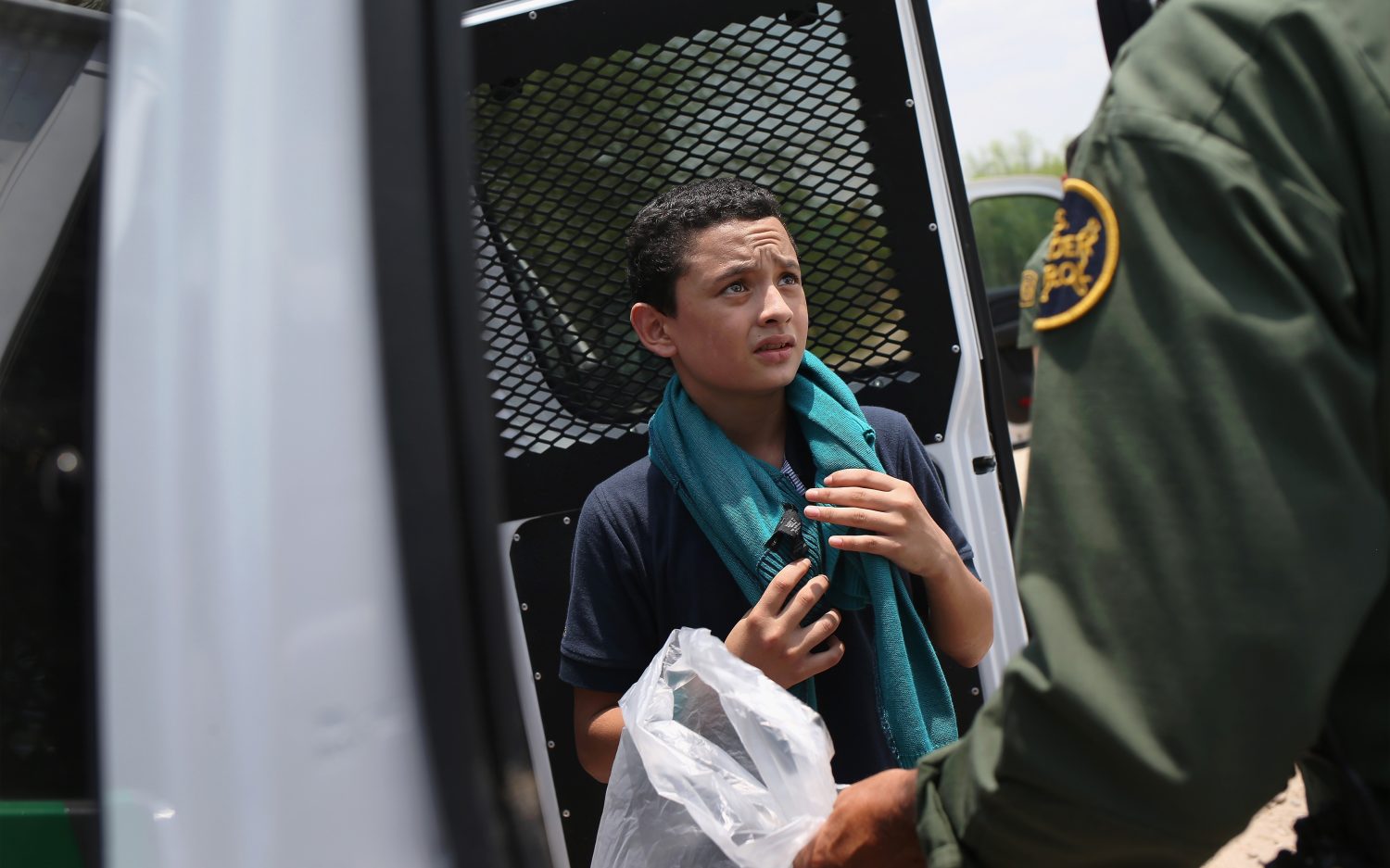
Last month, the U.S. Department of Health and Human Services announced it was establishing an office to provide public defender–style legal representation to unaccompanied immigrant minors. For teens and younger children who crossed the U.S. southern border without an adult relative and later appeared in immigration court, HHS would try to provide a lawyer to speak for them.
Many immigration advocates aren’t impressed.
While HHS said it was creating a new division within its Office of Refugee Resettlement to provide representation to minors, that’s the same office responsible for overseeing the care and custody of unaccompanied minors. And those minors are children the Trump administration is seeking court permission to deport. Critics say the setup creates an inherent conflict of interest.
“This is the agency that’s detaining them as part of an administration whose job it is to try to remove these children,” said Jennifer Podkul, chief of global policy and advocacy for KIND—Kids in Need of Defense.
The maneuver is just the latest in a series of steps the Trump administration has taken that many immigration advocates say make it harder for unaccompanied immigrant children to obtain representation—and therefore appropriate protections against wrongful deportation—in immigration court. But the Trump administration argued that it’s actually trying to assist children who cross the border without adult relatives. Meanwhile, some experts blame Congress for failing to better protect unaccompanied minors in federal immigration law.
Respondents in immigration courts, unlike defendants in traditional federal courts, don’t have a right to an attorney. But they can receive attorney representation either through a pro bono program or for a fee.
Having representation increases an immigrant’s chances of staying in the United States by up to 366%, according to a Vera Institute of Justice report focused on Chicago-area immigrants. The Transactional Records Access Clearinghouse (TRAC) reported in 2015 that representation in immigration court cases for women with children led to a 14-fold increase in their chances of being able to stay in the United States.
“There are a large number of pro bono providers and what we call ‘low bono’ providers—they will offer legal services, in particular to unaccompanied alien children, for a low or reduced cost,” said Andrew Arthur, a former immigration judge and a current senior fellow at the Center for Immigration Studies. “And, in addition, a lot of major law firms will have their junior associates, mid-level associates, provide pro bono legal services.”
But sometimes, respondents navigating immigration courts don’t have a lawyer representing them as the government tries to deport them. And sometimes, those respondents are children.
The federal government defines unaccompanied alien children as individuals who are under the age of 18 without a parent or legal guardian in the United States. The Pew Research Center estimated in 2014 that most unaccompanied alien children who were arriving in the United States were between the ages of 13 and 17, though around 16% were age 12 and under. Since fiscal year 2019, more than 60% of the unaccompanied alien children in the Office of Refugee Resettlement’s care each fiscal year have been 15 or older, according to data from ORR.
Days after President Donald Trump took office in 2025, the U.S. Department of Justice rescinded Biden-era administration guidance ordering immigration judges to conduct court cases with minors in a “child-friendly” manner. That move reinstituted previous guidance that simply told immigration judges to be aware that minors could require special considerations.
From 2005 to 2017, roughly 36% of the nearly 300,000 children who appeared in immigration court didn’t have an attorney, TRAC reported. Roughly 7 out of every 10 children who didn’t have an attorney during that time were ultimately deported.
But the federal government isn’t technically responsible for making sure young immigrants have legal representation, Arthur explained. “To the degree that this is happening, it’s because the NGOs and the organizations that used to provide those services aren’t doing it anymore,” he said.
Arthur argued that unaccompanied alien children generally don’t arrive in the United States accidentally, but family members often pay smugglers fees of around $7,000 to bring them in. Still, since 2008, the federal government has provided funding each year to provide attorneys for unaccompanied immigrant children.
Jennifer Podkul from KIND pointed to hundreds of millions of dollars that Congress has annually allocated to the HHS Office of Refugee Resettlement, which then contracted with private groups that provided legal services.
ORR primarily worked with the Acacia Center for Justice, Podkul explained. The Acacia Center then subcontracted with roughly 100 organizations such as KIND through its Unaccompanied Children Program, working with about 26,000 unaccompanied minors.
But even with the federal money, many unaccompanied minors navigating the immigration court system throughout the years never received legal assistance, Podkul said. “Even in the best of times, it was still like less than half the kids had lawyers,” she said.
And in March 2025, the federal support disappeared when the Trump administration terminated much of the Unaccompanied Children Program. Advocates sued the administration over the decision, alleging it violated federal law. The next month, a judge ordered the federal government to continue funding the program, and the Trump administration reinstated the contract accordingly.
An ORR spokesperson explained to WORLD that the office realized last year that, depending on the week, between 40% and 70% of the unaccompanied alien children in its care didn’t have a lawyer. ORR said it asked the Acacia Center to provide nonprivileged information about which children its subcontractors were representing and how it was billing the federal government for each client. According to the agency, the Acacia Center refused to provide that information.
The Acacia Center for Justice disputed that characterization. It told WORLD the annual federal funding isn’t anywhere close to enough to provide every unaccompanied immigrant child with legal representation.
“Instead of trying to close this gap, the administration repeatedly tried to eliminate legal representation for these children,” said Bilal Askaryar, director of communications at the Acacia Center. Providing the documents the federal government requested would have revealed case strategy and violated attorney-client privilege, he added.
Fast-forward to July 2026, when HHS ended its partnership with the Unaccompanied Children Program at the Acacia Center for Justice. The move threatened the legal representation of more than 20,000 children, according to the center.
The Trump administration offered the center a new contract that would have required it to provide clarity on which children in ORR custody its subcontractors were representing, and what services it was billing the government for related to those clients’ cases. The Acacia Center turned down the contract, ORR told WORLD.
“ORR’s proposal for the new contract was filled with poison pills that would have required us to hand over privileged information,” Askaryar said. “During every stage of the negotiation, we told them we would not violate our [clients’] privileged information, and no other ethical provider would either.”
Just weeks later, the administration awarded a federal funding contract to the organization Our Rescue for providing legal representation to minors in immigration court. But the federal government is unable to provide any money to Our Rescue through that contract, ORR told WORLD. That’s because the Acacia Center for Justice filed a protest against the contract in August. ORR can’t provide funding to Our Rescue through the contract until the dispute about the contract is resolved.
While that contract dispute plays out, ORR has enlisted the assistance of the U.S. Committee for Refugees and Immigrants to provide legal services to the minors in its custody, the office said. According to the Acacia Center, however, Our Rescue and the U.S. Committee for Refugees and Immigrants did not have experience representing minors in immigration court.
The number of unaccompanied immigrant children facing deportation without a lawyer has increased significantly since Trump took office, according to the Vera Institute. More than half of the roughly 700,000 unaccompanied children facing deportation in August 2026 never had an attorney representing them. Overall, the number of unaccompanied minors whose immigration court cases closed without them ever receiving assistance from an attorney was up 45% compared with before Trump took office, the Vera Institute said.
As it shifts funding away from previous projects that provided unaccompanied children with legal representation, the Trump administration has also reportedly taken steps to speed up the resolution of unaccompanied immigrant children’s cases. Outlets like ABC News and Bloomberg Law have also reported that the Trump administration has offered payments to children to self-deport.
The U.S. Department of Homeland Security told WORLD that it has only offered payments to children in its custody who are older than 14, aren’t citizens of Mexico, and have no gang affiliation.
“This administration was trying to convince kids just to drop their claims and to say, ‘OK, never mind, we’ll go back,’ by offering them money,” Jennifer Podkul from KIND said. “We’re very worried. Who is checking to make sure that when that kid goes back, there aren’t dangerous people waiting for the kid?”
Podkul added: “They almost made it more dangerous for kids to go back because now these kids are going to be carrying around a couple thousand dollars of cash, right? And these are places where kids have already left because they didn’t feel safe there.”
Government attorneys and lawyers acquired through new contracts could provide at least some children with legal representation. But the attorneys who’ve represented children in immigration court through previous federal funding have developed a speciality in the area, said Jennifer Anzardo Valdes, director of Children’s Legal Services at the International Rescue Committee.
“IRC, as well as the other legal service providers that were on this contract, have spent years building a specialty really around working with children and understand the responsibility of helping children understand the process and protect their rights and present that information in a child-friendly way,” Anzardo Valdes said. “We use puppets, fidget toys, art. We even have a model courtroom that’s made out of bricks in which to teach children what their rights are, what it would be like when they go to court and talk to a judge.”
But Andrew Arthur from the Center for Immigration Studies says federal government attorneys already represent individuals during courtroom proceedings in other contexts.
“We have public defenders. They’re government employees. … Why would this be any different?” Arthur said. “And the sort of people that would take a job like that probably would not be the sort of attorneys who would be 100% MAGA-focused on removing everybody who is unlawfully present.”
But whether they have a lawyer or not, children shouldn’t have their cases heard in the adversarial setting of an immigration court, said Arthur, who pins the blame for that reality on Congress.
“There’s no real reason why [unaccompanied alien children] should be in immigration court at all,” Arthur said. “And if this is an issue, Congress probably wants to reconsider whether there is some better way to screen these children to determine whether they need immigration protection or are eligible for any immigration benefits, and to handle that administratively in a nonconfrontational proceeding.”
Podkul explained that in her work—whether in the courtroom or outside—her biggest priority is getting the right answer for the children.
“I think as a lawyer. I’m drawn to fairness, right?” Podkul said. “Making sure kids—this population—has the opportunity to tell their story, and we get to the right answer for a kid. You know, the right answer could be they stay in the United States because they need protection. The right answer could be, ‘It’s OK, they can go back to their country of origin, and we can support them, and they can flourish and make their countries better.’ But it’s about getting to the right answer for these kids.”
ORR told WORLD it is pursuing all the means at its disposal to provide minors in its care with legal representation.


You sure do come up with exciting stuff to read, know, and talk about. —Chad
Sign up to receive Compassion, WORLD’s free weekly email newsletter on poverty fighting and criminal justice.
Please wait while we load the latest comments...
Comments