
Trump’s treatment-first homeless policy moves forward
While many conservatives in the homeless services arena support the move, other advocates say it will make more Americans homeless
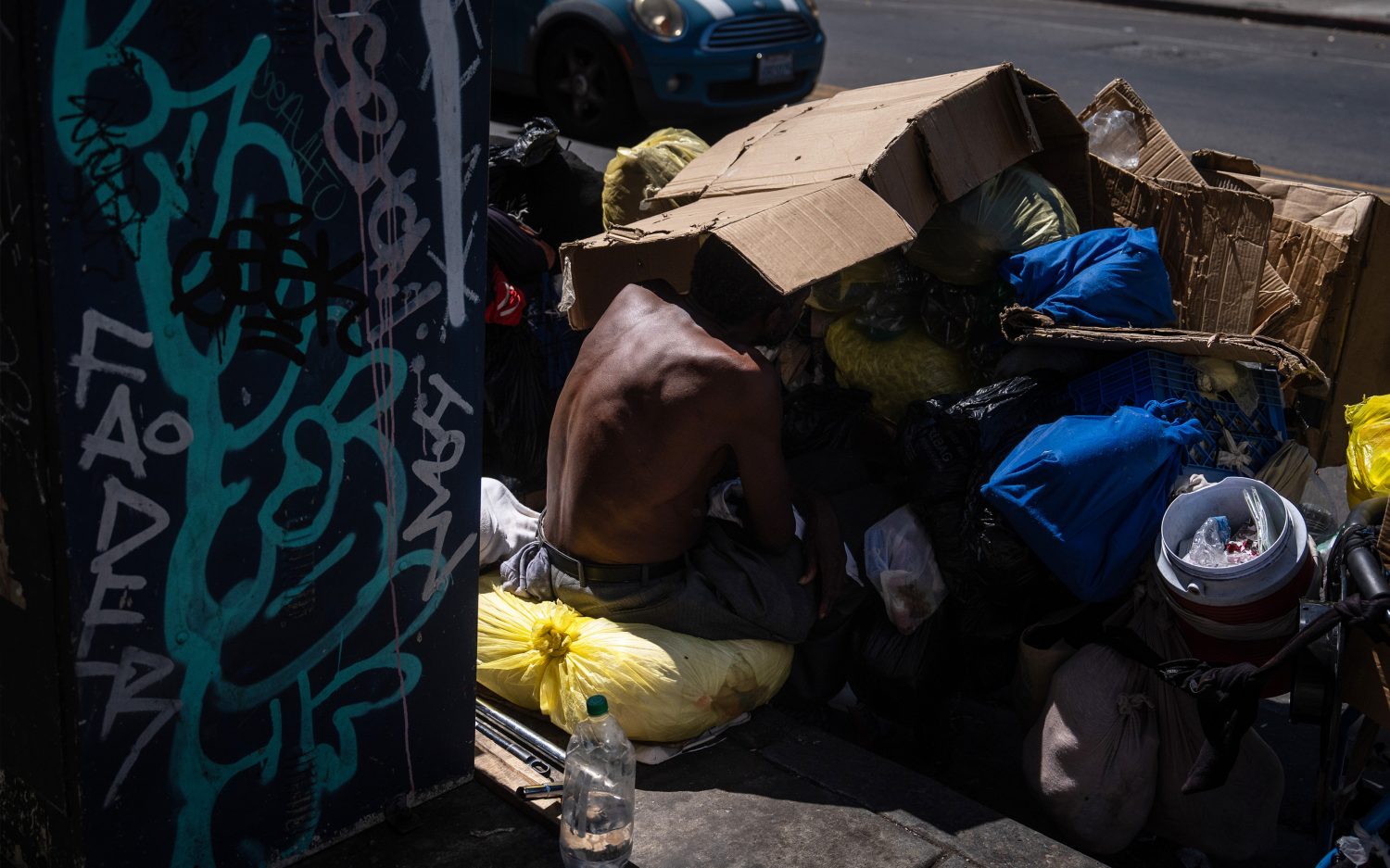
A homeless person sits on a sidewalk in downtown Los Angeles on Aug. 24. Associated Press / Photo by Jae C. Hong
A couple of weeks ago, while helping with a trash cleanup at a public park in the Seattle area of Washington, Michele Steeb met a man named John.
“I don’t know how old John is. … Maybe 25,” Steeb told me. “He was so—almost incoherently—high on fentanyl.”
Steeb, a senior fellow at the Discovery Institute’s Fix Homelessness Initiative, asked John if she could take his picture to help her remember to pray for him. She says she saw a glimmer in his eye cut through the fentanyl haze on his face, showing a glimpse of the person behind the addiction.
“I mean, it was so quick, but it was so real,” Steeb said. “That’s an individual with innate value.”
Days earlier, USA Today published an opinion column Steeb wrote about working with Julianna—a woman who went from homelessness, drug addiction, and abusive relationships to homeownership, independence, and empowered parenthood.
The difference between their stories came down to one thing, Steeb said: Julianna got plugged into a system that saw her innate value and helped her to see it as well. John, however, lived in a district that didn’t recognize his innate value.
After protracted legal battles, the 1st U.S. Circuit Court of Appeals last month cleared the way for the Trump administration to proceed with restructuring its funding strategy for homeless service providers across the country. The move highlights a longstanding debate over whether homeless service providers should prioritize housing without strings attached or require participants to take steps to better their situations in order to receive housing. While many homeless service advocates have argued the White House’s new policies will push more people into homelessness, Steeb and other supporters of the funding strategy say it could mean more homeless people are treated like Julianna, and fewer are treated like John.
Late last year, the Trump administration announced it would change how it handed out homelessness funding for the remainder of the 2025 fiscal year. The U.S. Department of Housing and Urban Development required homeless services providers to reapply for grants from the federal government and said it would prioritize funding programs that required participating individuals to accept treatment.
The federal government, when awarding grants to homeless services organizations across the country, can decide how much of each dollar goes to different kinds of programs, Michele Steeb explained. For much of the last decade and a half, the vast majority—roughly 80% to 90%—of the homeless services money the federal government sent local jurisdictions has funded permanent supportive housing programs. These Housing First initiatives generally give homeless people a place to live without any requirements that they get sober, obtain treatment for psychological issues, or pursue employment.
Housing First projects arose roughly 15 years ago on the back of a promise that the approach would end homelessness within a decade, Steeb noted. But homelessness has instead increased exponentially, according to figures from the U.S. Department of Housing and Urban Development.
Some experts credit that increase to the failure of Housing First policies. But others point to alternative causes. “I’m not saying anything that HUD hasn’t historically said or Congress [hasn’t historically noted],” said Mary Frances Kenion, chief equity officer at the National Alliance to End Homelessness (NAEH). “They’ve both come to the conclusion that the rise in homelessness is attributed—and attributable to—factors like the national affordable housing crisis, rising inflation, stagnated wages among both middle- and lower-income households, and then the persisting effects of systemic racism.”
In last year’s proposed funding changes, the Trump administration sought to pull money from Housing First programs and push it toward homeless shelters and transitional housing projects that require participants to address their substance abuse and mental health problems. Instead of sending 80-90 cents out of every dollar to permanent supportive housing, the new funding allotment plan for fiscal year 2025 would allow only 30% of its funding to go toward permanent supportive housing projects. The lion’s share of the remainder would go to transitional housing and homeless shelter projects employing a treatment-first mentality.
Several states, homeless services providers, and advocacy groups sued the Trump administration over the policy. U.S. District Judge Mary McElroy issued a preliminary injunction last December, preventing the Trump administration from proceeding while litigation continued. In June, McElroy issued a final ruling that the Trump administration broke the law and violated congressional instructions with its funding changes for the 2025 fiscal year.
But before the judge issued that ruling, the federal government announced that it was adopting funding initiatives for fiscal year 2026 that closely resembled the ones the court struck down for 2025. Again, homeless providers and Trump administration opponents sued, and again, McElroy struck down the Trump administration’s new approach, saying it was illegal.
But last month, a three-judge panel from the 1st Circuit disagreed with McElroy and stayed her order—effectively permitting the Trump administration to proceed with its planned funding adjustments for fiscal year 2026. On Wednesday night, the coalition of states and advocates refiled its latest claims against the Trump administration’s policy, although the Trump administration can proceed with its funding strategy while the lawsuit is pending.
Many advocates warn that unleashing the Trump administration’s funding changes will harm tens of thousands of Americans. “This new scheme set aside over a billion dollars for ‘new projects,’ aiming to move funding away from what has time and time again been proven to solve homelessness: permanent housing with built-in supportive services,” said Jesse Rabinowitz, communications director at the National Homelessness Law Center.
The Trump administration’s efforts to pivot funding away from permanent supportive housing could lead to many housing programs shutting down due to financial shortfalls, Rabinowitz said. And that could lead to tens of thousands of formerly homeless people winding up back on the streets.
“Many of [the] people living in this housing, who often have disabilities, mental health challenges, or other unique needs, will be evicted back into homelessness, where they will face higher risks of sickness and death,” Rabinowitz said. “This will not only make homelessness worse, but will make all our communities increasingly unsafe, unhealthy, and unstable.”
HUD data does provide some evidence for the argument that broad affordability problems are helping drive the homelessness problem. According to a June 2025 HUD report, the number of people experiencing homelessness for the first time has increased since 2020, reaching almost 913,000 in 2024. That meant, on average, about 17,500 people a week fell into homelessness.
“You cannot blame the emergency room for heart attacks, said Tom Murphy, vice president of communications at NAEH. “It is a failure that lives upstream.”
Kenion also noted that HUD’s Annual Homelessness Assessment Report for 2025—which reported on the state of homelessness during the last year of the Biden administration—showed a decrease in homelessness nationwide compared to the year before, following a long-term upward trend since 2013.
But some supporters of the Trump administration’s proposed policies say that, if more people did return to homelessness as a result of the Trump administration’s new policies, it would only be because of semantics, not practical changes to their circumstances.
Paul Webster, a senior fellow at the Cicero Institute, said that such claims misuse the government definitions of the word “homeless” laid out in the 2009 HEARTH Act, a law that ordained how HUD can allocate funds for homeless services.
“What Congress said is that if you are in permanent supportive housing … if you’re a homeless person and you sign on to a lease for your housing, you’re no longer considered homeless definitionally,” Webster said. “But if you’re a homeless person and you go into a program that has a time limit to it, say three years or two years or something like that, like a transitional housing program … you’re still considered homeless definitionally.”
If the Trump administration pulls funding from permanent supportive housing programs and pushes providers toward transitional housing programs, homeless service providers will begin changing their program structures to have a better chance of earning funds, Webster predicted.
Mary Kenion from the National Alliance to End Homelessness countered that deeds and other regulations mean buildings often can’t simply transition from permanent supportive housing to transitional housing. She warned that some facilities would have to close their doors following the Trump administration’s funding restructuring.
“The current notice of funding opportunity threatens to push roughly 97,000 formerly homeless people who have been stably housed back onto the streets,” Kenion said. “It’s more than a number. It’s human lives.”
Webster acknowledged that the 1st Circuit’s decision could mean that organizations that previously received funding for their Housing First programs could lose that funding. At the same time, programs that previously never had a chance to get funding might finally receive it, he noted.
“HUD has been very active in encouraging entities that have not been awarded historically with these Continuum of Care funds [to apply for them], like faith-based organizations, organizations that focus on sobriety, organizations that prioritize workforce training, organizations that are more interested in delivering mental health treatment along with housing and services,” Webster said.
Housing First advocates argue that the Trump administration’s policies decrease access to what they call evidence-based responses to homelessness. But critics of the Housing First model say the evidence actually points to housing-without-strings programs being ineffective.
“I’ve almost never heard an advocate discuss Housing First without adding the words ‘evidence-based,’” said Judge Glock, director of research and senior fellow at the Manhattan Institute. Glock pointed to two meta-analysis reports—one from The Lancet Public Health and another from The National Academies of Sciences, Engineering, and Medicine—that analyzed multiple studies measuring the experiences and outcomes of individuals in Housing First programs. The studies showed that Housing First policies didn’t improve most health, well-being, or outcome metrics.
“The one thing that Housing First did seem to do is increase the time people spent in housing,” Glock explained. “But for that crowd, ‘evidence-based’ means just that. They will stay in that house more than if you don’t give them a house. But it’s not evidence-based in terms of having other positive effects or reducing homelessness in the community.”
Kenion argued that treatment-first programs should bear the burden of proof and provide evidence that their method works. She said treatment-first programs can often create “bottlenecks,” where people aren’t able to proceed out of a program into supportive housing because they can’t meet the requirements of the program.
“When you have housing-focused policies and practice in place, you’re able to help people exit your system very quickly compared to when you don’t,” she said.
As the Trump administration implements its new funding strategy, Michele Steeb of the Discovery Institute said she expected that jurisdictions across the country may try to circumvent HUD. They may rebrand their current practices to fit the terminology the Trump administration is looking for in the grant applicant process, obtain federal funds, and then continue providing care the way they have for the past several years, she argued.
Steeb said that could be a real risk in places like Seattle—where she met John.
“Seattle can choose to uphold in a very genuine way what the federal government wants to do with that dollar and really embrace the new treatment-first approach,” Steeb said. “Or it can say … ‘We’re going to take that dollar, and we’re going to tell the administration we’re using it on its treatment-first approach. … But we’re really pulling the wool over their eyes. We’re gonna use it the way we’ve been using their dollars for the past 12 years.’”
And if that happens, HUD is likely going to revoke homeless services funding to different parts of the country.
“[HUD] Secretary [Scott] Turner has made it very clear that he’s not going to tolerate waste and fraud,” said Paul Webster from the Cicero Institute. “So, these continuums of care, if they want to try to deceive HUD, they do so at their own peril.”
Despite those concerns, some jurisdictions on the opposite side of the political aisle from the Trump administration have independently started to change their tune. In San Francisco, Mayor Daniel Lurie announced this summer that his administration was changing the way the city addressed homelessness. Following the overhaul of city funding for homeless services, Lurie’s office explained that only the most effective programs—the ones with the best measurable outcomes—would receive funding. And that funding would come with more transparency for taxpayers.
“What San Francisco is doing is it’s showing there’s a little bit of a limit on the left. … I think there’s a limit on the left to how much of these dumb ideas that don’t work,” Webster said, adding that he thinks Seattle will follow San Francisco’s lead and also backtrack its support for Housing First policies.
Until that happens, Michele Steeb from the Discovery Institute said she finds it unlikely that homeless individuals in Seattle, like John, will get effective assistance.
“John will not get the help he needs unless God intervenes,” Steeb said. “He is in a location where they don’t believe in the innate value and potential of human beings. They define compassion by allowing them to continue to degradate in their disease.”


You sure do come up with exciting stuff to read, know, and talk about. —Chad
Sign up to receive Compassion, WORLD’s free weekly email newsletter on poverty fighting and criminal justice.
Please wait while we load the latest comments...
Comments
Please register, subscribe, or log in to comment on this article.