
Trapped inside a cyberscam center
Anti-trafficking groups are helping scam center escapees walk the long road to recovery
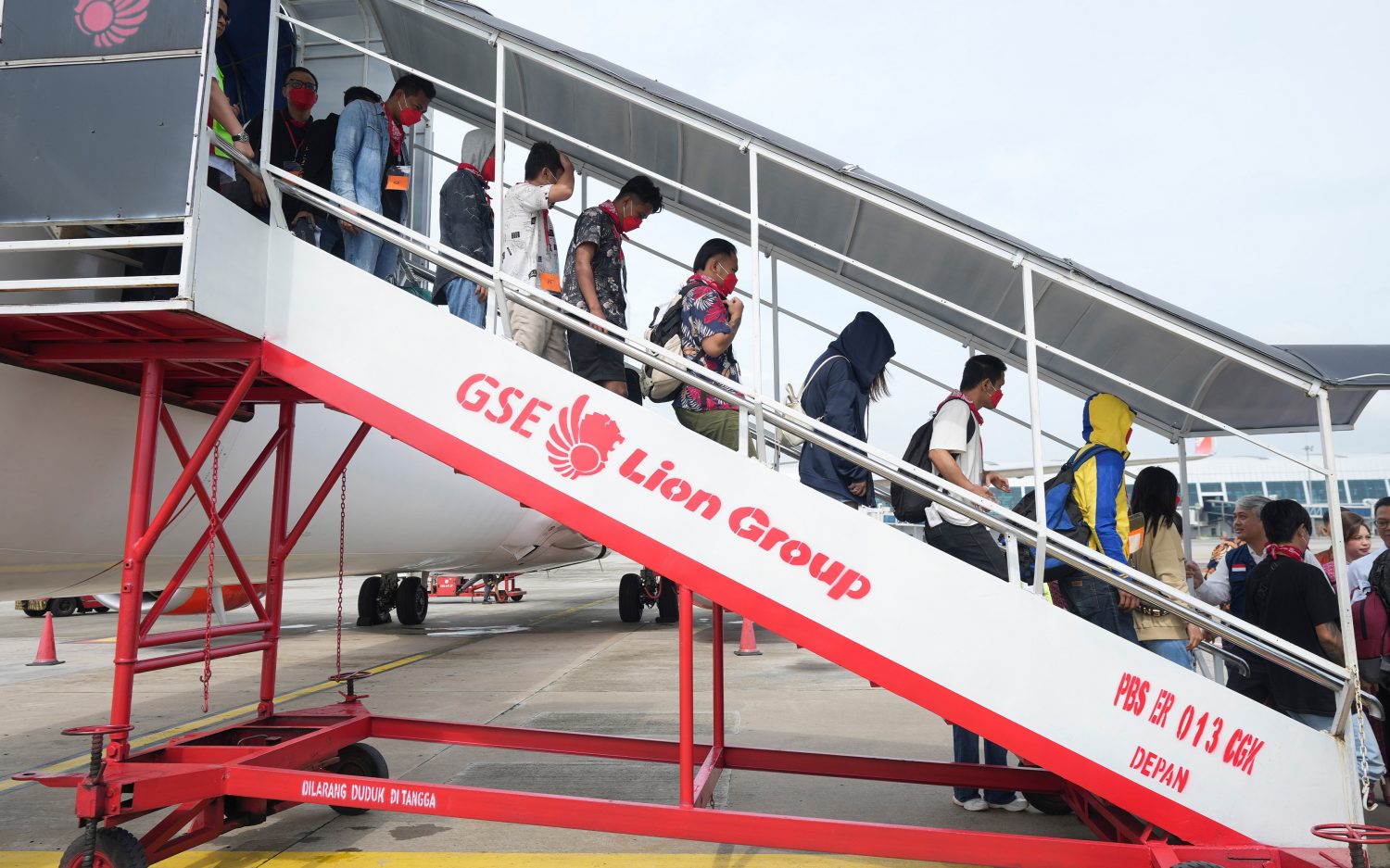
Indonesian nationals who had worked at scam centers in Myanmar disembark their plane upon arrival in Tangerang, Indonesia, March 18, 2025. Associated Press / Photo/ by Tatan Syuflana, Pool
Inside a 15-story building in Cambodia, a criminal gang forced Miracle Ang, a middle-aged Indonesian Christian woman, to operate online scams along with about 65 other people from different countries. Ang had to use fake social media profiles to pose as a rich, attractive woman to lure men aged 40 and older into supposed romantic relationships before tricking them into making cryptocurrency transactions.
When Ang failed to meet her scam quota, overseers made her do pushups as punishment. (WORLD is not using her real name due to concerns she may face retaliation from the criminal gang.) A fellow Indonesian told her their manager electrically shocked him for sending the wrong link for a bitcoin transaction to a man he was supposed to defraud. Ang said she prayed for help to leave, saying, “I worry, God. I don’t know what [I can] do. I want to go home.”
Ang’s two-month captivity at the scam compound ended in 2022, according to Ang, but more than 300,000 people from about 80 countries remain similarly trapped in forced labor inside Southeast Asia’s cyberfraud centers, according to the United Nations Office on Drugs and Crime. Many of the centers linked to human trafficking are located in Cambodia, Laos, and Myanmar, also known as Burma. The UN estimates that Southeast Asian scam operations resulted in up to $114 billion in losses in the Asia-Pacific region last year.
In July, Cambodia’s authorities announced they shuttered nearly 740 cyberfraud centers during a one-year period that ended in June. That same month, Myanmar’s military-backed parliament approved the death penalty for online scam offenses. Laotian police have also intensified raids on cybercrime operations. Still, criminal syndicates adapt to the crackdown and relocate scam activities, in some cases colluding with police to avoid clampdowns, according to Amnesty International.
Even when trafficking victims manage to leave a scam compound, whether by rescue with outside help, release from the crime syndicate, or escaping on their own, they often experience a long and difficult return to normal life. They face hurdles returning to their home country and reintegrating into their community, and they sometimes remain at risk of returning to cyberfraud operations.
A false promise of a well-paid job first lured many victims, including Ang, to a scam center. Her former boss in the travel industry in Indonesia connected her to an agent for a marketing job in Cambodia that promised a monthly base salary of $1,000 with commission possibly bumping the pay up to $5,000, several times the salary Ang had. Unbeknownst to Ang, the agent was a trafficker. Ang planned to do the marketing job for a year then return to Indonesia to start her own travel agency.
But when she arrived in Cambodia, her overseers confiscated her phone and passport and wouldn’t let her leave unless she paid $2,880, an amount she couldn’t afford. They also threatened to send Ang and others to another compound in Myanmar for poor performance.
Ang used a spare phone that she kept hidden to contact her relatives and International Justice Mission for help. That led to Cambodian police sending an officer to the scam center. According to Ang, the compound overseers eventually released her and eight other Indonesians to the officer after they signed statements saying they had no connection with the so-called company.
Freed from the compound, Ang said she cried uncontrollably and said, “Thank You, Jesus! Glory [to] Jesus! Hallelujah!” With assistance from the Indonesian Embassy, the Indonesians returned to their home country. IJM covered the travel costs for the cash-strapped survivors, while another anti-trafficking group, A21, paid for their accommodations before their repatriation.
But some victims of Myanmar’s scam compounds who flee or are released to neighboring Thailand face additional hardship when Thai authorities treat them as immigration law violators rather than as trafficking victims, according to Amy Miller, Acts of Mercy International’s Southeast Asia director. The organization provides food and shelter to trafficking victims who come out of Myanmar and helps them return home.
“The criminalization of victims is probably our largest struggle in the aftercare aspect,” said Miller. She gave the example of “some extreme cases” of Thai authorities sentencing freed trafficking victims to jail because they received a fake Thai immigration stamp in their passport when traffickers brought them from Malaysia via Thailand to Myanmar’s scam compounds.
Repatriating survivors who can’t pay for their own return has also become more difficult. Their home countries typically turned to the UN migration agency for repatriation funding, but that funding is limited after the United States cut its foreign aid funding for the agency last year, Miller explained. Acts of Mercy helped raise almost $223,000 last year to support about 3,100 of the nearly 9,080 trafficking victims that Myanmar’s ethnic militias released. Part of the raised funds went toward purchasing 433 plane tickets for repatriation.
Citizens of Ethiopia, Kenya, and Uganda were among those that Acts of Mercy helped repatriate. As Miller knew their return home was just the first step toward healing and recovery and they would likely lack support, she and her team traveled to those countries earlier this year to explore how to provide long-term help. “Unfortunately, the reality was worse than we imagined,” said Miller, referring to the scam center survivors failing to reintegrate into society, lacking job prospects, or choosing “to scam at home because they’re so desperate for any sort of job in Ethiopia.”
Acts of Mercy has partnered with anti-trafficking organization EverFree’s office in Uganda, which has provided aftercare to just over 90 Ugandan survivors of Southeast Asia’s scam centers over the years.
Monica Kyamazima, EverFree’s country director in Uganda, said the organization found that survivors’ top two priorities in rebuilding their lives are, first, physically recovering from the abuse they suffered at the compounds and, second, having sufficient income. To address those needs, EverFree provides healthcare through its medical staff or health service partners. It also runs vocational programs to equip survivors with skills for employment or starting their own business.
Informing survivors about human trafficking to prevent them from again falling prey to traffickers is also part of EverFree’s work. “We have a lot of people who think, ‘OK, I was unlucky last time. Maybe next time I’ll get lucky,’” said Kyamazima, adding that Ugandans also “have a very strong belief that jobs abroad are better.”
Andrew Wasuwongse, IJM’s country director in Thailand, said many of the survivors his organization has talked to struggle with feelings of guilt because they were forced to scam people. He thinks the psychological trauma that survivors suffer requires trauma-informed care, counseling, and supportive peer networks.
Survivors forming their own support groups also provide a safe space for members to process their experiences and help each other. Some Thai survivors created The Future Will Be Better group, which held IJM-facilitated vocational sessions in June to train fellow members in manicuring and bartending. The United Resilience Network, run by four trafficking survivors from the Asia-Pacific region, raises awareness about forced scamming. The group’s co-director spoke in July at a UN-affiliated webinar about his experience at a Myanmar compound.
Back in Indonesia, Ang felt lingering fear after her return from Cambodia. Despite living with her mother at the time, she kept her scam center ordeal to herself to avoid upsetting her mom. Ang eventually found a church where she felt safe, and she received counseling from a Catholic organization.
Ang endured economic hardship as well, but she said that “step by step, step by step,” God made a way for her. IJM provided her with some financial support. Her brother bought her a motorbike, and her pastor recommended her to potential clients after she started her own travel agency. One of her customers helped her pay for her medical bill.
In 2023, an Indonesian court sentenced three people to prison terms of three to four years for trafficking Ang and eight other Indonesians. Ang, with legal assistance from IJM, testified against the perpetrators, including the agent who connected her to the so-called job in Cambodia.


These summarize the news that I could never assemble or discover by myself. —Keith
Sign up to receive World Tour, WORLD’s free weekly email newsletter on international news.
Please wait while we load the latest comments...
Comments
Please register, subscribe, or log in to comment on this article.