
Seeking an independent Mount Lebanon
A diaspora-led movement advocates for a safe haven for Christians in the region
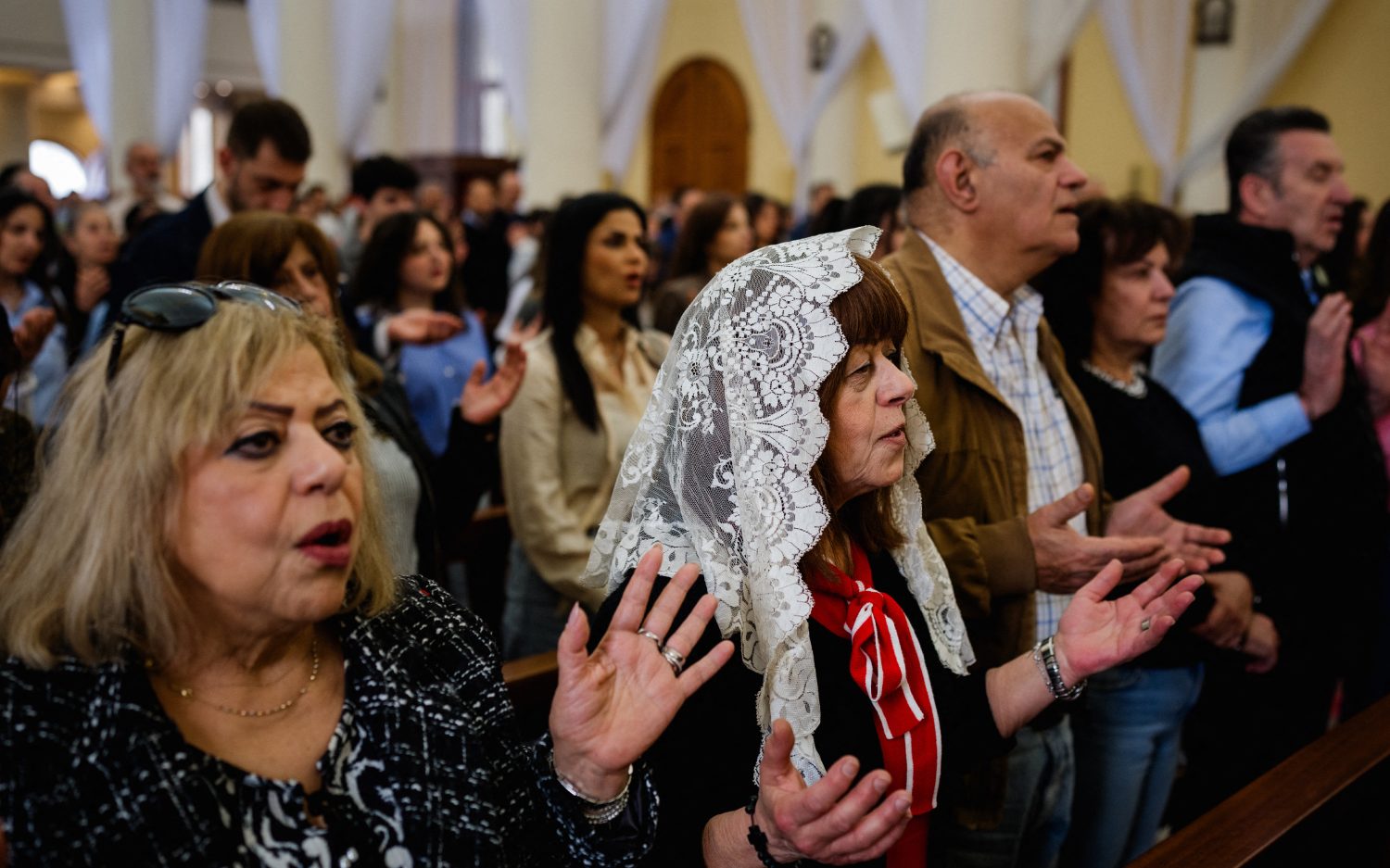
Lebanese Maronite Christians worship at the Saint Antoine Church in Beirut on April 5. Getty Images / Photo by Dimitar Dilkoff / AFP
More than 12,000 people, including Christians, Druze, and Israelis, got on X earlier this year for an online discussion titled “The Cedar Accords.” On the live audio feed, attendees discussed what a peaceful Lebanon with ties to Israel could look like.
“Lebanese Christians have never been historic enemies of the Jewish people and Israel. In times of shared dangers, we have stood as allies,” the meeting host said during the introduction. She and other online attendees hid their identities due to concerns of Lebanese government reprisal.
Similar sessions have continued throughout the year. Some attendees are members or supporters of a newly formed advocacy group called Mount Lebanon Transitional Council, which promotes a long-term vision to restore Mount Lebanon as a safe haven for indigenous Christians while advocating for a peaceful coexistence with Israel. Led largely by members of the Lebanese diaspora, the movement hopes to revive Mount Lebanon’s historic Christian heartland and encourage Maronites, an Eastern Catholic community historically centered in Lebanon, to return from exile. But some critics say the group’s efforts are getting ahead of the political reality in Lebanon.
After decades of the country’s civil conflict and enmity with Israel, which the Transitional Council says outside actors forced on Lebanese Christians, the group believes it is time to separate from the Shia and Sunni factions inside Lebanon. Lebanon’s sectarian political system divides power among the country’s religious groups. With Shiite Hezbollah’s grip on the country significantly weakened, the Council sees an opportunity to pursue an independent future for Mount Lebanon.
Mount Lebanon, a mountain range parallel to the eastern Mediterranean coast, was historically a center of Maronite life and existed as a semi-autonomous region within the Ottoman Empire. Maronites have been indigenous to the region for centuries, tracing their history back to a fourth-century monk named Maron. Today, the 77th patriarch leads a worldwide Maronite community that remains in communion with the pope and whose followers number in the millions, most of whom live outside Lebanon, including large communities in the United States, Canada, and Latin America. Mount Lebanon is now also a governorate of Lebanon, enveloping its capital, Beirut.
The idea of encouraging Christians to remain in Lebanon—or to return to it—has historical precedent. After the defeat of the Ottomans in World War I, France established Greater Lebanon in 1920. In a 1926 letter to French Prime Minister Aristide Briand, Maronite Patriarch Elias Hoayek lamented the emigration of Christians from southern Lebanon and described the founding vision of the Lebanese state as providing “a refuge for all the Christians of the Orient.”
Clay Hanna, 48, a U.S.-born founding member of the Transitional Council, said he feels a responsibility to carry forward older advocates’ vision for a free, autonomous, and independent Mount Lebanon. He believes Lebanon is at a crossroads. “We see the necessity for a separate, independent, self-governing Mount Lebanon,” he said. “Many Lebanese people want peace.”
A May 2026 poll from the Beirut-based International Information Co. found strong support among the country’s Christian and Druze communities for ending the Israeli-Lebanese conflict but less support for developing normal diplomatic, economic, and cultural ties. The poll showed that 77% of Maronites and 72% of Orthodox Christians backed a peace agreement, compared with 58% and 49%, respectively, who supported normalization. Among Druze, 84% supported peace and 79% approved of normalization.
Hanna argued that, in order to create a prosperous, secure, and peaceful country, leaders cannot partner with groups holding to totalitarian ideologies committed to the destruction of Israel. He wants to see Lebanon free of foreign-linked actors like the Iran-backed Hezbollah and the Palestinian Islamic Jihad, among others. These groups have violated Lebanon’s sovereignty, using it as a staging ground for attacks on Israel.
The council intends for Mount Lebanon to build a positive relationship with Israel that could include security coordination and economic ties. The Maronites, like the Jews, are indigenous to the region, Hanna explained, and they have traditionally acknowledged Israel’s right to exist and flourish. “We want to counter the invasion and colonization from the Muslim world,” he said.
Henri Zakaria, 44, leads the Maalto project, which promotes Maronites returning to their ancestral homeland and reviving their liturgical, Syriac-Aramaic language. “I want to bring my people back to Mount Lebanon,” he explained. The project operates an online program and a language center in Lebanon, but the work poses risks. Zakaria said Lebanese authorities arrested one of the project’s workers in Lebanon multiple times after the worker met with Maronite Christians from Israel at a 2018 language convention in New York. Zakaria mistrusts the Lebanese government, arguing it caters to Hezbollah’s wishes.
Zakaria’s team is prepared to welcome and provide Aramaic instruction for families moving to Lebanon. For now, the group waits for the security situation to improve. The Israel Defense Forces is still actively dismantling Hezbollah terrorist infrastructure in the south, and the U.S. government has maintained the highest-level travel advisory for Lebanon, warning Americans not to travel there.
Danny Burmawi, CEO of the Washington, D.C.-based Ideological Defense Institute, is skeptical of the Transitional Council’s strategy on relations with Israel. “They are skipping a crucial step,” he said. “The Christians in Lebanon should protect themselves from the Sunni-Shia war and focus on demanding a state.”
The group should forget about Israel for now, Burmawi argued. As long as it focuses on Israel, he said, many people will see the group as traitors, dooming the movement. He argued that Islamic countries with ties to Israel have been able to maintain those relationships because they have strong, dictatorial governments. But in Lebanon’s government structure, with equal representation for Muslim and Christian leaders, its Christian political leadership has faced challenges from the beginning, he pointed out.
Tom Harb, 67, is a Lebanese businessman and co-director of the American Mideast Coalition for Democracy. Lebanon’s Christian political parties are not ready for a self-governing state, he argues, and neither is the church. “The [council’s] theory is good, but we need the Lebanese Christians on the ground,” he explained.
Rather than focusing on Mount Lebanon, Harb believes forming a confederation is the best solution: Christians from Lebanon and Syria, Druze from Syria, and Alawites from Syria would form what he called a “beltway,” or corridor, and build ties with Israel. “But our first priority is to dismantle Hezbollah,” he said, adding that Lebanon should stop embedding Hezbollah in its institutions. “Then, after 10, 20 or 30 years, we can have new elections and better relations with Israel.”
Harb said U.S. Secretary of State Marco Rubio understands the situation well. On June 26, Rubio said the U.S.-Israel-Lebanon framework signed in June established a process to “restore Lebanon’s sovereignty, disarm Hezbollah and dismantle its infrastructure.” Rubio has also called Lebanese people “victims of Hezbollah.”
But Hanna and Zakaria are not willing to wait until the political situation changes. They are eager to get to work. “We have hundreds of people working on it, every day, week to week,” Hanna said. He claims the movement has thousands of supporters and is “ready, willing and able to govern,” with the first families ready to move to Lebanon as soon as the security situation allows.
Meanwhile, Zakaria said the language program is drawing people who want to reconnect with their Maronite heritage: “It is a success already.”
—This story has been updated to include several additional paragraphs that were inadvertently omitted from the original version.


These summarize the news that I could never assemble or discover by myself. —Keith
Sign up to receive World Tour, WORLD’s free weekly email newsletter on international news.
Please wait while we load the latest comments...
Comments
Please register, subscribe, or log in to comment on this article.