
Q&A: Jacob Dallal on Israeli election results, war rumors, and the Arab vote
Political analyst Jacob Laviel Dallal breaks down what the results tell us—and what comes next.
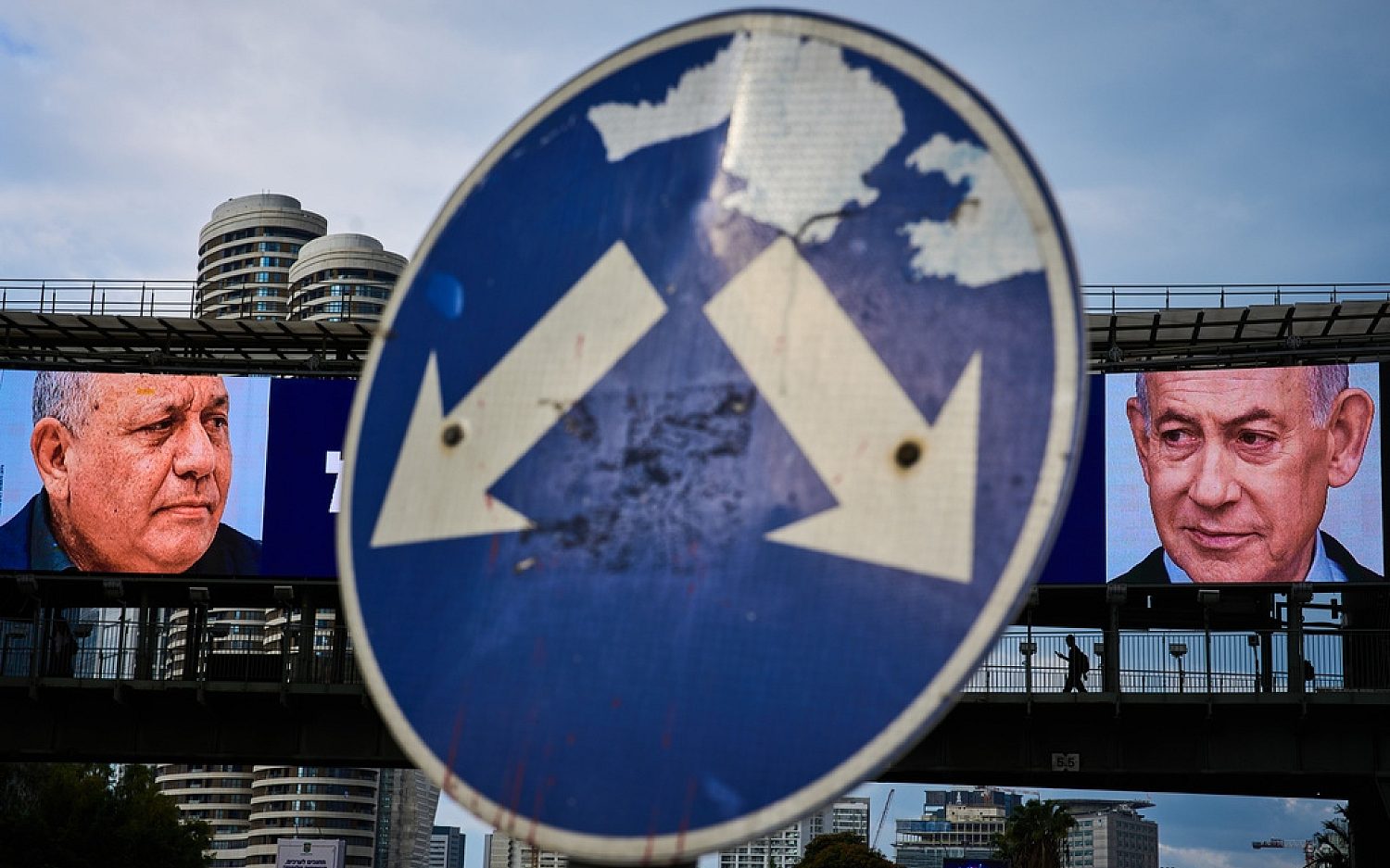
An advertisement featuring opposition candidate Gadi Eisenkot and Israeli Prime Minister Benjamin Netanyahu prior to the election Associated Press / Photo by Oded Balilty
These questions and answers were edited slightly for length and clarity.
JERUSALEM—Israelis turned out in record numbers Tuesday night to vote in their first election after the massacre of Oct. 7, 2023. Exit polls on Tuesday showed a tight race between Prime Minister Benjamin Netanyahu’s Likud Party and the Yashar! Party, or Straight! Party, headed up by Gadi Eisenkot, with official results still coming in on Wednesday. WORLD spoke to Israeli political analyst Jacob Laviel Dallal about what the numbers show, who the next prime minister may be, and how the prospect of renewed military conflict with Iran might affect Israeli politics.
Let’s start with the big question on everyone’s minds in the United States. Based on the numbers we’re seeing, who is most likely to be Israel’s next prime minister? Israelis also want to know who’s going to be the next prime minister, so we’re there as well with the uncertainty. So, in other words, we don’t know. There are two important takeaways from the election: Netanyahu did much better than people thought. His bloc has more seats—is projected to have more seats—than the opposition bloc. So the pro-Netanyahu camp is larger than the anti-Netanyahu camp, but it still does not have enough seats to form a majority.
So there is going to have to be some sort of compromise. And this is where it gets interesting, because neither side has enough seats to form its own government. So they need something to move from the other side, and that’s where the answer lies. What’s going to shift? We don’t know.
What about this election has surprised you so far? Two big surprises. One is the strength of the Likud; It did much better than the projections. And the second thing is the strength of the Arab parties. There was a very large voter turnout in the Arab sector—much more than usual. And that brought a gain in the number of seats held by Arab parties. Again, everything is subject to change, but currently they stand to gain 19 seats out of 120 in the Knesset. So that’s a huge deal, because that’s a big chunk of votes and seats. So, obviously, when you take those away, the possibility of either Netanyahu or the opposition reaching a majority without the Arab parties becomes very, very difficult.
What do you think brought the Arab-Israeli voters out in such large numbers? I think they wanted to show that they have a voice, and I think that that’s important. They also disliked Israeli Minister of National Security Itamar Ben-Gvir, who is part of the current government coalition. He’s very antagonistic towards the Arab population in general. So they wanted to show him that they responded to his antagonism by going to the polls.
It’s also, in a way, a positive development. Generally, there was lower voter turnout in the Arab sector because they simply weren’t interested in Israeli politics so much. But it turns out that they are becoming more interested in having their voices heard and in participating in the political system.
Based on the exit polls, how deeply divided are Israeli voters? They’re very divided. This election in particular was a “Yes, Bibi” or “No, Bibi” election. The parties were clearly aligned in either the camp in favor of Netanyahu, or the camp against Netanyahu. And they spoke. And the camp in favor of Netanyahu is greater in number than the camp against Netanyahu. That seems to be the result of the election.
How did the 77.7% voter turnout compare with previous elections? It was unprecedented in the sense that it was the largest in this century. So, people really cared on both sides—on all sides, I think—and that’s good. I mean, I’m glad that people were expressing their views in the ballot box, and so that sort of gives the result a little bit more weight in the sense that this is the voice of the people. And it’s a lot of people.
Israel doesn’t allow for absentee voting. Tell me about the number of Israelis living abroad who flew home just to vote in this election. Do we have a handle on the numbers? There were up to 100,000, which is huge. We don’t actually have a number of those who came specifically to vote, but we know the number of Israelis who live abroad who are now currently in Israel. That’s from the Ministry of the Interior. So, I think the number is close to 100,000, although in the last election, there were also about 70,000. So you see the difference.
What issues most motivated Israeli voters? Obviously, the security situation with the Oct. 7 attacks and the subsequent wars. So the security situation is top of mind. But also the blunder of Oct. 7: Were the wars prosecuted in the best possible way? I think most people, certainly the people who were in favor of Netanyahu, do feel that, militarily, Israel did a reasonably good job in the aftermath. The other thing was the ultra-Orthodox participation in the army. That was a huge, huge, huge issue, and a very divisive issue. It remains a divisive issue, and it’s no closer to being resolved. And then after that, I think come issues like the cost of living, which is exorbitant here.
What are we going to see play out over the next few days and weeks? In the next day or two, basically, the final tally will become very clear because we will have about 70% of the precincts reporting. And then they count the votes of IDF service members and other votes that aren’t immediately available. So the next few days will get actual results, and again, even a small shift can make life more miserable or better for some of the parties. Then the question is, who will the majority of the parties recommend to the president to ask to form a government? That’s the next step. Each party comes to the president and says who they recommend. So they’ll either recommend Eisenkot or Netanyahu.
The problem that Netanyahu has is that the Arab parties are likely to recommend Eisenkot, and if they do, Eisenkot will have the majority of recommendations to try to form a government. But that’s a blessing in disguise: He doesn’t have the numbers to do so without Netanyahu. So even if Eisenkot is given the mandate, which is possible, it’s almost impossible for him to succeed. And then the mandate will go to Netanyahu, who will also have a huge, huge hurdle because he also doesn’t have the required number, and he’ll need someone from the opposition to join him under some terms.
So you think there’s a good chance that Eisenkot may be given the mandate first to form a majority government? He definitely could be. But again, what he does with that is difficult to know. So it’s really uncharted territory. They had been hoping, and the whole opposition plan was, “OK, we might not get the number of votes needed, but we’ll get enough, and then the Arab parties will recommend us.” That was their plan. But now, that plan can’t work. That won’t be a majority. So I don’t know how Eisenkot forms a government.
Suppose the person with the mandate to build a coalition fails to do so. What happens next? Then it goes to the other person. In other words, if it starts with Eisenkot, he has a month and then a two-week extension—so let’s say 45 days. If he fails, then it goes to Netanyahu, and then Netanyahu has another 45 days. If he fails, then what happens is it goes back to the Knesset. If the parties are able to form a coalition, they form the government without necessarily one of the two being the prime minister, because they’ve already tried. And if neither is able, which is more likely, we hold another election.
Here in Israel, I’ve been hearing talk of the possibility of renewed military action against Iran after the Nov. 3 U.S. midterm elections. How might that play into the proceedings? It will play into it, and it’s, in my view, very likely. People here are so absorbed with the election that they’re forgetting that there might be a war in a week if they check their calendar. But that will create a sense of urgency, and that will push the two sides toward a unity government. Because if there’s a war, all the more you want to have the two biggest parties, one led by Eisenkot, who’s a former chief of staff, together with Netanyahu, running the war.


These summarize the news that I could never assemble or discover by myself. —Keith
Sign up to receive World Tour, WORLD’s free weekly email newsletter on international news.
Please wait while we load the latest comments...
Comments
Please register, subscribe, or log in to comment on this article.