
Netanyahu is up for reelection. Here’s how the voting works.
Israel holds elections one week before the United States, with the outcome set to determine Prime Minister Benjamin Netanyahu’s political fate.
Yarmulkes bearing images of Israeli National Security Minister Itamar Ben Gvir, left, Israeli Prime Minister Benjamin Netanyahu, right, and U.S. President Donald Trump are displayed in a Jerusalem market ahead of Israel's general election, Wednesday. Associated Press / Photo by David Goldman
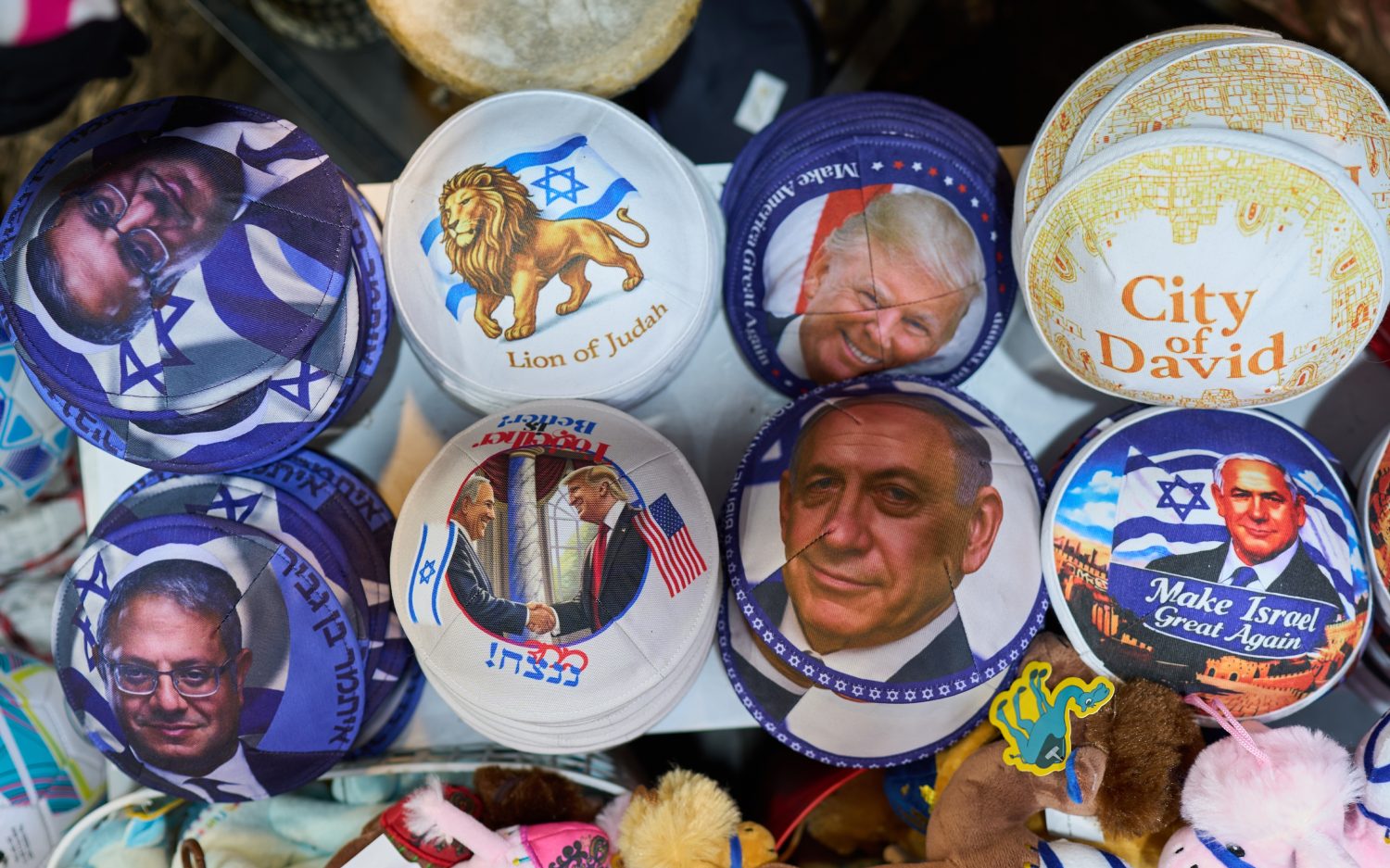
TEL AVIV— Israelis at the polls on Tuesday, Oct. 27, face a pivotal choice: continue the current government led by Prime Minister Benjamin Netanyahu, or turn the page with a new government, likely led by a dark horse candidate.
Political commentator Nadav Perry, host of Israel’s popular Nadav Perry Podcast, calls it the most influential and important election in decades. He says that’s because it’s the first time voters will cast their ballots since the massacre of the Oct. 7, 2023, terror attacks.
“This fact alone makes these elections more important than everything, because we have never had Oct. 7,” Perry said. “We have never had such a disaster, and therefore, it is easy to understand why it is so important for Israel … to see what is the verdict of the people three years after this disastrous day.”
With Israel recently involved in conflicts with the terror groups Hamas, Hezbollah, the Houthis, and Iran, voters will have plenty on their minds when they head to the polls. But voting in Israel is dramatically different than in the United States.
Pick your party
In Israel’s parliamentary system, voters cast ballots not for candidates but for parties. Whereas the United States typically has a binary party system—represented mainly by Republicans and Democrats—the Israeli political system boasts dozens of parties of varied sizes. Some form and dissolve quickly.
Each party submits its list of candidates it would like to fill the 120 seats that make up the Knesset, the Israeli parliament. Voters select the party list of their choice, seal it in an envelope, and place the envelope in a ballot box.
Based on Israel’s current population, a party must meet a threshold of at least 3.25% of the vote to win four seats in the Knesset—any vote totals under that threshold are discounted. If a party wins 12 seats, that means the first 12 names on its party list will become members of the new parliament.
All voters are required to show valid identification. There is no absentee voting: Israelis must vote in person.
“So many Israelis are buying flying tickets in order to participate in the most important elections in our lifetime,” Perry said.
Additionally, Israel only uses paper ballots. Each is counted by hand.
“The good news is you can’t tamper with them,” says political commentator Jacob Laviel Dallal. He oversees the Elizabeth and Tony Comper Interdisciplinary Center for the Study of Antisemitism and Racism, a Haifa-based think tank. “It is as primitive as it gets. I mean, there’s no ‘hanging chads’ here. You don’t have to press a lever. You don’t have to poke any holes. You just take a little piece of paper and put it in an envelope. So it’s probably not the most ecological thing, and the envelope industry is doing a little bit better this month.”
Prime Minister Netanyahu is hoping to retain his position after this election. He heads up the right-leaning Likud Party. His main challenger appears to be Gadi Eisenkot, the leader of the Yashar! Party, which describes itself as center-right and liberal Zionist.
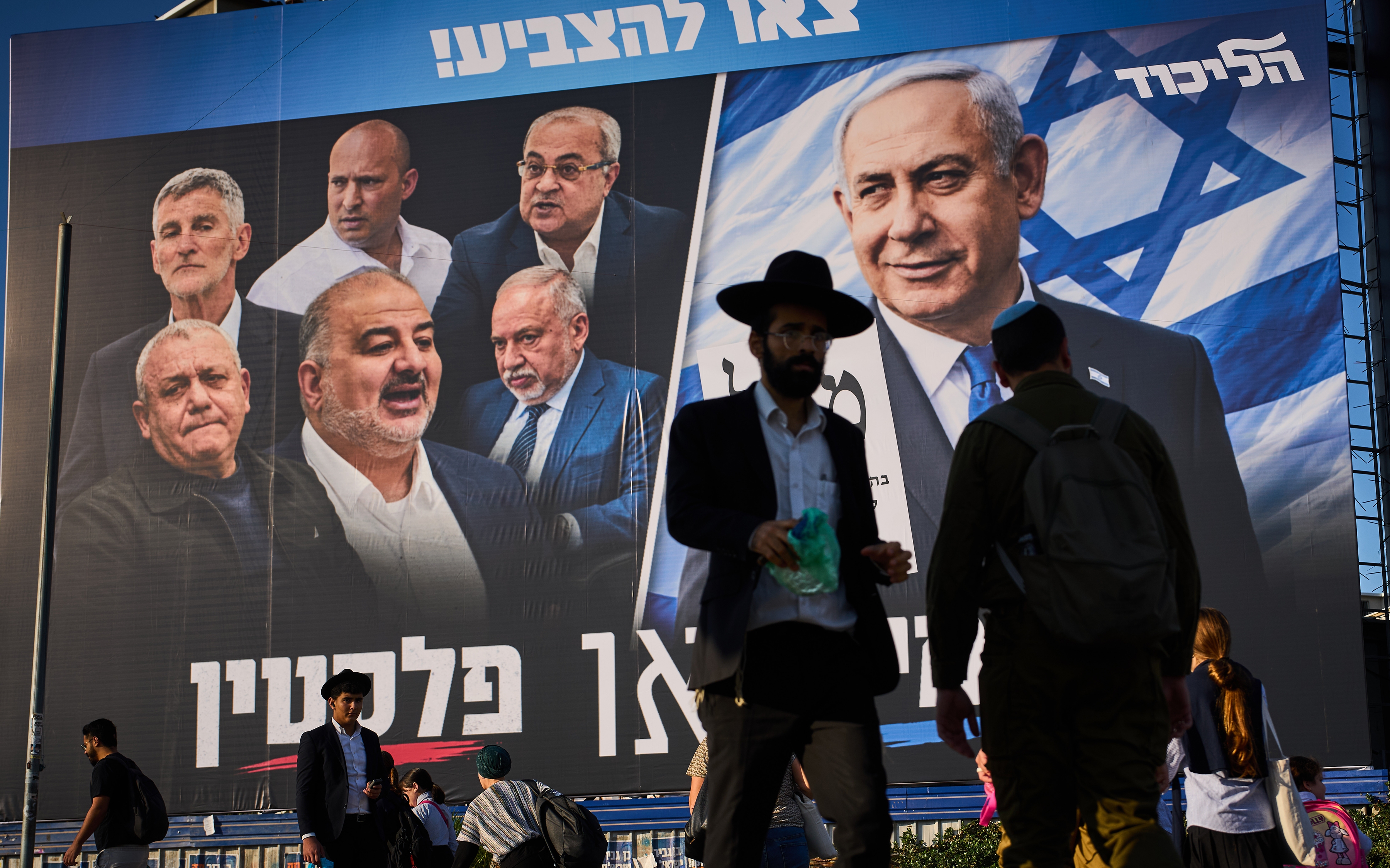
People walk past a Likud party campaign billboard featuring Israeli Prime Minister Benjamin Netanyahu alongside opposition party leaders and bearing the Hebrew slogan “Right or Palestine,” ahead of Israel's general election, in Beni Brak, Israel, Sunday. Associated Press / Photo by Oded Balilty
Oct. 7 in hindsight
It’s difficult to overstate the effect the Oct. 7 attacks are having on this election, according to Perry. The sheer brutality of the massacre, combined with the surprise nature of the attacks, led many to view the incident as a colossal Israeli intelligence blunder. That has some calling for an independent commission to investigate what led up to the attacks.
“It would be obvious that after such a catastrophe, there would be a formal state commission to fully investigate the events, but unfortunately, there wasn’t,” Dallal said. “There isn’t as of now. Three years later, there is no commission, not state, not national, not formal, not informal.”
The lack of an investigation has energized those who would like to see Netanyahu displaced, as many blame the current prime minister for the failure to predict the attacks. Eisenkot has pledged to launch a commission in the early days of his government, if elected.
But Netanyahu insists such an investigation can only take place after the war has ended, arguing it would be irresponsible to call officials to testify when their time is needed for the war effort. Instead of a purely independent commission, he proposed in August a commission made up of political appointees, half chosen by his own political coalition and half by the opposition. He said such a commission would be modeled after the investigation held by the United States after the Sept. 11, 2001, attacks. But that commission should only meet after the war is over, according to Netanyahu.
The controversy over conscription
Another issue that’s top-of-mind for voters is the ongoing exemptions from mandatory military service. Most Jewish Israelis—male and female—are required to serve a two-year term in the Israel Defense Forces. But members of ultra-Orthodox groups, known as Haredi Jews, are often exempted. They argue they can’t be required to serve because they have to spend their time studying Torah.
“It started as 400 individuals [who] were exempted,” Dallal said. “Now a number like that, no one would have a problem with. Only over the time it mushroomed to about 100,000. That’s a big problem.”
In the past, Netanyahu has sided with the ultra-Orthodox Jews, calling it a matter of conscience and a religious freedom issue. The controversy came to a head on Tuesday, when 42 ultra-Orthodox Jews were arrested at Ben Gurion Airport on charges of draft evasion, according to a report by The Times of Israel. Forty ultimately went free after signing affidavits saying they were willing to enlist, while two were jailed for allegedly evading the draft for an extended period of time, according to the Times.
Netanyahu on Tuesday called the arrests unacceptable, according to reporting by The Jerusalem Post, citing an interview the prime minister gave to Kol Barama, a radio news outlet. Netanyahu went on to say that Torah study should be preserved, but anyone not studying Torah should enlist.
The prime minister’s critics say he’s bowing to the ultra-Orthodox to win a sizable voting block. That puts him at odds with some of his more reliable conservative voters, according to Perry.
“Because they know he will go immediately with the ultra-Orthodox, while their kids are serving in the military,” Perry said. “For Bibi, it is a real issue that jeopardizes his odds for reelection.”
Eisenkot, in contrast, has called for universal conscription, limiting exemptions for the ultra-Orthodox to only 3% of the top Torah student prodigies.
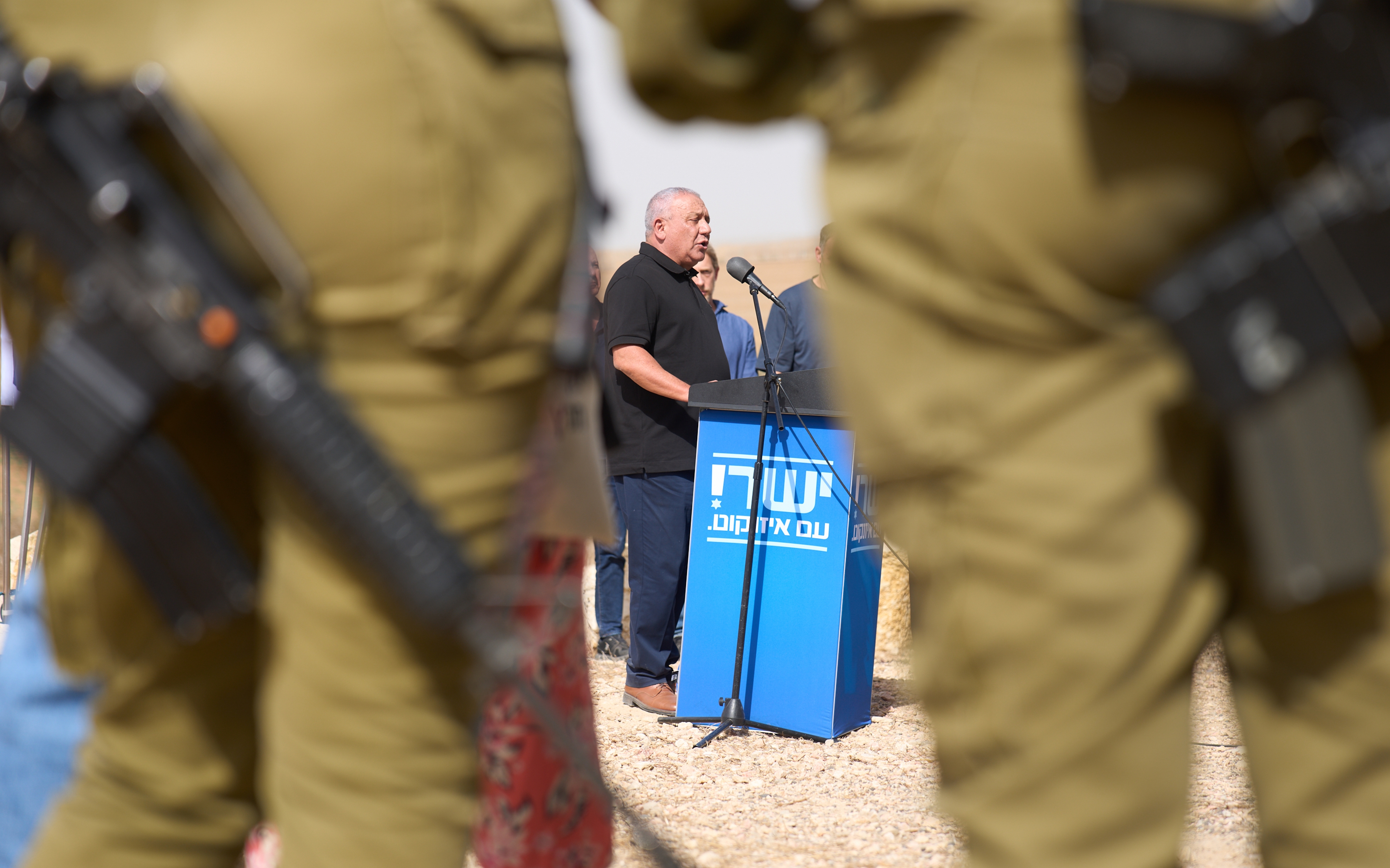
Gadi Eisenkot, former Israeli military chief of staff and leader of the Yashar party delivers a statement ahead of Israel's general election near Israel-Gaza border, southern Israel. Associated Press / Photo by Ariel Schalit
Political prowess
Of the two leading candidates, Netanyahu emerges as the stronger leader in terms of political prowess, charisma, and longevity. Having spent an accumulated 18 years in office, he is Israel’s longest-serving prime minister.
“Bibi’s strengths are pretty clear,” Dallal said. “He’s exceptionally intelligent. He’s exceptionally politically skilled and, you know, he has a lot of experience.”
He’s also viewed as tough on foreign policy, taking a firm, preemptive approach to national security, as exemplified by Israel’s involvement in the ongoing war with Iran. And he has the attention of the international community, including President Donald Trump, who on Oct. 18 publicly endorsed Netanyahu, calling him strong, brave, and brilliant in the face of opposition.
“This is the first time in the history that the president of the United States is endorsing, outspokenly, a candidate,” Perry said. “It is very good news for Netanyahu because it emphasizes his advantage.”
But both Perry and Dallal agree it’s too early to calculate the exact effects of Trump’s endorsement. Dallal said the endorsement will likely strengthen Netanyahu’s appeal to his already faithful supporters, but voters who are moved by a desire for change will likely assume that “another prime minister would also get along [with Trump] very well.”
Another point Perry and Dallal agree on is that Eisenkot’s public persona varies dramatically from Netanyahu’s.
“He is blank,” Perry said. He is not a charismatic person. He is not a man of words, is not a man of enthusiastic speeches or any kind of high charisma persona, is very ordinary.”
“He’s a little bit of an unlikely candidate,” Dallal added. “He doesn’t on the face of it seem very [like] someone who is very competitive, but he has a quiet perseverance.”
Delayed resolution
Even after all of the votes are cast and tallied, it could be weeks after Election Day before voters know who the prime minister will be. No single party has ever won a 61-seat majority in Israel’s parliament. That means that even if Netanyahu’s Likud Party, or Eisenkot’s Yashar! Party comes out ahead, they will have to cut deals with other parties in order to form a coalition to seize the majority.
That’s a task that could take days, even weeks. And it often involves humility and compromise.
“It is not just arithmetics,” Perry said. “It is also personal. It is also political. So therefore, it is very reasonable to assume that we will have the final results of the election, but we still won’t have an idea of the identity of our next prime minister.”
After the election, Israel’s president has seven days to choose the likely front-runner for prime minister. After that, the front-runner has 28 days to form a coalition. Should he fail to do so, the government remains as-is, and another election is held 90 days later.
Regardless of what happens in the coming days and weeks, Dallal said this election is overshadowed by the horror of the Oct. 7 attacks, and that will profoundly shape how voters cast their ballots.
“This was a major traumatic event, and it’s something that will take years for Israel to process. We’re still in the middle of it,” he said. “It’s definitely not fully behind us, nor are its ramifications fully behind the region. The dust is still to settle.”


These summarize the news that I could never assemble or discover by myself. —Keith
Sign up to receive World Tour, WORLD’s free weekly email newsletter on international news.
Please wait while we load the latest comments...
Comments