
Moral choices on the ballot
Virginia religious groups lead courtroom fights against proposed constitutional amendments addressing abortion and gay marriage
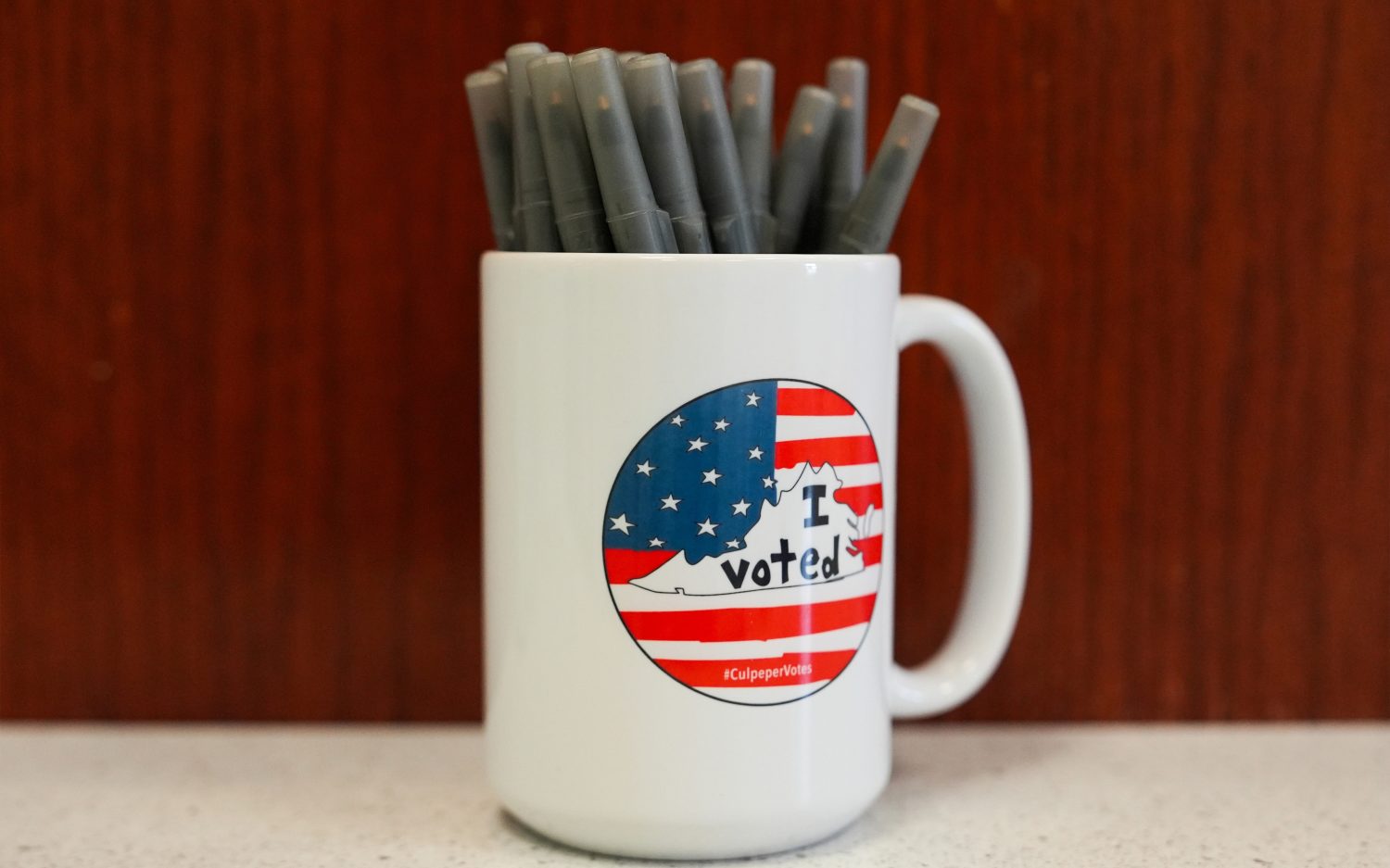
A mug holds pens at the Culpeper County Voter Registration office in Culpeper, Va. Associated Press / Photo by Julia Demaree Nikhinson
Next week, Virginians will vote on ballot measures that could undo protections for mothers and unborn babies and redefine marriage to include same-sex couples.
The state legislature placed the amendments, Virginia Questions 1 and 2, on the ballot—a process that takes two successive years. In that time, religious groups got to work, spreading the word and backing a handful of pending lawsuits that could potentially nullify the amendments even if voters pass them. Some of the suits focus on procedural steps, while others oppose language the groups argue is misleading. But with both amendments still on the ballot, voters will get to decide what the legal battles look like after Election Day.
Victoria Cobb, president of the Christian nonprofit Family Foundation of Virginia, oversees the organization’s legal arm, the Founding Freedoms Law Center. In April, the center filed a lawsuit to confront the language on the abortion-focused amendment, Question 1. It argues the text on the ballot neglects to inform voters of safeguards it would overturn and instead focuses on promises of prenatal and miscarriage care. Cobb compared it to hiding a dog’s pill in peanut butter.
“Unlike a lot of elections, we aren’t simply up against convincing Virginians to vote no because they agree with us on abortion. In this case, we’re up against an information game,” said Cobb. “This isn’t simply codifying [Roe v. Wade] or keeping Virginia law as it is today. Our job is to inform voters that we’re actually removing the very few parameters we have around the abortion procedure now.”
Current Virginia law allows abortions within a woman’s first and second trimester but protects against third-trimester abortions except under certain strict circumstances. The new amendment would roll back some of those protections and allow any third-trimester abortion if a physician deems it necessary for protecting a patient’s mental or physical health.
The amendment also uses vague language surrounding an “individual,” which Cobb says would allow minors to seek abortions without parental consent. “It is giving the right to an abortion to our daughters and our granddaughters,” she said. “Parents will no longer be able to be a required sounding board for those young girls. They, by law, can undergo an abortion, which certainly takes the life of their unborn child, but also impacts the rest of their lives.”
A circuit judge, who ruled a redistricting amendment unconstitutional on similar grounds, is scheduled to hear arguments for the Question 1 case on Nov. 13.
In addition to its legal work, the Family Foundation has hosted over 300 events to raise awareness surrounding the amendments across Virginia just this year, Cobb said. The group also leads door-knocking and student advocacy work, and Cobb said they’ve spread the word to at least 1,700 Virginia pastors.
One such pastor is now a plaintiff in one of the Founding Freedoms Law Center’s pending legal cases. Ben Purves from Occoquan Bible Church in Woodbridge, Va., challenged amendment Question 2, which would change the state’s definition of marriage, in a lawsuit filed by the Founding Freedoms Law Center last week. The suit objects to the amendment on procedural grounds—arguing that officials bypassed essential requirements to place the question on the ballot. Purves says that the clerk of the House of Delegates neglected constitutional duties to distribute copies of the amendment to Virginia’s circuit courts and to make a second copy available for public inspection three months before the state legislature’s general election.
While it is not part of Purves’ case, some also raise the argument that the amendment’s language, which affirms that two adults may marry regardless of “sex, gender, or race,” could carry unanticipated legal implications.
“It changes everything because gender is a social construct,” said Lynne Marie Kohm, a professor of family law at Regent University School of Law in Virginia Beach. “It’s not a biological or natural, or a legal, position. It’s a social construct, and it changes with the individual. It’s extremely subjective.”
Purves echoed this concern and more in an open letter he authored, “From Virginia Pastors to the Commonwealth,” which over 400 Virginia pastors have signed.
“We want to see the Lord honored in how Christian churches walk in this day, when it comes to these political issues,” Purves told me. “We hope that this is an example to others to also stand for the sanctity of life and marriage, to take theology seriously and bring it into the public square. … It’s right that the church proclaims that Christ is Lord over all things and that we don’t let the churches become sidelines from public discourse in our nation.”
A case similar to Purves’ is also pushing against the pro-abortion ballot item, with Liberty Counsel, a Christian ministry, arguing that Virginia officials failed to follow the constitutionally required process to place Question 1 before voters. Like Purves, Liberty Counsel says officials skipped mandatory steps in the distribution of the amendment’s text.
Lawmakers sought to roll back the requirements in question earlier this year, but their repeal did not take effect until July 1—months after Liberty Counsel filed its March suit. Now, Mathew Staver, founder and chairman of Liberty Counsel, argues that Virginia law doesn’t allow this kind of retroactive repeal.
“The implications of this legal fight moving forward really is life and death,” said Staver. “Certainly there’s a constitutional issue. Obviously, there’s the right of the people to be able to be informed and to vote so that they can affirm or move out these individuals who placed this before them. But I think the bigger issue is the fundamental right to life in the future of our nation as well as the Commonwealth of Virginia.”
Kohm compared the procedural issues facing the pro-abortion and marriage amendments to the argument that ended a redistricting fight in Virginia earlier this year. Virginia voters approved a constitutional amendment to gerrymander Virginia’s congressional districts in favor of Democrats in an April special election, but in May the state Supreme Court nullified the amendment due to procedural problems.
“Our current leaders are not impressive in understanding how Virginia law works,” said Kohm. “It’s quite complicated and intricate, and they kind of bumbled that badly. And they’re kind of doing the same thing here.”
With several legal battles in play, and the election just days away, the Family Foundation is keeping busy, hosting a town hall in Virginia Thursday night. Virginia pastors, like Purves, are also staying involved, with a day of prayer and fasting on Nov. 3.
Even if Virginians pass both amendments, the pending lawsuits could nullify election results. But Cobb says the fight does not end there.
“Those of us that are in this movement will continue until we are saving unborn lives in our commonwealth,” said Cobb. “Right now, the trajectory is the exact opposite. … We will keep working until both the law and the cultural belief around abortion are changed.”


This keeps me from having to slog through digital miles of other news sites. —Nick
Sign up to receive The Stew, WORLD’s free weekly email newsletter on politics and government.
Please wait while we load the latest comments...
Comments
Please register, subscribe, or log in to comment on this article.