
Missouri pro-lifers hope to reverse a “parade of terribles”
Activists are racing to undo the state’s pro-abortion constitutional amendment
Pro-life advocates gather outside the Planned Parenthood clinic in St. Louis. Associated Press / Photo by Jeff Roberson / File
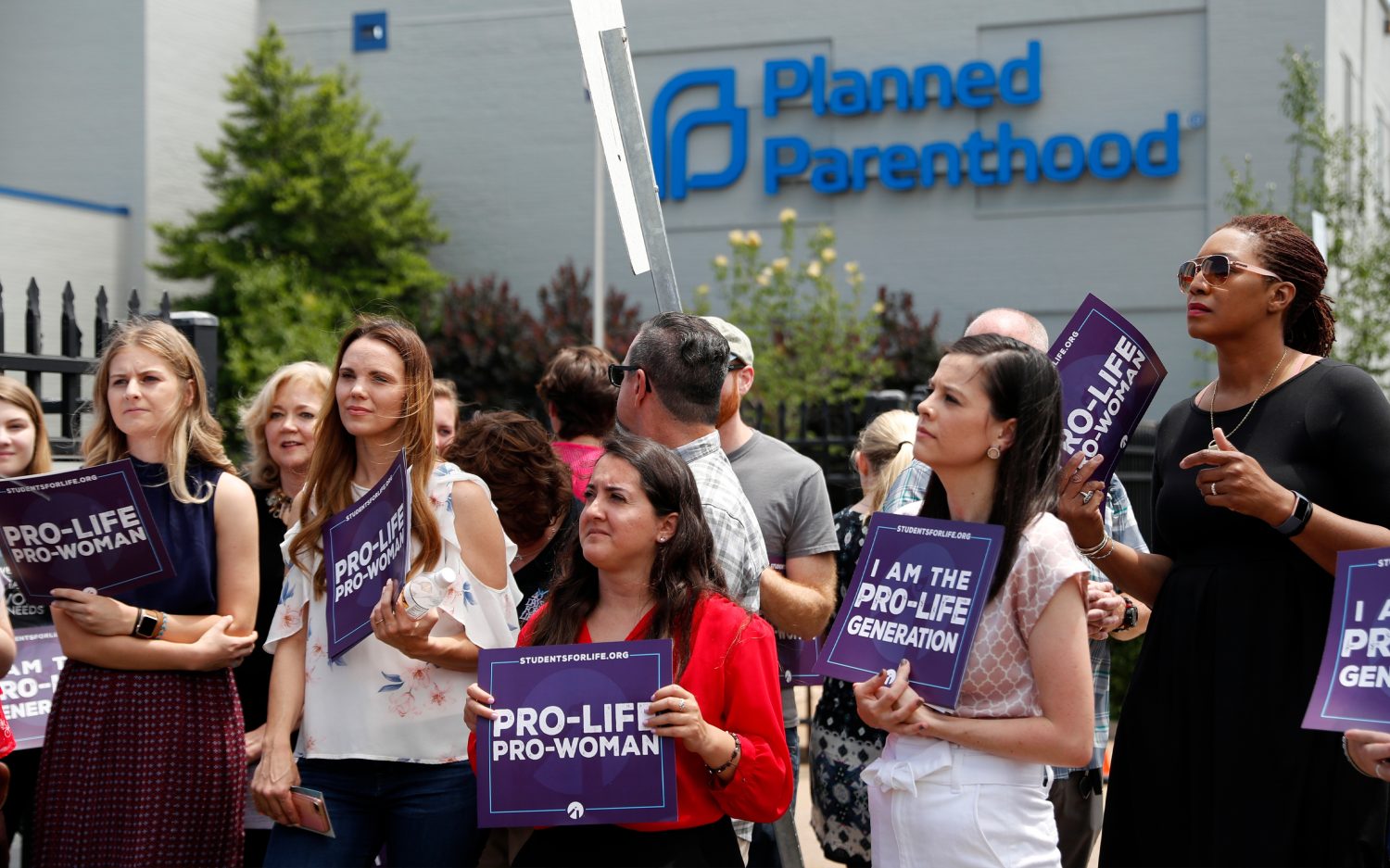
Pro-lifers in Missouri have been looking toward the 2026 midterms since November 2024, when 51.6% of Missouri voters narrowly passed a pro-abortion constitutional amendment.
“Even though the left poured in tens of millions of dollars to pass this so-called reproductive rights amendment in 2024, they still [only] narrowly passed it,” said Amanda Sanders, communications director for the pro-life Her Health, Her Future organization in Missouri.
Now, pro-lifers are working to turn back the clock.
Next week, Missouri voters will consider Amendment 3, which would reinstate protections for unborn babies that courts have stripped away over the last two years. It would also enshrine in the Missouri Constitution laws meant to protect children from transgender medical interventions. While opponents argue the proposal uses transgender issues to draw in voters that may otherwise favor abortion, supporters say both issues involve commonsense protections for women and children. And pro-lifers hope the election can prove voters still have the ability to rein in pro-abortion policies, even those inserted in their state constitution.
In April 2025, just less than six months after voters approved the pro-abortion amendment, legislators in both the Missouri House and Senate approved a resolution to amend the constitution again to repeal the right to abortion. According to state law, constitutional amendments proposed by either the General Assembly or by citizen petition must then go to the voters for consideration.
A poll conducted earlier this month by Remington Research Group showed the race is neck and neck, with about 14% of respondents saying they are undecided and the remaining 86% evenly split for and against the amendment.
Before the 2024 vote, the Show Me State protected unborn babies starting at conception. Missouri was one of the first states to enact its pro-life law after the U.S. Supreme Court’s 2022 decision in Dobbs v. Jackson Women’s Health Organization.
But in a wave of post-Dobbs state ballot initiatives, Missourians passed an amendment prohibiting the government from making laws that “deny or infringe upon a person’s fundamental right to reproductive freedom,” which the amendment defines to include both abortion and pregnancy care. Ahead of the election, pro-lifers focused their efforts on trying to stop the proposed amendment from getting on the ballot in the first place. But once it did, Sanders from Her Health, Her Future said they should have done more to convince voters to reject the measure. “We needed a unified voice,” she said.
The day after the election in 2024, Planned Parenthood asked a circuit judge in Missouri to block several pro-life laws that it said violated the new constitutional amendment. That prompted a monthslong legal battle that ended earlier this year when the judge struck down dozens of protections. “I don’t believe voters could see the parade of terribles that would follow this amendment,” Sanders said.
The judge blocked licensing and inspection regulations for abortion facilities, along with laws requiring abortionists to have admitting privileges to a local hospital in case a woman experienced a dangerous complication. “An abortion that’s not regulated is a back-alley abortion, and that’s what we have,” Sanders said. “That is not what Missourians voted on in 2024.”
The judge left in place requirements that only licensed medical professionals can perform abortions and that physicians must prescribe and administer chemical abortion drugs to women in person, not via telehealth.
While pro-abortion groups claim this year’s proposal simply aims to reverse the 2024 vote, pro-lifers argue it includes provisions that could appease some voters who feel the state’s original laws were too restrictive.
Missouri’s pre-2024 laws protected babies from conception except in cases of medical emergency. They also classified performing an abortion as a felony and stated that abortionists could lose their medical license. This year’s proposed amendment would not shield babies conceived in rape or incest until after 12 weeks of pregnancy. “This is the middle-of-the-road proposal that allows for some exceptions,” bill sponsor Republican state Rep. Ed Lewis told St. Louis Public Radio.
“Amendment 3 explicitly carves out exceptions for medical emergencies, ectopic pregnancies, and miscarriages, which we know are not actually abortion, but it does carve those out,” Sanders said. It also ensures parental consent for a minor to have an abortion, along with giving minors constitutionally based protections from transgender medical interventions.
In 2023, state lawmakers passed the Save Adolescents from Experimentation (SAFE) Act, which protects minors from undergoing sex-rejecting surgeries. The act also shields children under age 18 from receiving cross-sex hormones and puberty-blocking drugs, though that provision is due to expire next August after the legislature extended the expiration date from this September. But Sanders says that may not always be a reliable safeguard. “A mere change in the political winds could leave that vulnerable to be struck down,” she said.
Sanders also argues the constitutional amendment passed in 2024 could jeopardize the existing transgender-related protections like it did pro-life laws. The amendment created a “fundamental right to reproductive freedom” that includes “all matters relating to reproductive healthcare.” Sam Lee, director of Campaign Life Missouri, says that could be interpreted to include transgender interventions. “When you are changing children’s genital organs and doing surgeries—that affects their reproductive health, that affects their fertility,” he said.
Both pro-lifers and abortion supporters have gone to the courts to try to remove ballot items they oppose. Ahead of the 2024 election, pro-lifers sued to remove the pro-abortion amendment from ballots, arguing it was too broad and did not specify which state laws it would repeal. A lower court agreed with the pro-lifers, but the state Supreme Court reversed that decision, allowing the ballot measure to proceed.
Then, in July 2025, a St. Louis–area doctor sued the Missouri secretary of state over the proposed language for this year’s Amendment 3. She argued the amendment contained more than one subject by covering both abortion and transgender interventions and that the ballot language was misleading. Though a circuit court judge ordered the state to rewrite the ballot language and summary, the judge found that everything in the amendment related to reproductive health.
While pro-lifers have campaigned for Amendment 3 as a way to bring back commonsense protections for unborn babies, Lee said the protections against transgender interventions have attracted new support. The transgender measure brought in voices like Jamie Reed, a self-described lifelong Democrat who exposed how the Washington University Transgender Center at St. Louis Children’s Hospital pressured families into agreeing to transgender interventions despite little evidence of their effectiveness.
Reed has become a vocal supporter of Amendment 3. “I have liberals reaching out to me who are willing to find common ground and also vote yes on this because their families have been so impacted by gender and by trans,” she said on a St. Louis radio program. On Tuesday, Reed and national advocate and detransitioner Chloe Cole were scheduled to speak at a Missouri rally for the amendment.
Lee is encouraged to see voters and advocates who are motivated to protect children from transgender interventions speak up in favor of the amendment, but he said the election will come down to pro-lifers showing up at the polls. “It’s just not good enough to say, ‘Oh yeah, I’m with you,’” he said. “You got to vote with us.” Even among people who believe in protecting unborn babies, some say the new amendment does not go far enough and are planning to vote against it because it does not shield all babies.
Still, Lee hopes enough people will recognize the opportunity voters have to reinstate protections that have been stripped away. “A lot of states are facing this, either because of initiative petitions or pro-abortion amendments,” he said. “Can this give hope or guidance or both to other states? We hope so.”


I so appreciate the fly-over picture, and the reminder of God’s faithful sovereignty. —Celina
Sign up to receive Vitals, WORLD’s free weekly email newsletter on the pro-life movement.
Please wait while we load the latest comments...
Comments
Please register, subscribe, or log in to comment on this article.