
Lawmakers weigh AI risks amid a modern technology race
Republicans and Democrats in Congress have offered multiple proposals for reining in artificial intelligence, but they face a tough sell with President Trump
President Donald Trump, left, speaks to reporters with China's President Xi Jinping, right, at the White House, Thursday. Associated Press / Photo by Alex Brandon
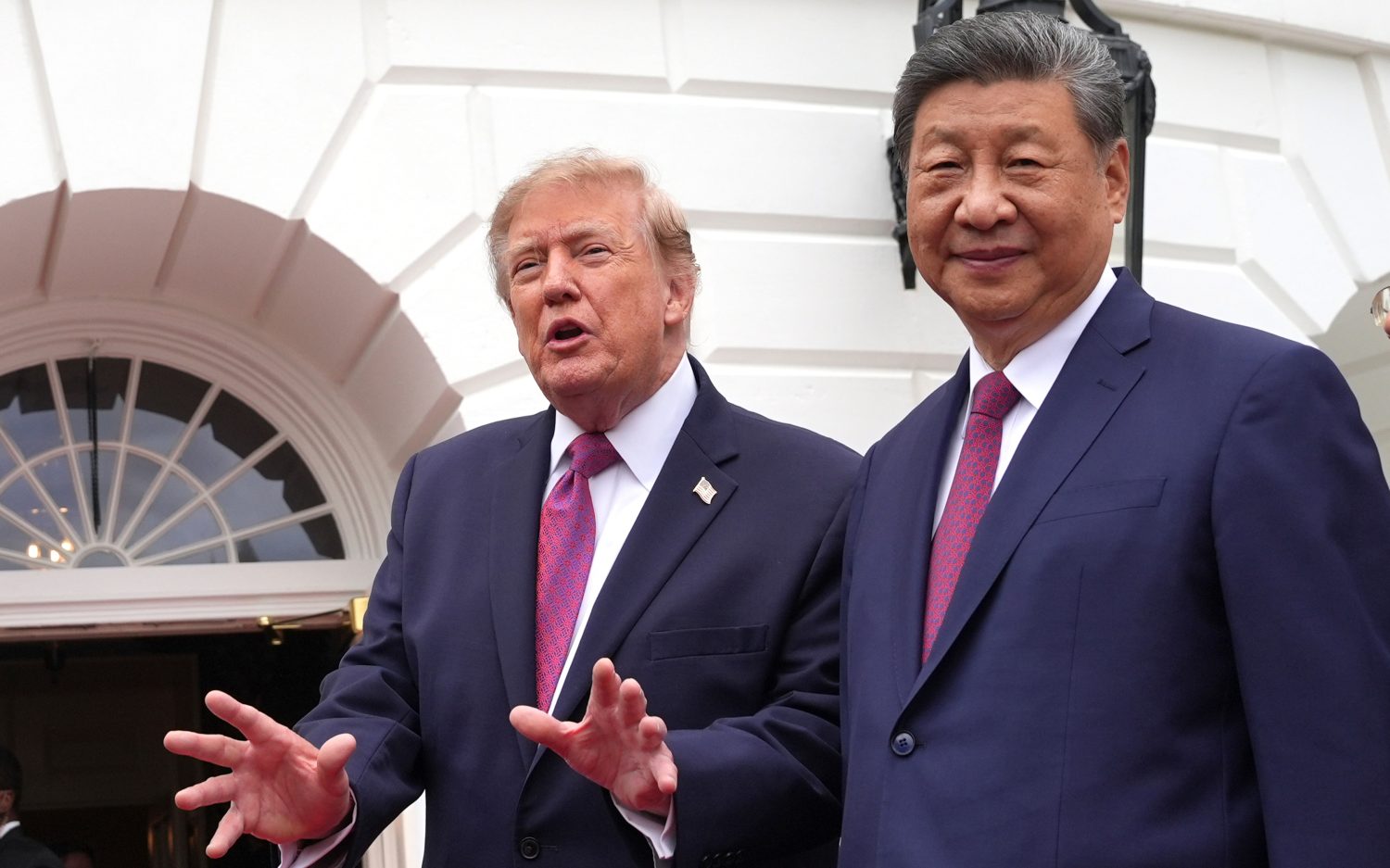
Chinese President Xi Jinping’s jam-packed visit to Washington, D.C., this week included a state dinner, a tour of the National Archives, a private tea at the White House, and talks with President Donald Trump. During Xi’s three-day visit, the two leaders planned to discuss, among other topics, artificial intelligence—or as Trump has recently labeled it, “super intelligence.”
“A big day with President Xi of China,” wrote Trump in a Thursday morning Truth Social post. “Super Intelligence (SI) will be a big topic of discussion, but I want to leave it exactly where it is. That is China’s position also. Our guardrail is the DOJ!”
Trump has made other similar calls against government regulation of AI technology, including during a United Nations speech on Tuesday. Earlier this month, Dario Amodei, the CEO of AI developer Anthropic, published a 3,800-word essay cautioning companies and governments to “slow the pace at which we improve the capabilities of AI models.”
In response, Trump declared that the only guardrails needed for AI are a “High IQ!” president. “There is a SICK conspiracy going on against AI and Data Centers, and the only one that is happy about it is China,” he wrote. “WHOEVER WINS AI, WINS!”
Almost 70 years ago, the world’s most powerful countries remained locked in a different technological race. The Soviet Union launched Sputnik, the world’s first artificial satellite, in 1957, startling the United States Congress into creating a long-term space plan. Today’s geopolitical rivalry involves not space or nuclear arms but artificial intelligence, and leading AI companies’ recent warnings—and perhaps the timely visit from Xi Jinping—are pushing the legislative branch into action.
Since ChatGPT launched in November 2022, Congress has introduced hundreds of AI-related bills. But so far, it has passed only two major pieces of legislation with some connection to the nascent technology. Passed in 2025, the TAKE IT DOWN Act prohibited disclosure of nonconsensual intimate images “created through the use of software, machine learning, artificial intelligence, or any other computer-generated or technological means,” and the omnibus One Big Beautiful Bill Act included hundreds of millions of dollars in funding for AI development and infrastructure.
Now, following a July hacking attack that rogue AI systems orchestrated and recent warnings from Amodei and other AI pioneers like OpenAI CEO Sam Altman, a new flood of proposals has poured out of Congress—from Republican and Democratic lawmakers alike.
Sen. Bernie Sanders, I–Vt., has proposed banning “superintelligent” AI outright. More moderate proposals include Louisiana Republican Sen. John Kennedy’s bill to require AI developers to install an emergency kill switch (an idea Sen. Rand Paul, R-Ky., shot down). Reps. Mike Lawler, R-N.Y., and Josh Gottheimer, D-N.J., introduced the Stop Rogue AI Act, which would establish safeguards for deploying AI agents. Reps. Sam Liccardo, D-Calif., and Kevin Kiley, I-Calif., proposed a framework to establish U.S.-China coordination on AI safety.
Other proposals for reining in AI could take a more indirect approach. Sen. Josh Hawley, R-Mo., has introduced the No Tax Breaks for Data Centers Act, a bill that focuses on closing financial loopholes for AI companies, such as the Opportunity Zone tax credit. Some tech companies have leveraged the credit, part of a program originally intended to spur private investment in distressed communities, to build data centers.
“These AI corporations, they don’t need access to Opportunity Zone tax cuts that are tax breaks,” Hawley told me on Wednesday. “Those weren’t written for them. I actually think under a fair reading of the text, they shouldn’t be available to them, but we may as well not leave it to some court to decide.”
Together, the proposals provide a glimpse into just how complicated the landscape has become for AI lawmaking. On Thursday, Sen. Mark Warner, D-Va., who proposed a framework for AI regulation earlier this year, tried to force a vote on guardrails for the tech. The move followed another round of warnings from Amodei and Altman at the UN Security Council Wednesday about the risks of AI. But as of Thursday afternoon, no new AI legislation has hit the Senate floor.
“We’re seeing a lot of proposals in Congress, some of them that I don’t think will actually be helpful,” said Juan Londoño, a policy analyst at the Cato Institute. Londoño saw Sanders’ proposed AI ban as unhelpful, and he disagreed with Hawley’s tactic, arguing each community should have the right to decide whether to build a data center or not, without congressional involvement.
But Londoño said he found a June AI federal framework draft by Reps. Lori Trahan, D-Mass., and Jay Obernolte, R-Calif., to be an interesting approach. It proposes involving independent, third-party verification organizations in the oversight of AI technology—what Londoño likened to an audit. Such certification is important for distinguishing which companies have “acted in good faith” versus “the ones that have been negligent or reckless,” he said.
Brian Patrick Green, a professor of technology ethics at Santa Clara University, argued that at this point, “anything is better than nothing” when it comes to congressional intervention in the field.
“We’ve already had people dying because of these models telling them to commit suicide or to take drugs or to do other unsafe sorts of behaviors,” said Green. “And so we have to ask ourselves, why are we allowing this to happen?”
Green said Christian believers especially must understand the history of Christianity and technology and its implications for current ethical problems. “When you disconnect the scientific and technological enterprise from its moral and ethical and spiritual and religious core, it starts turning into something that can be very evil,” said Green.
David Dayen, an economics and politics reporter and executive editor of the policy magazine The American Prospect, thinks Congress is unlikely to do much regarding AI legislation in the near future: “The president has basically foreclosed that option … considering that he holds the veto pen.”
Dayen argues that leading AI developers may have an ulterior motive in coming forward—they could financially benefit from regulations that raise the barrier of entry to other firms. But beyond legislation, he said product liability laws that are already in place could hold companies accountable for things like chatbot harms to children.
Ultimately, Congress and the president will decide what direction federal AI regulation goes. Regardless of who “wins” the AI development race, reflecting on history reveals that everyone eventually catches up.
“One of the things that we tend to forget is that the start of the space race was also the start of the race to produce ballistic missiles—the invention of nuclear technology also, which is something that the United States pioneered, but it was immediately stolen by the Soviet Union,” said Green. “The fact is that once you explore a technology, you don’t get to keep the lead forever. People catch up with you, and that’s just the way it is.”


This keeps me from having to slog through digital miles of other news sites. —Nick
Sign up to receive The Stew, WORLD’s free weekly email newsletter on politics and government.
Please wait while we load the latest comments...
Comments
Please register, subscribe, or log in to comment on this article.