
Is U.S. political violence still getting worse?
One year after Charlie Kirk’s death, elected officials still endure political threats
Sisters spend time at a makeshift memorial honoring Charlie Kirk at Turning Point USA headquarters, Sept. 11, 2025, in Phoenix. Associated Press / Photo by Ross D. Franklin
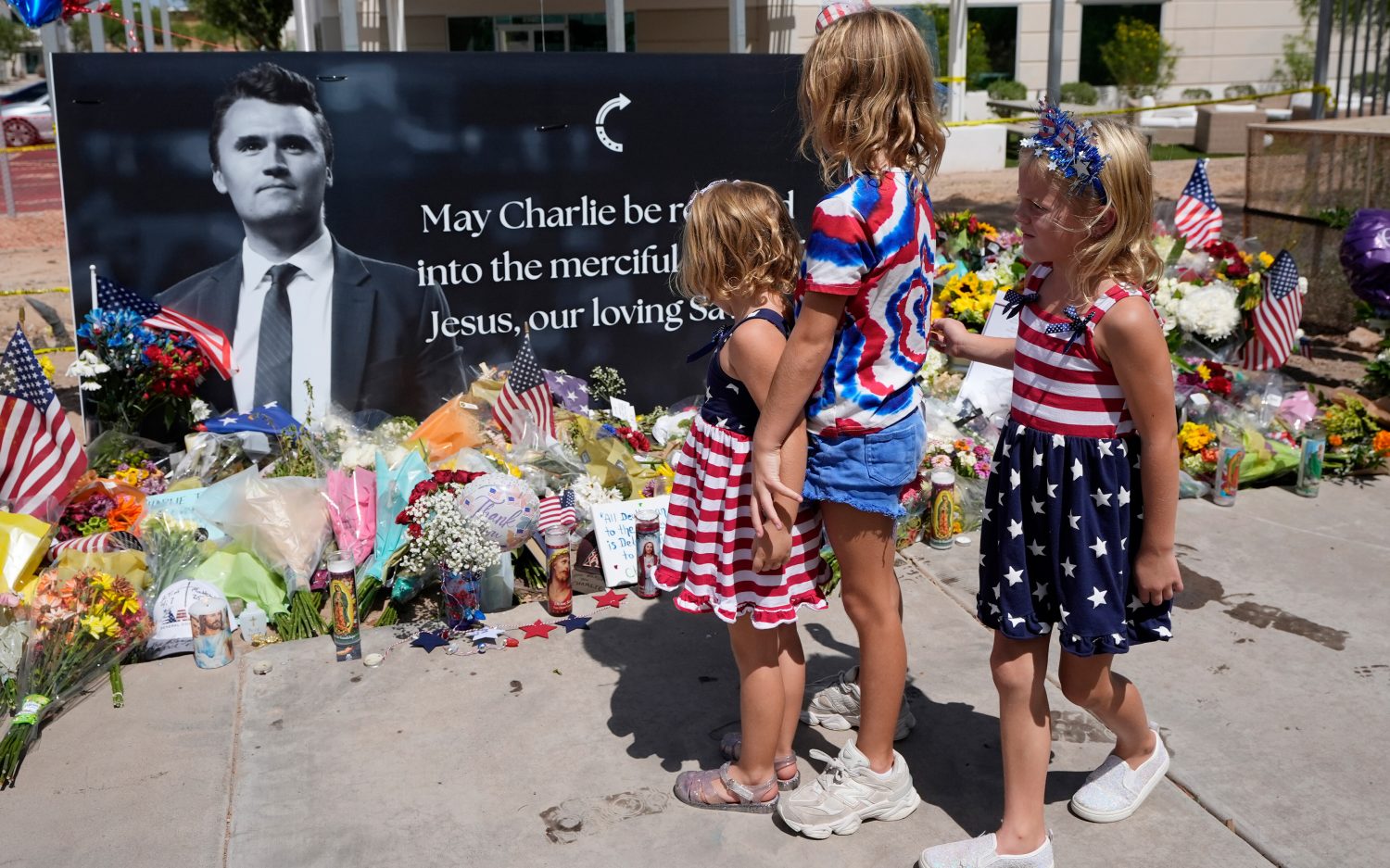
Today marks one year since the assassination of conservative political activist Charlie Kirk. On Sept. 10, 2025, a bullet flew above a crowd of 3,000 spectators at Utah Valley University—striking 31-year-old Kirk where he sat fielding questions for a live debate hosted by his nonprofit political organization, Turning Point USA.
Kirk was whisked off to a hospital and soon pronounced dead, survived by his wife and two children. In a briefing the same day, Utah Gov. Spencer Cox called the event “a political assassination.” Last week, Utah District Judge Tony Graf approved a felony aggravated murder charge for Tyler Robinson, the 23-year-old Utah man accused of killing Kirk. Robinson has pleaded not guilty to all counts against him.
In the past 12 months, political violence has continued to rear its head, from December bomb threats at three of Senate Democratic leader Chuck Schumer’s New York City offices, to an apparent assassination attempt of President Donald Trump at the White House Correspondents’ Dinner in April. Just this week, an armed man lunged at Amy Acton, a Democratic candidate in Ohio’s governor’s race, before her security detail intervened.
Is political violence in the United States getting worse? Here’s an assessment, one year after Charlie Kirk’s death.
What counts as an instance of political violence? The Carnegie Endowment for International Peace, a Washington, D.C., think tank, defines political violence as physical violence, threats, or intimidation that are “intended to destabilize public institutions or democratic functions,” are aimed at elected officials or candidates, or are otherwise intended to limit a particular person or group’s political participation.
Are political violence and threats in the United States on the uptick? The Carnegie Endowment reports that threats against members of Congress have been on an upward trend over the past decade. And in February, the nonpartisan Princeton University political violence tracker Bridging Divides Initiative published a report on the key trends of 2025. The findings revealed that targeted political violence increased over 30% from 2024 to 2025 and that the largest spike of danger against local officials followed Kirk’s assassination last September. BDI also pointed to a U.S. Capitol Police assessment from January that documented a climb in threats to members of Congress on both sides of the aisle, their families and staff, and the Capitol Complex for the third year in a row.
“We have been strengthening our partnerships with law enforcement agencies across the country to keep the Members of Congress safe when they are away from Capitol Hill,” said U.S. Capitol Police Chief Michael Sullivan in a news release announcing the assessment case. “We want to make sure agencies have the resources they need to be able to enhance protection, which is critical to the democratic process.”
In July, the initiative also reported survey results from the first three months of 2026 indicating that 54% of local elected officials said they had experienced insults, harassment, threats, or physical attacks this year, a slight increase from early 2025.
Is this actually making a difference on the political scene? Bridging Divides Initiative’s survey results from the first quarter of 2026 indicate that, due to concerns about hostility, 76% of local officials say they are less willing to engage in key political activities such as campaigning for higher office or working on controversial issues. The number continues a three-year upward trend in such responses, according to BDI.
Last November, Rep. Jared Golden, D-Maine, announced that he would not seek reelection after 11 years in elected office, citing threats of political violence against his family. Around 42 members of Congress are retiring next year, although Golden appears to be the only one to explicitly state safety concerns as a reason.
“It’s always been dangerous to do the kind of work that our civic and elected officials do, but I think the climate is more heightened,” said Jess O’Connell, co-founder of the Democracy Security Project. The nonprofit has worked with hundreds of clients ranging from political candidates and election officials to churches and schools, providing safety training and tools. “It’s not just our politicians, it’s civil society that’s under attack too. Charlie Kirk wasn’t running for anything,” O’Connell said.
Does the current environment pose any danger to the midterm elections? “The temperature is really high. Sometimes that translates into real world action. Other times it doesn’t,” said Colin Clarke, the executive director of the Soufan Center, a New York City-based nonprofit that researches security challenges, including domestic terrorism. “We’re fighting the culture wars in many ways, and I think the closer we get to the midterms, the more heated the political rhetoric will get, and that just increases the opportunities for people with grievances to have them.”
Clarke added that it’s important to monitor threatening rhetoric as the midterm elections draw closer: “We just have to be very aware of calls to mobilize the violence. Both explicit and implicit, subtle or overt. We just need to be really on guard against this stuff and discourage it, and to the best that we can, urge people to be civil,” he said.
Have lawmakers passed any legislation to address the problem? In the days following Kirk’s death, Trump issued a memorandum directing federal agencies to pursue a coordinated national strategy against what it defined as organized political violence. Congress also adopted several bipartisan resolutions condemning political violence, honoring Kirk’s life, and rejecting dehumanizing political rhetoric—but no actual federal legislation surrounding the issue has passed since September 2025.
O’Connell says some low hanging fruit for potential policies addressing political violence could include anti-swatting laws and eliminating the requirement in some states that candidates filing for public office list their personal addresses.
Any positive signs? This week, the Centers for Violence Prevention at the University of California, Davis, published a preprint of national survey findings documenting a decrease in support for political violence in the United States from mid-2025 to mid-2026.
“These findings are clear. Entrapment in a spiral of escalating political violence is not inevitable in the United States,” wrote Garen Wintemute, director of Centers for Violence Prevention, in an emailed news release. “We who reject political violence must make our rejection known to our families, friends, and larger social networks. A public climate of non-acceptance for violence can help reduce the likelihood of it occurring.”


This keeps me from having to slog through digital miles of other news sites. —Nick
Sign up to receive The Stew, WORLD’s free weekly email newsletter on politics and government.
Please wait while we load the latest comments...
Comments
Please register, subscribe, or log in to comment on this article.