
Help wanted: White House seeks new congressional liaison
James Braid’s departure comes ahead of a potential congressional flip
James Braid, right, accompanies J.D. Vance and Marco Rubio at the Russell Senate Office Building on November 21, 2024 in Washington, D.C. Getty Images / Photo by Kevin Dietsch
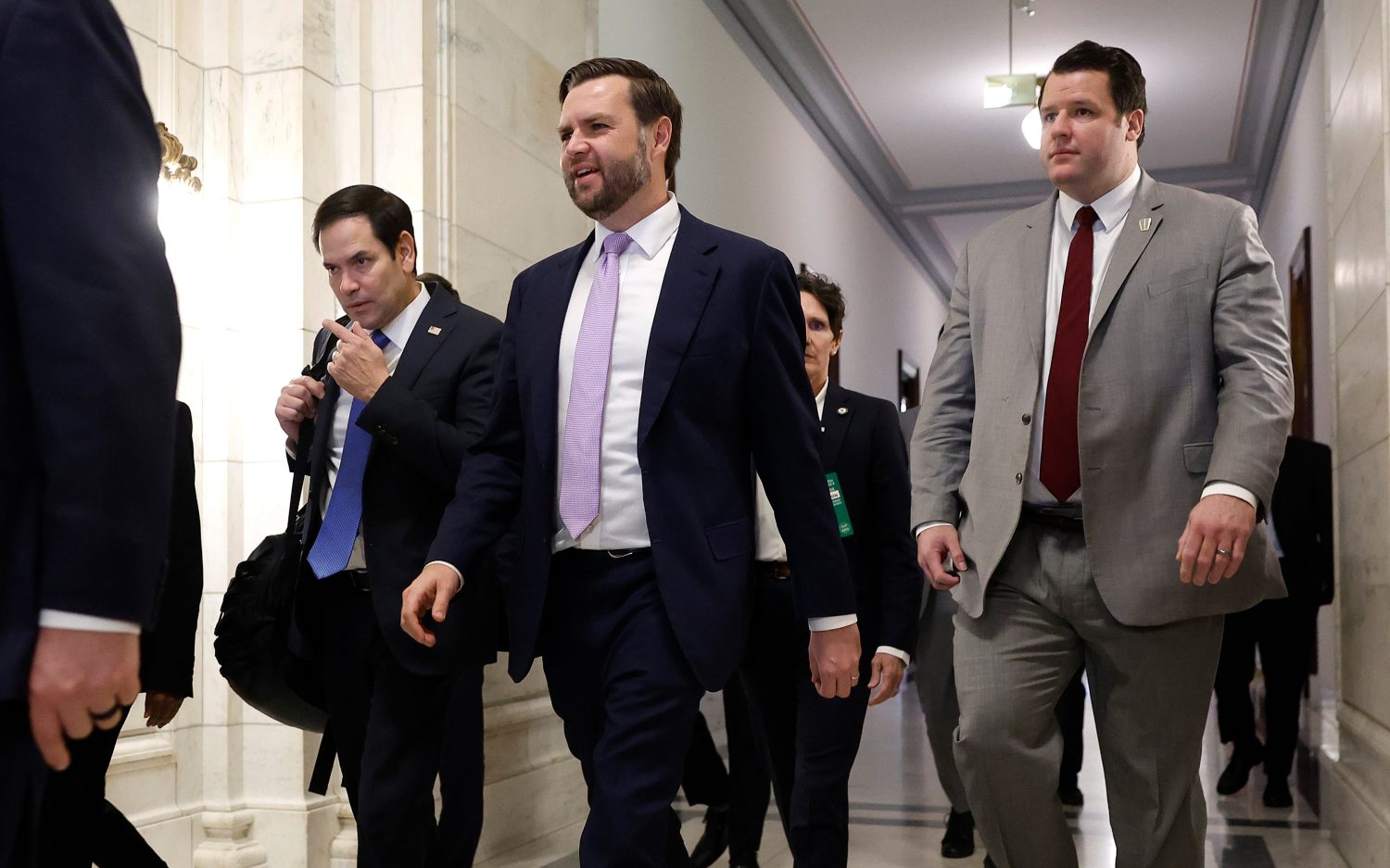
Out of the 400-plus personnel it takes to run the Executive Office of the President of the United States, a single post is said to be one of the toughest jobs in Washington, D.C.—the role of White House congressional liaison.
James Braid, a North Carolinian and former policy aide to then-Sen. J.D. Vance, assumed the position in January 2025. Last week, he announced his departure. The conventional understanding of the role is to help communicate the president’s agenda to Congress—but under President Donald Trump, the job’s specifics may be shifting.
Braid will leave the White House in September and reportedly plans to join the private sector. His exit comes less than three months before midterm elections, where Democrats have a chance to seize both chambers of Congress through a few competitive House and Senate seats. With no official successor announced, it remains to be seen whether the administration will prioritize a pick who could operate with a potential Democratic majority in Congress.
The roots of what is now titled the Office of Legislative Affairs, which Braid presides over as director, can be traced back to President Dwight D. Eisenhower—the first president to establish a congressional liaison office. The office allowed the president a more formalized way to help manage the relentless back-and-forth between the White House and Congress and achieve the administration’s political priorities.
“It was less about having someone doing arm-twisting or brow-beating for the president and more about having someone who can credibly convey messages across Pennsylvania Avenue,” wrote Matthew Beckmann, professor of political science at the University of California, Irvine, and author of Pushing the Agenda: Presidential Leadership in U.S. Lawmaking, in an email to me. “Still, part of helping the president is helping his allies on the Hill—nudging the president to endorse a deal, oppose an amendment, or nominate a supporter.”
Today, under the current administration—where Trump frequently prods Congress over social media posts and communicates through phone calls—the congressional liaison, or CL, no longer enjoys a monopoly of communication.
“There are evidently scores of people who have the president’s own cell phone number and find it possible at a moment’s notice to pick up the phone and call the president from the Hill,” said Russell Riley, a presidential scholar and professor of ethics and institutions at the University of Virginia’s Miller Center of Public Affairs. “In one sense, that’s actually a great advantage because it cuts out the middleman, right? … But there’s a bigger problem there, and that is that it undermines the CL’s ability to do the job.”
In 2003, Riley hosted a seminar for seven of Braid’s predecessors—from the administrations of Presidents Richard Nixon to Bill Clinton—to discuss the intricacies of their role and compare experiences.
“The last thing you wanted if you were a CL under President Clinton or under President [Barack] Obama is to go up [to the Hill] with a carefully developed position and discover that the members have already been talking to the president on the phone,” said Riley.
Along with adapting to the president’s communication style, the job itself is grueling, Beckmann noted. “Long hours, high stakes, crazy pressure. It is a sprint, and after a few years, people are excited to get a break.”
Given the pressures, it may be little surprise that Braid is departing after less than two years in the role. At least five different White House directors of legislative affairs worked during Obama’s two terms, two during President Joe Biden’s, and at least four during Trump’s first administration.
“If you get two years out of somebody in this job, that’s really pretty good … particularly when Congress is in session, you’re just not getting any sleep,” said Riley.
On the day of Braid’s announced departure, Trump, Vice President Vance, and House Speaker Mike Johnson took to social media to thank Braid for his work and the role he played in advancing legislation.
“His great friendship, unwavering commitment, and tireless work ethic have helped House and Senate Republicans advance President Trump’s America First agenda in spite of our razor-thin majorities,” wrote Johnson.
White House press secretary Karoline Leavitt, who announced her own departure days prior, also posted her appreciation for Braid’s “advice on legislative issues.” Trump’s communication style has also somewhat encroached on the secretary’s conventional role—even leading to jokes that the president himself will succeed Leavitt. (One artificial intelligence image posted on Trump’s Truth Social account shows the president standing behind her podium with the caption “The Best Press Secretary.”)
White House press secretaries also have a high turnover rate, but Leavitt and Braid are not the only two administration officials to go. White House counsel David Warrington and Justice Department pardon attorney Ed Martin are also leaving, Trump announced in recent weeks.
One possible explanation for the press secretary’s and congressional liaison’s departures is that they can earn more money for far fewer hours a week in the private sector, Riley noted. Currently, Braid and Leavitt both make $195,200, according to the “2026 Annual Report to Congress on White House Office Personnel.” Leavitt has publicly stated her decision to leave the White House was so she could devote more time to her two young children.
Beckmann suggested yet another factor. Late summer and early fall are a convenient time to slip out without seeming to be jumping ship.
“For White House staffers looking at the horizon, storm clouds are easy to see. If Democrats take the House (as seems likely) … or Senate (which seems possible), it means the next two years will include more investigations, conflict, and stress,” he wrote.
On Thursday, in a preview of what a Democratic House majority with subpoena power might look like, Rep. Jamie Raskin, D-Md., Ranking Member of the House Judiciary Committee, launched an investigation into a venture capital firm Donald Trump Jr. joined shortly after the 2024 presidential election.
The White House may look to find a successor for Braid with the proper temperament and personality type to deal with a flood of subpoenas in case the Democrats take power in Congress and shock the investigatory apparatus into action. So far, Jeff Freeland, President Trump’s lead House liaison, and Katie Bailey, his special assistant, are among the names rumored as potential picks.
Whoever gets the job, Riley said the role of liaison to Congress will likely continue to operate unconventionally under Trump.
“I fully expect as long as he’s in office to have this kind of atypical staffing structure around him where people are basically almost like jazz,” said Riley, “with the instrumentalist having to follow whoever is the lead instrument at the time.”


This keeps me from having to slog through digital miles of other news sites. —Nick
Sign up to receive The Stew, WORLD’s free weekly email newsletter on politics and government.
Please wait while we load the latest comments...
Comments
Please register, subscribe, or log in to comment on this article.