
Far from battle lines, a safe retreat for Ukraine’s orphans
A weeklong camp offers war-weary children a gospel message and a reprieve
At Junior Ranger School the Rangers and volunteers lead the children in physical training each morning. Photo by Antonio Graceffo
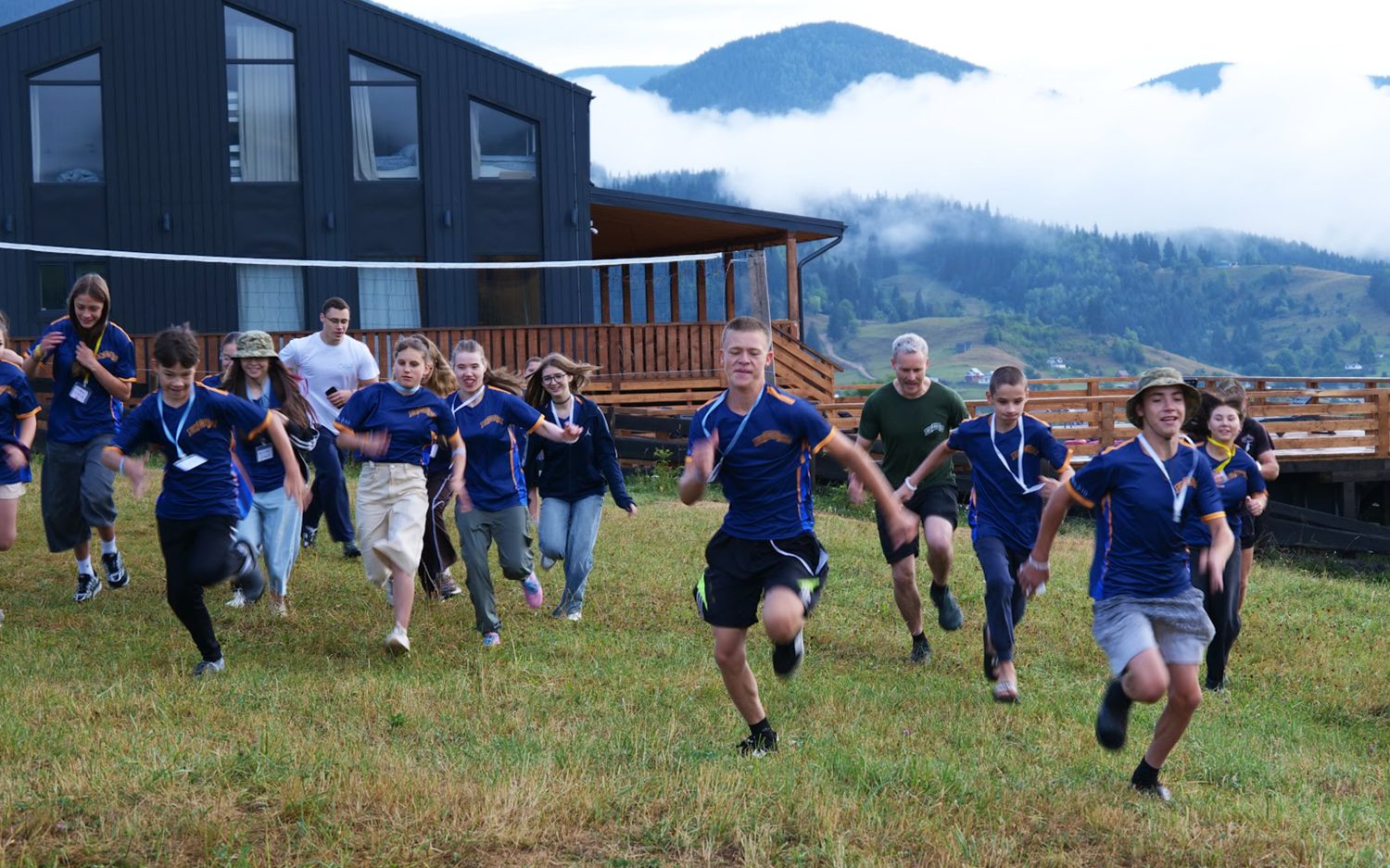
Nestled under the beauty of the Carpathian Mountains in Ukraine, 37 orphans and around 10 volunteers ran sprints in mid-August across green grass as misty clouds filled the valleys. The teenagers panted and complained about the exercise alongside the volunteers, but their smiles and laughter showed they were happy to be there. A week later, many cried as the camp ended and they returned to lives of hardship in villages and towns regularly targeted by Russian drones and missiles.
This was the second time that the Christian aid group Free Burma Rangers and Ukraine’s Bible Orphan Ministry jointly organized the camp, called Junior Ranger School. Forty-seven-year-old Alla Vasilyeva, whom the children call Aunt Alla, leads the Bible Orphan Ministry. She began helping orphans before the war, but the ongoing conflict has created a greater gap for the ministry to fill.
Vasilyeva said the ministry focuses on caring for children officially classified as social orphans. Some have no parents, while others “have parents who drink alcohol or abuse their children, or they live with parents who don’t take care of them because of alcohol,” she explained. Vasilyeva said part of the ministry involves teaching children and volunteers to abstain from alcohol and smoking.
For her, the mission is both religious and personal. “I was in an orphanage from the time I was 9 years old,” she said. “I know how they feel, and every child wants to belong to a family.”
As an adult, during one of her visits to an orphanage, Vasilyeva met a young girl named Natasha and “fell in love,” she said. Although unmarried, she wound up adopting Natasha and her siblings. “Those kids, they stole my heart,” Vasilyeva said.
Vasilyeva ultimately adopted five children legally while providing a temporary home to several others. She still has room in her heart for more. “I often pray, ‘God, please send orphans to our family,’” she said.
Camp organizers chose the mountainous location for its beauty and distance from the fighting, both of which Vasilyeva believed would be therapeutic for children who had lived with war for more than a quarter of their lives. The mountains were so quiet that, after several days, some children asked whether the war was over. Only by gaining physical distance from the noise and fear of Russian attacks could they relax and simply be children.
The contrast became clear during an outing to Hutsul Land, a cultural village at the Bukovel mountain resort. The children spent the day touring traditional Ukrainian homes and learning about their country’s history. “We didn’t hear air raids or explosions all day,” Vasilyeva said.
The next morning, however, she checked the news. “We had massive shelling last night,” she said. On Aug. 19, Russian jet-powered drones struck the regional police headquarters in the western city of Zhytomyr, the hometown of many Bible Orphan Ministry volunteers. Three people were killed and 53 others were injured. A combined missile-and-drone attack that began overnight also struck Kyiv, damaging residential buildings, a children’s hospital, and other sites. Kyiv observed a day of mourning on Aug. 21.
“Now, there will be more orphans,” Vasilyeva said. She noted the war has left children traumatized, afraid of explosions, and crying at night. “It is a very bad situation.”
Despite the bad news, the camp continued with its usual routine. Each morning began with physical training, followed by showers, breakfast, and devotionals. The broader program included self-defense, basic medical instruction such as applying a tourniquet, fire-making, swimming, floating, and Bible dramas.
During the morning sprints, Free Burma Rangers member Noelle Barkley encouraged a group of girls while carrying her infant on her shoulders. She and her husband, Sky, an instructor who also managed the rangers’ relationship with Bible Orphan Ministry, brought their two children with them, as the rangers often do on missions.
The children helped build connections between the team and the Ukrainian teenagers. The girls all wanted to hug and play with the Barkleys’ baby, while the couple’s 5-year-old became a mascot for the group. He disappeared among the teenagers, moving from activity to activity, participating and helping whenever he could. “They just need someone to love on them for a week,” Barkley said of the orphans.
Much of the program focused on sharing God’s love with the teenagers and building their self-confidence. Vasilyeva studied therapy and psychology related to trauma recovery and incorporated that knowledge into the program.
During art therapy, for example, each child wrote his name on a piece of paper and decorated it in any creative way he wished. The children then passed the pages around the room so the others could write positive comments about them. By the end, each child had a page featuring his or her name and about 30 positive comments.
About halfway through the week, Vasilyeva’s daughter Natasha arrived from college to help at the camp. Using photographs on her phone, Vasilyeva told the story of how she, Natasha, and Natasha’s siblings had become a family. The photos showed the filthy, cold home where the children had lived with a leaking roof, damaged walls, and holes throughout the building. Vasilyeva also recalled the children saving food from lunch at school to feed their families rather than eating it themselves.
Natasha first met Vasilyeva when Bible Orphan Ministry visited her ninth-grade class at the orphanage seven years ago. “They came to us, our class specifically, and told us about God,” Natasha recalled in a recent video interview with the Boaz Project, another orphan ministry. Afterward, the two began communicating more closely.
After Natasha turned 14 and left the orphanage, Vasilyeva took her to Zhytomyr. “I enrolled in college [trade school] there and lived with our Aunt Alla,” Natasha said.
Vasilyeva later learned that Natasha had a younger brother. Natasha’s older sister was already living with Alla. Rather than separate the siblings, Vasilyeva took all three into her home.
“When our aunt took us in officially, we became one family,” Natasha said, becoming emotional as she recalled the experience. “That moment was the best event ever.”
The war later brought new sorrow. About two years ago, Natasha’s older brother was killed on the front lines, shortly after graduating boot camp. Two months later, her birth parents died.
Despite these hardships, Natasha, now in her early 20s, helps her adoptive mother care for other orphans. “When I see the children, I see myself when I was like them,” she told the Boaz Project. “When we needed help, there was no one there. I want them to have someone who doesn’t just bring food or other assistance, but also talks to them.”
At the end of the camp, eight children either professed faith in Christ or were baptized. Several others asked to learn more about Jesus. After tearful goodbyes, hugs, and heartbreak, the children boarded vans that returned them to the poverty in which many lived—and to places where the bombings would resume.
—WORLD updated this story Sept. 25 to correct the description of when Vasilyeva took in Natasha and learned about her siblings.


These summarize the news that I could never assemble or discover by myself. —Keith
Sign up to receive World Tour, WORLD’s free weekly email newsletter on international news.
Please wait while we load the latest comments...
Comments
Please register, subscribe, or log in to comment on this article.