
Data centers loom large in Ohio Senate race
Sen. Jon Husted’s attempt to insulate Americans from utility rate increases fails on the Senate floor
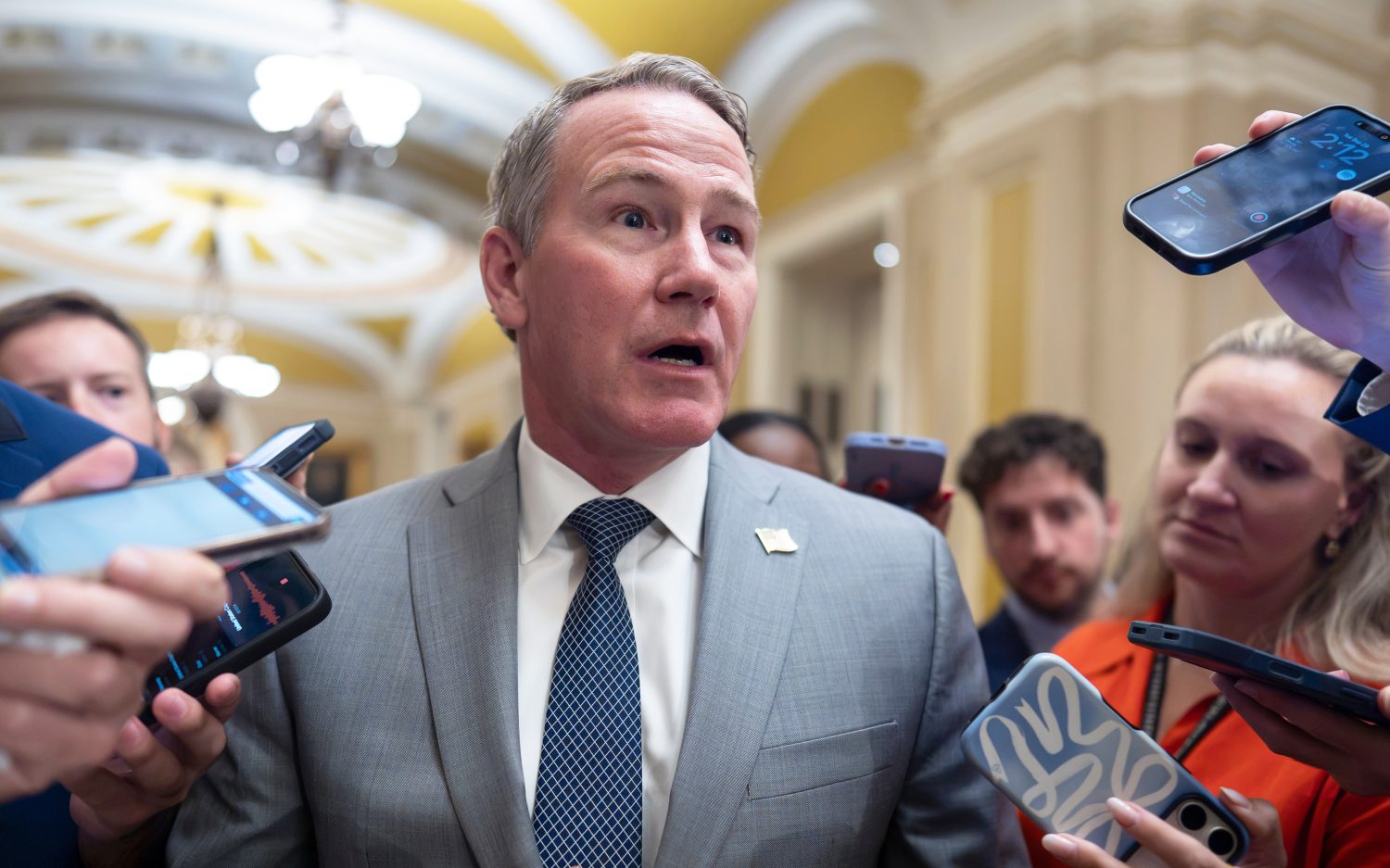
Sen. Jon Husted, R-Ohio, talks to reporters at the Capitol in Washington, Tuesday. Associated Press / Photo by J. Scott Applewhite
Among the seven U.S. Senate races the Cook Political Report rates as toss-ups, one formerly reliably red state has drawn increasing attention, both as a battleground district and as a focal point for a major midterm election issue—data centers.
In the race for Ohio’s available Senate seat, the top two contenders are former three-term Democratic Sen. Sherrod Brown and incumbent Republican Sen. Jon Husted. Ohio Gov. Mike DeWine appointed Husted to the Senate in January 2025 after J.D. Vance resigned to become vice president. This year’s special election will determine who fills the remainder of Vance’s original term.
“Republicans just have an advantage in Ohio, so that it’s close and that it looks at this point in time [to be] favoring Brown is just kind of surprising to me,” said Daniel Birdsong, a political science lecturer at the University of Dayton in Ohio.
In a state President Donald Trump won by at least 8 percentage points for three consecutive elections, the competition may come as a surprise. But a recently failed affordability bill that Husted sponsored, aimed at addressing Ohio’s energy costs, provides a glimpse into what led to such tight margins. With tensions high in Ohio over data center construction and a recent political scandal over utility subsidies, Husted’s legislation might have given him a winning message for voters at home.
“My bill is the only bill in town that you could’ve gotten done and to the president’s desk before the election,” Husted told The Scott Jennings Show on Wednesday afternoon. “And [Senate Minority Leader Chuck] Schumer and the Democrats are blocking it because they really don’t want to solve the problem of affordability, they want to talk about the problem of affordability.”
Husted and two House representatives introduced the Ratepayer Protection Act in late July to address the issue of higher electricity bills as a result of connecting large utilities such as data centers to the grid. The bill directs state regulators to consider establishing formal standards that would require large load customers to foot the bill for upgrades. On Sept. 16, the legislation passed in the House on a bipartisan vote of 417-3. But on Wednesday, the bill foundered in the Senate 57-43, short of the 60 votes needed to pass the upper chamber.
Travis Fisher, the director of energy and environmental policy studies at the Cato Institute, a libertarian think tank in Washington, D.C., told me in a call before the Wednesday Senate vote that the political roadblocks for the bill’s passage were “pure politics.”
Fisher is skeptical of the Ratepayer Protection Act because it doesn’t require utilities to do a better job of allocating new costs. But he said it would force a discussion that could be useful in a lot of states.
“Even though I feel like it’s not that effective … it would be an interesting conversation starter, and it’s really a no-brainer to pass it. Like, the cost of passing it is zero,” said Fisher. “If I had to guess the politics of it, the reason it’s all in the Senate is less because they didn’t think it had teeth, which is true—but more that they didn’t want to give [Brown’s] opposition a win in a tight race.”
A handful of Democratic senators voted for the bill, including Maggie Hassan from New Hampshire, Amy Klobuchar from Minnesota, and Raphael Warnock and Jon Ossoff of Georgia. But the majority voted along party lines.
In a Tuesday floor speech, Sen. Mark Warner, D-Va., called Husted’s legislation a “fig leaf” and a “flimflam do-nothing bill,” and took the chance to promote his own data center bill. Other Democratic senators lobbed similar criticisms—with Martin Heinrich from New Mexico and Dick Durbin from Illinois arguing the bill lacks substance. Senate Minority Leader Chuck Schumer told reporters that Republicans were trying to secure an “ineffectual participation trophy.”
“It doesn’t surprise me that this is becoming a political hot button, because it’s so complicated and a politician can just make up whatever tough point they want because people don’t know how this industry really works,” said Fisher. “But if you really wanted to improve affordability of all things from gas, to diesel, to your power bill, all of it, permitting reform should be top of mind.”
On Wednesday, senators reached a bipartisan agreement on separate permitting reform legislation aimed at slimming timelines for energy infrastructure development and holding AI data centers accountable for rising costs connected to energy use. But according to reports, a vote on that legislation won’t happen until after the November midterm. Husted’s energy-focused legislation was closer to crossing the preelection finish line, but its political implications likely played into the opposition.
“[Husted’s] been attached, either metaphorically, rhetorically, or literally, to energy price increases,” said Birdsong.
In 2019, during Husted’s first year as lieutenant governor, Ohio lawmakers passed House Bill 6—legislation that became the centerpiece of one of the biggest political scandals in the state’s history. In an attempt to save declining nuclear and coal plants in Ohio and Indiana, FirstEnergy and other utility companies paid around $60 million to influence a favorable vote on the bill.
The legislation resulted in at least $500 million in subsidies costs to Ohio residents. Racketeering and bribery charges led to convictions for former Speaker of the Ohio House Larry Householder and former Chair of the Republican Party Matt Borges. The chair of the Public Utilities Commission of Ohio, Sam Randazzo, who was also charged with receiving bribes from utilities, committed suicide amid the controversy.
“It’s just such a deeply sad story that I wouldn’t blame anybody in the state of Ohio for being a complete cynic about how lawmakers work,” said Fisher, who told me he personally knew Randazzo. “The bribes and the political dynamics when it comes to utilities are awful.”
But Fisher suggested Ohio could still become a model of what to do instead of what not to do. Last year, Ohio’s Legislature passed House Bill 15 and Senate Bill 2, which aimed to set a standard for energy policy and eliminate hidden utility charges, among other things. Fisher called the reform “a huge step in the right direction.”
When House Bill 6 was proposed, Husted purportedly supported the legislation, but he has claimed innocence surrounding knowledge of the bribery dealings. Although the trial is still unfolding, Husted has never been charged in the case. But his proximity to the scandal, including being called to the witness stand to testify for the defense, are easy fodder for his opponent.
One of Brown’s campaign ads labels Husted “the face of data centers” and accuses him of “aggressively recruiting data centers to the state.”
I reached out to Husted’s campaign to ask if his position on data centers has changed since his earlier support for such developments, like one $600 million Ohio data center project by Google. A spokesperson responded in an email, “Senator Husted’s tone has not shifted, and his position has not changed. He has always believed that it should be up to the local communities whether or not they want new data centers. When he served in the Ohio state government, he encouraged data centers to do power purchase agreements many years ago.”
According to a state agency website, Ohio has the fifth most data centers in the United States at 240 actively listed. Recent polling reports indicate that data centers are unpopular in the state, with around 6 in 10 Ohioans viewing them unfavorably. The issue may be particularly sticky in battleground regions: A September Cook Political Report poll noted that in battleground House districts, voters trust Democrats more than Republicans to address data center policies by a 10 percentage point margin.
Regardless of Husted’s stance on data centers, Birdsong believes it will be difficult to unravel the association. “The Brown campaign and other Democrats, who are doing ads, are trying … to make sure that when people think about Husted, they think about him in a negative way in relation to this issue,” he said.
“Economy is top of mind, especially this year,” Birdsong added. “In a very close election, that could really tip the balance.”


This keeps me from having to slog through digital miles of other news sites. —Nick
Sign up to receive The Stew, WORLD’s free weekly email newsletter on politics and government.
Please wait while we load the latest comments...
Comments
Please register, subscribe, or log in to comment on this article.