
China-linked program targets U.S. high schoolers
New report accuses a study abroad program of hiding its ties to the Chinese Communist Party
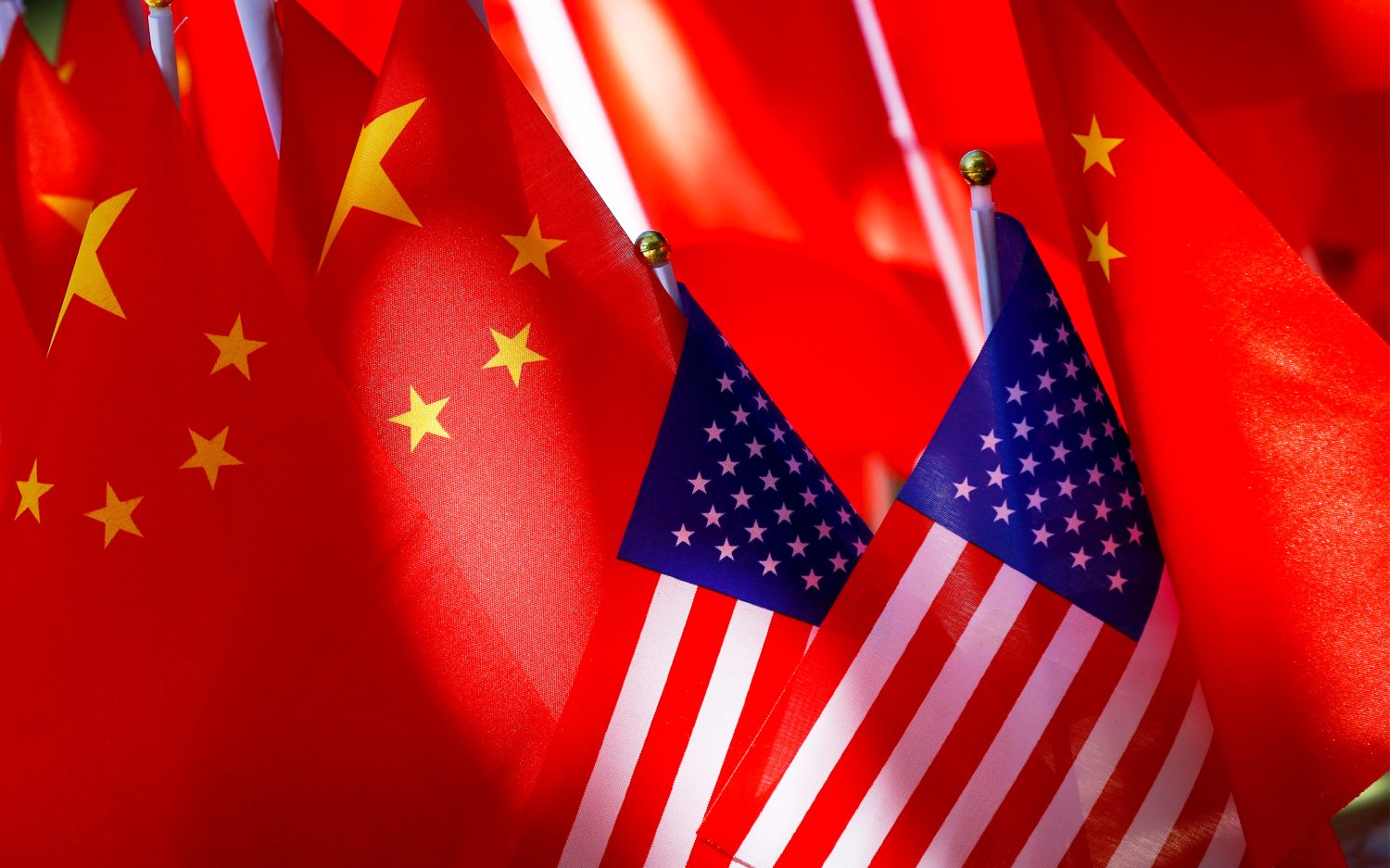
American flags are displayed together with Chinese flags on top of a trishaw in Beijing, China. Associated Press / Photo by Andy Wong, File
When Muscatine High School students from Muscatine, Iowa, visited China in 2024, they brought a school flag to President Xi Jinping, whom they referred to as “Grandpa Xi.” The Chinese government had picked up the tab for the trip as part of the Young Envoys Scholarship (YES), a study abroad program that facilitates student trips to China.
This month, advocacy group Defending Education released a report showing that at least 83 universities and 27 K-12 schools have participated in the YES program. The initiative claims to “provide a nurturing environment for young people to move and see the world,” and many students get to visit well-known, educational attractions like the Great Wall or Beijing Zoo. The YES program seems harmless, the report’s authors acknowledge, but they warn that the Chinese government hopes to sway student opinions of China with programs that hide their ties to the government’s Communist ideology.
The China Education Association for International Exchange (CEAIE) launched the YES program in 2024 as part of Xi’s goal of inviting 50,000 U.S. students to China. In its report, Defending Education tallies multiple stories of student trips to China, including another Muscatine High School trip earlier this year.
In 2021, three years before CEAIE started the YES program, the U.S. Senate unanimously voted to withhold federal funding from universities that hosted another Chinese program, Confucius Institutes, due to national security concerns. The bill died in the House, but scrutiny of Confucius Institutes continued to mount.
In the United States, Confucius Institutes provided Chinese language and cultural programs on college campuses. By 2017, around 120 Confucius Institutes operated in the United States. Some Confucius Institutes partnered with local school districts to provide textbooks and even invite Chinese national teachers to teach inside K-12 schools. But as pressure grew for schools to distance themselves from the program, the number of Confucius Institutes at colleges and universities decreased from 100 in 2019 to less than five in 2023, according to the Government Accountability Office.
Although many Confucius Institutes shut down completely, some simply rebranded. According to a 2022 report from the National Association of Scholars, about 64 colleges and universities opened similar programs under different names or “maintained close relationships with the Chinese entities that cosponsored Confucius Institutes.”
In August, the Department of Defense sent notices to 30 universities requiring them to audit their research and funding ties with “foreign entities of concern,” including organizations associated with the rebranded Confucius Institutes. “This action is designed to protect American taxpayer-funded research investments from unauthorized technology transfer, intellectual property theft and adversarial exploitation,” the department’s news release read.
Jennifer Richmond is the deputy director of the Education and National Security Program at the Foundation for Defense of Democracies. She said the former director for the Confucius Institute’s U.S. hub runs the Center for Bridging Cultures, a K-12 nonprofit that operates in several states.
“We have identified at least nine other intermediaries operating similarly to the CBC, and we are researching additional organizations that may operate within the same Confucius networks,” Richmond told WORLD in an email.
The YES program does not appear to have any formal connection to the Confucius Institutes, but the two programs may have similar objectives. The CEAIE’s English-language website makes no mention of Chinese Communist Party affiliations. But on its Chinese-language website, the group claims to be aligned with Marxism-Leninism and to “always adhere to the leadership of the Party.”
Last year, several U.S. lawmakers accused the CEAIE of being aligned with the Chinese Communist Party’s “United Front,” a strategy that targets opposition to the party within China and abroad. “[The YES Program] seems to be a continuation of that soft power play by the Chinese government,” said Rhyen Staley, Defending Education’s director of research.
Staley believes the YES program aims at indoctrination of American students. “What we want people to understand, especially parents, is that this is concerning because it’s an attempt to train young children and young college students to view China in a very friendly, favorable fashion,” he said.
While Staley is particularly concerned about China’s influence within American schools, he also said that members of rising groups like the Democratic Socialists of America support “a strong relationship with the Chinese Communist Party and promote socialism as the model going forward for the American public.” Staley noted several DSA-linked activists have signed a statement resolving to “support, defend and build understanding of Chinese socialism.”
“I do think that on the farther reaches of the U.S. left there are some convoluted opinions about China as well as other left-leaning authoritarian regimes,” said Josh Kurlantzick, senior fellow with the Council on Foreign Relations.
Kurlantzick said a hard stance on China has been a fairly bipartisan issue for more than a decade. But recent, softening views on China don’t only come from the political left. Kurlantzick said President Donald Trump hasn’t been nearly as tough on China during his second term as he was in his first.
Despite confusing signals from the right and the far left, public U.S. opinion on China has remained fairly negative, Kurlantzick said. Positive views on China have climbed slightly within the past few years, but about 71% Americans still have an unfavorable opinion of China, up from 35% in 2005.
Kurlantzick doesn’t believe the Confucius Institutes succeeded in swaying student opinion on China. But he was still concerned about them when they were operational. By undermining curriculum critical of China and silencing Taiwanese speakers on campus, “[Confucius Institutes] were trying to exert a level of control that was just not acceptable,” he said.
According to the Defending Education report, some students do come back from trips with warm views on China and Xi. “I am a China fan,” one high school student said after a YES program visit.
Staley said the YES program looks pretty innocuous on the surface, and he doesn’t blame students for accepting an all-expenses-paid trip to China. “Even though these trips might be free, they’re not free from an intellectual or ideological standpoint,” he said.
When it comes to cracking down on the Chinese Communist Party’s influence within American schools, the Foundation for Defense of Democracies’ Jennifer Richmond points to the Transparency in Reporting of Adversarial Contributions to Education Act, which passed the House in December. If codified, the TRACE Act would give parents the right to know about foreign funding in schools, though Richmond noted the bill does not address U.S.-based nonprofits like the Center for Bridging Cultures.
In the meantime, Richmond says parents shouldn’t underestimate education programs with links to the Chinese government. “If you can sway students in K-12, you have college students who dismiss the national security concerns that China presents,” Richmond said. “Ultimately, this makes them easier to manipulate either for future espionage purposes, or for general foreign policy and public policy initiatives in the voter booth.”


I enjoy them immensely and share them every week. —Joel
Sign up to receive Schooled, WORLD’s free weekly email newsletter on education.
Please wait while we load the latest comments...
Comments