
Children of the underground
Sheltering from Russian attacks, Ukrainian kids return to school to study in subsurface classrooms
Children attend school inside an underground subway station in Kharkiv, Ukraine. Associated Press / Photo by Andrii Marienko
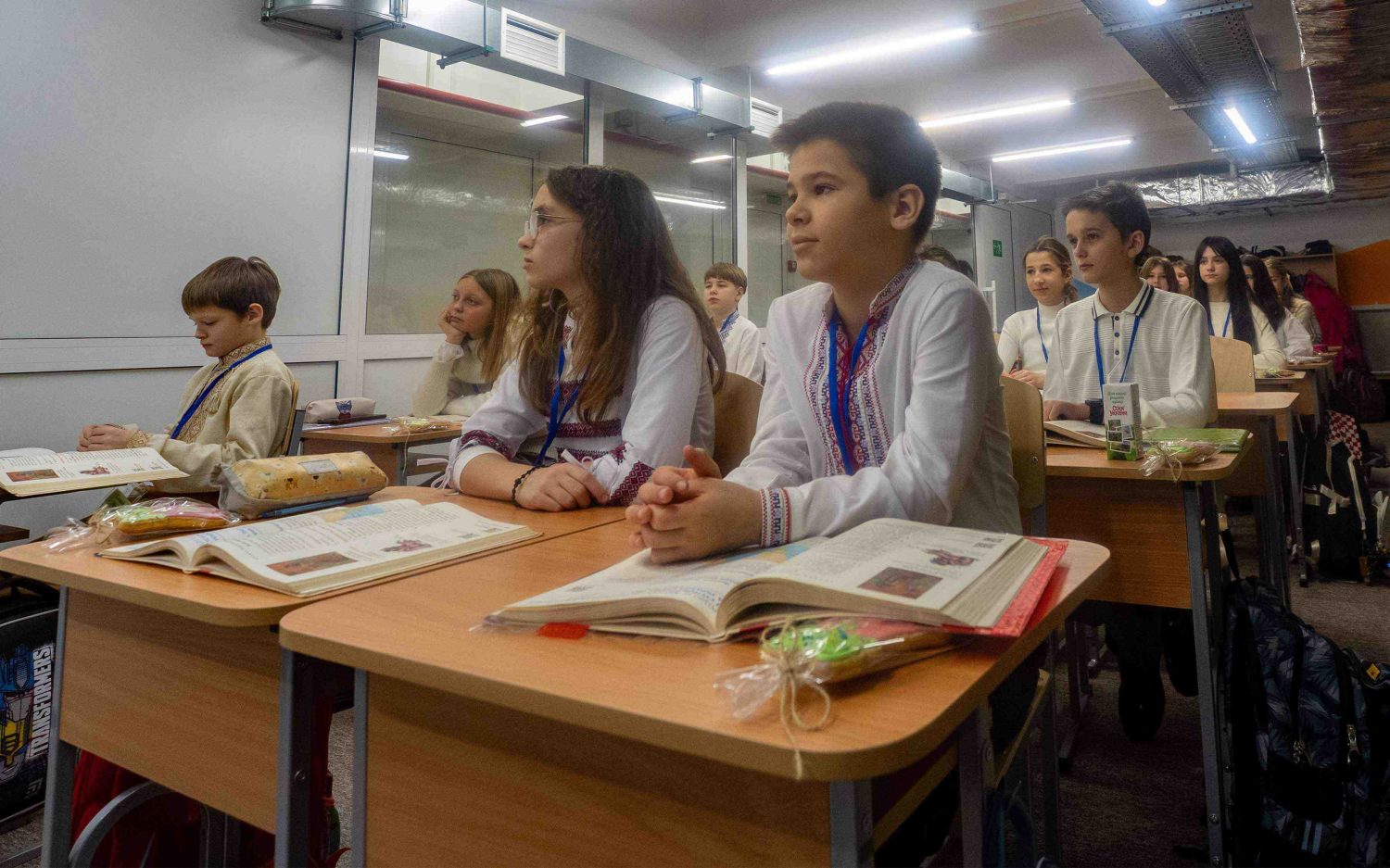
Like many parents in the back-to-school season, Natalia is busy helping her children prepare for another year of learning in Ukraine’s eastern city of Kharkiv. Her 15-year-old son and her 12-year-old daughter need new shoes and school supplies, Natalia told me. Amid Ukraine’s continued hostilities from Russia, she requested that I not print her family’s last name.
The late-summer routines seem normal, but they come with a life-and-death difference in this city of 1.4 million people. Natalia’s children are among Ukraine’s young students who spend part of their school days underground, in tight spaces that double as both classroom and shelter. About 20 miles from the Russian border, Kharkiv stands within easy reach of Russian aerial weapons.
Since Russia launched a full-scale war against Ukraine in February 2022, Ukraine’s students, teachers, and families have adapted to the dangers of wartime education. This means solving daily problems once as simple as getting to school safely—tasks that many Ukrainians took for granted before. On Tuesday, Ukrainian children will begin their sixth consecutive school year during a full-scale war. Parents like Natalia are trying to support their kids’ learning the best they can, even as they have good reason to worry.
Natalia described the loss of normalcy with a sense of sadness. And anger.
The war “has completely robbed children of a childhood,” she said, “from the daily air raid alerts and explosions, to socialization and the chance to interact with peers … and many other elements we didn’t even notice during peacetime.”
Schools across Ukraine—especially those in the crescent-shaped combat zone across the country’s east and south—have suffered frequent attacks since 2022. According to a report from the U.S.-based Scripps News Service, nearly 4,000 Ukrainian schools, or 31% of the 13,000 schools across the country, have been damaged or destroyed in 4½ years.
Natalia’s son and daughter attend underground classes twice a week, and otherwise follow courses online. Natalia has come to feel grateful for even a part-time schedule of offline instruction.
“Considering the current situation and the realities of life in a frontline city, underground schools are the only option for children’s education,” she said. “And they are far better than [only] online learning.”
Ukrainian officials argue that Russia is targeting the schools deliberately to break the will of the civilians who want to stay in their homes and communities.
School districts have responded by building facilities underground, an expensive and time-consuming process. When below-ground construction isn’t possible, teachers improvise classrooms in subway stations, basements, and other spaces below the reach of drones and missiles.
The schools of Kharkiv Oblast, the administrative region surrounding the city, are the hardest-hit of all Ukrainian regions, according to the Scripps report. That fact bears somber symbolism, because Kharkiv is Ukraine’s ultimate student city for legal minors and for the youngest Ukrainian adults. Kharkiv has more than 60 universities and postsecondary institutions, minting thousands of graduates each year.
For the generations of Ukrainians who studied here, or do today, Kharkiv is synonymous with school—a tradition now under mortal threat. And for young people dreaming of successful lives after war, many wonder if achieving their goals means leaving their country.
More broadly, the damage to Kharkiv’s schools and student life reflects a recent trend of intensified attacks on Ukrainian civilians. In May, the numbers of Ukrainian dead and wounded reached a four-year high, with grim new records set in June and July. More than 3,000 civilians were wounded or killed in July—a 30% increase from June, according to the United Nations.
Research from SavED, an education-focused Ukrainian foundation, found that learning formats varied drastically by how close students were to the fighting. Just a third of all students in frontline areas received fully in-person class time, versus 90% in non-frontline areas, according to the group’s 2025 annual report. SavED in August said it has built and equipped 160 underground facilities.
Ukraine plans to complete about 200 subsurface schools by the end of 2026, according to an Aug. 18 statement Prime Minister Serhii Koretskyi posted online.
Evgheniya Hryhorieva, 18, knows Kharkiv’s classroom realities firsthand. A lifelong resident of the city, she finished high school and plans to attend college in Kharkiv. Part of Hryhorieva’s recent school years took place underground. Twice a week, she commuted from downtown Kharkiv to a technical high school in the nearby Ivanivka neighborhood. Though most of her commutes went safely, she once came under Russian shelling on her way underground.
“At times, the only thought on your mind was simply: ‘God willing, let us make it to school safely,’” she said.
The Ivanivka school’s bunker-like basement offered protection, time with teachers and fellow students, and a way to finish high school no matter what. The cramped, crowded rooms, with no natural light, felt far from ideal—especially for older students, as they crammed for the National Multi-Subject Test, Ukraine’s equivalent of the SAT.
Still, Hryhorieva and her classmates relished in-person time together, below ground but at least face-to-face.
“The opening of underground schools became crucial, especially for graduating students,” she said. “We were able to reclaim at least a part of the school life we had missed so much.”
Hryhorieva saw underground school as a formative experience for not just her classmates, but her whole generation. Enduring together below ground has made them different people.
“One could even say that we are ‘children of the underground,’” Hryhorieva said. “Unfortunately, it is much safer underground in Kharkiv right now.”
Ukraine’s government and civil-society groups are laboring to ensure that students like Hryhorieva will have opportunities close to home—no matter how long the war may last. One of SavED’s programs supports adolescents and teens, whom they hope will see Ukraine’s future as their own. The group organizes development opportunities, guidance counseling, and school alumni networks, part of an ongoing effort to convince Ukrainian young adults to stay, work, and help their country rebuild.
Hryhorieva and Natalia each said they have no plans, or desire, to leave Kharkiv for safety in or beyond Ukraine.
“I was born in Kharkiv, so for me, it isn’t just a city I can simply move away from,” Hryhorieva said. “Kharkiv creates a very strong bond; it is hard to imagine life without it.”
Early in the war, Natalia briefly moved with her children to Ukraine’s north. But the family missed home and eventually returned to Kharkiv. Natalia works for the Ukrainian Red Cross, and she feels a duty to serve her city.
“I cannot just drop everything and leave,” she said. “This is our home, our native land, our life. Who needs us at the other end of the country or in another country?”
For the days ahead, Ukrainian mothers like Natalia are counting the cost of war—for themselves, and for their children’s uncertain future.
“It is heartbreaking that the genuine, safe, and carefree childhood that was lost can never be reclaimed, and that the inner anxiety born of these horrors will remain forever,” she said.
Nonetheless, Natalia seems prepared to accept more cramped underground classrooms, more dangerous school runs, and more struggle for her children’s sake. That means staying in Kharkiv and standing her ground for as long as it takes.
“We are trying to live our lives amid today’s challenges,” Natalia said. “Above all, we are all waiting for peace.”


These summarize the news that I could never assemble or discover by myself. —Keith
Sign up to receive World Tour, WORLD’s free weekly email newsletter on international news.
Please wait while we load the latest comments...
Comments
Please register, subscribe, or log in to comment on this article.