
Can Democratic Project 2029 initiatives unite a fractured party?
Competing blueprints lay out moderate leftist policy priorities
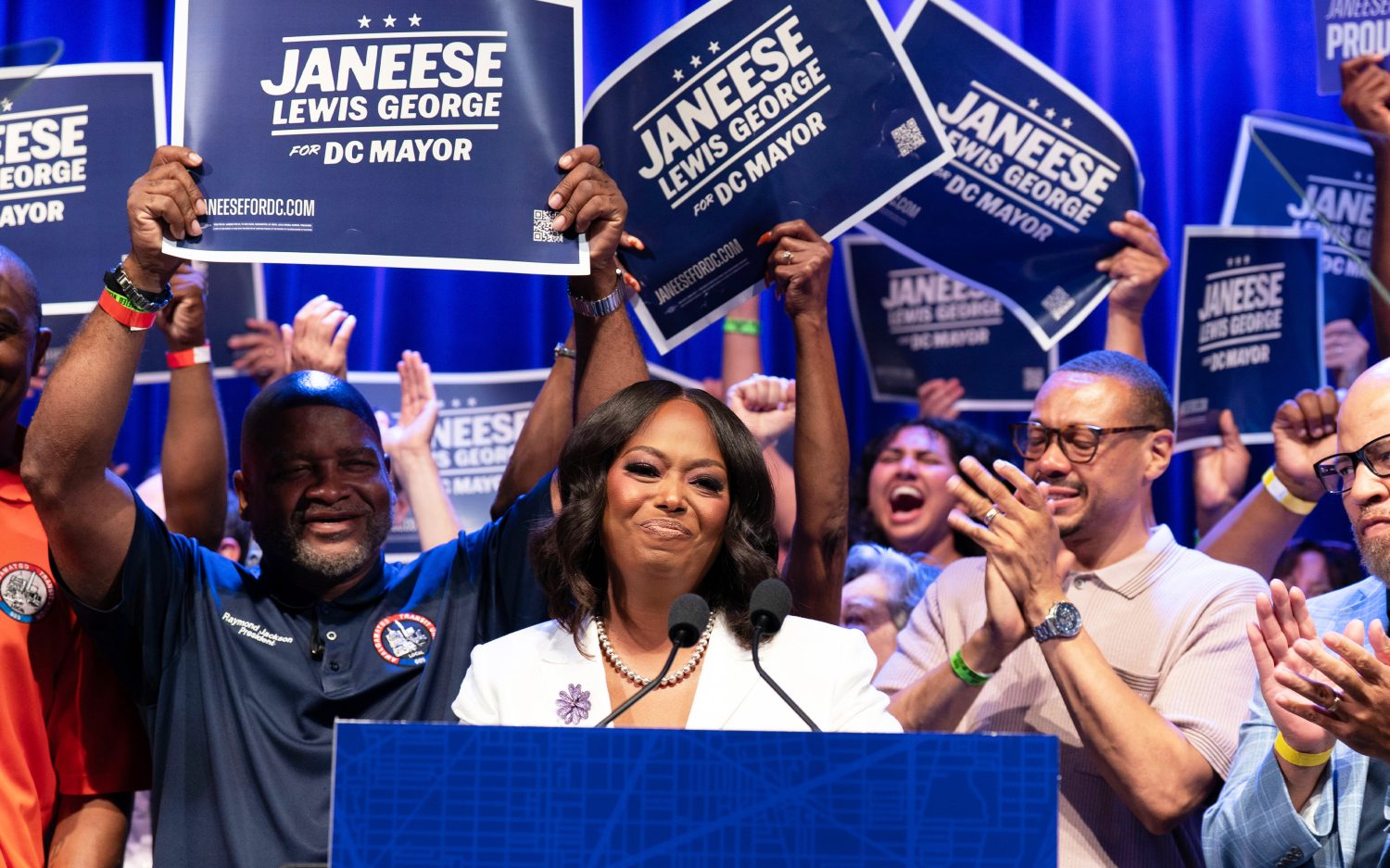
Janeese Lewis George speaks after winning the D.C. Mayor primary election in Washington, June 16. Associated Press / Photo by Jose Luis Magana
This year’s high-profile political races featuring progressive candidates in New York, Washington, D.C., and Michigan have raised a key question for the Democratic Party: Just how far left will it go?
Two rival Democrat organizations would like the answer to be “Not too far.” The organizations released a set of policy proposals this year, both debuting under the name “Project 2029” and both seeking to shape a future progressive presidency. These duplicate Project 2029s style themselves after the conservative presidential blueprint the Heritage Foundation released three years ago called Project 2025.
Each group hopes its policy plan will galvanize Democratic support and unite a party currently divided by competing levels of progressivism. But with democratic socialism increasingly swaying Democratic voters to the left, both groups face an uphill battle.
“There’s a desire to reestablish a pre-Trump status quo,” said Jake Altman, a former union official and author of Socialism Before Sanders, of the Democratic projects.
The American voting public is more complicated than the stereotypical Republican-Democrat divide might suggest. In a June report, Pew Research Center grouped American voters by their values. On the left—in order from moderate to progressive—Pew identified the “Order and Opportunity Left,” the “Left-Out Left,” “Loyal Liberals,” and “Leftward Progressives.” Feelings toward the Democratic Party vary within those groups. Many in the Left-Out Left say that no party represents them, and Leftward Progressives display a steep drop-off in warmth toward the Democratic Party. According to Pew, 66% of Leftward Progressives say they favor democratic socialists.
Further, a 2025 poll from the Heartland Institute found 51% of likely voters ages 18 to 39 want a democratic socialist to win the 2028 presidential election. The far-left organization Democratic Socialists of America has significantly raised its profile in the past year, thanks to politicians and candidates that have been linked to the group, such as New York Mayor Zohran Mamdani and the Democratic nominee in the District of Colombia’s mayoral race, Janeese Lewis George. The trend presents a particular challenge to Democrats who hope to draw a line in the sand against socialist ideas.
Jake Orlowitz, a Wikipedia administrator and mental health advocate, leads a group that released a Project 2029, recently renamed We Are Next to avoid confusion. The group mainly focuses on revoking Trump era-policies, and it outlines standard Democratic policy aims like formally recognizing Palestine and relaxing immigration enforcement. Though it supports abortion and “gender affirming care” and calls for universal federal healthcare, housing rights, and stronger public schools, its platform doesn’t reach as far as the Democratic Party’s most leftward members would like.
By comparison, Reform America’s Project 2029 is even less ambitious. Headed by Chad Maisel, who worked in President Joe Biden’s White House and served as a policy adviser in the Obama administration, the project has only released three policy briefs so far. They outline government-provided childcare, keeping children safe online, and reducing the cost of living. Maisel did not respond to an interview request, but according to the project’s website, the group plans to release more policy briefs.
“We started kind of poking around on other issues that we thought would similarly strike a chord with Americans and really take on problems that people are suffering through quietly in their daily lives but that never seem to be acknowledged by people in power,” Maisel told NPR in July.
Orlowitz of We Are Next did not agree to an interview but told me in an email that his organization is not affiliated with the Democratic Party. We Are Next’s team of policy contributors include a former USAID official, a retired CIA analyst, and an economics professor. Orlowitz said in an interview with the website 21st Century Adulting earlier this year that contributors range from independent to progressive.
“We are open, should we have the ability to influence the democratic or governing agenda in some fashion or an individual politician’s agenda,” Orlowitz told the website. “We’re pragmatic. I think that’s a term that defines us quite well. I view myself as a progressive, personally.”
Steven Groves, director of the Presidential Transition Project at the Heritage Foundation and co-editor of Project 2025, said there’s no comparison between Project 2025 and the new Democratic initiatives. Heritage has released a policy book like Project 2025 preceding every presidential election since 1981. Project 2025 united conservative priorities, successfully balancing a range of views and boasting over 400 contributors, according to Groves. Meanwhile, Project 2029 has seven authors so far, and We Are Next has eight authors or contributors listed, with a handful of anonymous writers, too.
“Imitation is the fondest form of flattery,” Groves said.
Critics pilloried Project 2025 for its conservative policies, and President Donald Trump even denounced it as far-right. According to the Center for Progressive Reform, which opposes the project, the Trump administration has implemented 53% of Project 2025 so far. But Groves said a similar Democratic policy platform may not bring similar results for the party, whose energy right now is on the far left.
“I don’t think that there’s a book that could be written that could capture all of the different views of where the Democrat Party is and where the progressives are,” Groves said.
Both Project 2029s’ lists of objectives strike a more moderate tone than the increasingly extreme beliefs of the Democratic Socialists of America. In July, the DSA released a platform called Workers Deserve More, calling for universal free healthcare and free medical school, universal rent control, and racial reparations. The group also seeks to abolish Immigration Customs and Enforcement, the U.S. Senate, and the Electoral College.
More traditional Democrats see such proposals as a threat to their party. Over the summer, CNN host and political analyst Van Jones said he’s committed to progressive ideals like universal healthcare and criminal justice reform, but he rejects the DSA’s support of Hamas and calls to dissolve the police and the state of Israel. Jones said these ideas aren’t progressive, but regressive.
“The DSA are not Democrats,” agreed Rep. Josh Gottheimer, D-N.J., in comments on X. “They’re socialists, who want to hijack the Democratic Party.”
Kyle Kondik, a political analyst and managing editor of the political newsletter Sabato’s Crystal Ball, said a Project 2029 designed for an establishment Democrat candidate could give the party’s moderates a boost. Still, he acknowledged that with Democrats lacking control in Washington, younger, more radical progressives want to see a fighter on the ballot in 2028.
“At a time where you’re politically kind of powerless, where Democrats are right now, there may be more of a desire for just more of a kind of a pitchfork-wielding attitude,” Kondik said. “And some of the more left-wing candidates are probably doing a more compelling job of providing that.”
Though Kondik said these projects won’t be as much of a political liability as Project 2025 was for Trump’s campaign, it remains to be seen how the party will look in 2028.
“That’s going to be the ultimate test of this kind of left-wing growth on the Democratic side,” Kondik said. “Who does the party ultimately nominate?”
Jake Altman is a former member of the Democratic Socialists of America. He left over concerns the group was becoming increasingly extremist and communist, and while he no longer calls himself a socialist, he worries about the far left wing’s influence on the Democratic Party.
“There will probably be a big battle over what the Democratic Party actually represents,” Altman said.
If DSA candidates continue to win primaries, Altman is concerned the Democratic Party will accommodate communist ideas. He expects Democrats to try to present a united front for the 2028 presidential election, but he predicts a Project 2029 won’t unite them. The rift between moderates and socialists is too wide, he said.
“There’s just incredibly intense internal conflict in the Democratic Party right now,” Altman said. “I think that the high-propensity Democratic Party primary voters have been very radicalized.”


This keeps me from having to slog through digital miles of other news sites. —Nick
Sign up to receive The Stew, WORLD’s free weekly email newsletter on politics and government.
Please wait while we load the latest comments...
Comments
Please register, subscribe, or log in to comment on this article.