
A fresh look at a medieval poem
A newfound version of “Caedmon’s Hymn” illuminates the influence of the English language and the spread of Christianity
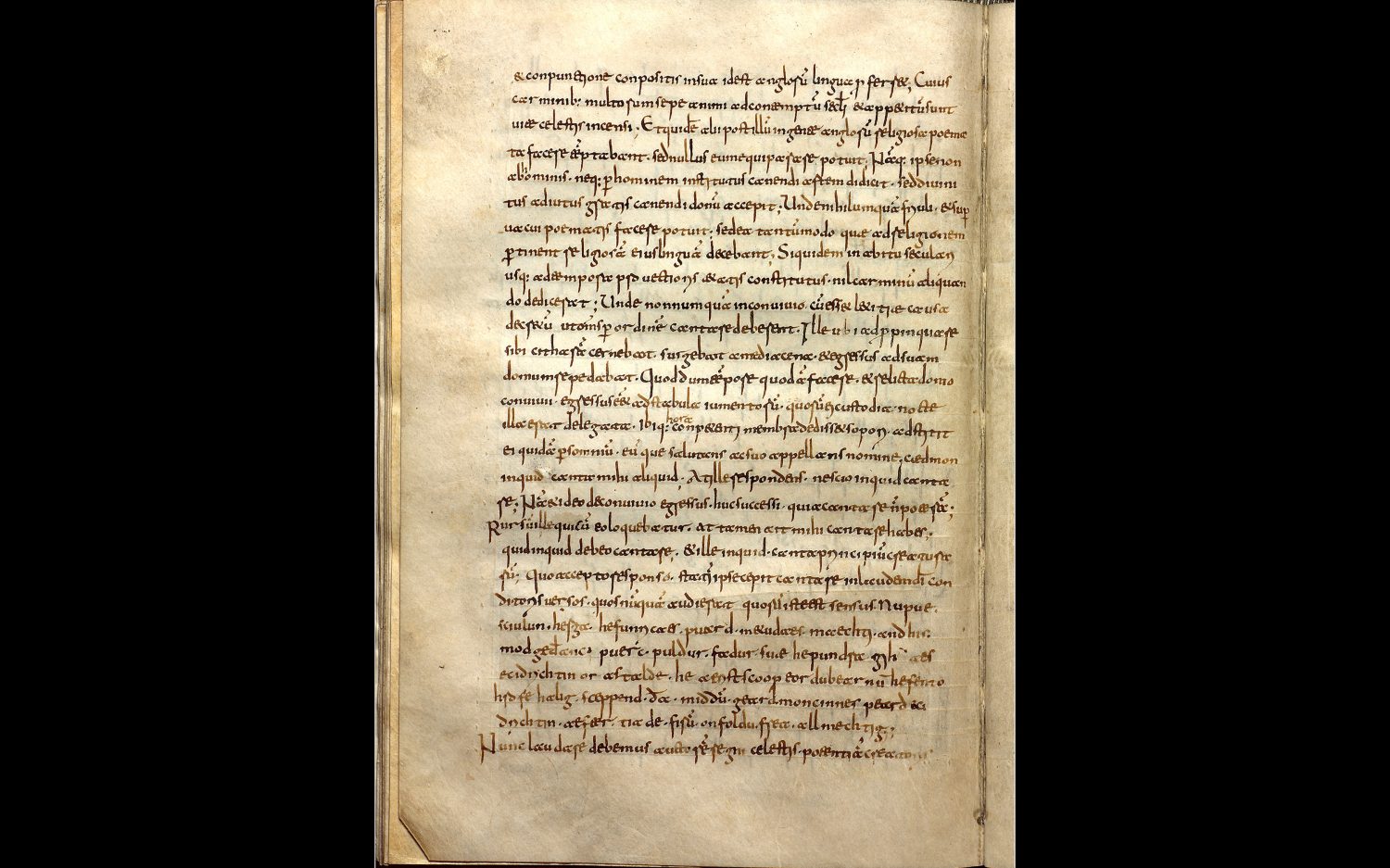
A copy of Bede’s Historia Ecclesiastica recently discovered in Rome, contains Caedmon’s Hymn. Courtesy of Rome, Biblioteca Nazionale Centrale ‘Vittorio Emanuele II’
Earlier this year at Grace Preparatory Academy in New Braunfels, Texas, principal Margy Pryor passed out copies of the medieval poem “Caedmon’s Hymn” under the scrutiny of a cardboard cutout of William Shakespeare in her Advanced Placement English Literature class. Pryor picked the poem for two reasons: One, it’s in Old English, and two, she wanted her students to learn the story of how Caedmon composed it.
Caedmon was an illiterate cowherd in the 7th century in what is now northern England. At night, the men who tended the animals passed around a harp, but Caedmon was embarrassed that he didn’t know what to sing.
One night, he dreamed that a man called him by name. Caedmon answered he was afraid to sing in front of the others, so the man said, “Sing to me.” The man, supposed by some to be a manifestation of God or Jesus, told him to sing about the creation of the world. That song became “Caedmon’s Hymn.”
Pryor said that she and many of her students resonate with the story. “Maybe there’s something that you feel called to do, but you don’t know how to do it. You don’t have to have every bit of information about it, you just have to have the subject matter,” she said. “We don’t have to figure it all out, because God just says, ‘Hey, sing to Me.’”
Students returning to school this fall could benefit from a similar study of the hymn, whose literary history was further illuminated by a recent discovery. Historians have known about “Caedmon’s Hymn” for centuries, but earlier this year, scholars at Trinity College Dublin found a new Old English copy dated to the early 9th century, pushing back the poem’s known existence as a central text in English by nearly 200 years. Though two older copies from the mid 8th century are known, they’re written in Latin, with Old English translations later added by scribes in footnotes. Experts say the discovery proves English’s influence on the world and on the spread of Christianity, affecting how scholars look at both Christian and literary history.
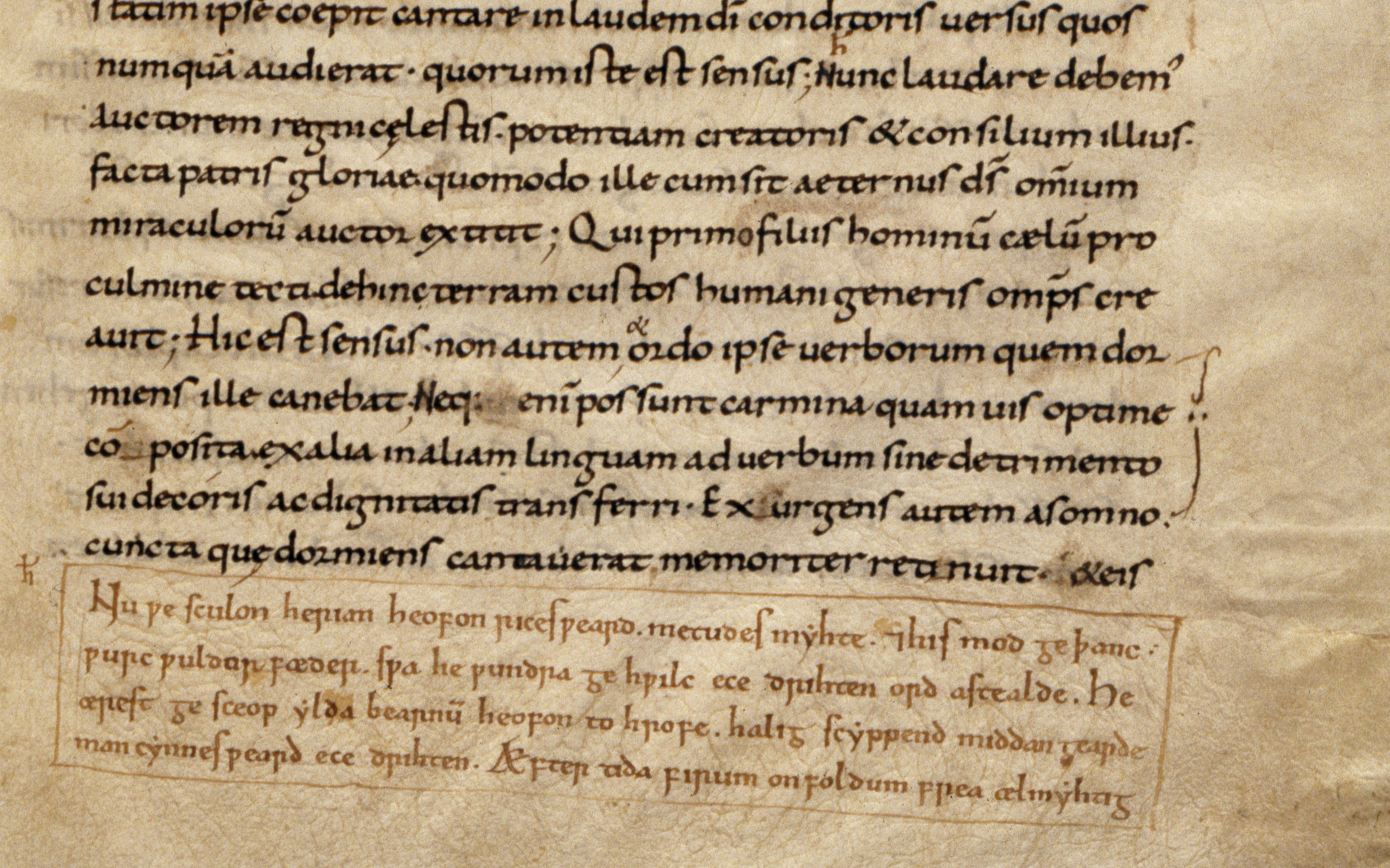
In this previously known manuscript, a portion of a page from Book IV, chapter 24, of Bede’s Latin Historia ecclesiastica gentis Anglorum, shows Old English text of Caedmon’s Hymn added as a footnote in the lower margin. Creative Commons / Wikimedia Commons / Bodleian Libraries, University of Oxford
When Elisabetta Magnanti and Mark Faulkner, from Trinity College Dublin’s School of English, looked at a copy of the early medieval historian Bede’s Ecclesiastical History of the English People dating to the beginning of the 800s, they found a copy of “Caedmon’s Hymn” written in Old English, predating the only existing copy of Beowulf by some 150 years, if not more. Beowulf is the longest poem written in Old English, and it survives in a single manuscript believed to have been written between A.D. 975 and 1050, although it may have been composed earlier. While Beowulf is often thought of as the earliest example of English literature, “Caedmon’s Hymn” predates it, both in composition and in manuscript.
“About three million words of Old English survive in total, but the vast majority of texts come from the tenth and eleventh centuries. Caedmon’s Hymn is almost unique as a survival from the seventh century—it connects us to the earliest stages of written English,” Faulkner said in a statement released by Trinity College Dublin. “As the oldest known poem in Old English it is today celebrated as the beginning of English literature.”
The fact that the poem in the manuscript even appears in English is surprising. Monks copied the recently discovered edition of the poem at the Benedictine Abbey of Nonantola, near modern-day Modena, Italy—a geographical area where, in A.D. 800, no one spoke English.
“Inside a monastery, everything was in Latin. If you were writing something down, it was in Latin,” said Irene Rieger, a professor of English at Bluefield University. “I think it’s very interesting that he’s using the Old English language to sing this hymn to the Lord.”
The new discovery also showcases early use of punctuation, which writers didn’t use in medieval times, when oral storytelling still served as the dominant tradition. Readers discerned when to pause via an innately understood rhythm, explained Matt Hearn, a Lipscomb University professor of English specializing in medieval literature.
“[The copy] says something about their efforts to help people pronounce the poem right and make sense of it when they’re reading it out loud,” Hearn said. “It still has traces of its oral performance, but they’re captured in this literal shape of sort of ad hoc punctuation marking the text.”
Researchers noted that while Caedmon originally composed the poem near Newcastle upon Tyne, in northern England, the Old English dialect in the manuscript is possibly from Mercia, a rival ancient British kingdom that was a significant distance away at that time, Hearn said. This shows scholars that other areas and peoples adopted the poem.
Hearn added that the text’s typographical errors indicate it might be an original version of the hymn that others later copied. Such typographical errors, known among linguistic scholars as variations, act as fingerprints, helping trace which manuscripts were copied from which other manuscripts, creating a timeline.
Christian scholars across disciplines recognize the hymn’s importance. Only nine lines long, “Caedmon’s Hymn” encapsulates Genesis 1 and the beauty of creation and its Creator. The first two lines read, in modern English:
Now let us praise Heaven-Kingdom’s guardian,
the Maker’s might and his mind’s thoughts …
In Old English, those same two lines read:
Nu scilun herga hefenricæs uard
metudæs mehti and his modgithanc …
Old English is more similar to German than to today’s English. Since “Caedmon’s Hymn” was composed, English has gone through several stages of change. Viking influence simplified the language, introducing a different way of constructing sentences, according to Hearn. English also picked up Latin influence, which now plays a heavy part in the language.
“It makes trying to read Old English vaguely nightmarish,” Finley said. “They were a culture that largely depended on rhythm and alliteration and stresses.”
“It’s very different from contemporary English. It’s pretty much another language,” said Rieger.
Because the text uses poetic styles like alliteration, rhythm, and wordplay that evolved in pagan circles, “Caedmon’s Hymn” is viewed as the first English written example of a Christian work appearing in an otherwise pagan oral tradition.
“It shows how Christianity is spreading. [Caedmon is] using his own native language and a native form of poetry,” said Rieger. “And even one of the words, ‘Frēa,’ comes from the name of a pagan god, but he’s using it to describe our God.”
Bede wrote that, after composing the hymn, Caedmon spent the rest of his life turning the stories of the Bible into Old English poems so that other illiterate peasants could learn about Christianity in their own language. Apparently none of Caedmon’s other works have survived.
Autumn Finley, the director of language and literature at Southwest Baptist University, said most people aren’t aware of Old English Christianity.
“A lot of people think praise and worship and hymns come out of the Protestant movements and the King James Bible and everything, but that’s much later,” Finley said. “English has always kind of had Christian texts, even all the way back. … Those Christian roots run deep.”
Despite its differences from the language we know today, “Caedmon’s Hymn” remains important to scholars and Christians.
“It’s one of the first instances that we know of where we’re seeing the beginnings of the English church spreading among people of different classes,” Rieger explained.
The poem is less than 45 words long in its original Old English form. It is no Odyssey or Iliad. Yet that is one of the things that Margy Pryor from Grace Preparatory Academy loves about it.
“It’s short, but the depth of it is really incredible because it all comes out in nine lines,” Pryor said. “There’s just so much depth in all the little pieces, I think, that offer us so much in their richness. It doesn’t have to be a 14-line sonnet. … It’s just nine lines and it’s simple, but it’s everything.”
As more and more ancient libraries are taking advantage of digitization tools, other manuscripts that haven’t been seen in centuries may surface. Hearn hopes to see that happen.
“It’s like this little jewel. It’s one pearl that fell off of a big strand that we’ve discovered that’s been preserved for centuries,” Hearn said. “It’s tantalizing to wonder what else is out there.”


Beginnings alone is worth the price of a WORLD subscription. —Ike
Sign up to receive Beginnings, WORLD’s free weekly email newsletter on science and intelligent design.
Please wait while we load the latest comments...
Comments
Please register, subscribe, or log in to comment on this article.