
A 50-year firewall against taxpayer-funded abortion
Pro-lifers say Trump administration needs to defend the Hyde Amendment against Democratic detractors
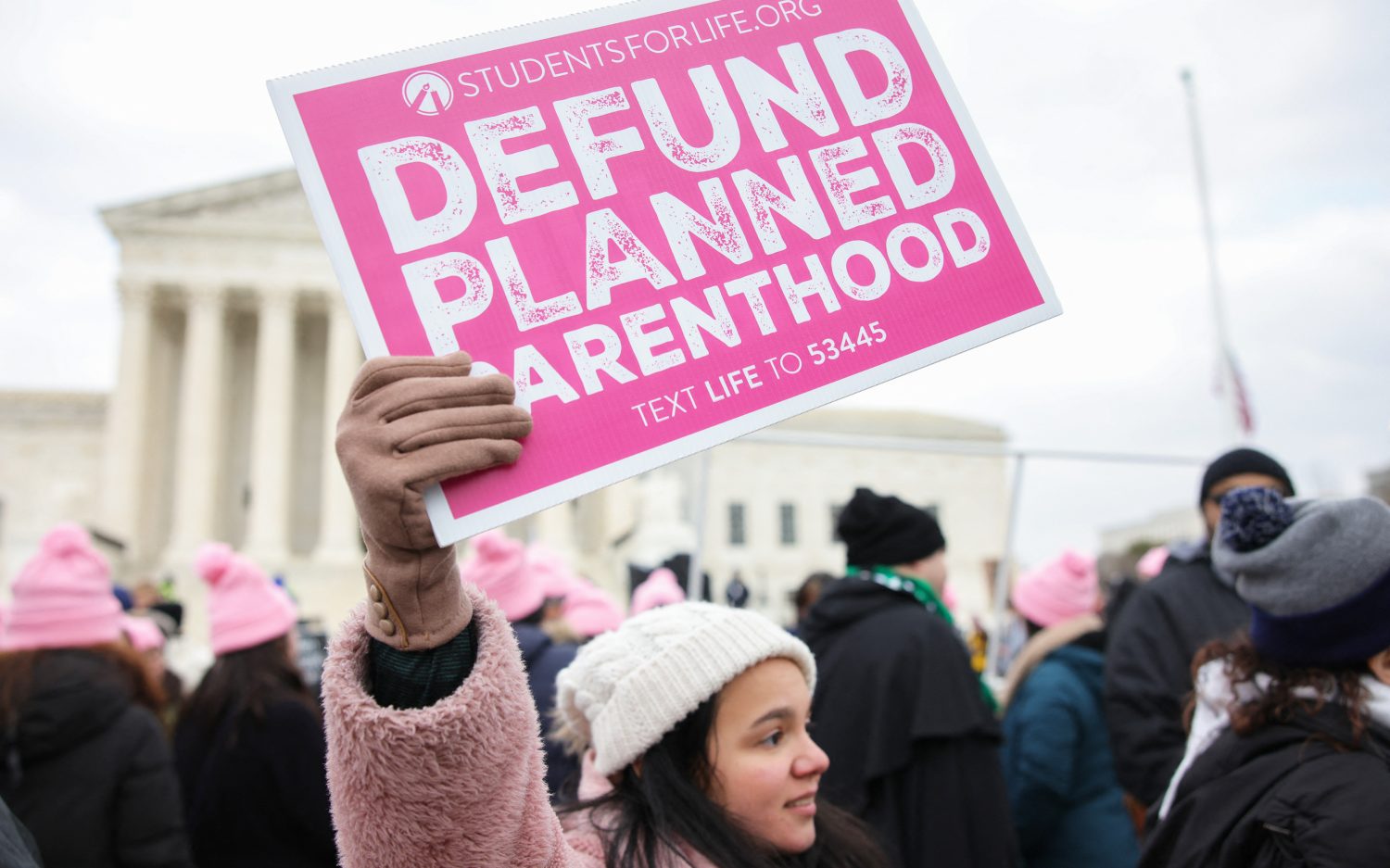
Pro-lifers march to end funding for abortion at the annual March For Life in Washington, D.C. Getty Images / Photo by Bryan Dozier / Middle East Images / AFP
WASHINGTON—At 9:30 a.m. on Wednesday, the trimmed lawn behind the U.S. Capitol was still wet with dew while the sun was already blazing. About a dozen representatives from eight pro-life groups and a sitting U.S. senator stepped up to a makeshift podium to commemorate 50 years of the pro-life policy rider the Hyde Amendment.
“Just three years after Roe, Congress drew a line. It said the federal government would not use taxpayer dollars to pay for elective abortion,” John Mize, CEO of Americans United for Life, told attendees. “That line has held for half a century.”
While the abortion debate has morphed in the 50 years since former Rep. Henry Hyde, R-Ill., first offered his amendment, advocates say the policy of keeping tax dollars from subsidizing abortion remains one of the most consistent and effective pro-life federal policies. But flatlining support from Democrats and indifference from the White House put the endurance of the policy in question.
Hyde drew the line in 1976 when he proposed amending the appropriations bill funding federal healthcare, education, and welfare programs to prevent taxpayer dollars from paying for abortion on demand. “Whatever your view on abortion itself, actually, more Americans opposed taxpayer funding of abortion than opposed abortion itself,” Advancing American Freedom legal scholar Tom Jipping told WORLD. A Democratic majority in the House fractured to pass the Republican-sponsored measure.
Despite bipartisan support for Hyde’s amendment, fierce opponents launched four years of legal battles that went all the way to the Supreme Court in the case Harris v. McRae. A narrow majority of five justices ruled in 1980 that the constitutional right to abortion the court had enshrined in Roe v. Wade did not compel the government to subsidize abortion.
Michael New, a senior associate scholar with the Charlotte Lozier Institute, credits the Hyde Amendment with saving nearly 2.7 million lives since that ruling. “We’ve been able to see what happens to abortion rates in states that change policies,” New said. He reviewed data from states including Texas and Pennsylvania that stopped funding abortion through Medicaid.
“Once a state quits funding abortion with taxpayer dollars, it lowers the abortion rate by 1.52 for every thousand women of childbearing age,” New said. Tallying up the states that comply with Hyde over 50 years, that represents tens of thousands of abortions prevented annually, he estimates.
“Between 1980 and 2017, we cut the abortion rate in half in this country,” he said. In 2000, however, the Food and Drug Administration approved the drug mifepristone for use in abortions, kicking off a chemical abortion trend that has since surpassed surgical abortion numbers.
In 1980, about 80 Democrats in the House of Representatives reliably supported the Hyde Amendment, Rep. Chris Smith, R-N.J., told WORLD. “Unfortunately, we’re down to none,” he said. As abortion became a more central plank of the Democratic Party, presidents from Bill Clinton to Joe Biden have sought to remove pro-life policies. But the Hyde Amendment stayed intact, largely because Republicans in the Senate filibustered appropriations bills that stripped it out.
While the Hyde Amendment acts as a firewall between taxpayer dollars and the abortionist’s office, abortion-boosting officials have found ways to push funds through. Until last year, abortion business Planned Parenthood received hundreds of millions of dollars in federal grants to pay for programs like family planning and cancer screening.
“It’s a shell game,” said Jipping. “Money is fungible: $1 that you get from the government for this frees up $1 that can be spent for that.” That funding stopped for a year, when the bill reauthorizing tax cuts from President Donald Trump’s first term also blocked all federal funds for Planned Parenthood. The policy expired in July, restoring payments.
Democratic administrations have found other ways to get around Hyde, such as by authorizing the Pentagon to pay for service members’ transportation to get abortions while not paying for the procedures themselves. The Trump administration ended that policy last year. The largest category of taxpayer funding for abortion comes from states, which cannot use federal dollars to fund abortion but are able to divert their own tax dollars. Twenty-one states now do so, with seven making the switch in the last decade, including Pennsylvania.
Henry Hyde died in 2007, 15 years before the Supreme Court overturned Roe v. Wade and limits on abortion pills began to fall away. New, the Charlotte Lozier Institute researcher, says Hyde would be concerned about the decimation of Democratic support for the policy and Trump’s lack of strong pro-life moves.
“He’d be dismayed that the current presidential administration isn’t taking stronger action against telehealth abortions, that’s weakening the pro-life laws that we have,” New said.
At a recent Concerned Women for America conference, Attorney General Todd Blanche told attendees the Trump administration is taking its time following through on a safety review of the abortion drug mifepristone. Republican lawmakers have been demanding answers about the status of the review for more than a year.
Trump has also walked up to the line of the Hyde Amendment itself. In January, he weighed in on how Republican leaders in Congress were handling a debate on extending Biden-era healthcare subsidies. During his remarks, Trump told GOP lawmakers “you have to be a little flexible” on the Hyde Amendment.
On Wednesday, Mize from Americans United for Life called that moment out as a red flag for pro-lifers: “The pressure will not only come from our opponents; it will come from our friends who are tempted to trade it away for a deal.”
Smith has made multiple attempts to codify Hyde’s policy into permanent federal law. While his No Taxpayer Funding for Abortion Act has passed the House four times, it “always dies in the Senate, sadly,” Smith said.
The dew was gone when the commemoration of the Hyde Amendment wrapped up on Wednesday. Americans United for Life communications director Sarah Zagorski, an abortion survivor, left her audience with a charge: “Flexibility on the most popular pro-life protection in our nation’s history is not an option. American taxpayers deserve more protections, not less.”


This keeps me from having to slog through digital miles of other news sites. —Nick
Sign up to receive The Stew, WORLD’s free weekly email newsletter on politics and government.
Please wait while we load the latest comments...
Comments
Please register, subscribe, or log in to comment on this article.