
The World and Everything in It: September 7, 2026
Legal Docket follows an Ohio homeowner who stopped gathering for Sabbath prayer after a city order—and lower courts said he still had more process to finish before he could sue. David Bahnsen’s Monday Moneybeat asks when AI’s staggering investment begins to pay and, on Labor Day, why work is rooted in the image of God. Plus: the WORLD History Book on the night Ed Sullivan’s “never” ran into Elvis.
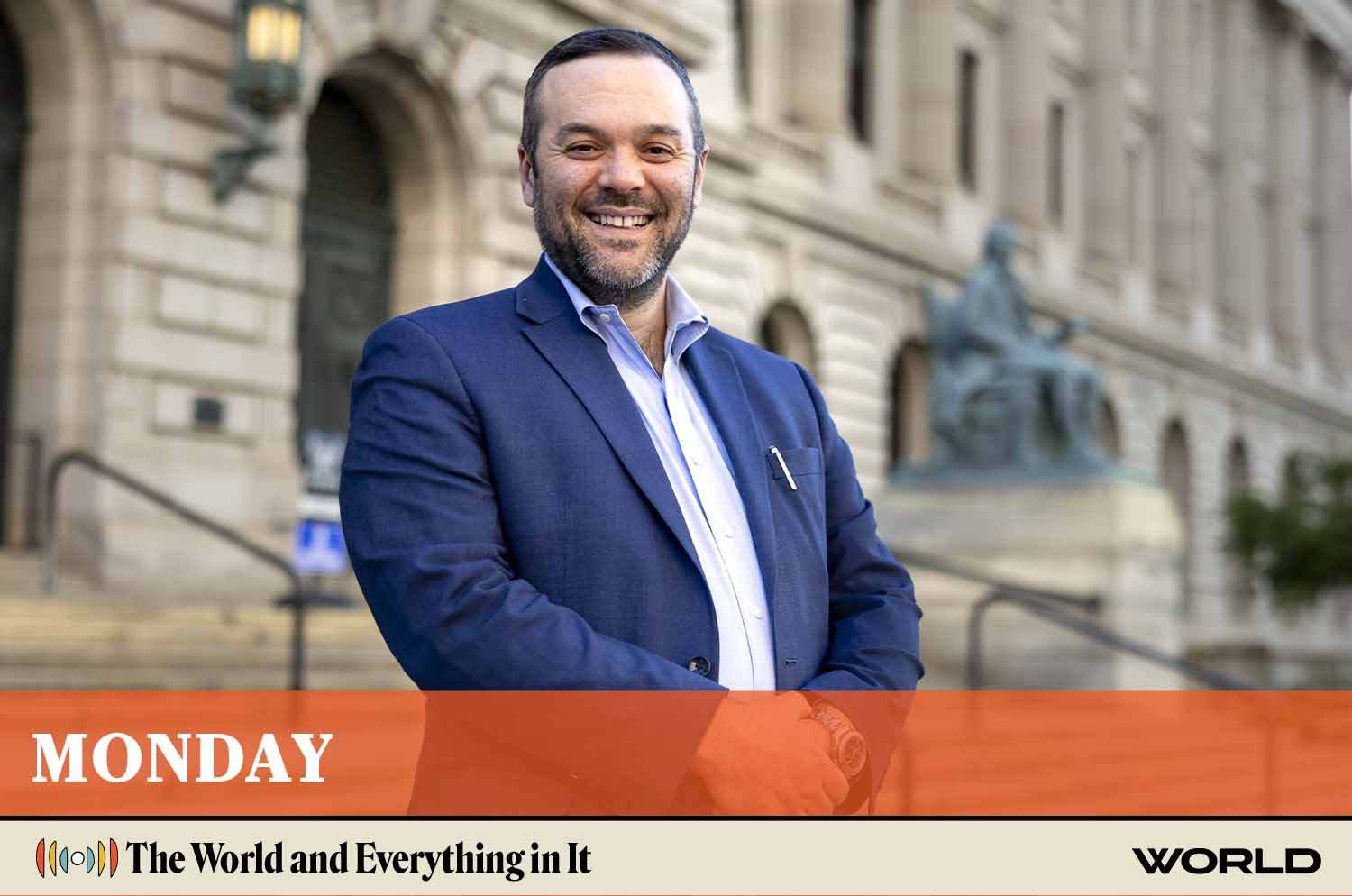
Daniel Grand Photo courtesy of Alliance Defending Freedom
Editor's note: The following text is a transcript of a podcast story. To listen to the story, click on the arrow beneath the headline above.
NICK EICHER, HOST: This summer we’ve marked a milestone anniversary: 15 years of The World and Everything in It.
MARY REICHARD, HOST: And now we’re closing in on 100 million downloads. That’s a lot of mornings together.
EICHER: Sure is, so we made something to mark the occasion—a commemorative The World and Everything in It sticker.
REICHARD: Yeah, for your laptop, water bottle, notebook, toolbox—we’ll leave the placement decisions to you.
EICHER: So whether you’ve been listening for 15 years or 15 minutes, we’d love to send you one—free to you.
REICHARD: Just go to theworldandeverythinginit.org/sticker, and let us know where to send it. A link’s in the show notes.
MARY REICHARD, HOST: Good morning!
Do you need the government’s okay to hold a prayer meeting in your own home?
BURSCH: …they weren’t allowed to get together in a group and pray unless they had a permit … And that put the kibosh on this prayer group.
NICK EICHER, HOST: Red tape and religious freedom today on Legal Docket.
Also today the Monday Moneybeat. Work and human dignity on this Labor Day. We’ll talk with economist David Bahnsen.
And later, the WORLD History Book:
GURALNICK: Ed Sullivan said, “I'll never have Elvis on my program.”
Arsenio Orteza on one of the largest single-night TV audiences in history.
REICHARD: It’s Monday, September 7th–Labor Day. This is The World and Everything in It from listener-supported WORLD Radio. I’m Mary Reichard.
EICHER: And I’m Nick Eicher. Good morning!
REICHARD: Now the news. Here’s Kent Covington.
KENT COVINGTON, NEWS ANCHOR: Miami plane crash » A fiery crash just beyond a runway at Miami International Airport Sunday ended in tragedy.
Miami-Dade County Mayor Daniella Levine Cava:
CAVA: Today is an incredibly difficult day for all of us here in Miami-Dade County. Earlier today, we know that the Prime Air Flight 7598 overran the runway, and now we know that five people lost their lives and five others were injured.
The Amazon cargo jet touched down, but then it couldn't stop. The Boeing 767 ran past the end of the runway, hit a road beyond the airport fence, and caught fire.
More than 60 fire-rescue units responded. Miami-Dade Fire Rescue Chief Ray Jadallah:
JADALLAH: The airplane did strike a couple of vehicles, couple of, uh, victims that were actually trapped in the vehicles. So a complex extrication with our technical rescue team started to occur. In addition to that, we had a very complex fire. Engine, uh, compartments that were on fire.
The airport shut down for about three hours, and two of its four runways reopened by evening.
The National Transportation Safety Board is sending a team to investigate. And Transportation Secretary Sean Duffy is warning of long delays and cancellations today, the last day of the Labor Day weekend.
Witkoff, Kushner Ukraine-Russia talks » Two of President Trump's envoys went from Moscow to Kyiv over the weekend, trying to restart peace talks that stalled months ago. Steve Witkoff and Jared Kushner, the president's son-in-law, met Russian leader Vladimir Putin Saturday, then Ukraine's President Volodymyr Zelenskyy on Sunday.
Kushner says the question is not only -- how to end the war.
KUSHNER: But how do we create the right conditions and arrangements for a long-term, durable peace that allows Ukraine to use the amazing bravery, agility, and strength that it's used to get through the last years of war in order to build themselves into a great nation that they have the fullest potential to achieve. so.
Zelenskyy said they talked about air defenses and getting Ukraine through the winter.
ZELENSKYY: [Speaking Ukrainian]
He also made clear that he wants the war to end , but ended justly, in a way that leaves Russia no chance to attack again.
That last part is the sticking point. Russia wants Ukraine to give up any path to NATO and shrink its army. Putin also wants all of the Donetsk region, including ground his troops have never taken. Ukraine has rejected those demands.
They agreed to stop hitting each other's capitals during the talks, and kept firing everywhere else.
Hawaii hurricane » Hawaii spent the weekend bracing for its third major storm in three weeks. Hurricane Lowell is closing in from the south, and a tropical storm warning is up for the two islands at the northwest end of the chain Kauai and Niihau. Forecasters expect the center to stay 100 to 200 miles offshore.
Robbie Berg with the National Hurricane Center:
BERG: So even though Lowell may not be a direct impact with the eye moving on those islands, we do think that there will still be strong winds. There could even be gusts close to hurricane force, especially in some of the mountainous areas.
The wind should pick up on Kauai this afternoon, local time, and peak tonight. Kauai's mountains could get more than a foot of rain. Surf could build to 30 feet.
The islands are still cleaning up from Hurricane Lala, which killed one person and damaged more than 100 homes last month. Tropical Storm Moke flooded them again a week later.
Lindsay Clancy trial » Lindsay Clancy could face a second murder trial for killing her three children. That's the district attorney's call, and he hasn't made it. A hearing is set for September 29th.
Her trial ended Friday with a hung jury. Clancy never denied strangling Cora, Dawson and Callan in 2023, ages five, three, and eight months. Prosecutors said she knew exactly what she was doing.
Plymouth County District Attorney Timothy Cruz:
CRUZ: Our priority has always been to fight for Cora, for Dawson, and for Callan. Children were murdered, and it's our job to seek justice.
Her lawyer argued that postpartum psychosis, a rare illness after childbirth, left her not criminally responsible for what she did.
Defense attorney Kevin Reddington said Clancy should have been found not-guilty, and blames a single juror he says refused to follow the judge's instructions.
REDDINGTON: For Lindsay, I, my heart breaks for her. She deserved that acquittal that she should have had.
Cruz can retry her on three counts of first-degree murder, file lesser charges, or drop the case. Legal analysts consider dropping it unlikely. Clancy has been in a state psychiatric hospital, without bail, for more than three years, and she stays there while the case is open. Even an acquittal wouldn't necessarily set her free. The judge could order her confined to a mental hospital instead.
Box office » At the weekend box office, Spider-Man: Brand New Day continues to put up historic numbers.
CLIP (Spider-Man trailer): We are faced with a danger that we can’t control — one we can’t even see.
Spider-Man has now spent six straight weeks atop the box office, earning another $18 million dollars stateside. Its global total now is now $2.4 billion dollars, the third largest ever.
That was followed again by The Odyssey, which is now the 14th highest grossing film ever, at $1.6 billion.
I'm Kent Covington..
Coming up: Red tape and religious freedom on Legal Docket. And later, the World History Book.
This is The World and Everything in It.
MARY REICHARD, HOST: It’s The World and Everything in It for September 7th, 2026.
And 15 years in, we’re still grateful to be part of your mornings.
Good morning! I’m Mary Reichard.
NICK EICHER, HOST: And I’m Nick Eicher.
Time now for Legal Docket.
A dispute over prayer in a private home raises a crucial question about government power.
If a city’s cease-and-desist order stops the prayer, is the homeowner required to go through the entire local zoning process before a federal court can hear his First Amendment claim?
At stake is whether bureaucratic delay itself can chill First Amendment rights. And whether the process itself can become the punishment.
REICHARD: The case goes back to January 2021, in a Cleveland suburb called University Heights, Ohio. Orthodox Jewish homeowner Daniel Grand invited about a dozen people for prayer gatherings at his house on the Sabbath. The city ordered him to stop, saying he needed a special-use permit. So Grand did cancel the gatherings.
And he later applied for the permit but withdrew his application before the planning commission ruled. When he sued, the lower courts never decided whether the city violated his rights. They said he sued too early, because zoning officials never reached a final decision.
Now the Supreme Court is stepping in to resolve a key procedural clash. At issue: Whether a “finality rule” built for property takings applies to First Amendment claims ... when land use is involved.
The case is Grand v. City of University Heights. Here’s what Mr. Grand was trying to do.
GRAND: I wanted to have a group of my friends come over to pray in basically my recreation room.
EICHER: His Orthodox Jewish practice requires communal prayer with what is called a minyan, a group of ten adult Jewish men.
During the week, Grand could drive to a nearby synagogue. But on the Sabbath, his religious practice prohibits driving.
GRAND: So when it's twelve degrees outside and you've got a mile to walk six times back and forth, it becomes a bit of a trek and sometimes it's hard to actually do. If it's raining, we can't carry umbrellas. So it's like a very difficult thing to accomplish. Nobody wants to show up to an engagement sopping wet and then walk back home …So it's more like necessity, I think, than it really is luxury….It's hard to go that far sometimes, in really inclement weather. So the group made sense.
REICHARD: His email invitation found its way to the mayor.
Within hours, the city sent Grand an order to stop, warning that hosting the prayer meeting would violate city code. The city declared his private residence an unauthorized “place of religious assembly.”
Alliance Defending Freedom attorney John Bursch represents Grand.
BURSCH: And they issued a cease-and-desist letter to Daniel and told him that they weren’t allowed to get together in a group and pray unless they had a permit from the city that they were a “designated house of worship.” And that put the kibosh on this prayer group.
EICHER: That kibosh came with teeth: the letter warning that violating the order could result in fines or prosecution.
REICHARD: So, that was the end of the prayer meetings and Grand applied for the permit, thinking it might be like when neighbors hold a garage sale that also requires a permit.
GRAND: I complied…thinking it would be like a cute thing an administrative permit, you go to the window, you pay your ten dollar fee, and you move on to get your paperwork and then they leave you alone. But that's not really what it was.
Here’s an important wrinkle: The city later took the position that a small gathering like the one Grand describes did not actually require that house-of-worship permit. I did contact the mayor’s office to discuss this further, but was told the city “does not comment on on-going litigation.”
But five years ago, Grand understood the city order to mean he could not proceed. So he applied for the permit and expected to go through a more involved, but still normal administrative process.
What he later found out is that he needed to hire a lawyer, provide building plans, and get approvals from city officials. And then there was a public hearing:
GRAND: …people living within close proximity of my house, you could say within a mile or two, brought up certain types of concerns that are typical zoning concerns, and I would even say that are typical, reasonable zoning concerns. But the problem was we had stated again and again and again in writing, on the record, in verbal forum in public, that we can't drive. “But you might start doing that later. That's what you say now.” I'm like, no, we've been pretty consistent with that for the past three and a half thousand years. I don't see how we're gonna change that one now, but…
EICHER: Regardless, the planning commission neither approved nor denied Grand’s application. It tabled the matter and asked him for more documentation. But Grand says when he tried to find out exactly what additional information the officials wanted, the mayor told him no further information would be accepted.
GRAND: So anybody who's rational…understands, okay, you tabled this event to ask me for more information. I am now pursuing you because you're not telling me how to provide you any of that asked for information. And now in the process of pursuing you, you told me point blank that you will not accept any other information from me. So if that's not the very essence and definition of futility. Then I ask somebody to please explain the word because I might not know what it means.
So he withdrew the application.
He said he didn’t want to operate a “house of worship,” as the zoning rules defined it.
And good thing: Because Grand also discovered those rules hold that a property approved as a house of worship could not also be used as a residence.
In other words, as his lawyer puts it—
BURSCH: He was kind of caught between a rock and a hard place, because if he had gotten the permit that said that he had a house of worship under the city’s zoning code, his family would no longer be able to live and sleep there. And so to have a permit to pray in your home, you have to give up your home.
REICHARD: The city held the second hearing anyway. The mayor said the cease-and-desist order was still in place. And he called on neighbors to report potential violations. Police patrolled past his house and a housing inspector came by to search it. No violations noted.
EICHER: Grand decided the only way to resolve this was a federal lawsuit. He sued the city and several officials under the First and Fourteenth Amendments—alongside a federal law protecting religious land use.
He lost at the trial court and appeals court levels; each court finding his claims weren’t “ripe” for judicial review, because the city hadn’t reached a final decision about his permit.
REICHARD: And now we get to the legal doctrine at issue in the Supreme Court case: the land-use finality requirement.
Typically, when a property owner challenges a zoning restriction, he or she must get a definitive answer from local officials before suing. Because until the zoning authority actually says what it will and won’t allow, a court may not know the extent of the alleged injury…if there even is an injury.
EICHER: The city relies on that rule to resolve the dispute.
The city’s position is: Grand withdrew his application. He merely asked for more information. Nothing was enforced.
So on that basis, the lower court dismissed the case without prejudice. That means Grand could sue later if the city eventually did apply its ordinance in an unlawful way.
But that’s where the idea of the-process-is-the-punishment comes in.
His lawyers argue there’s a First Amendment “chilling effect” here, when a government threatens to deter religious exercise, zoning concerns or not.
BURSCH: When you're talking about a Free Exercise violation where someone was denied the ability to pray, that injury is immediate and it's already well known. And so that person has the ability to go to court right away. And so it's really about access to the federal courts after religious liberty rights have been violated.
REICHARD: In other words, you don’t have to wait to be fined or arrested before challenging a credible threat to a first freedom. Without that assurance, some people would give up their rights rather than risk punishment just to create a lawsuit.
Still, the city says nobody should assume how it might have ruled, and Grand is asking for intervention in a local zoning matter that just hasn’t completed yet.
EICHER: If Grand wins at the Supreme Court, it won’t mean every gathering in a private home might not be subject to neutral rules about noise, or traffic, or big crowds. Nor will it decide whether University Heights violated Grand’s rights.
A win would mean his claims are ripe and the trial court has to open its doors to address the merits.
GRAND: What I want from the Supreme Court is is just essentially justice to be served. That, you know, this man is allowed to have a private prayer gathering in his home without governmental interference. And if that can't happen, then he is going to be allowed to have a capacity and a path forward to redress his issues of injury in a court, which is really what's been prevented.
REICHARD: Oral argument is scheduled for December. And that’s this week’s Legal Docket!
MARY REICHARD, HOST: Coming up next on The World and Everything in It: The Monday Moneybeat!
NICK EICHER, HOST: Time now to talk business, markets, and the economy with financial analyst and advisor David Bahnsen. David heads up the wealth management firm, the Bahnsen Group, and he is here now. David, good morning.
DAVID BAHNSEN: Good morning, Nick. Good to be with you.
EICHER: David, let’s begin with Friday’s jobs report. The first estimate says that August payrolls grew by 162,000, but the Monday Moneybeat rule is we prefer trends to single data points. And lately, David, you’ve been especially cautious about that first estimate because the revisions downward have been so substantial.
Even still, that 162,000 number did outpace expectations. David, how did you see it?
BAHNSEN:It’s better than where things had been. You really want 200,000 a month as a normal monthly jobs number, and I get a little bit disappointed when I hear people celebrating 162. But on a relative basis, celebrating 162 makes sense if there was a possibility of declining 20,000, the way we’ve had revisions and things the last couple months.
That’s the other piece you bring up: the trend. I like to get two or three months of data in a row, and that’s more important than it’s even historically been because of all the restatements and revisions we’ve had over the last several years.
EICHER: David, let’s turn to AI and your Dividend Cafe writing this week. AI, of course, has been a big political story. It’s an economic growth story. It’s obviously a huge market story. But your argument is that there’s a more basic financial question underneath all of it. What is the big question you think people are missing?
BAHNSEN:One of the points that I make is that there’s a very heavy amount of discussion right now in the political realm about AI, in the macroeconomic realm because our economic growth is so incredibly dependent on the AI story, and then naturally there are various questions when you see returns that were this high, this quick, certain things going up 100%, going down 50%. That sort of heavy volatility naturally provokes people wondering about a bubble and wondering about all the noise around it.
And I think all of those various categories are important, and they’re all legitimate, and I’ve addressed all of them, and will continue to. But the element that I believe, from a finance standpoint, from an underlying investment standpoint, needs to best be understood, is the totally unknowable answer to the question about future returns on invested capital and the timing of those things when they are so dependent on capital markets funding them.
What I mean by this is we are not in a situation where you take your favorite AI application, or what they call an LLM—and a lot of people use ChatGPT or Claude or Grok—and you say, “I’m really enjoying it, and maybe I’m paying 20 bucks a month for it.” And there’s other companies paying more, but their revenues are a teeny, teeny, tiny percentage of hundreds of billions of dollars of commitments.
And you say, “They wouldn’t have made those commitments unless anticipated future revenues out to extend it.” Maybe, and then you need profits from that, and we don’t know what those will be. And I’m not referring to the profits of the people that are making data centers or making GPUs or even making ChatGPT. I’m referring to the profits of the customers of these things, the enterprises that have to use it.
There’s all these questions there, and my point, Nick, and what I really hope WORLD listeners will understand is this thing is only possible right now because of hundreds of billions of dollars of debt and equity being issued to pay for it.
And so there’s a lot of risk takers out there that at some point may say, “Yeah, no, we need to get paid more to do it, or we’re not going to put more in until we get more return.” And that timing of capital markets cooperation with the most expensive expenditure in human history—more than it was to build the national railroad network, adjusted for inflation, more than it was to build telecom, fiber optics, cable, more than it was to build cloud, more than it was to build the internet.
This is the most expensive endeavor in human history. We do not know what the future profits will be, when they will come, and I think people need to question: Is there some risk about how the funding will align?
And then you add in all the other things people are bringing up about the political environment, controversy about data centers, competition from China. I was trying to simplify it to the one big thing, but if I’m being fair, there’s six or seven other things that pile on too.
EICHER: David, before we let you go, it is Labor Day today, so it seems appropriate to ask: In your book Full-Time, you make the case that work is bound up with why God made us. Why do you say that work itself is a matter of human dignity?
BAHNSEN: That book I wrote, Full-Time, on a sort of understanding of work from a biblical perspective that I think will always be an evergreen message. It isn’t meant to be a current-events hot topic. The argument I’m making is by definition perpetual because I’m arguing for this existential understanding of work that roots why we work to why God actually made us, and to the very fundamental Christian concept of imago Dei, that if we are made in the image of God, it behooves us as believers to understand what that means.
And as an economist, I’ve long believed that my appreciation for economics—why I long ago transcended this idea of, “Oh, it’s a dismal science. It’s boring. It’s a good thing I’m a nerd”—I’ve always found it a very exciting, invigorating, fulfilling topic because I view it in the context of imago Dei, and because I view it in the context of what God made man for.
And I think that God made us to work, and in that endeavor, whereby we are producing goods and services that meet the needs of others, dignity is found. And it is that way because God made it that way.
And we can appreciate this in small and big ways. Just when we do something that helps serve a customer or serve a coworker, we feel good about that, but also the notion that we have our needs met, but we had to do something. There’s an agency where you really don’t see a lot, Nick, of people that feel very satisfied, that have fulfilled lives, when their needs are met by them being passive.
Laying on the couch and having your needs met may sound good for some people, and every now and then maybe it’s a little alluring when someone gets tired. But it’s no way to live.
And so my message about work is rooted in this biblical anthropology: God made mankind in His image, and that means for us to really stoke our own productive, creative, and innovative impulses, and I find a lot of fulfillment in that.
EICHER: Excellent. David Bahnsen is founder, managing partner, and chief investment officer of the Bahnsen Group. He writes regularly at dividendcafe.com and at WORLD Opinions. David, I hope you have a terrific week and a productive Labor Day.
BAHNSEN: Thanks so much, Nick.
NICK EICHER, HOST: Good morning! This is The World and Everything in It from listener-supported WORLD Radio. I’m Nick Eicher.
MARY REICHARD, HOST: And I’m Mary Reichard. Up next: The WORLD History Book. Today, Elvis on Ed Sullivan.
It has long been said Elvis Presley was the Big Bang that set pop culture as we know it in motion. But that “bang” was really a series of them, each bigger than the one before. And there’s no doubt that Presley’s September 9, 1956, appearance on one of the nation’s most-watched television programs was right up there.
Here’s WORLD’s Arsenio Orteza.
ARSENIO ORTEZA: Six of the 10 songs that Elvis Presley recorded for his first label, Sun Records, failed to make any Billboard chart. And three of the four that did were country hits. One was “Mystery Train,” which reached #11. Another was “Baby, Let’s Play House,” which reached #5. And one was this Stan Kesler-Charlie Feathers composition.
MUSIC: [“I Forgot to Remember to Forget” by Elvis Presley]
“I Forgot to Remember to Forget” became a country #1 in 1955, one year after Presley’s first appearance on the pop chart with this song.
MUSIC: [“I Don’t Care If the Sun Don’t Shine” by Elvis Presley]
“I Don’t Care If the Sun Don’t Shine” peaked at an unimpressive #74. Presley had already been nicknamed “The Hillbilly Cat” because of his seemingly effortless ability to blend the gospel music, country music, and blues he’d loved growing up. But as someone who would eventually be called the King of Rock and Roll, he was off to a slow start.
Then he signed with RCA, where “Heartbreak Hotel” and “I Want You, I Need You, I Love You” were instant smashes. And both sides of this single topped the pop and country charts.
MUSIC: [“Hound Dog (Studio Version)” by Elvis Presley]
Presley and a backing band performed “Hound Dog” eight weeks after its release on The Ed Sullivan Show. He’d performed on national TV shows before—nine times, in fact. But the Sullivan show was bigger than any of the others. And the 60 million viewers who tuned in to watch him on September 9 made that Ed Sullivan episode the most-watched U.S. TV broadcast up to that point. But Presley biographer Peter Guralnick says the event almost didn’t happen.
GURALNICK: Ed Sullivan said, “I'll never have Elvis on my program.” He then got beaten in the ratings by Steve Allen, and he then said, “O.K., I will have this artist.”
Interestingly, Sullivan wasn’t the host that night. He’d been in a car accident and was still recovering. So the man who introduced Presley to Sullivan’s audience was the English actor and regular Sullivan guest Charles Laughton. Presley also didn’t perform at the show’s Broadway theater. Instead, he was beamed in from a CBS soundstage in Hollywood because he was making his first film. Its title became apparent with the second song he performed.
MUSIC: [“Love Me Tender (September 9, 1956)” by Elvis Presley]
Presley performed two more songs that evening, including this cover of the then-new single by Little Richard.
MUSIC: [“Ready Teddy (September 9, 1956)” by Elvis Presley]
But the number that he opened with was “Hound Dog”’s flip side, which was also riding high at the time.
MUSIC: [“Don’t Be Cruel (September 9, 1956)” by Elvis Presley]
Presley ended up appearing on the Sullivan show three times (at eight-week intervals), and he got paid $50,000. It was a figure negotiated by his manager, Col. Tom Parker, and one that translates into a little over $600,000 today. Time magazine called it “astronomical.” And it remained so for a while—Sullivan only paid the Beatles $10,000 for their three appearances eight years later.
Details from Presley’s second and third Sullivan appearances sometimes get mixed up with those of his first. His gyrations already had people calling him “The Pelvis,” for instance, but Sullivan’s crew had not yet been told to shoot him only from the waist up. Not that such instructions would’ve made much difference. By September 9, 1956, the Hillbilly Cat was out of the bag.
MUSIC: [“Hound Dog (September 9, 1956)” by Elvis Presley]
That’s this week’s WORLD History Book. I’m Arsenio Orteza.
MARY REICHARD, HOST: Tomorrow: A nationwide EMS staffing problem may mean longer wait times in a medical emergency. We’ll have a report. And, a year after Charlie Kirk’s assassination, apologist Frank Turek says something has changed on college campuses. That and more tomorrow.
I’m Mary Reichard.
NICK EICHER, HOST: And I’m Nick Eicher.
The World and Everything in It comes to you from WORLD Radio. WORLD’s mission is biblically objective journalism that informs, educates, and inspires.
The Bible says … “Trust in the LORD with all your heart, and do not lean on your own understanding. In all your ways acknowledge him, and he will make straight your paths. Be not wise in your own eyes; fear the LORD, and turn away from evil. It will be healing to your flesh and refreshment to your bones.” —Proverbs 3:5-8
Go now in grace and peace.
WORLD Radio transcripts are created on a rush deadline. This text may not be in its final form and may be updated or revised in the future. Accuracy and availability may vary. The authoritative record of WORLD Radio programming is the audio record.
Please wait while we load the latest comments...
Comments
Please register, subscribe, or log in to comment on this article.