
The World and Everything in It: September 3, 2026
Collapsed roads strand thousands beyond easy reach in flood-ravaged Nepal, while a 25-year counterterrorism review asks whether America is ready for threats armed with drones and AI. A prenatal screen can raise life-and-death questions before diagnosis. Plus: an electrician spends six hours trapped inside a 130-foot truck-stop sign, musicians make joy from wind and steam, and Daniel Suhr considers the leverage behind Seattle’s narrowly averted teachers strike.
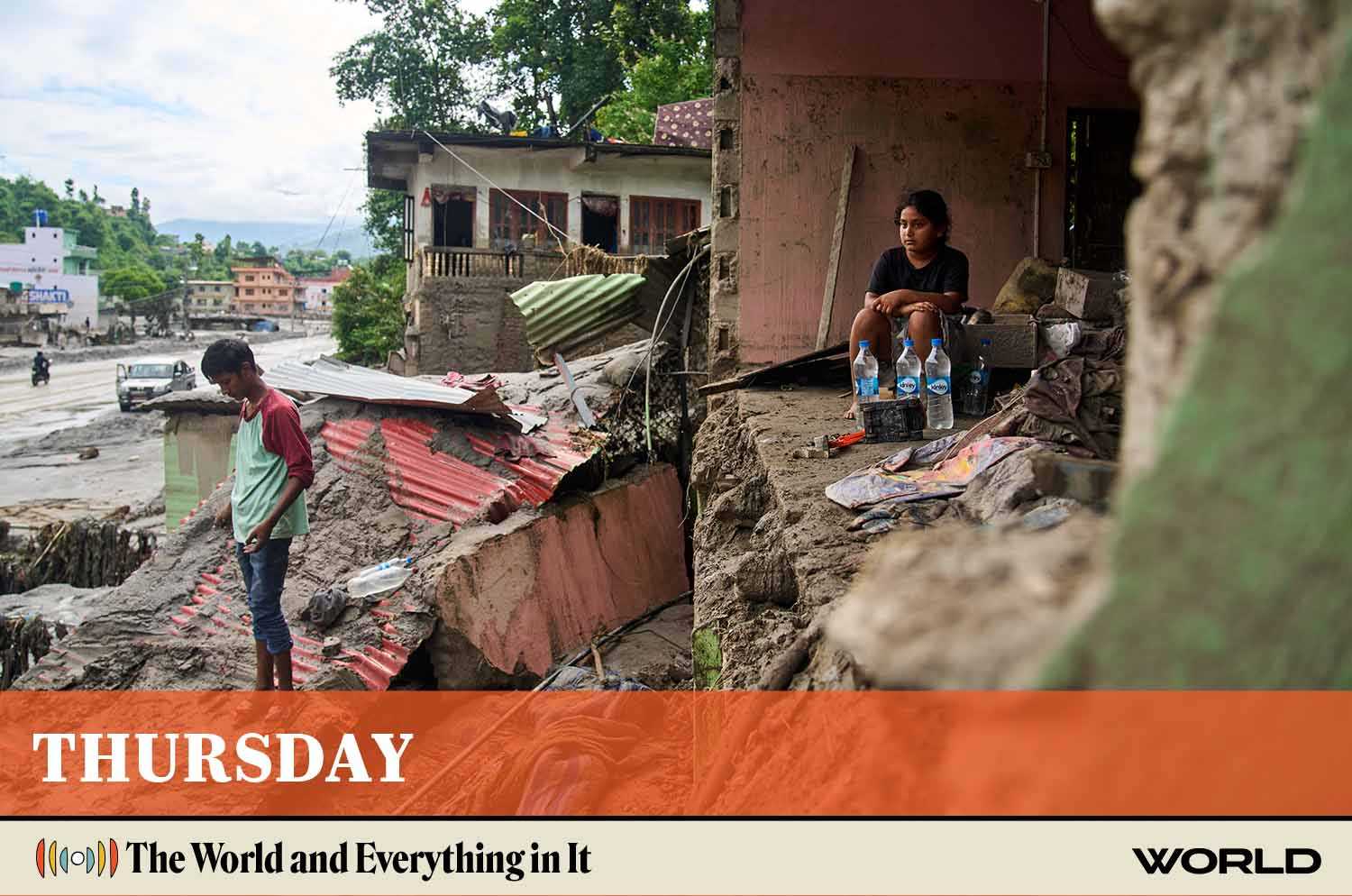
A girl sits in a building damaged by the recent flash floods in Nepal, Sunday. Associated Press / Photo by Niranjan Shrestha
Editor's note: The following text is a transcript of a podcast story. To listen to the story, click on the arrow beneath the headline above.
MYRNA BROWN, HOST: Good morning!
A new report identifies possible weaknesses in fighting terrorism 25 years after 9/11.
CLARKE: Are we in a place now similar to August 2001? I would say yes.
MARY REICHARD, HOST: And, on the ground in Nepal. We’ll talk to an aid worker about the massive floods.
Also, how prenatal screenings may endanger the lives of unborn babies.
And using uncommon instruments to bring joy.
HELTON: The tips ain’t the biggest thing in my playbook. It’s brightening people’s day.
And WORLD commentator Daniel Suhr on the leverage lessons from a narrowly averted teachers’ strike.
BROWN: It’s Thursday, September 3rd. This is The World and Everything in It from listener-supported WORLD Radio. I’m Myrna Brown.
REICHARD: And I’m Mary Reichard. Good morning!
BROWN: Up next, Kent Covington with today’s news.
KENT COVINGTON, NEWS ANCHOR: Iran latest » Iran keeps firing missiles at American bases in the Middle East. Air defenses keep knocking them down. Jordan says it destroyed 10 of 13 Iranian missiles Wednesday. Kuwait, Bahrain and Iraq also came under attack. No deaths reported.
American strikes are landing, though. President Trump says the U.S. now has almost total control of the Strait of Hormuz. And he said of Iran’s government:
TRUMP: The regime is getting weaker and weaker by the day, and at some point they're not gonna be able to shoot so easily because I think the people aren't going to take it.
Iranian officials claim a U.S. strike hit a wedding on Iran's southern coast, killing four people. The Pentagon says it's looking into those reports, which came from Iranian state media.
Iran's Revolutionary Guard also claims it killed Americans at a base in Kuwait. The U.S. has not confirmed that.
The administration is also squeezing Iran's economy, and warning others not to help Tehran. Treasury Secretary Scott Bessent:
BESSENT: Look, my, my message to everyone is, uh, s- stay away. We all want this conflict to end, and the fastest way for the conflict to end is the, uh, for no one to provide any support to this regime. We are going to sever every tie that they have from the outside world.
Secretary of State Marco Rubio says countries helping Iran should know what they're funding:
RUBIO: They want money for two things, to sponsor terrorism and ultimately to have a nuclear weapon. And, and we can't allow that to happen.
Trump says Iran's response means a harder American strike is coming.
Rubio on Army Secretary » Secretary Rubio also chimed in on another leadership change inside the Pentagon.
Army Secretary Dan Driscoll stepped down this week, the latest in a string of top officials to either leave or be fired from the Pentagon under Secretary of War Pete Hegseth.
Rubio says it's not unusual for officials to leave.
RUBIO: Every administration has turnover and, and obviously, look, when you're trying to systemically reorganize an agency, uh, like as, one as big and as, uh, large as the Pentagon is, there are gonna have to be some changes made, which is one of the things, some of the things that Pete Hegseth has done.
Driscoll had reportedly clashed with Hegseth for months over changes the War Secretary had made to the Pentagon leadership.
Venezuela deals » Oil companies signed deals Wednesday to go back into Venezuela… the country holding the world's largest proven oil reserves. The signing happened at the presidential palace in Caracas, with U.S. Energy Secretary Chris Wright standing by. Venezuela's acting leader Delcy Rodríguez signed for her government. Wright thanked the companies:
WRIGHT: Thank you from the Pre-- United-- President of the United States, from myself, and from the people of the United States of America to Chevron, to Eni, to GE, and to the many companies that will follow behind you to bring capital, technology, and opportunity into the country of Venezuela.
Chevron is putting in more than $7 billion over five years… aiming to more than double its own output there, to about 600-thousand barrels a day. President Trump says Venezuelan crude will refill America's emergency oil stockpile, which sits near a 44-year low.
The deals came together in less than three months. Wright:
WRIGHT: We were trying to work at what I call Trump speed. President Trump didn't want a, a nudge or a slow drift in the positive direction. He wanted to see as fast a p-- as possible transformation in Venezuela.
But the industry says fast is relative. Venezuela pumps about a million barrels a day, down from three million in the 1990s. Analysts at Rystad Energy figure getting back to three million would take 15 years and $183 billion.
Russia » Authorities say a Russian drone attack nearly damaged a number of cargo planes at a major airport, not in Ukraine, but in Germany.
Top European and NATO officials said Wednesday that the evidence is in, and it shows Russia launched the foiled attack at the Leipzig / Halle airport in Germany.
European Commission President Ursula von der Leyen condemned the attack which she said risked further escalation of the war.
LEYEN: Had this attack succeeded, this would have resulted in enormous damage and possibly even loss of life. So I want to be very clear about what this was. This was an attack using military-grade material, carried out by Russian operatives on European Union soil.
German authorities say they neutralized a drone carrying explosives near cargo planes at the airport on August fourth. A second drone collided with an aircraft, causing minor damage. They said the drone's configuration, components, explosives, and detonator all pointed to a Russian origin. But Russian leader Vladimir Putin denied the claims, accusing German authorities of planting the evidence.
European countries are lining up in support of Germany. UK Foreign Affairs Minister Ed Miliband:
MILIBAND: We see an attempt by Russia to divide us in Europe, and to deter us from our support for Ukraine. And I say very clearly today on behalf of the United Kingdom, this attempt will fail.
In response to the attack, German authorities shut down the Russian consulate in Bonn, as well as a Russian cultural center in Berlin.
Ebola » Congo's Ebola outbreak has now killed more than 3,000 people. WORLD’s Benjamin Eicher reports.
BENJAMIN EICHER: The health ministry there says about half of everyone confirmed infected has died.
The outbreak is only three and a half months old and it’s already the deadliest Ebola outbreak Congo has ever seen, and the fastest growing anywhere. The World Health Organization says it's on pace to pass the West Africa epidemic that killed 11,000 people a decade ago.
Trackers can't find the virus fast enough. U.S. health officials say up to 80 percent of new cases show up outside the chains of infection anyone is following. And there's no vaccine and no approved treatment for the strain behind it.
The CDC is blocking travelers who've been in Congo in the last three weeks from boarding flights to the United States.
For WORLD, I’m Benjamin Eicher.
Minneapolis shooting » Three people are dead after a shooting in Minneapolis Wednesday. Two victims were killed. The shooter is also dead. It was not immediately clear how he died.
Minneapolis Police Sgt. Garrett Parten said officers arrived at the scene before 5pm, inside a high-rise building, and immediately saw victims and “heard additional gunfire.”
PARTEN: Officers followed the sound of gunfire to the upper floor of the building, and on that floor, officers encountered a haze that significantly limited their visibility. Three officers were injured, two of those by gunfire
Hennepin County Medical Center said it received seven patients, including three officers who were in stable condition last night.
I'm Kent Covington.
Coming up, how fighting terror has changed since 9/11. Plus, musicians use unique instruments to delight their audiences.
This is The World and Everything in It.
MARY REICHARD, HOST: It’s Thursday the 3rd of September.
Glad to have you along for today’s edition of The World and Everything in It. Good morning, I’m Mary Reichard.
MYRNA BROWN, HOST: And I’m Myrna Brown.
First up: devastation in Nepal
SOUND: [Helicopters taking off]
Army helicopters continue flying supplies to search and rescue teams in the mountains west of Kathmandu. They’re searching for survivors and victims of massive flooding last week. More than 1,000 people are confirmed dead. Nearly 4,000 are still missing. And 90,000 more impacted by the destruction.
REICHARD: Well, joining us now to talk about all this is Grant Parker with Hope Over Crisis. That's an evangelical international relief organization that partners with churches in vulnerable regions.
Grant, you're on the ground there. What are you seeing?
PARKER: Thank you for having me. The situation remains still very challenging and very dynamic. You still have rains that can cause flash flooding. There are still humanitarian actors and organizations that are trying to get to places where people are still cut off from access to emergency relief.
REICHARD: So there's such a great need for relief. Thousands of people displaced, infrastructure just gone. What are the main barriers, do you think, keeping aid from getting where it needs to go? Is it access funding, coordination, all three more?
PARKER: All three, I know the UN is coordinating with the government and so are the humanitarian humanitarian actors on the ground. It is a government-led response. That said, the government is, you know, requesting assistance from other humanitarian organizations. I know China and India have also been involved. They have, the military right now has, I believe, eight to twelve helicopters at their disposal. But that remains a barrier to getting relief supplies to the thousands that are cut off from the, from emergency relief. You have about forty bridges that have collapsed. And large sections of the highway that are destroyed are under meters of mud, which also creates another barrier to being able to get emergency relief to a lot of these communities.
REICHARD: What are you seeing that isn't in the official reporting as of yet?
PARKER: Being able to identify exactly how many people have been affected and how many deaths we are looking at. They are still finding survivors, though limited. I think one of the biggest concerns or fears is that the thousands, the close to four thousand that are considered missing, that the majority of them have have died. But again, that's, it's, it's early to, to really say that. I don't want to say that, but it's, it is something that I think goes through the minds of, of many of the people here.
REICHARD: Just to get a sense of context, Grant, you've been to a lot of disaster areas. Are there any that you can compare this one to?
PARKER: Each disaster has its own unique set of challenges. This one is, holds its own. It's unique. In some ways it, it can resemble even the Hurricane Helene there in the United States with the flooding, massive devastation along the riverbanks, communities getting swept away. There are some similarities there and the challenges of having a coordinated response, while also trying to mobilize and maximize the capacity of organizations and even communities on the ground. You know, each disaster just has its own unique set of, of challenges.
REICHARD: Do people in these affected communities say that they need and is there a big discrepancy in what's getting to them?
PARKER: So right now people still need emergency relief and supplies. So that, that means that food, clean water, even clothing, blankets, these are all needs. Many of these people have lost everything. But getting access to transport is challenging, even fuel for generators is challenging. You know, some of the other needs that have come out is a lot of people who have survived are now in about 27 identified sites throughout the flood affected areas. I believe there are probably more, but 27 is kind of the official number that's been published. And the biggest concern when you have a lot of people in sites like that is it becomes a hygiene issue. You start worrying about illness and disease in these places because when there's a lack of access to clean water and lack of access to even latrines or human you know the ability to effectively get rid of human waste you then you start having concerns of of disease.
REICHARD: Of course, this is headline news now, but time goes on. What happens to this response in four to six weeks once this acute phase ends?
PARKER: Yeah, I know our team and other others are already thinking through what the recovery phase of this looks like. The government is offering land to those who have lost homes. The challenge is is that the land is further up the mountain in some of these places. So, though they may have land, a lot of these families do not have the ability to rebuild.
REICHARD: And then last but certainly not least, how would you urge people to pray for this situation right now?
PARKER: I would say right now, you know, pray for the government of Nepal, that God continue to give them wisdom. Pray for those on the ground, that that they also are coordinating their efforts well and not duplicating those efforts because the need is vast, there are thousands that still need, emergency assistance. Pray for the churches that are here. We work with churches. We have about eighty church partners throughout the country, but about eleven in this case. And between those eleven, they've lost over 80 people, 56 are still missing, and they're sheltering about 200 people between just two of them. And so pray for the churches that they're able to you know, care for one another and also reach out to their communities and and bless them.
REICHARD: Very important. Grant Parker is in Nepal working for Hope Over Crisis. That's an international aid organization. Grant, thank you so much for making time for us today.
PARKER: Thank you, Mary.
MARY REICHARD, HOST: Coming up next on The World and Everything in It: terrorism 25 years after 9/11.
The House Intelligence Committee released a report this week on the effectiveness of U.S. counterterrorism policies since 9/11. It warned new technology could enable a new kind of attack, just as deadly.
MYRNA BROWN, HOST: The 9/11 Commission published its first report in 2004 with 41 recommendations. The new Commission’s report says the government accomplished many of them, but as threats evolve, so should US strategy.
WORLD’s Mary Muncy reports.
MARY MUNCY: This year, U.S. officials say they have kept an ISIS affiliate from detonating a bomb at the New York State Capitol building, stopped men from using drones to shoot and drop explosives on people in Washington, D.C. and kept an extremist group from bombing immigration officers.
So far, the U.S. has not seen another terror attack on the scale of 9/11. Officials want to keep it that way. But co-chair of the 9/11 Commission Elise Stefanik says that will require vigilance. She wants standardized intelligence sharing across the entire intelligence community.
9/11 COMMISSION, STEFANIK: Expert witnesses before this committee continuously stressed how important it was it is that private companies realize that they must also be on the front lines in this fight, not just the government.
She says technology has changed over the past 25 years, and if officials are not creative, bad actors will get ahead.
The top Democrat on the House Intelligence Committee, Jim Himes, says a first step is building and maintaining the Intelligence Community, or IC.
HIMES: We collectively need to make sure that our cadre of IC professionals is strong and that they are allowed to do their jobs within the law and without fear of retribution if they say the wrong thing.
The report lists five overarching recommendations—mostly related to unifying intelligence sharing structures and strengthening counterterrorism agencies.
The report partly blames the 9/11 attack on not sharing information.
CLARKE: Are we in a place now similar to August 2001? I would say yes.
Colin Clarke is Executive Director of the Soufan Center. It focuses on counterterrorism.
CLARKE: In some ways, we're safer because we've done a good job of attacking these groups like al-Qaeda, the Islamic State, and their various affiliates. We've weakened them significantly… but at the same time, you know, terrorists remain determined. Their capabilities are growing with the the leveraging of emerging technologies, and our capabilities, our bandwidth have shifted.
He says many policymakers have shifted from counterterrorism, leaving less funding for projects and personnel.
There are a lot of ways to define terrorism, but Clarke says it’s generally non-state actors using violence for a political agenda. Then the bad actor attacks civilians to cause death, destruction, and psychological wounds.
CLARKE: Terrorism is a tactic. Anyone can be involved in it, right, from a group, to an organization, to an individual. I think we too often lose sight of that. And and we made a mistake by labeling it the the GWOT, the Global War on Terrorism, because it makes no sense to go to war with a tactic.
He says lacking a clear definition of “terrorism” can also dilute focus. For example:
CBS NEWS: The Trump administration has officially designated Mexican drug cartels as domestic terrorist organizations.
Now, counterterrorism resources can be diverted to fighting drug trafficking.
CLARKE: There's a danger in if everybody's a terrorist, nobody is.
Clarke says there is plenty to do within the narrower definition.
One global index counts about 5,600 terrorism deaths worldwide last year, the lowest since 2007. But 57 of those were in the West, nearly four times the year before.
For a long time, the biggest terrorism threats were ethno-nationalists and secessionist groups. Groups like the IRA—they wanted a united Ireland and used violence to force their point. Then it became groups like al-Qaeda that want to establish a global caliphate.
Now, Clarke is seeing “salad-bar” terrorism.
CLARKE: It's basically picking and choosing things that you believe in. We had terms like white jihad, right? So these were white supremacists, neo-Nazis, that were revering the jihadists because of they were so brutal and because they admired their tactics.
Then there’s new technology, things like AI and drones that give terrorists dangerous new weapons at a very low cost.
CLARKE: One of my big concerns is some kind of a drone attack that involves a chemical or a biological agent.
Clarke and the report agree: The U.S. needs a comprehensive strategy. After 9/11, the military hunted down particular high-value targets and dismantled particular groups. Now, Clarke thinks it would be wise to include U.S. allies and aid in high-risk places to prevent radicalization in the first place.
CLARKE: We were going around the world knocking out high-value targets, and here we are. The Taliban's back in power, al-Qaeda's back in Afghanistan, you know. Are we any better off than we were 25 years ago? In some ways yes, in other ways I'd argue no, and I'd say we're far less prepared to deal with this threat.
Reporting for WORLD, I’m Mary Muncy.
MYRNA BROWN, HOST: Up next, how noninvasive prenatal testing may be endangering babies.
The tests have become a popular way for couples to learn more about their unborn child.
MARY REICHARD, HOST: But every year, thousands of babies are aborted after screenings show possible genetic abnormalities. And pro-life doctors warn parents may choose abortion before receiving a more definitive diagnosis.
WORLD’s Lauren Canterberry has the story.
LAUREN CANTERBERRY: Late last year, Sarah Kennedy was pregnant and wanted to find out the sex of her baby. She and her husband Alex decided to do NIPT: noninvasive prenatal testing.
ALEX KENNEDY: Are you ready? Ok turn around.
SARAH KENNEDY: It’s a girl!
But their doctor also told them the screening had detected a possible complication.
SARAH: My OB wanted to call me, the blood test people wanted to call me. That’s a lot of anxiety. “What’s wrong, why does everyone want to talk to us so urgently?”
The test showed their daughter Haven had a 62% chance of having Trisomy 18. Most babies with the condition die before or soon after birth.
SARAH: Just hearing those words on the phone call saying that she’s most likely to pass in the womb, this is a life-limiting diagnosis, was super devastating news.
NIPT uses fetal DNA detected in the mother’s blood to search for potential anomalies, and varies in accuracy depending on diagnosis. An abnormal result often leads to in-depth ultrasounds and invasive tests.
The Kennedys’ primary doctor suggested abortion as an option but did not push for it. Their high-risk doctor seemed even less hopeful about Haven’s diagnosis.
SARAH: I feel like the high-risk doctor didn’t really see her as a human. She was really pushing termination.
The couple switched to a more supportive doctor.
But Alex had been sharing their journey on social media and some viewers claimed abortion was the merciful choice.
ALEX: There were several people that said “it’s selfish of you to carry her all the way and not terminate because she could be in pain.”
Last August, New Jersey researchers published a report finding more than 60% of parents chose abortion after their baby was diagnosed with a chromosomal abnormality.
ROBIN PIERUCCI: This is the history of our genetic testing. It is with an eye toward offering to terminate this child. In no other patient population do we offer death prior to even meeting the patient.
Dr. Robin Pierucci is a former neonatologist. She’s also the founder of the group Navigating Fetal Concerns, which supports parents who receive difficult prenatal diagnoses.
Pierucci says she has seen these babies surpass expectations. Families who believed they would never get to meet their child alive spend hours or days with them after birth.
PIERUCCI: Even when we get the diagnosis right, a diagnosis is not equivalent to the prognosis.
Prior guidance about NIPT screening changed in 2020. Before, it was recommended for older mothers or those with a family history of chromosomal abnormalities. Now, it’s recommended for every pregnant woman.
PIERUCCI: It’s ubiquitous, it is everywhere. Even though everyone says we need to get a diagnostic test, I can tell you people are getting offered to terminate their pregnancies based on a screen, not an official diagnostic test.
Pierucci says the tests are less accurate for more rare conditions and for younger mothers. But many parents are not informed that the tests can be wrong before they agree to them.
At 33 weeks pregnant, Sarah noticed Haven wasn’t as active. She and Alex watched their baby girl pass away.
SARAH: We got to watch her heart fade away peacefully on the ultrasound screen.
The Kennedys hope to encourage other parents to continue fighting for their babies in the face of difficult diagnoses.
ALEX: It all goes back to loving God, loving others. And one part of loving others is giving them a chance, a fighting chance. And that’s essentially what we did.
They say despite the outcome they wouldn’t have chosen any differently.
Reporting for WORLD, I’m Lauren Canterberry.
MARY REICHARD, HOST: It was just another day at the office for electrician A.J. Gow.
Except his office has one of those enormous signs vying for the attention of highway traffic. This one, an Illinois truck stop—130 feet off the ground.
Gow rode a lift up to the sign, then climbed into the cramped interior to work on it.
It was hot in there. So he sent his coworker back down for water and a fan.
But on the way back up, the lift broke.
Leaving Gow stranded inside the sign.
Did I mention it was hot up there?
He told A-B-C Seven Chicago his only request:
AUDIO: I don’t care what you have to do, get me down.
Rescuers had to source another lift 15 miles away. State police escorted it to the truck stop, and rescuers finally brought Gow down, six hours later.
He’s already back at work—but says next time, he’ll work from the lift bucket.
No more inside jobs.
It’s The World and Everything in It.
MARY REICHARD, HOST: Today is Thursday, September 3rd.
Thank you for turning to WORLD Radio to help start your day.
Good morning. I’m Mary Reichard
MYRNA BROWN, HOST: And I’m Myrna Brown
Coming next on The World and Everything in It: Make a joyful noise!
Scripture commands it, and there are lots of ways to do it.
I met two musicians who use uncommon instruments to bring unexpected joy to the public.
MYRNA BROWN: The locals call it the Square. An outdoor space in downtown Knoxville. With so much to do and see…
MUSIC: [Faint Amazing Grace ]
…most people never notice Cindy Helton.
MYRNA OFF MIC: Can I record some of you playing?
CINDY: If you want to.
MUSIC: [Cindy plays this Little Light of Mine]
Helton sits under a canopy of trees. She holds a slim, blue keyboard with one hand, and blows into a long, white tube attached to the keyboard.
CINDY HELTON: It’s called a melodica. It’s basically a wind-powered keyboard that you play the melody on and it’s meant for the right hand only, which is good for me because I can’t play an instrument with both hands.
42-year-old Helton suffered brain and spinal cord injuries as a child.
CINDY HELTON: Back in ‘93, when I was heading to my school bus stop, I was getting out of the car to cross the other half of the road to wait for the bus and I got hit by a pickup truck.
Before the accident, Helton’s mother taught her piano lessons. She never forgot.
MUSIC: [Lord I lift Your Name On High]
Helton relies on public transportation to get around. When her wheelchair isn’t parked in the square, it’s in front of the courthouse on Main Street.
MUSIC: [My Country Tis of Thee]
CINDY HELTON: There’s been plenty of times people have been there thanking me for easing their anxiety going into court or easing their anger coming out of court with the kind of music that I play. One thing I enjoy is as I’m playing, people going along singing the song that I’m playing.
MUSIC: [Star Spangled Banner]
Most people show their appreciation at her tip jar.
CINDY HELTON: The tips ain’t the biggest thing in my playbook. It’s brightening people’s day.
But Helton admits some people are a little harder to please.
CINDY HELTON: One homeless woman, who’s a drug addict, and she looks back at me with this scowl on her face.
MYRNA: Do you feel safe out here?
CINDY HELTON: Yeah! I trust God!
MUSIC: [What a wonderful world]
Six hundred miles southwest, Debbie Fignano stands on the roof of a New Orleans riverboat, playing the same song. Like Helton, Fignano also started playing music early.
DEBBIE FIGNANO: So in grammar school I was already playing the organ in church and I never stopped.
Fignano has spent 60-years as a church organist, but for more than half of it she’s been playing the steam organ too.
DEBBIE FIGNANO: The calliope was invented in 1955 as a steam piano or steam organ up in Worcester, Massachusetts
Calliopes entertained passengers on American vessels from the 1850s to the 1950s.
DEBBIE FIGNANO: There used to be many steamboats and riverboats with calliopes up and down the Mississippi and Ohio Rivers.
But then train travel took off and the calliope took a hit. Many of the instruments ended up on traveling circus wagons.
DEBBIE FIGNANO: Today this is the only fully steam-powered vessel paddlewheel, working on the Mississippi River with a steam calliope.
MUSIC: [When the Saints Go Marching In]
Fignano arrived in New Orleans in 1988. A year later, she heard the Steamboat NATCHEZ needed a fill-in calliope player. She auditioned, was hired and never left. With its brass keys and whistles, this 100-year-old antique operates much like a teapot filled with boiling water.
DEBBIE FIGNANO: This pin is coming out of the whistle with about 20 pounds of steam pressure and that pin has to be pushed in, in order to open the whistle.
And that pushing produces the calliope’s unique sound.
DEBBIE FIGNANO: But that’s the beauty and charm of a calliope. That it’s a little bit out of tune.
Seventy-one-year old Fignano is training her protege to keep the music playing after she’s gone. But she's in no hurry.
DEBBIE FIGNANO: I’ll never retire. Never. I love what I do. You know when I’m playing calliope and I look down at the dock and I see people listening and pointing. Sometimes they’re bouncing up and down. It makes people happy.
Reporting for WORLD, I’m Myrna Brown in Knoxville, Tennessee and New Orleans, Louisiana.
MUSIC: [You Are My Sunshine]
MYRNA BROWN, HOST: Good morning! This is The World and Everything in It from listener-supported WORLD Radio. I’m Myrna Brown.
MARY REICHARD, HOST: And I’m Mary Reichard. Public-sector labor negotiations have an unusual dynamic: government officials bargain with unions that can also be powerful political constituencies—while taxpayers ultimately pick up the tab.
BROWN: That tension came into view in Seattle this week, where a last-minute agreement averted a teachers strike and kept schools open. WORLD commentator Daniel Suhr considers what happened—and the larger problem it illustrates.
DANIEL SUHR: For most families, the last week of summer means one last trip—or one last run for school supplies.
In Seattle this year, families had a more basic question:
Would school open at all?
Days before the first bell, members of the Seattle Education Association voted overwhelmingly to authorize a strike if no agreement was reached by opening day.
That put the start of school in doubt for roughly 50,000 students.
And this was not a district offering nothing.
Seattle Public Schools is already deep in the red. Even so, the district offered salary increases of almost 9 percent over three years, reflecting projected state inflation adjustments.
The union wanted those adjustments plus another 6 percent.
Superintendent Ben Shuldiner put the district’s problem rather plainly:
SHULDINER: We’re broke. If we had money, I’d love to give it to everybody, but the problem is, we don’t.
Now, the negotiations involved more than salaries. Class sizes, workloads, special-education staffing, and pay for lower-paid paraprofessionals were also on the table.
Fine. Bargain hard over all of it.
But there’s an irony here.
The union is quite willing to insist the district follow state law when that law produces inflation adjustments in teacher pay.
When it comes to the legal limits on teacher strikes, suddenly the law carries considerably less weight.
Washington gives public-school employees collective-bargaining rights.
It does not give them a legally protected right to strike.
That has been the state’s legal position for decades.
It didn’t stop Seattle teachers from walking out in 2015.
Or again in 2022.
And Washington is hardly alone.
Teacher strikes are prohibited in 37 states and the District of Columbia. Yet unlawful strikes still happen.
Why wouldn’t they?
A Massachusetts labor agency supplied the answer after a string of walkouts there.
Illegal strikes, it said, were being “regularly used as a bargaining tool.”
Of course they were.
If breaking the rules wins millions of dollars at the bargaining table, while the eventual penalty costs only thousands, that isn’t much of a deterrent.
It’s practically a price list.
And that’s the real problem.
A public employee union is free to press hard for better pay and working conditions. It can organize. Lobby. Negotiate. Rally public support.
But students and parents should not become leverage for a tactic the law does not authorize.
Seattle avoided that outcome.
The district and union reached a tentative agreement late Tuesday, and schools opened on time Wednesday.
Good.
But the larger problem remains.
A no-strike rule without meaningful consequences teaches a simple lesson:
Break the rule when the leverage is worth more than the penalty.
That’s a strange lesson for educators to teach.
Students are expected to know better.
Their teachers’ union should, too.
For WORLD, I’m Daniel Suhr.
MARY REICHARD, HOST: Tomorrow: John Stonestreet is back for Culture Friday. And, a review of the critically acclaimed 1976 political thriller All the President’s Men. That and more tomorrow.
I’m Mary Reichard.
MYRNA BROWN, HOST: And I’m Myrna Brown.
The World and Everything in It comes to you from WORLD Radio. WORLD’s mission is biblically objective journalism that informs, educates, and inspires.
The Bible says, “The saying is trustworthy and deserving of full acceptance, that Christ Jesus came into the world to save sinners, of whom I am the foremost. But I received mercy for this reason, that in me, as the foremost, Jesus Christ might display his perfect patience as an example to those who were to believe in him for eternal life. To the King of the ages, immortal, invisible, the only God, be honor and glory forever and ever. Amen.” —1 Timothy 1:15-17
Go now in grace and peace.
WORLD Radio transcripts are created on a rush deadline. This text may not be in its final form and may be updated or revised in the future. Accuracy and availability may vary. The authoritative record of WORLD Radio programming is the audio record.
Please wait while we load the latest comments...
Comments
Please register, subscribe, or log in to comment on this article.