
The World and Everything in It: September 28, 2026
Legal Docket follows the first U.S. social-media addiction verdict, a $6 million judgment that may give thousands of similar claims a roadmap around Section 230 by targeting platform design. On Moneybeat, David Bahnsen explains why housing affordability depends on lower home prices, why diesel-export limits could backfire, and how AI is driving new energy demand. Plus: the WORLD History Book on Ana Montes, who entered U.S. intelligence already spying for Cuba.
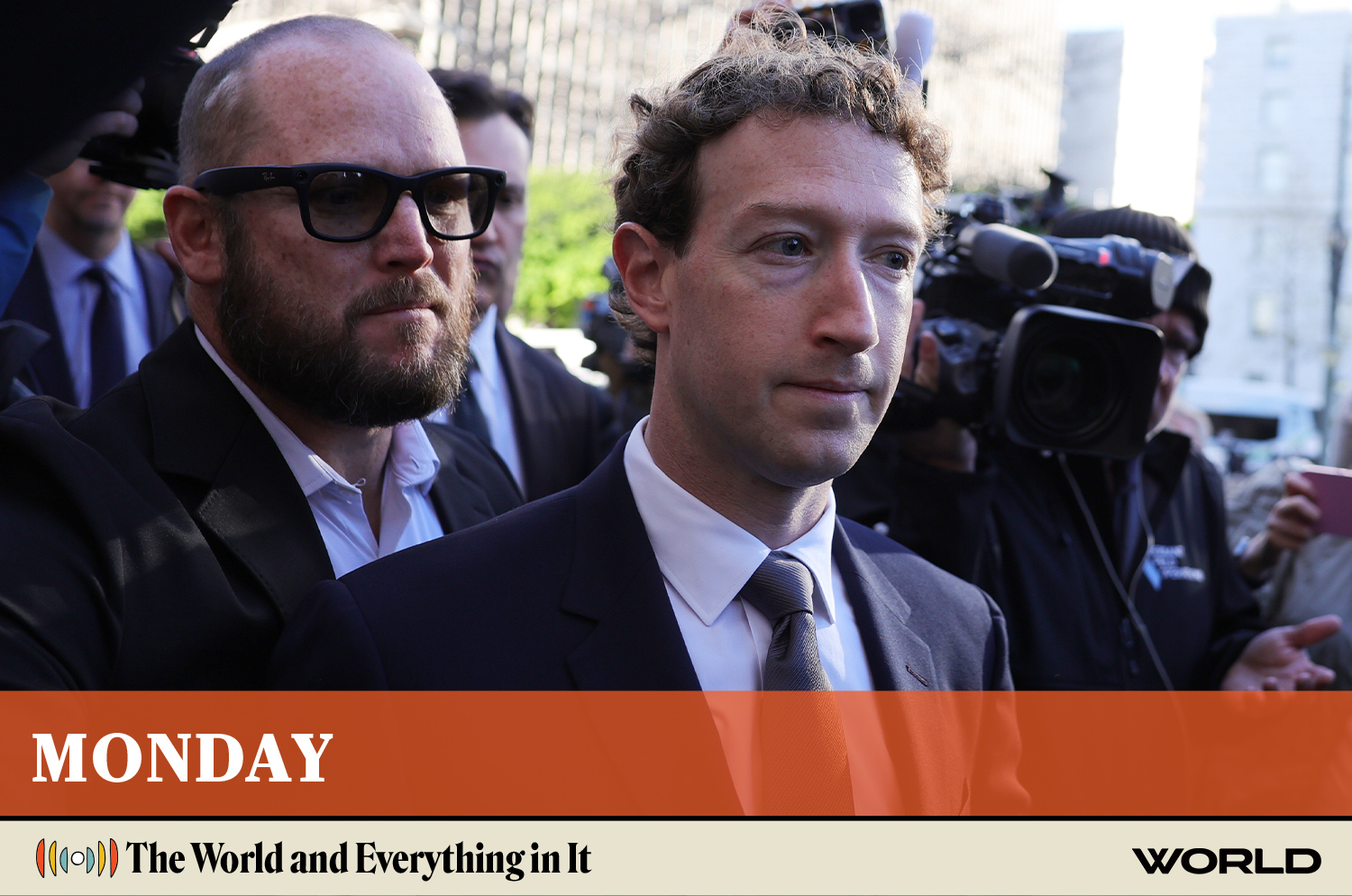
Mark Zuckerberg arrives for a landmark trial in Los Angeles, Feb. 18. Associated Press / Photo by Ryan Sun
Editor's note: The following text is a transcript of a podcast story. To listen to the story, click on the arrow beneath the headline above.
NICK EICHER, HOST: Hey, before we get started today, maybe you know this, maybe you don’t, but about a week and a half ago, The World and Everything in It passed the 100 million download mark, and that happened to come right around the time of WORLD Radio’s 15th anniversary.
So we made a commemorative sticker to celebrate that fact, and mostly just to say thank you. We’re doing these in batches, and I am told the first several thousand of these are already in the mail by now. They are probably showing up on laptops, car windows, coffee mugs, wherever you would put a sticker.
We did do a second run; those are on the way, and we’re planning a third and final one the end of this month.
So, if you haven’t gotten in on this yet? Come on in, not too late. Maybe you’ve been listening 15 years. Maybe you found us 15 days ago. None of that matters. You are part of this celebration too, and we’d be glad to send you one.
It’s free. Just make sure you get your request in by Wednesday, September 30th. A couple easy ways to do that on your phone right now. You can tap the headline for today’s program. That will open up episode notes, and you’ll find the sticker link in there. Tap it, fill out the form, done. Or just go to theworldandeverythinginit.org/sticker. That’s theworldandeverythinginit.org/sticker.
All right, Carl, you’ve got the intro theme ready?
CARL PEETZ: Got it!
EICHER: Benj.
BENJAMIN EICHER: Ready!
EICHER: Jenny.
JENNY ROUGH, HOST: Ready now…
EICHER: All right. Three, two, and one.
JENNY ROUGH, HOST: Good morning!
Social media on trial.
LANIER: These companies hardwired their products to be addictive on purpose. They said we need the kids.
NICK EICHER, HOST: That’s ahead on Legal Docket.
Also today the Monday Moneybeat, mortgage interest rates now on the rise. Economist David Bahnsen is standing by.
Later, the World History Book: A spy inside the U.S. Department of Defense.
LAPP: Most individuals start loyal and then they're flipped at some point in time. And Ana walked in fully recruited.
Ana Montes, the spy who passed American intelligence to Cuba for more than a decade and a half.
ROUGH: It’s Monday, September 28th. This is The World and Everything in It from listener-supported WORLD Radio. I’m Jenny Rough.
EICHER: And I’m Nick Eicher. Good morning!
ROUGH: Up next, Mark Mellinger with today’s news.
KENT COVINGTON, NEWS ANCHOR: Terror arrests in U.K. » Five men are under arrest in the U.K. on suspicion of plotting terrorism. The arrests came early Sunday morning near an airbase the U.S. is using in the war with Iran.
London’s Metropolitan Police says three suspicious vehicles were headed toward RAF Fairford, a base about 100 miles west of London owned by the U.K. but operated by the U.S. under a longstanding agreement.
The U.S. military has used the base to send out American bombers for limited strikes against Iranian missile sites and investigators are looking into whether Sunday’s arrests are linked to the Iran war. President Trump praised British police for helping foil a potential catastrophe.
TRUMP: They were looking to do big damage to our fort, and working with the British worked out great.
Police have not given many details about the suspects. People evacuated about 85 homes near the scene of the arrests as a precaution, while a bomb disposal team examined three white trucks.
Trump rejects proposed Iranian peace deal » Meantime, President Trump has rejected a new peace proposal from Iran. The deal called for a seven-day ceasefire and reopening the Strait of Hormuz.
U.S. Ambassador to the United Nations Mike Waltz says Iran wasn’t offering the deal in good faith.
WALTZ: This was, I think, a pretty cynical attempt to put something on the table that they knew was unacceptable: to ask for the release of the blockade, the sanctions, international sanctions, and access to billions in assets just to talk.
Waltz on NBC’s Meet the Press.
The response from Iran Foreign Minister Abbas Aragchi:
ARAGCHI: We are ready for diplomacy. We are ready for war at the same time. They have tested us in both cases. They tested us in their aggression twice and they are welcome if they want to test us once again.
Despite the hostility, President Trump says the U.S. will start a new round of negotiations with Iran this week.
Gas prices up $.32 over past two weeks » If you thought it seemed like gas prices just took another big jump, you’re right.
The Lundberg Survey puts the national average at $4 dollars 58 cents a gallon, up $1.30 from a year ago. Prices at the pump have shot up 32 cents over the past two weeks alone.
If you’re looking for relief, here’s one hopeful possibility from analyst Trilby Lundberg.
LUNDBERG: If oil prices will kindly remain around where they are -about $92 dollars per barrel for West Texas intermediate, after they dropped last week- then perhaps gasoline prices can come down from the clouds.
The White House acknowledges the war with Iran is driving gas prices up. On Sunday, the president said those prices will plummet once the war is over, which he says will be soon.
Nor’easter brings East Coast flooding » From New Jersey to New England, a rare September Nor’easter packed a massive punch over the weekend.
The storm caused flooding, damage to homes from toppled trees, and power outages that at one point affected more than 100,000 customers.
New Jersey Governor Mikie Sherrill:
SHERRILL: The storm has brought strong winds, heavy rain, and flooding. Our shore communities have been hit hard, and we’re monitoring the damage closely.
The storm has also caused at least one death: a New York City Housing Authority worker killed by a falling tree.
And though the nor’easter is weakening now, forecasters still warn more flooding could be coming to New York and New Jersey because of high tide late Monday.
Trump, Johnson to host top AI execs Tuesday » With concerns about artificial intelligence on the rise, President Trump and House Speaker Mike Johnson will host executives from top AI companies at the White House this week.
The meeting, scheduled for Tuesday, comes as Microsoft founder Bill Gates says AI is developing too fast and needs stronger federal government safeguards.
GATES: AI is utterly different, and don’t be complacent thinking that we’ve faced anything like this.
In the wrong hands, Gates even thinks AI could drive events that could kill a billion people.
President Trump is downplaying such a doomsday scenario, saying America needs to stay in the lead when it comes to AI development.
TRUMP: We're building tremendous, you know, trillions of dollars' worth of places, and why should we give that up?... And we've used the Department of Justice on two occasions to straighten out a company that we thought there was a problem with, and they immediately straightened it out… We will straighten it out if and when a problem occurs.
Other tech titans like Elon Musk and Open AI’s Sam Altman have joined Gates in calling for more government regulation of AI.
Singapore imposes harsh new fines for eating, littering on buses » If you’ve ever been to Singapore, you’ve probably noticed it’s a very clean place, and stiff fines for public misbehavior are meant to keep it that way, including some new ones that just took effect on public buses.
From now on, eating, drinking, littering, blasting music, or even putting your feet on the seat in a public bus could cost you $400 U.S. dollars.
The government says the goal is safer, cleaner, more considerate rides for everyone.
Critics say it’s no wonder Singapore is widely nicknamed The Fine City.
I’m Mark Mellinger.
Straight ahead: Can social media companies face legal consequences for the ways they design their platforms? And later: Sizing up the keys to more affordable housing, in the Monday Moneybeat.
This is The World and Everything in It.
JENNY ROUGH, HOST: It’s Monday the 28th of September.
This is The World and Everything in It from WORLD Radio, celebrating 15 years. I’m Jenny Rough.
NICK EICHER, HOST: And I’m Nick Eicher.
Time now for Legal Docket.
Today a state court case—a little out of the ordinary for Legal Docket. But this one could shape thousands of lawsuits already in the pipeline. The question is not simply whether social media can harm children. It’s whether the companies can be held legally responsible for the way they designed their platforms.
ROUGH: The case arose in Los Angeles County Superior Court. In March, a jury returned a six-million-dollar verdict against online giants. K.G.M. versus Meta was the first social-media addiction case to go to trial in the U.S.
EICHER: The plaintiff is the “K” in “K.G.M.,” a young lady we’ll identify by first name, Kaley. Her legal team accused big tech companies of designing features that encouraged compulsive use—and harmed Kaley’s mental health.
ROUGH: I talked with one of Kaley’s lawyers, Rachel Lanier.
RACHEL LANIER: These social media companies created an app that’s highly addictive, and they did it on purpose, and they wanted to target children and teenagers. And it worked.
And that distinction matters. Federal law generally protects internet companies from liability for content posted by their users. It’s called Section 2-30. But Kaley’s lawyers weren’t simply blaming Instagram and YouTube for harmful content. They blamed the companies for features of the platforms themselves: infinite scroll, autoplay, algorithm-driven recommendations, and beauty filters.
EICHER: Kaley started using YouTube at age 6 and Instagram at 9. She sued Meta and YouTube, as well as TikTok and Snap—those two settled before trial. The negligence claims against Meta and YouTube went to the jury.
ROUGH: A word about the legal meaning of negligence: Negligence means failing to use reasonable care to prevent foreseeable harm. Here, Kaley’s legal team made the argument that the companies were negligent in the design and operation of their platforms … particularly where they concerned Kaley.
LANIER: She struggled with anxiety, depression, body dysmorphia, all sorts of issues. And she is one of many. There is a generation of children that were impacted negatively by social media.
EICHER: Under the law, breach of a duty alone wasn’t enough. Kaley also had to prove causation—namely that the companies’ failure to use reasonable care actually contributed to her anxiety, depression, and distorted body image. Caused it.
LANIER: That was a big challenge for us. Because with a mental health injury, there are a lot of things that can cause depression and a lot of things that can cause anxiety. Social media is one of them. So we had to prove, for our specific plaintiff, what social media did to her and what the company’s actions did to her.
ROUGH: To prepare for the trial, Lanier reviewed pages and pages of documents that the social media companies were required to turn over in the discovery phase.
LANIER: They’ll dump millions of documents on us, and then we have this giant database, and we have to run word searches, and you really have to look for the needle in the haystack.
One of the more revealing needles was a record documenting conversations at Meta about beauty filters.
LANIER: And internally at the company, one of the employees was basically pleading with Mark Zuckerberg, who is in charge of all of Meta, and with Adam Mosseri, who is charge of Instagram, and she was pleading with them and she said, my two daughters have been hospitalized with body dysmorphia. And I believe these filters are a big reason why. These filters are really hurting people, and I think we should take these off the app. The company decision back then, coming from the top, was nope, we’re going to keep these filters on here. … It felt so callous.
What made the filters so concerning went beyond how accessible they were. It was how they redefine what a young person sees in the mirror.
LANIER: The so-called beauty filter, and even that term is damaging. That beauty filter would make your eye a little bit bigger, it would make your nose and your face a little bit slimmer. It might whiten your teeth. It might smooth out blemishes, which every teenage kid goes through a period of having acne. That’s a part of growing up.
Kaley testified she lost sleep trying to match an unrealistic standard.
LANIER: It would take her four hours to get ready in the morning every day because she would wake up, she even testified on the stand … we asked her how long did it take you to get ready for court today? She said four hours. We said, so you came here, you testified, you had to come through security at 8:00, 8:30, what time did you wake up? And she said, I woke up at 3:00. That was her testimony.
EICHER: Lanier says internal evidence showed Meta had been warned about the mental-health risks of beauty filters.
LANIER: Every single one of them told Meta these beauty filters, these types that you have on Instagram, are damaging to mental health, especially for teen girls.
Lanier says other evidence showed executives discussing features designed to keep users hooked.
LANIER: And there were internal company documents where the executives are comparing themselves to big tobacco and comparing themselves to gambling casinos and how you just keep swiping and … .
And swiping, and swiping. Those were among the design features Kaley’s lawyers put on trial.
LANIER: A machine that does not care about anybody, a machine that has no morals whatsoever, it is hardwired just to want to keep you on the app. … It gets to know you so well, and it will show you something that, in one moment it will shock you because [shocking breath] that will keep you watching a little bit longer, and then the next moment, oh, it’s a cooking video. I love cooking videos ….
ROUGH: A Meta whistleblower who testified for the plaintiff used a bookstore analogy to explain recommendations by algorithm. Imagine walking in, picking up a book, putting it down, then wandering to another section.
LANIER: It’s a normal experience. And what an algorithm does, is it turns that bookstore into a trap, essentially, where you are in a vortex, sucked in. Let’s say you go in and pick up a book. Well, the algorithm is watching you. How long do you have the book in your hands? What type of book is it? And it rearranges all the other books in the bookstore to feed to you what it thinks you will engage with. It’s all about engagement because time on the apps is money for the companies.
Advertisers pay handsomely for those increasingly captive audiences. That was the plaintiffs’ theory: that these weren’t merely neutral tools displaying content. The design itself was tuned to trap users.
EICHER: Meta and YouTube contested that account. Meta argued Kaley’s mental-health problems had other causes, including turmoil in her family. YouTube denied its platform was addictive by design. Meta CEO Mark Zuckerberg and Instagram chief Adam Mosseri rejected the notion that Instagram was clinically addictive. That put causation squarely in front of the jury: whatever problems these platforms may have, did their design actually cause Kaley’s injuries?
ROUGH: Lanier says she wrestled with another obvious question before taking the case: What about the parents?
LANIER: I’ll be honest. Before I saw any documents, I thought, c’mon isn’t it the parents’ responsibility? Shouldn’t the parents be doing more at home? You know, how are we going to blame Meta? It’s just a social media app. People are just sharing pictures. No. Not true. These companies hardwired their products to be addictive on purpose. They wanted to have maximum engagement and they wanted children. They said we need the kids.
The trial lasted about five weeks. The jury deliberated more than 40 hours across nine days.
LANIER: I pray every day, but I prayed more in that case than I ever have in my entire life. And I prayed, God, this is Your will. Let justice be done.
California civil juries do not have to be unanimous. Kaley needed only 9 of the 12 jurors. So the jury found Meta and YouTube negligent in the design of their platforms—negligence that caused her harm.
EICHER: The jurors who were not persuaded on causation focused on other difficult things in Kaley’s life.
LANIER: There were three jurors … that they just didn’t feel like the apps caused her issue. And she did have other difficult things in her life. … Her parents were divorced for example, and there were times where her relationship with her father was challenging for her. And where she would sometimes feel abandoned by him, for example. There were also times where she had difficulties with her mom like many teenage girls do.
The jury awarded three million dollars in compensatory damages, then another three million in punitive damages. Meta’s share came to 4-point-2 million dollars. YouTube’s: 1-point-8 million.
ROUGH: Lanier is a mother of four. And she admits to the challenge of managing access to these apps with her own teens.
LANIER: It’s tough as a parent. … It’s a lose-lose. Because you want your kids to be able to have friends and not experience FOMO. And when everybody’s on these apps, or everybody’s using phones, it’s a difficult position, and you want them to be able to connect with their friends.
EICHER: Meta and Google asked the judge to toss out the verdict. Judge Carolyn Kuhl refused. The companies have appealed. And Kaley’s case is not the last: thousands of similar claims are pending, with more bellwether trials expected.
ROUGH: So the six-million-dollar judgment is not really the number to watch. The larger question is whether this becomes a workable path for holding social-media companies responsible for the platforms they build, and how they built them.
That’s this week’s Legal Docket.
JENNY ROUGH, HOST: Coming up next on The World and Everything in It: The Monday Moneybeat
NICK EICHER, HOST: Time now to talk business, markets, and the economy with financial analyst and advisor David Bahnsen. David heads up the wealth management firm, the Bahnsen Group, and he’s here now. Good morning, David.
DAVID BAHNSEN: Well, good morning, Nick. Good to be with you.
EICHER: Well, David, last week you explained that one hope behind the Fed’s rate hike was that longer-term rates might actually come down, but instead, the 10-year Treasury went above 5% to 5.2 on Friday. The 30-year moved above 5.5, and that set off a lot of news stories, a lot of alarm in those news stories breaking out of the business pages and onto the front pages.
So, what happened between now and then?
DAVID BAHNSEN: First, the good news: the TIPS spreads, which is what we call inflation breakevens, that tells you how much of the overall 10-year is from inflation expectation and how much is from real growth expectation. The inflation expectations have gone higher, but not by much. So there is some confidence for some real growth that’s implied in a 10-year that is sitting at around 5.1 to 5.2 percent.
The answer is connected to the AI story, Nick, that there has been absolutely no corporate debt issued at the 10-year, 20-year, 30-year, for a long time, and at this level, this kind of supply, you’re seeing long-term debt from very high-quality credit issuers. I should point out Microsoft has a higher credit rating than the United States government does, so you’re seeing competition.
What happens to prices when there’s the same level of demand but a lot of new supply? Prices come down, which means the yields have gone up, and so that’s what’s happened in the bond market.
The Fed cannot do a lot to lower the long end. By showing credibility on the inflation front, they can bring inflation spreads down, and that’s why those have not moved a lot. But one rate hike was never going to be a huge factor. That’s why they’re pricing in a second one coming, and I think that the main issue for me, it would be what are we going to do about mortgage rates here?
Right now, the fact of the matter is, mortgage rates coming down is not going to be the lever that improves housing affordability. It’s going to have to be lower prices, and the sooner people realize that, the better.
EICHER: Well, David, let’s stay with housing for a moment. Talk about those mortgage interest rates. The Wall Street Journal says that these 7% mortgages squeeze not only buyers but also sellers who are reluctant to part with the much cheaper loans that they have on their homes, and reports of builders paying to buy rates down.
So how do those pressures reinforce each other?
BAHNSEN: Well, we’ve averaged about a 7% mortgage rate for over four years now, and there have been a couple times when it dipped into the six and a quarter to six and a half range.
Now you have the highest level of delta between sellers and buyers that we have seen since they started recording this data on a national level in 2013. You had a significant—about one in five of houses that sold last month had a price reduction. You had over 40% of home sales last month result in some sort of concession that may have been related to other factors in negotiation.
This has become a buyer’s market, and so I understand that sellers have been reluctant to trade out of a 3% mortgage, but keep in mind, Nick, every month that goes by, there’s less and less that still have those 3% because a lot of them were done as five-year and seven-year type interest-only loans, and so a lot of those rate locks are starting to come off as you get further away from when people were doing that cheap financing in 2020, ’21, ’22.
About May of ’22 was the last point in which people had that very cheap financing, and so into 2027, you’re going to see more of those five years rolling off as well.
So it’s all marginal. There’s no cliff level where all of a sudden something happens. It’s just month by month the data is more and more favoring buyers versus sellers. And to the extent that somebody says, “I’m not willing to lower the price of my home,” then they’re not really a seller, right?
And it won’t happen to everybody at one point, but it will be happening. And it will be happening with lower prices, and the reason is that the current level of prices are not affordable to the buyers.
EICHER: David, I want to turn to the diesel story. Diesel fuel, with prices sitting at record highs, President Trump expressed support for temporarily restricting U.S. diesel exports, the idea being that if more American-made fuel stays here at home, that domestic supply will go up and prices will come down.
But that’s not exactly how it works, is it?
BAHNSEN: No, it isn’t. And I gotta say that kudos to the president, who appears at this point to have walked that back on the advice of his advisers. I don’t know exactly what they’ll end up doing. As we’re sitting here Monday morning, it’s a moving target.
But what you saw, which was very encouraging to me, was a lot of people who have often been hesitant to criticize some of these ideas have really been out front of saying to the White House, to the president in private channels and publicly, this is not going to help. It’s not going to do what you think it’s going to do, and it will make things worse long term.
To just briefly explain why it’s such a bad idea, first of all, we need to start with first principles. The United States government has absolutely no business telling a company who they can and can’t sell to now, unless it’s a matter of national security.
And to the extent that we believe in supply-side economics, what you do is disincentivize production, and you signal yes to diesel fuel producers, but also to any number of other economic actors: “Hey, I didn’t know the government could just tell me I’m not allowed to sell to ally nations whenever they want to,” and so it disincentivizes production.
And what is it that is the greatest friend of bringing prices down? More supply.
It looks like it’s not going to happen, but it gave us a chance to explain to American people why that this is just not something that makes any sense. And, by the way, a lot of these more craven political ideas in advance of the midterms, none of them have helped politically.
EICHER: Well, and speaking of energy, David, your Dividend Cafe this week—the energy case that you made—is not really even built around today’s high oil price. You connected instead to the build-out of AI, more data centers. They need more power. More power requires a lot more energy infrastructure.
Where do you think investors are missing that connection?
BAHNSEN: I’m not sure how many American people wake up and even realize how electricity is produced, or that it was coal for a long time, and now natural gas is a larger factor. Those are not things that everybody necessarily thinks about.
I would say this, Nick. I do believe, as I wrote in Dividend Cafe, that the AI story is a particular catalyst, and that one can say, “I don’t believe that the AI story is going to happen,” but you can’t say you believe it’s going to happen and that it isn’t going to be relevant to power generation, which then involves not only natural gas but pipelines that are necessary to get natural gas to the end destination.
But if it wasn’t data center and AI, I still believe the exact same thing. We have a ton of natural gas in this country, and we have a ton of need for electricity and other forms of power.
And as long as we are heating our homes and as long as we are creating food, so that a society and civilization do not starve themselves to death, then we have a need for energy, and therefore I believe this not only represents a very compelling investment opportunity, but it’s a great economic opportunity, and you have the need to export this.
EICHER: All right, David Bahnsen, founder, managing partner, and chief investment officer of the Bahnsen Group. He writes regularly at dividendcafe.com and for WORLD Opinions. Have a great week, David. Thank you.
BAHNSEN: Thanks so much, Nick.
JENNY ROUGH, HOST: Good morning! This is The World and Everything in It from listener-supported WORLD Radio. I’m Jenny Rough.
NICK EICHER, HOST: And I’m Nick Eicher. Up next: the World History Book.
25 years ago, the FBI arrested a woman who’s been called one of the most damaging spies the US has ever found.
ROUGH: Ana Montes worked in the Defense Intelligence Agency and fed classified information to Cuba for 17 years before she was caught.
WORLD’s Mary Muncy reports.
MARY MUNCY: Ana Montes was in graduate school when she first met Marta Valazquez. They had a lot in common: both Puerto Rican, both bilingual, and both convinced the US should stay out of Latin American affairs.
LAPP: Marta said, ‘Hey, I've got a friend who wants to meet you. He's a Cuban, and he wants to have dinner with us in New York City.’
Pete Lapp is a retired FBI agent who would eventually investigate Montes. He wrote a book about her called Queen of Cuba.
Valazquez, it turned out, recruited for the Cuban intelligence machine. At that dinner in 1984, the Cubans asked if Montes would translate some newspapers from English to Spanish.
LAPP: Ana pushed back initially a little bit and she said, ‘You know, it's kind of menial just translating.’
The Cuban said, ‘Well maybe you can add some of your own analysis about what the Americans will do about a given topic.’
LAPP: And that definitely intrigued her, and she agreed to do that.
Then, on the train ride home, she had an “epiphany.”
LAPP: The translating project was not enough to help the Cubans, that she really needed to get a job in the intelligence community.
Montes had such “visceral empathy” for the Cubans…she only asked them to pay for her extra expenses.
Before Montes started, she and Valazquez took a “girls’ trip.” … Flying first to Europe with their real passports, and then to Cuba with fake ones.
LAPP: The goal was to teach her how to be a spy.
Montes says she learned how to pass a polygraph. Afterward they flew back to Europe, took a few pictures, and came home.
Montes wanted to start right away. She started working for the U.S. government in September of 1985, with the DIA…the Defense Department’s intelligence arm.
LAPP: Most individuals start loyal and then they're flipped at some point in time. And Ana walked in fully recruited.
First, she worked on El Salvador and Nicaragua, then Cuba in 1992.
Every day at work, she memorized three things.
LAPP: And then she would go home and… write down these notes, kind of, you know, empty her mind a little bit and then type it up, encrypt it.
And give it to her handler. They met for lunch two to three weeks. In broad daylight. In the middle of DC.
Lapp thinks these meetings kept her focused, even though the work was isolating. Montes’ father was in the military; two of her three siblings were in the FBI. She believed her DIA colleagues were part of the “war machine,” and she rarely dated.
LAPP: The guy sitting across the table, Ernesto, or whoever it was at that time, he he knew more about her than her own mother. And that that emotional intimacy really helped sustain her through what she described as torture.
Even so, she was good at both jobs.
She didn’t draw suspicion until 1996, when Cuba shot down two US civilian planes. The DIA wanted her at the Pentagon constantly, but her handler wanted to meet every night. Once, she left a high-level meeting to take a phone call. When she came back, she said she needed to leave at 8:00. A colleague thought it was odd and reported her.
She underwent a polygraph test. But she answered every question, and when the investigator reviewed her file, he saw a dedicated, impressive employee.
LAPP: That reputation really wrapped a security blanket around her in a way because anytime there there may have been suspicion, you know, you had this file of accolades and and exceptional performance evaluations.
Lapp says she covered her tracks almost perfectly. It took someone else to bring her down.
In 2001, two Cuban defectors told the FBI about a mole in the intelligence community codenamed Agent S or Sergio. Investigators found that Sergio had been in the same places at the same time as Montes. They got a warrant, searched her home, and found a laptop… full of incriminating information.
LAPP: If she had thrown that computer into the Potomac River, there's absolutely no way she would have spent one night in prison.
The government held off on arresting her to build a case against her handler, too. But shortly after 9/11 she was set to be re-assigned to war plans. Rather than let that happen, Lapp and another agent went to the DIA to arrest her.
LAPP: So three of us sat down and we kind of did this song and dance.
She was stoic as they handcuffed her. Later in her cell, she broke down. Lapp thinks her actions killed at least one US service member and Montes says she revealed the identities of four U.S. undercover agents. She got 25 years in prison in exchange for interviews about what she did.
She got out on probation in 2023.
LAPP: I think she just wants to live live her life and be be left alone. I don't think she's a danger to the United States.
She now lives in Puerto Rico with her mother. Lapp thinks it’s ironic that Montes lives freely in a country she spent 17 years working to undermine.
Reporting for WORLD, I’m Mary Muncy.
JENNY ROUGH, HOST: Tomorrow: an effort to encourage students to bring their Bibles to school. And? Young adults with autism learning to be independent. That and more tomorrow.
I’m Jenny Rough.
NICK EICHER, HOST: And I’m Nick Eicher.
This is episode 3496 of The World and Everything in It, from WORLD Radio—celebrating 15 years. WORLD’s mission is biblically objective journalism that informs, educates, and inspires.
The Bible says: “For the word of God is living and active, sharper than any two-edged sword, piercing to the division of soul and of spirit, of joints and of marrow, and discerning the thoughts and intentions of the heart.” —Hebrews 4:12
Go now in grace and peace.
WORLD Radio transcripts are created on a rush deadline. This text may not be in its final form and may be updated or revised in the future. Accuracy and availability may vary. The authoritative record of WORLD Radio programming is the audio record.
Please wait while we load the latest comments...
Comments
Please register, subscribe, or log in to comment on this article.