
The World and Everything in It: September 24, 2026
President Trump gives Xi Jinping a welcome with diplomatic meaning of its own as the two leaders take up Taiwan and U.S.-China relations. In Kyiv, civilians shelter through a deadly daylight barrage, then try to resume ordinary life between strikes. Congress confronts uneven rules in women’s sports, and a father passes to his children the Christian rock that shaped his faith. Plus: Daniel Suhr argues for putting classroom technology back in its place, and Yellowstone turns up a very strange lost-and-found.
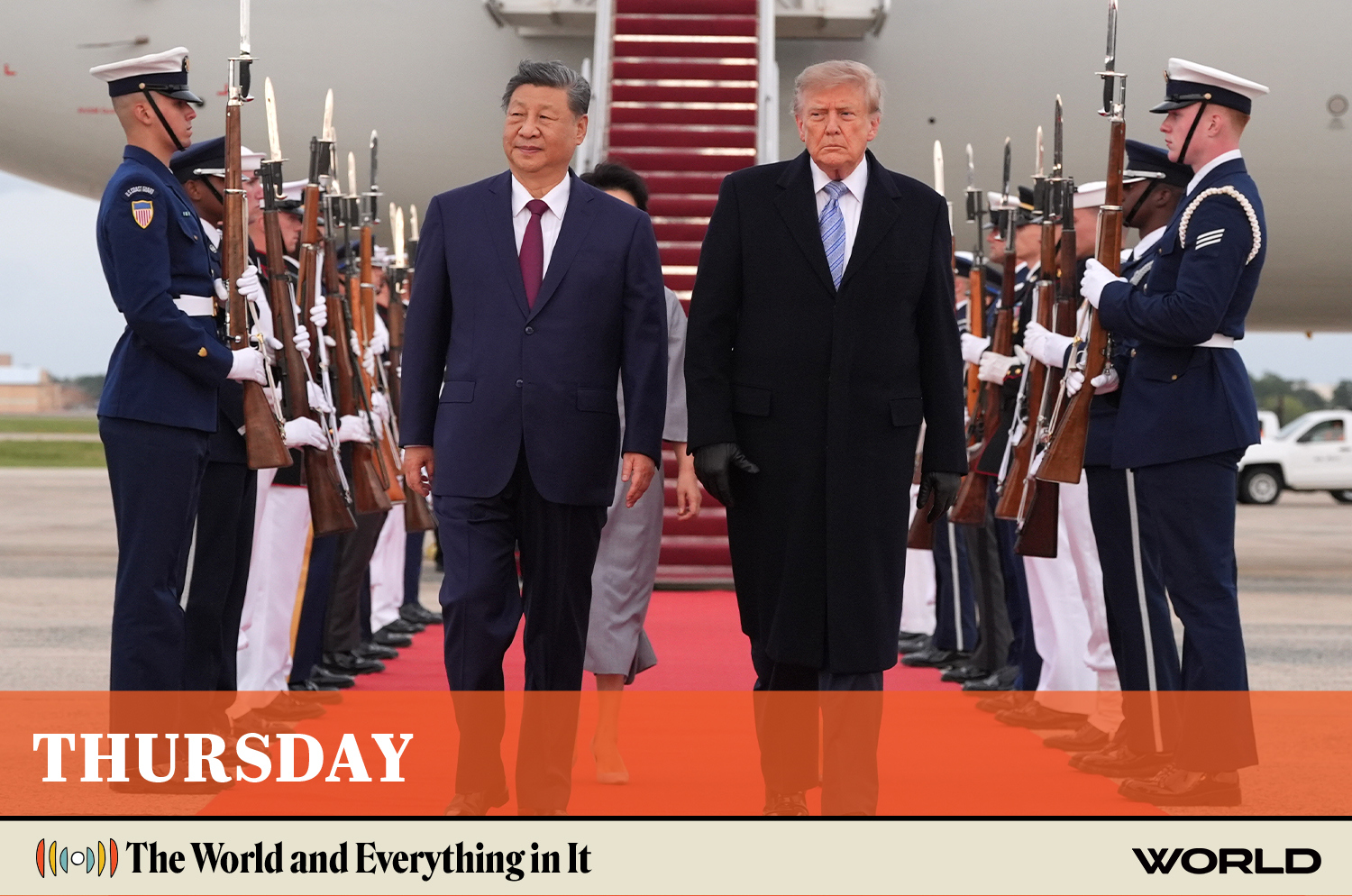
President Donald Trump and China's President Xi Jinping at Joint Base Andrews, Md., Wednesday. Associated Press / Photo by Alex Brandon
Editor's note: The following text is a transcript of a podcast story. To listen to the story, click on the arrow beneath the headline above.
MYRNA BROWN, HOST: Good morning!
A deadly daytime attack in Ukraine.
URI: In the last moment we duck a little in the car. That’s all we can do
MARY REICHARD, HOST: We’ll hear from our reporter in Kyiv.
Also, the U.S.-China summit gets underway.
And missed opportunities to protect women’s sports.
Later, the Christian rock that shaped one dad’s faith is now shaping his kids’ playlists.
SHAKER: There's this message of consistently, like I can come back to God. I can go to Him. I can find safety in Him.
And WORLD Commentator Daniel Suhr on schools shifting away from screens.
BROWN: It’s Thursday, September 24th. This is The World and Everything in It from listener-supported WORLD Radio. I’m Myrna Brown.
REICHARD: And I’m Mary Reichard. Good morning!
BROWN: Up next, Kent Covington with today’s news.
KENT COVINGTON, NEWS ANCHOR: Iranian president at UN plays victim card » One day after President Trump addressed world leaders at the UN General Assembly, Iran’s president did the same.
Masoud Pezeshkian Wednesday played the victim card in a rare wartime speech.
He held up a photo of the late Ayatollah Ali Khamenei, killed in American and Israeli strikes in February.
PEZESHKIAN: Those who are terrorists and train and protect terrorists describe us as such. We have only defended ourselves. We are not terrorists.
The U.S., Canada, Australia, and the European Union have designated Iran’s Revolutionary Guard as either a terrorist entity or a state sponsor of terror.
Pezeshkian also struck a defiant tone:
PEZESHKIAN: We will never bow our head or bend at the knee. We are ready for dialogue and diplomacy and negotiations without accepting the language of force.
That came after Trump on Tuesday said he has a big decision to make , strike a deal with Iranian leaders, or —his words— annihilate Iran. Though, he said he believes there will be a deal.
Iran says it will let ships through the Strait of Hormuz again if Washington lifts its naval blockade of Iran's ports, releases frozen Iranian money, and ends the war on all fronts. U.S. officials haven’t verified that those were Tehran’s terms, but confirmed that they talked with Iran this week.
They note that Iran already broke an agreement it signed back in June.
Rubio on Iran / now officially NSA » Secretary of State and National Security Adviser Marco Rubio said if Iran thinks US midterm elections give them leverage, they’re wrong.
RUBIO: When it comes to the imposition of both sanctions and the use of military force, the president has extraordinary powers. Every president does. He's the commander-in-chief, both constitutional and, and otherwise, to be able to carry out those functions.
President Trump believes Tehran has been hoping that political pressure ahead of the midterms will lead him to offer more favorable terms. He says that won’t happen.
Secretary of State Rubio spoke from UN headquarters, one day after the White House made it official that Rubio is now Trump’s national security adviser, and no longer just his acting advisor.
That makes Rubio only the second person in history to hold both of those posts at the same time, joining only Henry Kissinger.
Zelesnkyy » Ukrainian President Volodymyr Zelenskyy also addressed the General Assembly yesterday. He called on world leaders to turn up the pressure on Russia economically.
ZELENSKYY: When someone gives Russia more money through trade, they give this war more time. That is exactly why we insist on limiting trade with the aggressor and why we are burning Russia's revenues ourselves
Russian Foreign Minister Sergei Lavrov, meanwhile, spoke to the UN Security Council.
LAVROV: [Speaking Russian]
He said the Kremlin is ready to negotiate toward a lasting peace, but it won’t pause the war in the meantime because, he said, that would give Kyiv more time to rearm.
Also Wednesday, 50 countries and the EU issued a joint statement supporting Ukraine. NATO Secretary General Mark Rutte, meanwhile, says he's given up trying to figure out what's going on in Vladimir Putin's head. But there's one thing he does know:
RUTTE: We have to make sure that we are prepared, we are strong and he knows it. And if he does anything silly, he knows our reaction will be tough. We will never be aggressive, but if necessary, we will defend ourselves and every inch of our territory. He knows it.
Moscow continues to carry out near daily strikes throughout Ukraine.
Xi arrival » Meantime, at Joint Base Andrews near Washington:
SOUND: [Xi Jinping welcome band]
Chinese leader Xi Jinping emerged in the doorway of his jet to a ceremonial welcome.
SOUND: [Gunfire]
He descended down a flight of stairs, where President Trump was there to greet him on the tarmac with a handshake.
Both leaders then made a slow walk down a red carpet, pausing for a ceremonial Air Force flyover:
SOUND: [Flyover]
Before they both departed separately for the White House.
The two leaders will meet today on a range of issues, including trade, AI, and the war with Iran. Tonight, the Chinese leader will be the guest of honor at a state dinner, with some of America’s biggest tech leaders also on the guest list.
Hurricane Polo » The powerful Hurricane Polo is churning off Mexico’s Pacific coast, threatening deadly flooding and mudslides today. WORLD’s Kristen Flavin reports.
KRISTEN FLAVIN: Polo's winds peaked Tuesday at 180 miles an hour. It has weakened since then, but it’s still a monster.
The good news is that it’s not expected to come ashore, but it remains a serious threat. Forecasters at the US National Hurricane Center say Polo's outer bands could soak the state of Guerrero, including Acapulco. They expect four to six inches of rain there through today, up to eight in spots. Forecasters say the danger is worst where the ground is steep.
Mexico's navy closed the ports at Acapulco and Zihuatanejo, in Guerrero. And the state has opened dozens of shelters.
For WORLD, I’m Kristen Flavin.
I'm Kent Covington.
Coming up, a Senate committee hears testimony about the risks male athletes still pose for women’s sports. Plus, the lead singer of Skillet on Christian rock.
This is The World and Everything in It.
MYRNA BROWN, HOST: It’s Thursday the 24th of September.
Glad to have you along for today’s edition of The World and Everything in It. Good morning, I’m Myrna Brown.
MARY REICHARD, HOST: And I’m Mary Reichard. First up: Talks about trade, technology and Taiwan.
Chinese President Xi Jinping and President Trump are expected to spend the day in talks about a wide range of topics including a US-China tariff reduction framework, artificial intelligence, and U.S. arms sales to Taiwan.
BROWN: It’s the first U.S. visit for Xi in nearly three years, and the first time he’s been at the White House in more than a decade. Xi is scheduled to attend a state dinner tonight and there are more events planned for tomorrow.
MARY REICHARD: Well, joining us now is Bonny Lin. She served in the office of the Secretary of Defense from 2015 to 2018 as an advisor on China and Taiwan. She's now director of the China Power Project at the Center for Strategic and International Studies in Washington. Bonny, good morning.
BONNY LIN: Good morning and thank you for having me.
REICHARD: We're really glad you're here. What do you think President Trump's top priority is this week, and also for President Xi?
LIN: I think the top priorities from the U.S. side is having more discussions on seeing what China could do or contribute to ending the war in Iran. And of course also continuing to stabilize U.S. China relations. And under stabilizing U.S. China relations, there are a whole bucket of issues that the two presidents will likely focus on. This includes more on economics, the tariff side. So whether or not we will extend the trade truce that we had with China that's supposed to expire November 10th of this year. I think the Chinese side want to extend it until the end of President Trump's term, but the U.S. side are interested in extending it for a much shorter duration, potentially six months. China is also likely to bring up Taiwan. Additional issues that are might also pop up include human rights if President Trump wants to raise that issue and of course what's also happening on fentanyl and some of the domestic implications for the United States.
REICHARD: So a lot to cover there. Okay. Now President Trump planned quite the welcome for President Xi, including meeting his plane on the tarmac. Bonny, what do you read into the fanfare for such a potentially tense visit?
LIN: So I think President Trump is basically providing the Chinese leader Xi Jinping with as much respect as he can by meeting him on the tarmac. So historically, this is a very rare occurrence for U.S. presidents to meet foreign leaders on the tarmac. The last time this occurred, that wasn't a U.S. leader meeting the Pope, was under President John F. Kennedy. So it's been decades since that has occurred. And it's interesting to note that as President Trump is rolling out the red carpet to President Xi Jinping, he has most recently in New York City have had very limited time only for short pull-asides with some of our key allies and partners. So he's attaching significant importance to the meeting with President Xi.
REICHARD: Well let's talk about some of the things you mentioned before. President Trump says that he wants to keep things the way they are with Taiwan, but China has been stepping up its military exercises, wants the US to stop a major arms sale to Taiwan. How do you think this summit might change things?
LIN: Well, I hope it doesn't change things, but I think President Xi from the Chinese side is coming in with continuous asks of President Trump to potentially change US policy or downgrade our support for Taiwan. So what we've seen since this past May is we still see a $14 billion arm sales package to Taiwan that's still pending. I think the Chinese leader would prefer that to be forever pending or at least that package broken up. The other thing that we're hearing is that on the on the schedule as part of the state visit will be a tour of the US National Archives. I think President Trump will probably use that as an opportunity to give his history lesson about the bilateral relations to the Chinese leader. But I also wonder to what extent will the Chinese leader also give his own version of the history lessons to President Trump. And he might reference the nineteen eighty two communique between the United States and China, in which the US did promise to curb and limit future US arms sales to Taiwan.
REICHARD: Let's talk AI for a minute here. It was already the subject of trade talks with China earlier this week. A host of tech leaders are scheduled to be at a state dinner for Xi. But the Chinese don't seem to fear AI the way many Americans have come to fear it. Do you think there's a path to cooperation with China on AI safety?
LIN: I think you're spot on to say that the Chinese don't fear AI the same way. When China's Ministry of State Security talked about artificial intelligence, his main concern about artificial intelligence was the threats it could pose to the Chinese Communist Party's control, political control. So there is a sense among among Chinese officials right now that their threat-level perceptions of the dangers of AI to humanity may not be at the same level as the United States. What I will say is from the Chinese perspective, they still do recognize, despite the achievements of DeepSeek and some of their recent other advances, that US is leading in AI and one worry that Chinese leaders have is any discussions on AI could be viewed as a way to slow down China's AI speed of development. And that's what Chinese would not want.
REICHARD: You had mentioned human rights as on the agenda, possibly. Now China released Christian pastor Ezra Jin when President Trump visited Beijing earlier this year, but eight of his colleagues still are in prison. Jin's asked President Trump to help free those people as well as Hong Kong businessman Jimmy Lai. What role do you think human rights is going to play in this week's talks? Top of mind or no?
LIN: I don't think top of mind. The reason I mention human rights is because I know there's lots of the Trump administration is getting a lot of pressure from Congress, from organizations to raise this issue. I do expect this to be raised, but I don't think it's anywhere near the top five or six most important issues for either side. And I don't see President Trump putting too much political capital on this, given the other big strategic issues that he wants to get from this from the summit.
REICHARD: We will continue to pray for that situation then. Bonny Lin is director of the China Power Project for the Center for Strategic and International Studies. Bonny, thank you so much.
LIN: Thank you for having me.
MYRNA BROWN, HOST: Coming up next on The World and Everything in It: Taking cover.
Ukrainian President Volodymyr Zelenskyy says Russian attacks are taking a toll on everyday life.
ZELENSKYY: The Russians launch jet-powered shahids every hour. Every hour. Against our cities, our economy, our infrastructure, our combat aircraft are fighting them 24-7. And this is part of Russia's strategy to create an air threat every hour.
MARY REICHARD, HOST: He addressed the United Nations yesterday, saying the attacks disrupt the economy and schools. His speech came hours after a deadly daylight bombing campaign hit Kyiv. Our correspondent Caleb Welde was near the site of some of those attacks and he brings us this report.
CALEB WELDE: It’s just before eleven AM in Kyiv. I’m two blocks from the central train station in an underground parking area when I hear the third explosion of the morning impact nearby.
SOUND: [Bomb impacts]
On the other side of the building, two hundred yards away, a fire burns from an impact twenty minutes earlier.
AUDIO: [People speaking Ukrainian]
Around a hundred people are gathered in the parking area. At first glance the people inside the building appear relatively calm. A minute or two later some begin stepping outside.
SOUND: [Woman on radio, firefighter says to get back inside]
A firefighter’s radio comes alive and he then tells everyone to go back inside. Thirty seconds later:
SOUND: [Distant bomb impacts]
Another strike, this time on the other side of the train tracks further away.
Many in the garage appear on edge, a few are crying. One woman has collapsed to the ground, shaking and unconscious.
SOUND: [Ukrainian civilians yelling for help]
Soon afterward, a police officer runs in, followed by paramedics. The woman came to a few minutes later. We hear explosions further away every fifteen minutes or so. The air raid alert is lifted an hour or two after I arrive, and on the street I meet a woman walking back toward her office. She tells me her name is Yara.
YARA: Today was usually morning in my office. Something around 9am was the first blast.
She won’t tell me what sort of work is done in the building. She does say she and her coworkers did not evacuate. But many of them rushed to the first floor.
YARA: We say oh it's it's too close it's a little bit dangerous, but we keep on working everything like like usual …and we feel the second blast.
The second blast hit the sixth floor of their building.
YARA: So we were just… extremely happy that we was not there in that time. A couple of our colleagues worked on the sixth floor at the time, but God save, everything is fine with them, just little scratches, so we are so happy that everything is fine. There is a burning of papers … but the people are alive and that's the main.
A block away I meet a man and woman, Uri and Tanya.
URI: We was about fifty meters near the impact point.
They’re okay, but their car was badly damaged.
WELDE: We've got... both passenger side window, rear side window, top sunroof completely blown out. The back window has one, two, three, four, five holes.
They were driving home when a drone came in.
URI: As you can see, our heads here, and not in car.
WELDE: but but right by your heads we've got dents in the metal here how are you not hit?
URI: Don't know.
TANYA: Or we had good angels.
URI: In the last moment we duck a little in the car. That’s all we can do.
At least two people were killed and more than 40 injured in Wednesday’s attacks.
SOUND: [Walking on broken glass]
Reporting for WORLD, I’m Caleb Welde in Kyiv.
MARY REICHARD, HOST: Up next, Congress takes another look at women’s sports.
Republican Senators heard testimony Wednesday on unsettled policies surrounding them.
President Trump’s executive orders protecting participation in those events have yet to be codified by Congress.
MYRNA BROWN, HOST: Twenty-three states and some sports leagues still allow men in women’s sports. The current patchwork leaves some athletes wondering if they’ll get the awards they’ve earned.
WORLD’s Harrison Watters reports from the Capitol.
HARRISON WATTERS: Retired professional women’s soccer player Carly Smolak remembers the shock she felt learning a man had joined a team she used to play with.
SMOLAK : I immediately looked up his name. I saw that he was a former Marine. I saw that he was an ex-con and considered himself a prison abolitionist.
It wasn’t until the league president found out he was also a registered child sex offender that the man was asked to leave the team.
SMOLAK : The obvious solution is to enforce a clearly stated policy that women's competition is exclusively for female athletes.
Members of the Senate Judiciary Committee heard nearly two hours of testimony from witnesses Wednesday. Kim Jones is Co-Founder of the Independent Council on Women’s Sports.
JONES: The problem we have today in the United States is intentional noncompliance and a deliberate desire of leaders to undermine the women's category, despite more than 50 years of federal law intended to protect women.
The International Olympic Committee now requires athletes to do a genetic test to confirm their sex. But Jones says governing bodies from the U.S. Soccer Federation to the Women’s National Basketball Association still allow men to compete if they identify as women.
Attorney Bill Bock III represents former swimmer Riley Gaines in a case against the NCAA. Missouri Sen. Josh Hawley asked him about it.
HAWLEY : My understanding is that the NCAA's position in court, even as we speak, is that Title IX doesn't apply to them. Is that correct?
BOCK: That's right. They don't think that federal law applies to the NCAA that controls athletics for 1,100 schools, most of which receive federal funding…
Minority committee members mostly sat out of the hearing. Only Ranking Member Dick Durbin of Illinois showed up to say Democrats refused to call witnesses or ask questions.
DURBIN : The issue of this hearing would not be in the top 10, maybe not the top 20. People are concerned about the cost of living.
Tennessee Sen. Marsha Blackburn said she suspects there’s a different reason.
BLACKBURN: They know they are wrong on this issue. They know that, and their position is not a defensible position.
NCAA president Charlie Baker told the Judiciary Committee in 2024 he was aware of fewer than ten transgender college athletes out of 500,000. But women’s rights groups estimate the numbers across leagues nationally are higher and growing. Concerned Women for America, or CWA, estimates men and boys have taken nearly 300 top awards from females in the last year alone.
The Protect College Sports Act, a bill regulating revenue in college sports, is expected to pass the Senate later tonight. The bill would prevent schools from cutting women’s sports to pay for more profitable programs but does not protect women’s participation in those sports.
Florida Sen. Ashley Moody points out legislation aimed at fixing that more fundamental problem remains stalled.
MOODY : We tried to pass common sense legislation in the Senate just last year, this Congress, but not a single Democrat voted for the Protection of Women and Girls in Sports Act of 2025, not a single one.
The Senate is scheduled to leave town next week.
Reporting for WORLD, I’m Harrison Watters, in Washington.
MARY REICHARD, HOST: Yellowstone National Park would like visitors to hold onto their belongings.
Especially their hats.
So far this year, geology crews have pulled more than 280 hats out of the park’s hot springs and geyser areas.
Also recovered: 36 pairs of sunglasses, 54 camera-lens caps, 17 pacifiers, five AirPods, and six retainers.
Park officials say the trash can damage Yellowstone’s thermal features.
So at Old Faithful, keep your hat on, your AirPods in and your retainers where they belong. Please and thank you.
It’s The World and Everything in It.
MYRNA BROWN, HOST: Today is Thursday, September 24th.
Thank you for turning to WORLD Radio to help start your day.
Good morning. I’m Myrna Brown.
MARY REICHARD, HOST: And I’m Mary Reichard.
Coming next on The World and Everything in It: The case for Christian rock!
The genre blends elements of rock music with Christian lyrics and themes. Its roots go back to the late 1960s and early 70s and artists wanting to attract a Christian and secular audience.
BROWN: Critics argue secular influence compromises and dilutes the Christian values and messages. I talked with two Christian rockers who insist the message in the music has never been stronger.
MYRNA BROWN: Dan Shaker steadies his phone and presses record.
SOUND: [Vincent on guitar, then Melody comes in on drums]
That’s his son on guitar and daughter on drums playing a song Shaker grew up listening to. It’s called “The Resistance.”
SONG: [The Resistance]
He was 13 when a friend gave him a cassette tape. It was the Christian rock band, Skillet.
DAN SHAKER: And he was like, hey man you should check out this band. They’re kind of cool. And I was like, OK
SONG: [I Can]
MYRNA/SONG: Can this grace of God cover me this time? Were you paying attention to those lyrics or was it just the beat and the music?
DAN SHAKER: Well I think when the song starts off, it starts with a little guitar and then it kicks in about a few seconds later with this heavy music and I thought that was catchy. And then it slows down and then you kind of get into the lyrics.
That’s when he began to think a little deeper.
DAN SHAKER: There's this message of consistently, like I can come back to God. I can go to Him. I can find safety in Him.
The friend also invited him to church. And that’s where he found Christ.
DAN SHAKER: I don’t know if I would have said I came to salvation because I listened to a Skillet song.I think it reinforced my faith and solidified that decision. I think that’s something music can do.
John Cooper wrote most of the songs on Dan Shaker's playlist. He helped form Skillet in 1996 and has been defending songs like “Hero” ever since.
SONG: [I need a hero…. to save me now…]
JOHN COOPER: And I just say I wrote this song for the person who gave me hope when I had no hope and brought me out of my depression and gave me life. That’s my hero Jesus Christ.
The song “Monster” has been streamed more than five billion times since its release in 2009 but still stirs up debate.
MYRNA/SONG: The secret side of me, I never let you see. I keep it caged but I can’t control it. So stay away from me. The beast is ugly. I feel the rage and I just can’t hold it. Tell me about that?
JOHN COOPER: The song in its most theological sense is really about original sin. But I do know some Christians had a problem with the lyrics. They don’t like it. They feel like you’re focusing too much on this dark thing. But I have to actually disagree.
Cooper believes Christ followers are both sinners and saints and that belief informs his lyrics.
JOHN COOPER: We have been made legally right with God because of the work that Jesus did and it is so wonderful. We are saints because of Him. But we are still wrestling every single day. Sin is crouching at the door waiting for someone to devour and that’s me. If I don’t have Christ every single day, I am going to get really angry and I’m going to fly off the handle because that’s just the thing that I deal with. That’s what Monster is about.
Beyond music, Cooper says his faith also directs him to speak out on cultural issues…like gender ideology.
JOHN COOPER: I don’t hate transgender people. We see people like that at our concerts. We always have. Because those kinds of people listen to rock music because they are suffering and rock music speaks to people like that. I am passionate about them. But we do need to speak to the issue and the truth about a wonderful God who created them. He created man and woman alike. He created them in His image.
Cooper is also prolife and has written in depth about his views in two books.
JOHN COOPER: I’ve been a very outspoken person about life beginning in the womb for instance. That’s something that takes you to a new level of cultural criticism.
But the 51-year-old husband and father of two says he’s undaunted by his critics.
JOHN COOPER: I believe the Word of God . I’m not ashamed to say what we believe. I’ve been faithful and married to my wife for twenty-nine years. I think a lot of parents who are inline with what we believe feel comfortable that there’s a band that shares their values.
Dan Shaker is one of those parents. He sees Cooper’s work as shaping how his kids, Melody and Vincent, interact with music.
MELODY SHAKER: I’ve been listening to Skillet long enough that they have a pattern almost. Like they want to get you to listen to the song because it sounds cool.
VINCENT SHAKER: But the more I listen to it, I start to focus on what the song’s actually saying.
MELODY SHAKER: And it gets you thinking about what the song really means.
Making the band’s music a multi-generational part of their family’s faith.
Reporting for WORLD, I’m Myrna Brown.
MARY REICHARD, HOST: Good morning! This is The World and Everything in It from listener-supported WORLD Radio. I’m Mary Reichard.
MYRNA BROWN, HOST: And I’m Myrna Brown.
Schools spent years putting more technology into the classroom. But now some are starting to pull back. WORLD commentator Daniel Suhr now on the shift away from screens—and why it’s even getting the attention of the Federal Communications Commission.
DANIEL SUHR: Seattle Public Schools once put an iPad in the hands of every young student.
Beginning in January, it won’t.
For years, technology in schools moved in one direction: more devices, more apps, more screens, more connectivity. The pandemic accelerated all of it.
Now some schools are reconsidering what all that technology displaced.
Seattle is ending its one-device-per-child program for kindergarten through second grade. Screen time will generally be limited to 30 minutes a day. Some days, there may be none.
Seattle Superintendent Ben Shuldiner says COVID helped create an overreliance on technology. He told KING TV in Seattle:
SUPERINTENDENT: In some respects, because of COVID, we kind of threw this technology at teachers rather than saying, ‘Hey, do you want this?’ Now we get to step back and say, ‘Let’s really do what we know works: kids, teachers working together.
Especially for our youngest students, much of what works is pretty basic: direct instruction, reading a physical book, working with our hands, and learning from each other.
Seattle isn’t banning technology. Teachers will still have shared iPads when they’re useful.
That’s what makes the change significant.
Technology goes back to being a tool—not the default.
And it’s not just cutting back on technology used for learning. New Hampshire is cutting back on technology that competes with learning.
AYOTTE: Lunchrooms are loud, libraries are full, teachers are teaching, our kids are learning.
New Hampshire Governor Kelly Ayotte is running for reelection. In one campaign ad, she touts the state’s new bell-to-bell cellphone ban.
When a governor puts a cellphone ban in a campaign ad, you know the politics around screens have changed.
Personal phones and classroom iPads are different things. But they raise the same question.
When does technology help learning—and when does it crowd learning out?
Which brings us to the Federal Communications Commission.
For nearly 30 years, the FCC’s E-Rate program has helped schools and libraries pay for broadband and internal networks. Today, it provides billions of dollars in federal universal-service support.
No one is proposing that schools unplug from the internet.
But FCC Chairman Brendan Carr is asking a more fundamental question. After decades focused on getting schools connected, should federal policy pay more attention to what schools do with that connection?
This summer, the commission opened a proceeding specifically addressing children’s screen use and E-Rate-funded services.
Among its questions: Should E-Rate support come with limits on screen time? Should participating schools give parents a meaningful way to opt their children out of screen-based instruction?
And more broadly: if schools are changing how they use technology, should the federal policy subsidizing it change, too?
Those are questions worth asking, because federal subsidies do more than build infrastructure. They create incentives.
For years, public policy treated more connectivity almost as a synonym for educational progress. But a faster network doesn’t guarantee better instruction. And putting a device in every child’s hands doesn’t guarantee better learning.
Seattle seems to be rediscovering something pretty basic.
Children need teachers. They need books and conversation. They need to work with their hands—and with each other.
Broadband and technology have their place. Federal policy matters. School policy matters. And parents still have work to do at home.
Because the point of school is not to keep children connected to a network.
It’s to connect them to their teachers, ideas, and the world around them.
For WORLD, I’m Daniel Suhr.
MARY REICHARD, HOST: Tomorrow: John Stonestreet will be along for Culture Friday. And, Collin Garbarino reviews a new Brad Pitt survival drama. That and more tomorrow.
I’m Mary Reichard.
MYRNA BROWN, HOST: And I’m Myrna Brown.
The World and Everything in It comes to you from WORLD Radio. WORLD’s mission is biblically objective journalism that informs, educates, and inspires.
The Bible says, “In the morning sow your seed, and at evening withhold not your hand, for you do not know which will prosper, this or that, or whether both alike will be good. Light is sweet, and it is pleasant for the eyes to see the sun.” —Ecclesiastes 11:6–7
Go now in grace and peace.
WORLD Radio transcripts are created on a rush deadline. This text may not be in its final form and may be updated or revised in the future. Accuracy and availability may vary. The authoritative record of WORLD Radio programming is the audio record.
Please wait while we load the latest comments...
Comments
Please register, subscribe, or log in to comment on this article.