
The World and Everything in It: September 23, 2026
On Washington Wednesday, Hunter Baker considers whether President Trump’s use of American power adds up to a governing principle, what Xi Jinping wants from Washington on Taiwan, and whether campaign money still moves voters. In Nepal, flood survivors remain suspended between loss and rebuilding. Plus: an Illinois worm farmer finds value where he least expected it, Fat Bear Week rewards excess, and Janie B. Cheaney reflects on hymns that still carry hope through dark times.
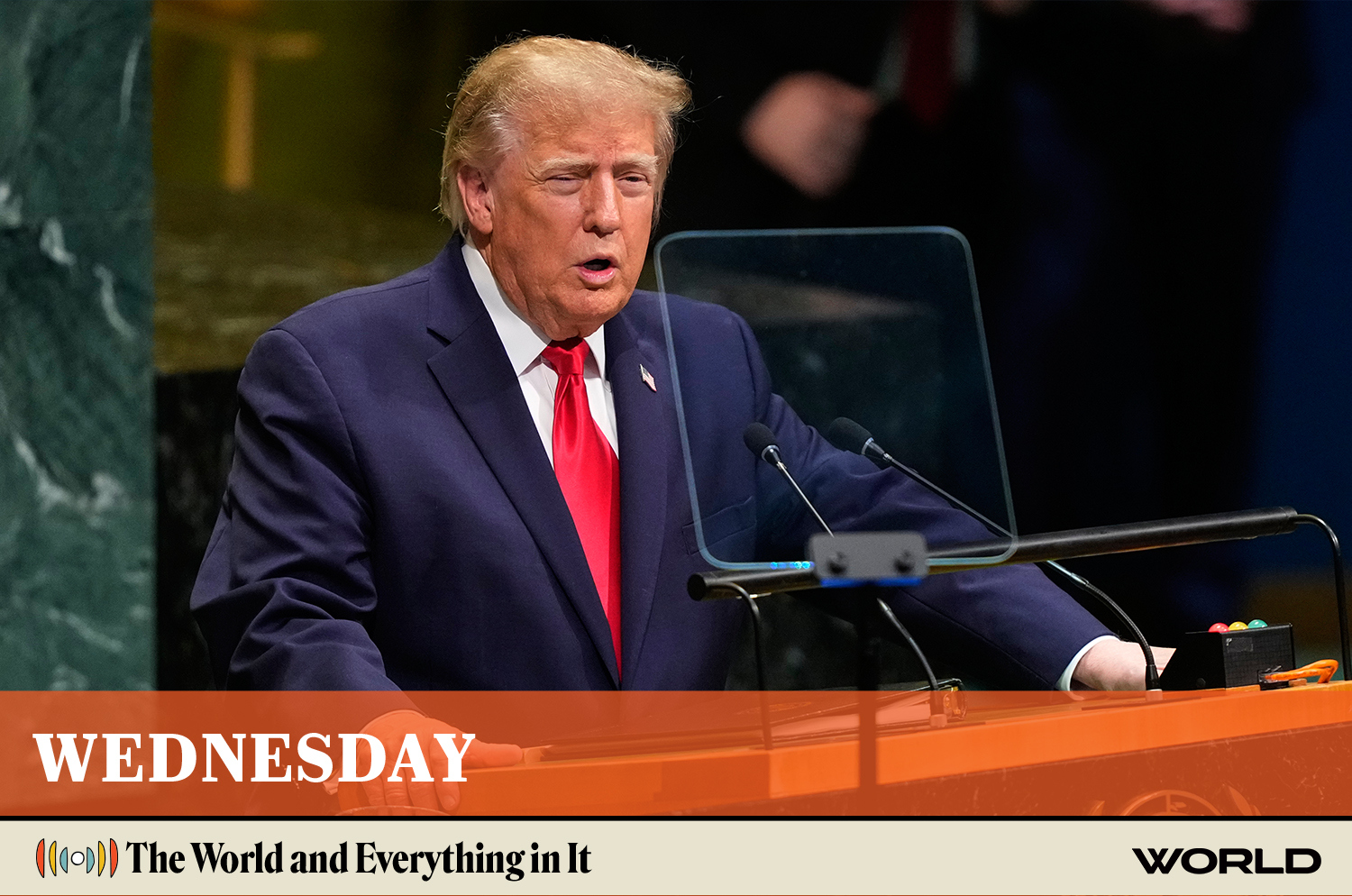
President Donald Trump speaks at the United Nations General Assembly, Tuesday. Associated Press / Photo by Yuki Iwamura
Editor's note: The following text is a transcript of a podcast story. To listen to the story, click on the arrow beneath the headline above.
LINDSAY MAST, HOST: Good morning!
President Trump touts an American resurgence as he prepares to welcome the Chinese president.
NICK EICHER, HOST: Hunter Baker is standing by for Washington Wednesday.
Also today World Tour: Nepal still recovering from devastating floods.
Later: An Illinois farmer
finds a new way to make a living.
CALLISON: They take something that is poisonous to us, break it down to something that is actually good for us.
And WORLD Commentator Janie B. Cheaney on classic hymns in dark times.
MAST: It’s Wednesday, September 23rd. This is The World and Everything in It from listener-supported WORLD Radio. I’m Lindsay Mast.
EICHER: And I’m Nick Eicher. Good morning!
MAST: Up next, Kent Covington with today’s news.
KENT COVINGTON, NEWS ANCHOR: Signing of Greenland deal » At UN headquarters in New York, President Trump Tuesday sat shoulder to shoulder at a table with leaders from Denmark and Greenland.
SOUND: [Applause]
They drew a round of applause from the small gathering as they each held up their signed copy of a new agreement to boost the U.S. military footprint in Greenland.
The deal updates a 1951 defense agreement, and President Trump says it gives the U.S. more power to defend both America and Europe.
TRUMP: We will immediately begin the process of developing a large military presence in the appropriate locations. We'll be building two very major military bases
The deal lets American forces expand Pituffik Space Base in the northwest and set up new defense areas in the south and the east.
Danish Prime Minister Mette Frederiksen:
FREDERIKSEN: Mr. President, you have been very clear. You don't want adversaries to come too close. I fully agree, and with this deal, they are not.
The text also recognizes Danish sovereignty and Greenlanders' right to decide their own future. Greenland's Prime Minister Jens-Frederik Nielsen:
NIELSEN: It is about taking shared responsibility for this, for a secure America, a secure Greenland with mutual respect and a peaceful Arctic. This is a win-win-win agreement.
Lawmakers in Denmark and Greenland must approve the deal before it takes effect.
Trump speech » Just before that signing, Trump spoke to a gathering of world leaders at the UN General Assembly, declaring that America, in its 250th year, is stronger than ever.
TRUMP: Our economy is the envy of the world. Our military is the most powerful on Earth. Our technology is second to none.
Trump brushed aside safety concerns over artificial intelligence, and rejected what he called a globalist scheme to control AI.
TRUMP: From this point forward, all of United States documents, and hopefully the world's, will be changed to use the much more accurate term
On Iran, he said the regime had been the bully of the Middle East, but after US military action, it is the bully no more. And he said what comes next in the war is still undecided.
TRUMP: Do I drive them into hell with no chance of survival and no hope of future greatness or generations? But I believe we'll make a deal right after the election because it doesn't make sense for them not to.
Trump said Iran has been trying to leverage the US election to apply political pressure.
Most of Iran's delegation walked out during his speech.
Afterward, US diplomats sat down with Iranian officials for three hours. Trump called it a very good meeting, and said they plan to meet again.
Iran's president, Masoud Pezeshkian, will speak to the assembly today.
Trump-Zelenskyy meeting » President Trump also met with Ukrainian President Volodymyr Zelenskyy Tuesday.
And he said he’s optimistic that an end to the Russia-Ukraine war is in sight.
TRUMP: Well, I think they're going to make a deal, and I don't want to say what the deal is. We talk about it a lot, including with President Putin. And I think something's going to happen.
He said he's also talking with Zelenskyy about the possibility of making defensive Patriot missile interceptors in Ukraine. At the same time, Trump said it's time to stop targeting energy facilities, criticizing Ukraine's recent strikes on Russian oil refineries.
Zelenskyy said he’s willing to stop those strikes if Russia will do the same in Ukraine.
ZELENSKYY: We are ready for any kind of format of energy ceasefire. So, if we don't attack energy, so all the energy, everything. So, this is our proposition. We are very thankful to the American side. They will share it with Russians.
Zelenskyy also said he's very open to trilateral talks with with the US and Russian leader Vladimir Putin himself.
Xi visit preview » And today Chinese leader Xi Jinping lands outside Washington for a state visit, and President Trump plans to greet him on the tarmac.
That's rare. Trump usually welcomes foreign leaders at the White House.
The two leaders will sit down for wide-ranging talks. Topping the agenda will be trade, artificial intelligence and the U.S. war with Iran. The Chinese are the biggest buyers of Iranian oil, and Trump wants them to cut back.
But Beijing wants something too. China's Communist Party newspaper calls Taiwan a red line. Xi Jinping is expected to press Trump to drop a pending U.S. arms sale to the island.
Vance on Obamacare » In Washington Tuesday:
VANCE: We are stopping Obamacare enrollment for about 750,000 people.
Vice President J.D. Vance announced new steps in rooting out healthcare fraud. WORLD’s Harrison Watters reports from the nation’s capital.
WATTERS: Vance says hundreds of thousands of people on Affordable Care Act plans were getting help they didn't qualify for.
Their income was too high in many cases, and some never even gave a Social Security number.
The White House Antifraud Task Force said Tuesday one in three people on Obamacare has never filed a claim. Insurance brokers signed some up without their knowledge, to collect commissions.
Obamacare enrollment more than doubled under the Biden administration. The task force blames eligibility rules the government relaxed during the pandemic.
Vance says many of the deleted accounts didn't belong to real people. And the government is still checking more than 400,000 others.
VANCE: We're going to make sure that they're, first of all, legal residents of the United States of America. And second of all, we're going to make sure that they actually meet the income threshold requirements.
WATTERS: The administration says cleaning house could save taxpayers $2.2 billion.
Reporting for WORLD, I’m Harrison Watters, in Washington.
I'm Kent Covington.
Straight ahead: Hunter Baker joins us for Washington Wednesday. Plus, an Illinois farmer finds a new way to make a living.
This is The World and Everything in It.
NICK EICHER, HOST: It’s Wednesday, the 23rd of September. Glad to have you along for today’s edition of The World and Everything in It. Good morning. I’m Nick Eicher.
LINDSAY MAST, HOST: And I’m Lindsay Mast. Time now for Washington Wednesday. Back with us is political scientist and WORLD Opinions commentator Hunter Baker.
Hunter, good morning.
HUNTER BAKER: Good morning.
MAST: Issue one: Trump at the United Nations. President Trump went before the U.N. yesterday and offered a sweeping account of American power, military force against Iran and Venezuela, economic pressure, national sovereignty, and deep skepticism toward international institutions.
His recurring theme was this: while others have talked, he has acted. So, Hunter, what principle ties all of that together? What did we learn about Trump’s view of American power?
BAKER: I’m not sure that there really is a coherent view in what he expressed there. He talked about being a peacemaker. He’s somebody who acts. He’s somebody who makes peace.
Right now, that’s not entirely clear, right? Maybe a peacemaker in the sense that the Colt .45 was called the Peacemaker.
EICHER: Yeah.
BAKER: That’s …
EICHER: It’s not illegitimate.
BAKER: That is a sense of peacemaking, I suppose.
But I think that what he has done that is consistent, at least, is that he has exerted significant influence with regard to Venezuela and Cuba, and he talked about that a lot. And we can reconcile that with the Monroe Doctrine and the idea that the United States is going to be the premier power in the Western Hemisphere.
But then he got into this very heavy rhetoric about Iran, and that he’s either going to make a deal or essentially he is going to end Iran. And that is heavy stuff. That is not really U.N.-type rhetoric. That’s not really what that body is for.
I’m sure he made himself very clear, but the thing is that he has been bombastic before, and I think that there probably is a certain degree of people thinking, well, he’s going to keep on upping the rhetoric, but we don’t know how serious he is.
EICHER: As you mentioned, Hunter, Iran at the center of that speech. He said he expects a deal after the midterms, but he also framed the alternative in extraordinary terms, saying he could, as you said, annihilate the Islamic Republic.
Since the speech, he said that talks with Tehran are ongoing. I wonder whether the objective is still the same: preventing that nuclear weapon, or if he has described something broader than even that. What do you think?
BAKER: I think it is broader. It’s obviously deadly serious. The problem is, I’m not sure that there are reasonable people in Iran who can make a deal with him. I just don’t know if that channel really exists. We’ll see if it emerges.
But the reason he’s pointing to after the midterms is that he’s making it clear he’ll still be in power. He may lose Congress, he may lose the Senate, but he’ll still be in power, and they will still have to deal with him at that time.
MAST: Hunter, Gerard Baker of The Wall Street Journal wrote this week that Republicans were handed an extraordinary governing opportunity in 2024 and, in his view, have badly mishandled it. The headline was, “Help! I Feel a Bad Case of TDS Coming On.”
So, did Trump’s speech answer Baker’s underlying question at all? Did the president give us a clearer idea of what he thinks this governing opportunity is for?
BAKER: I want to be fair to him. When it comes to Iran, we can sit here, and I would be one of these people who’d say, “I wish that he had not attacked Iran.”
But I also have to say that presidents know things that people like me do not know, and there are potential threats that people like me do not necessarily understand, and so he may have felt he had to act.
But the simple fact is that when he came back to win that second term, I think he was extremely confident. I think he had everybody at his feet, and instead of the victorious second term that I think everybody expected, he has encountered problem and misstep one after the other.
EICHER: Well, Hunter, issue two: Xi comes to Washington. Chinese leader Xi Jinping is due in town sometime today. They will have meetings tomorrow. There’s a lot on the table: trade and critical minerals, artificial intelligence, Taiwan, potentially China’s role with Iran.
U.S. officials have also proposed a new system for Washington and Beijing to notify one another about serious problems with A.I., or S.I.—superintelligence, as the president wants to call it.
But this reminds me of the nuclear hotline during the Cold War. But in any event, Hunter, do you think these are separate negotiations, or do you think Xi sees all of this as one big bargaining table?
BAKER: I do think that it’s all one big bargaining table. I think it is extremely naive for anyone to think that China wishes to accommodate us. They probably view us as a very large power, but one that may be expiring.
I think that they believe that they are rising, and we are falling. Some academics have talked about this as the Thucydides trap between the former superpower and the rising superpower.
And I think that China’s attitude is that they may not directly antagonize us, and they’re willing to go through all the motions, but I do not think that they’re going to go out of their way to help us. And I certainly don’t think that they’re going to try to get Donald Trump out of any trouble that he’s got with Iran.
The big thing is Taiwan. We have this strategic ambiguity where we all say there’s one China, but we don’t say which China that is, whether that’s the People’s Republic of China or the Republic of China in Taiwan. And we’ve maintained that for almost the entirety of my lifetime, but with a sense that American presidents would probably intervene if China did something aggressive.
And I think that what Xi wants—and he might be willing to offer a lot to Donald Trump to get it—is to get Donald Trump to make some motion to indicate that the United States may be somewhat indifferent to what Taiwan’s fate is.
MAST: Well, speaking of Taiwan, that is the clearest test. Beijing is pressing Washington over American arms sales to Taiwan.
So when this summit is over, what would count as an actual change in American policy toward Taiwan and not just different words?
BAKER: It would be some sort of statement from the president that is accommodative with regard to China’s designs for Taiwan. Some change in the rhetoric.
We have maintained this fairly neutral sort of a stance, although always knowing that we probably would step in. I think they’re just looking for—it’s that small. They’re just looking for something from Trump to indicate that our attitude may be changing.
That Taiwan could become like Hong Kong, right? That perhaps it goes back into China’s hands. That something—the smallest statement in that direction is what they’re looking for.
EICHER: Well, issue three: money and politics. Now the midterms, Hunter. Republican candidates are often being outraised by Democrats, but GOP super PACs and party organizations have an enormous outside-money advantage. Republican-aligned groups spent about $204 million in just the first half of September.
So, Hunter, does that kind of money still buy what it used to, or has the fragmented media environment changed the value of the campaign dollar?
BAKER: We are looking at a potential wave election, and when there’s a wave, when the voters are gonna make a significant move because of dissatisfaction, especially over something like affordability, then the party that is in office is swimming upstream, and things are difficult.
However, there is one thing that you really can do, and I think the Republicans are really trying to do that thing, which is to focus on the negatives of candidates who have them.
So, for example, in Texas, you can spend a lot of money not bolstering Ken Paxton, but pointing out the weaknesses and the problems with James Talarico. So you can just plaster all over the state direct quotes from James Talarico of him saying things like, “Trans people need abortions too,” and point out his extremely heterodox form of Christianity. And for a lot of voters, that will either prevent them from voting for Talarico or help them to go ahead and take that extra step and vote for Paxton.
And the same thing is true in that Michigan race with El-Sayed. Mike Rogers will be able to point out radical things in El-Sayed’s worldview to help him maybe get over the finish line.
MAST: All right, Hunter, lightning round. President Trump and New York Mayor Zohran Mamdani met again this week. They disagree on immigration, economics, and plenty more, but they continue to speak warmly about their working relationship.
How do you explain that strange rapport? Is there a difference between campaigning against somebody and governing with him?
BAKER: Well, Trump respects people who win. Trump is a New Yorker and somebody who has made his life and reputation in that city as a real estate developer, as somebody who does major projects.
And Zohran Mamdani has interest in doing some major projects to improve the housing affordability problem in New York City, and I think that’s something that Trump is potentially interested in. And Mamdani can lure Trump maybe into getting involved with some federal money and doing some of that kind of work.
EICHER: All right. Next, the president and the press last week. President Trump barred CNN, MS NOW, and Politico from the White House. The major TV networks responded to that by suspending their regular pool rotation.
So, what principle do you think ought to govern White House access when a president believes that a news organization is unfair or dishonest or just fake, as he says?
BAKER: There’s really a spectrum of possible stances to take with regard to the press. There are times when Republicans have been covered in a very tough way by the press, and I sometimes think they’re almost like they have Stockholm syndrome, and they treat the press extremely well, even when they’re being treated very badly.
Trump certainly feels that he has been treated badly, and he has complained about it a lot, and he has made “fake news” part of the American lexicon.
But I think that maybe he’s gone a bit far in trying to ban different outlets from being involved in these press availabilities. He would look better. He’d be the bigger man if he didn’t try to do that sort of thing.
MAST: Well, finally, Obamacare. The administration says it is removing more than 750,000 people from the insurance marketplaces, saying they were ineligible for subsidies or, in some cases, weren’t real people.
Vice President Vance says that will save taxpayers $2.2 billion. Hunter, is Vance building a political identity around fraud? Basically saying, “Give me a government program, and I’ll show you where the money is leaking out.”
BAKER: Well, he should be doing that because he was given this job by the president, I think, in the latest State of the Union address. And Vance has, instead of ignoring that task, instead of making that a throwaway sort of a line, he actually has gone after it with other officials in the government.
And I think that this is a tremendous thing to do. You may remember that Kamala Harris was supposedly charged with cleaning up the border, or dealing with the border, or going to the border, and really did not prioritize that.
But Vance seems to be taking this fraud question seriously.
EICHER: All right, Hunter Baker is a senior fellow at the First Liberty Institute and our regular Washington Wednesday analyst. Hunter, thank you. We’ll see you next week.
BAKER: Thank you.
LINDSAY MAST, HOST: Coming up next on The World and Everything in It: World Tour.
In Nepal, around 6,000 people are still missing almost a month after flash floods killed at least 1400 more. Recovery is so slow that even holding a funeral is a challenge.
WORLD’s Mary Muncy reports.
MARY MUNCY: Weeks after the flood, Kalpana Thapa Magar walked over feet of silt trying to find her home.
MAGAR: (Nepali) I only recognized it after others told me that it was my house.
She says she didn’t recognize the pile of pink rubble until someone told her it was her house.
MAGAR: (Nepali) When I came here, I recognized it from the color, design and lights on the roof.
and she only recognized it by the color and the string lights on the roof.
BHATT: The need is great.
Mohan Bhatt is a Nepali pastor who visited the area to bring supplies.
BHATT: Those who are not affected directly by the flood also, they have been, you know, affected by this, you know, lack of supplies in their homes and their and their families.
The flood also destroyed livelihoods. It buried business fronts and removed the topsoil, making farming impossible, leaving some people with business loans they can’t repay.
The government is making some progress, rebuilding suspension bridges and finding missing people’s remains.
But the death toll has maxed out morgue space.
KRAMER: A backhoe came in and dug out the hole.
Michael Kramer is an American architect currently living in Nepal’s Latipur District. It’s a few hours from the flood-affected area, and recently, the government buried several unidentified people there.
KRAMER: They covered it up with looked like just small like river rock, stone, and dirt, so that's kind of over the top, and there's a stick with a little number that's like out of piece of paper, tape that's on it that has the number on it for each person.
That number is attached to a database of DNA samples and pictures of identifying features. Nepal’s government says the mud and water make some people hard to identify, but prolonging burial is a health hazard. Close relatives can send in DNA profiles to try to find a match.
Kramer isn’t sure why the government chose his village. But he has a guess:
KRAMER: This is already… an area for the the cremation ceremony… and it's governmental land, so they have the right to do it in that location.
About 80% of Nepalis are Hindu. And that cremation ceremony is part of the Hindu tradition. They believe the spirit needs to be released from its earthly attachments and that burning the body is the best way to do that.
SOUND: [Funeral]
Without their loved one’s remains, some Nepalis are holding symbolic funerals, Building small fires and burning effigies.
But legally, they’re in limbo. The state will only consider a missing person dead after three years. That means some families can’t get a death certificate and are left without state benefits like pensions.
TOSH: The very government that you're supposed to coordinate with may very well have been swept away. And so the government building doesn't exist.
Darren Tosh is the team lead for Samaritan’s Purse’s response in Nepal. Last year, protestors forced the country's long-time Prime Minister to resign and voted in a new party. Tosh says the new government is especially motivated to help, despite being affected by the disaster themselves.
TOSH: I think with this new government, they're, they're very excited about what Nepal will be in the future, and so I think there is some hope that this is a relief effort that's going to be strong, it’s going to be uniting the country.
Tosh says relief efforts will need to last for a long time.
The flood destroyed the country’s main trade route with China, plus hydropower projects, and tourism facilities. One economist estimates it destroyed about five billion U.S. dollars of infrastructure. That’s a little less than half of Nepal’s government’s budget this fiscal year.
TOSH: There's simply no more villages left. Like there's just it will be a full reconsideration of where to live, what to live in, and what people will do for for a living.
That means it will likely be a while before families are back in homes, wherever those may be.
Reporting for WORLD, I’m Mary Muncy.
NICK EICHER, HOST: Lots going on in the lower 48: UN meetings, the China visit to the White House.
But north, to Alaska, it’s Fat Bear Week.
Sixteen brown bears competing in a single-elimination bracket for the heavyweight crown at Katmai National Park.
Last year’s winner, Chunk, estimated at twelve-hundred pounds, he’s trying to retain the title.
Tough competition, bears eating as many as 30 salmon a day before hibernation.
Voters are asked to compare before-and-after photos and pick the winner online.
By the way, voting’s open to all, so vote early, vote often. We’ve put a link in the episode notes if you want to weigh in, so to speak.
Organizers say: fat bears are successful bears.
Proving that at least sometimes, showing up overweight is exactly how you win a championship.
It’s The World and Everything in It.
LINDSAY MAST, HOST: Today is Wednesday, September 23rd. Thank you for turning to WORLD Radio to help start your day.
Good morning. I’m Lindsay Mast.
NICK EICHER, HOST: And I’m Nick Eicher.
Coming next on The World and Everything in It: Delighting in dirt.
Worms’ ability to create compost has led one Illinois man to a thriving business… and a new appreciation for God’s transformational design.
Joel Belz Journalism Fellow Claire Wilkerson has the story.
CLAIRE WILKERSON: Jerry Callison is serious about worms.
CALLISON: This is called a trommel, and when we run the product, we start up here with the completed castings…
Today, he’s running a trommel, which is just a big spinning worm sorter.
SOUND: [Trommel]
Jerry and his brother Ron run the Northern Illinois Worm farm in Dover…though farm might be a generous term. The property consists of a small barn attached to a smaller air-conditioned room with an even smaller back office. A large window air conditioner keeps the main room cool for the worms.
CALLISON: Just be very careful. Don't get the place dirty or cluttered (laughter)...the place is a royal mess…
Jerry Callison’s specialty: worm poop, formally known as vermicomposting.
CALLISON: Vermi is Latin for worm, okay? So, you got worm cast, okay? And that's castings, worm poop.
Callison hasn't always been a worm expert. He was a commercial truck driver until a life-altering diagnosis.
CALLISON: I came down with Guillain-Barré syndrome in 2013, and I have partial paralysis in both legs.
But he wanted to stay active.
CALLISON: I'm going to be doing something…I'm going to be productive.
A 6 hour IV infusion every two weeks keeps him from having to use a wheelchair. He learned about suppliers selling worms online as live bait or for home composting. He figured it was something he could do in his basement.
CALLISON: …and so that's where we started..
But when he began shipping them to customers, the worms kept dying. Transit times varied so worms sat in post offices and trucks too long. Then he hit on something he could control.
CALLISON: I said, Hey, look, we're looking at the wrong side of the business. The value's in the castings, not in the worms. Because the post office can't kill this.
In 2023 the brothers began raising worms to harvest their castings. They started small, with customers looking to boost home gardens.
CALLISON: We were going to farmers markets, and we were selling it 5 lb, 15 lb, 25 lb, 40 lb at a time…
Now their customers include professional landscapers. The farmer across the street even used some of the castings on his corn crop this year.
But the growth process had its challenges. The brothers discovered there's lots of ways to kill worms: overly wet bedding, too much rotting food, not enough dry material...
CALLISON: And now we've had some bad days in here. We have killed worms. We have killed worms with zeros behind it…[34:49] it got us on our knees and got us asking, you know, what what are we doing wrong, you know, and and God led us to the answer.
Jerry still has hard days. Even with his infusions, he’s often in pain and has to return to his wheelchair. He’s put inspirational signs around the room where the worms live in four large wooden boxes. One sign stands out…
CALLISON: May I never forget on my best day that I still need God as desperately as I did on my worst. And that is so true.
Jerry sees God’s hand in the worm and its ability to create something pure from garbage.
CALLISON: It eats 1 1/2 times its weight a day. Okay, and as it does that, it puts out a superb product that is full of microbes that only come from the worm gut…Okay, that can't have happened by accident.
He’s found purpose in taking care of the worms and serving his customers.
CALLISON: He opened the door to put me into without me even wanting it. I didn't know I wanted to do worms. But once I got started, man, and I have more fun than you can shake a stick at.
He’s also found comfort in the act of working with God’s creation.
CALLISON: When we come in here, we're tired, we're worn out, and it's been a tough week. We get in here and get our hands down into the soil. It's just, it's rejuvenating. It just does so much just to settle your spirit,
The farm has doubled its sales year over year. Now, the Callisions are expanding to supply castings to more farms and landscapers. They’re also building more sophisticated boxes to house even more worms.
Reporting for WORLD, I’m Claire Wilkerson in Dover, Illinois.
CALLISON: I always use my hands. Ron usually uses a scoop…I prefer to use my hands.
NICK EICHER, HOST: Good morning! This is The World and Everything in It from listener-supported WORLD Radio. I’m Nick Eicher.
LINDSAY MAST, HOST: And I’m Lindsay Mast.
The lyrics of great hymns have a way of sticking with us, and they often come back to us outside of worship. WORLD Commentator Janie B. Cheaney now on the power of spiritual songs in dark times.
JANIE B. CHEANEY: We had things to pray about, my friend and I. It was only a couple of weeks after 9/11 and a grayish pall still hung over the nation. Personal concerns weighed heavily too. We met at the park to bear each other's burdens to the Lord.
I am easily sidetracked; rather than levitate into the spiritual realm with a prayer group, my thoughts go skittering after trifles. Even while clasped in prayer with a dear friend, I wondered if my hand was sweating. My elbow was getting sore--should I move it? A jogger panted by; a maintenance man made broad swipes in our direction with a lawn sweeper.
Then, another interruption: On the other side of the lagoon, out of sight but certainly not out of earshot, an incongruous interruption:
SOUND: [AMAZING GRACE]
My first thought: Who comes to the park to practice their bagpipes? (I've since learned that practicing this particular instrument outdoors is much preferable to indoors.)
After a glance around to see where it was coming from (we couldn't), and asking each other if we knew who it was (we didn't), we continued our prayer service with accompaniment. After "Amazing Grace" (popular at memorial services these days), the tunes that squalled across the lagoon like gusty breezes were not the sort commonly associated with this medium: "The Old Rugged Cross," "Softly and Tenderly," even "Whispering Hope" - all laid on thick by this unsubtle instrument.
With the melody came the words: "I once was lost but now I'm found . . ." "So I'll cherish the old rugged cross . . ." "Ye who are weary, come home . . ."
I grew up on gospel songs, sung from a blue-backed hymnal with shaped notes. In time I grew away from them: "Messiah" they're not. My affection for them now owes something to nostalgia and fond memories of grandparents long gone--but the bagpipe rendition brought another dimension to mind.
Believers wrote those songs, and believers sang them, in smoky camp meetings, in overstuffed parlors, in church buildings with creaky floors, under-confident pump organs and over-confident sopranos. Even so, those old tunes, warbled and trilled through the ages to be picked up by wheezing pipes on the shore of a park lagoon, spoke for generations of a hope beyond this world.
Through the ages God has raised up believers like us, many of them called to believe through difficult times, uncertain times, even terrifying times. They wrote songs to encourage or admonish each other. The songs have survived, as a testimony to the Lord's continuing work of building a church by building faith in each believer. From William Cowper and Isaac Watts to the unknown country hymn writer whose heart was broken, the old tunes look forward to a city not made with hands and a multitude no man can count, their purified voices raised in a heavenly theme: “Worthy is the lamb.”
We continued in prayer, as the piper played on and an unseen cloud of witnesses hovered nearby. I imagine them singing along, and singing still. As dark as the world may appear, we look forward to the day we’ll sing a new song, all together at last.
For WORLD, I’m Janie B. Cheaney.
LINDSAY MAST, HOST: Tomorrow: The Senate takes another look at protecting female athletes. We'll talk to a former elite gymnast about it. And, how Christian rock artists blend music with the gospel message. That and more tomorrow.
I’m Lindsay Mast.
NICK EICHER, HOST: And I’m Nick Eicher.
The World and Everything in It comes to you from WORLD Radio. WORLD’s mission is biblically objective journalism that informs, educates, and inspires.
The Bible says, “Better is the end of a thing than its beginning, and the patient in spirit is better than the proud in spirit. Be not quick in your spirit to become angry, for anger lodges in the heart of fools. Say not, ‘Why were the former days better than these?’ For it is not from wisdom that you ask this.” —Ecclesiastes 7:8-10
Go now in grace and peace.
WORLD Radio transcripts are created on a rush deadline. This text may not be in its final form and may be updated or revised in the future. Accuracy and availability may vary. The authoritative record of WORLD Radio programming is the audio record.
Please wait while we load the latest comments...
Comments
Please register, subscribe, or log in to comment on this article.