
The World and Everything in It: September 22, 2026
President Trump’s Greenland deal expands America’s longtime foothold there, while affordability politics runs into the limits of what government can do about prices. Sen. Ron Johnson says key COVID-era records may already be gone, and a rebuilt cog railway climbs toward “America the Beautiful.” Plus: raccoons train for the wild, and Cal Thomas defends the friction of a free press.
dlerick / iStock / Getty Images Plus via Getty Images
Editor's note: The following text is a transcript of a podcast story. To listen to the story, click on the arrow beneath the headline above.
MARY REICHARD, HOST: Good morning!
Senator Ron Johnson is accusing federal health officials of withholding or destroying Covid shot records.
JOHNSON: Some of these records that are vital to our investigation, that the American people deserve to see, may not exist.
NICK EICHER, HOST: Also today, the Greenland deal and the affordability issue: politicians promising to lower prices—but some economists say that’s mission impossible.
Later: A trip to Pike’s Peak.
CHAD: His creation declares His glory. We're getting to see just a glimpse of His glory.
And WORLD Commentator Cal Thomas on the President and the press.
REICHARD: It’s Tuesday, September 22nd. This is The World and Everything in It from listener-supported WORLD Radio. I’m Mary Reichard.
EICHER: And I’m Nick Eicher. Good morning!
REICHARD: Up next, Kent Covington with today’s news.
KENT COVINGTON, NEWS ANCHOR: U.S. proposes AI emergency hotline with China » The United States wants a hotline with China for emergencies involving artificial intelligence. US officials pitched the idea in weekend talks.
Cooperation will have limits. The two countries are racing for the lead in AI, and Washington restricts China's access to advanced computer chips. But U.S. Trade Representative Jamieson Greer said Monday:
GREER: We want to figure out the bounds of what we should and shouldn't tell each other, right? There's still national security bounds to this. But, uh, the- there should be a baseline, uh, understanding that each side, if there's an emergency, if there's a crisis, we should be able to have a hotline to tell each other.
Beijing hasn't said publicly whether it's on board.
Chinese leader Xi Jinping is skipping this week’s U.N. General Assembly, which opens today in New York. Instead, he arrives tomorrow in Washington, where President Trump will host him for talks.
Trump has invited AI and tech leaders to join them for a White House dinner.
Strait of Hormuz / IRGC threat » In the Middle East, a British navy center that tracks shipping says an unknown projectile hit a tanker Monday in the Strait of Hormuz. Two crew members were injured — though not seriously, and the ship kept going. No one has claimed responsibility.
Vice President JD Vance:
VANCE: We continue to see a substantial amount of oil and ga- gas flow through the Strait of Hormuz despite the Iranians terrorizing ships every single day.
Oil tankers continue to move, moving through the strait, but ship trackers say the traffic is down by as much as three-quarters or more from pre-war levels.
Meantime, Iran's Revolutionary Guard is threatening to further widen the war and hit new targets if the U.S. strikes again.
That came after President Trump told a Fox reporter Sunday he's in what he called “deciding mode” on Iran, adding that “very big things” will happen in the near future in that war.
But US Ambassador to the UN Mike Waltz says Iran could end this at any time.
WALTZ: He's always open, uh, to talks. He's always open to diplomacy. He's always open to crafting some kind of peace deal. Uh, but the Iranians have to come to the table with good faith, and we have to know that they're actually speaking for the Ayatollah.
Iran's president heads to the U.N. today. But Ayatollah Mojtaba Khamenei, Iran's supreme leader, hasn't appeared in public since taking over in March.
College sports bill on the Senate agenda this week » The U.S. Senate is back in session after taking Monday off for the Jewish Yom Kippur holiday—and senators have some big items on the agenda. WORLD’s Harrison Watters reports from the nation’s capital.
HARRISON WATTERS: Lawmakers are set to debate and vote on a bill aimed at overhauling college sports. It would create federal protections for athletes to profit from their name, image and likeness, limit transfers, and protect roster spots and scholarships in women’s and Olympic sports.
The bill has broad bipartisan support, though some Republicans want stronger protections governing participation in women’s sports. Separately, the Senate Judiciary Committee holds a hearing on that issue Wednesday.
Another hearing will examine Flock’s nationwide network of AI-powered license-plate cameras.
Lawmakers will also consider nominations for federal courts and posts in the Trump administration … including Trump’s picks for surgeon general and FDA commissioner.
The Senate has nine scheduled session days left before its October recess.
Reporting for WORLD, I’m Harrison Watters in Washington.
Media lawsuit over White House access » Three left-leaning news outlets filed a lawsuit Monday against the Trump administration after being banned from the White House.
CNN, Politico and MS NOW, formerly MSNBC, say the White House barred their reporters because it dislikes their coverage. They want a federal judge to restore access immediately.
President Trump asserts that their reporting is comprised of unfair —quote—“fiction and lies.”
The big TV networks share one camera on the president. Monday they stopped participating in the White House TV pool after CNN was blocked from its turn.
Several major networks, including the right-leaning Fox News network, signed a rare joint statement saying no administration should restrict a news organization because it objects to its reporting.
Ukraine-Russia latest » In Ukraine:
SOUND: [Russian strike]
Russian forces launch another major attack after Kyiv’s forces carried out a massive strike in Russia. WORLD’s Kristen Flavin reports.
KRISTEN FLAVIN: The Russian airstrike Monday in Zaporizhzhia hit apartment blocks, a university and a shopping mall, wounding five people.
That came after Ukraine over the weekend fired more than 1,000 drones at military and energy targets in Russia, including hundreds launched toward Moscow.
There remains no end in sight to the war as world leaders gather this week at the UN General Assembly.
Ukrainian President Volodymyr Zelenskyy plans to meet with President Trump, while Russian President Vladimir Putin will not attend.
For WORLD, I’m Kristen Flavin.
I'm Kent Covington.
Coming up, how much power do politicians have to answer American’s concerns about affordability? Plus, the unique railway taking visitors to the top of Pike’s Peak.
This is The World and Everything in It.
NICK EICHER, HOST: It’s Tuesday the 22nd of September.
This is WORLD Radio and we’re so glad you’re listening. Good morning, I’m Nick Eicher.
MARY REICHARD, HOST: And I’m Mary Reichard.
First up on The World and Everything in It: the Greenland deal.
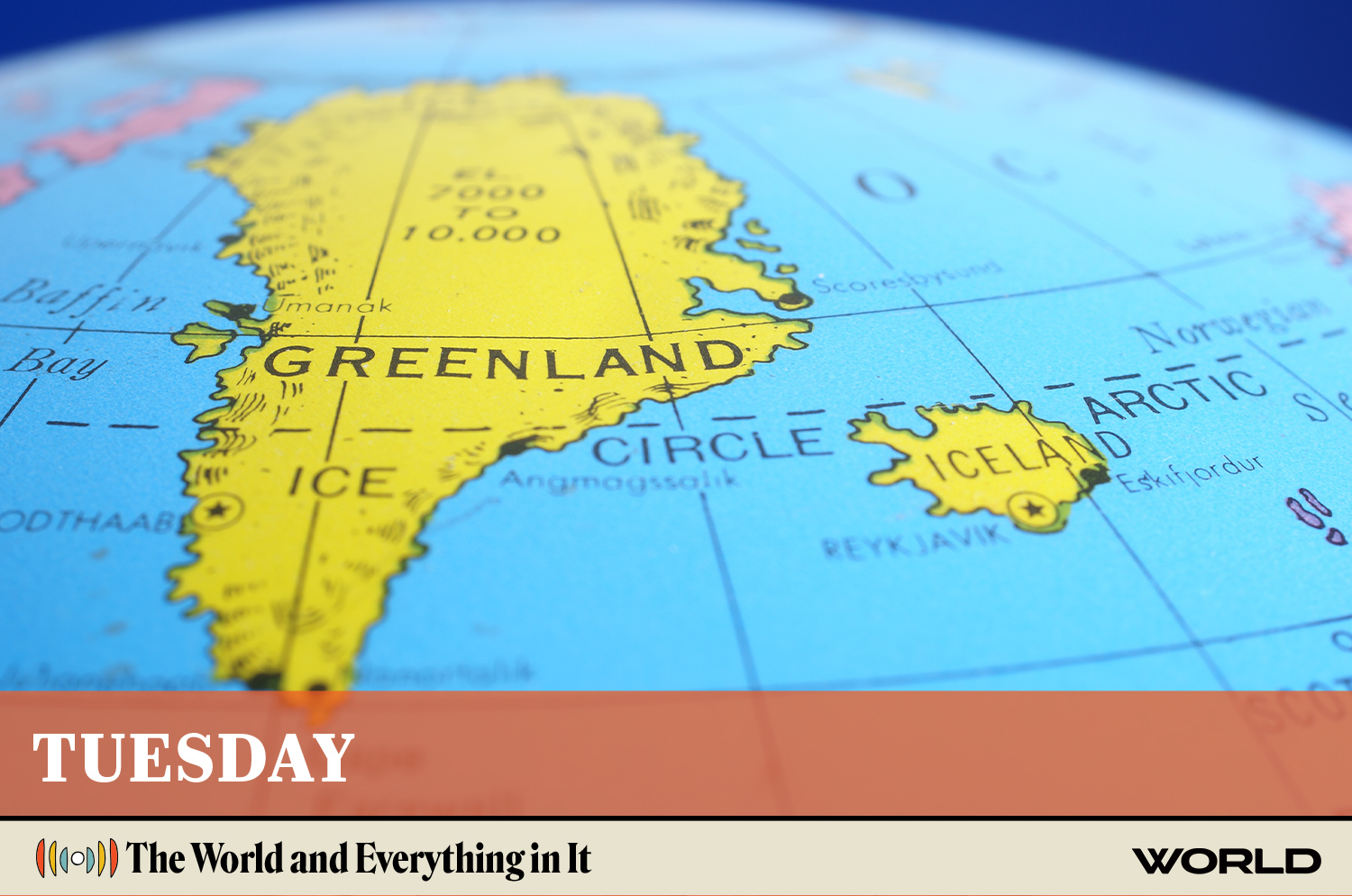
Today, on the sidelines of the UN General Assembly in New York, leaders from the U.S., Denmark, and Greenland are set to put pen to paper. They’re expected to sign a new deal giving the U.S. military a stronger foothold there.
EICHER: President Trump has talked about the strategic importance of Greenland since his first term. But after returning to the White House last year he ramped up the pressure.
TRUMP: All the United States is asking for is a place called Greenland.
Insisting that the United States needed to acquire the island. That, he argued, was vital for U.S. national security and global stability.
This deal does not go that far: Greenland will remain a self-governing territory under Denmark.
Still, Trump seems quite happy with the new arrangement.
REICHARD: He announced it on social media last week, saying the deal—his words … “gives the United States permanent control over security, and all other needs, in Greenland, completely addressing ALL of our many U.S. concerns.”
So, what exactly are those concerns, and how does this deal address them?
Speaking to that first question, Greenland is strategically important because of where it is. It’s positioned between North America and Europe and serves as a critical hub for Arctic security.
Trump has pointed out that Chinese and Russian military forces roamed far too freely around the island.
TRUMP: If you take a look outside of Greenland right now, there are Russian destroyers, there are Chinese destroyers, and bigger … we’re not going to have Russia or China occupy Greenland and that’s what they’re going to do if we don’t.
EICHER: And as for the way the deal addresses Trump’s concerns, he says it keeps China and Russia from ever gaining a military foothold in Greenland, calling it an “Infinite Life” agreement—no end date.
But skeptics doubt anything is actually changing from a military standpoint.
MCMILLAN: The United States has had basing access before this; they have basing access now.
REICHARD: Cameron McMillan is a senior research analyst at the Foundation for Defense of Democracies. He says the U.S. has been able to place military bases on Greenland since the 1951 U.S.-Danish Agreement.
MCMILLAN: This is nothing more than symbolic and really is just a result of the president pursuing what I'd frankly call aggressive and unnecessary policy towards Denmark, towards the territory of Greenland.
Still, one potential aspect has teeth: preventing Chinese and Russian investment into rare earth mining. China has used rare earth exports as leverage over the U.S., and Greenland may provide a reprieve:
MCMILLAN: If it has some concrete action of blocking adversarial states from doing business dealings in Greenland, then I would say that would be positive.
On the ground, some native Greenlanders have questions…
GREENLANDIC WOMAN: I’m not comfortable. But let’s see the concrete terms of the agreement. Then we need to have a process to discuss it.
…while others are supportive:
GREENLANDIC MAN: It works very well for me because Denmark is too small. It cannot defend itself when it’s such a small country.
EICHER: McMillan says rhetoric from the president surrounding Denmark and Greenland has been unnecessarily hostile.
MCMILLAN: The Danes see the threat from Russia. They have a shared interest in the security of the Arctic and the security of Greenland, and the Danes have really been a very good ally to the United States.
As the deal wraps up, McMillan says the Administration ought to emphasize strengthening NATO.
MCMILLAN: We pair this kind of contentious fight over Greenland with the administration decreasing the U.S. military force posture in Europe, things like canceling the Armored Brigade Combat Team rotation in Poland, and to me, these things are not unconnected. And we don't need to be creating headaches by creating internal tensions right now, because the Russians will see that as an opportunity to continue to test and, in their view, break NATO.
REICHARD: Today’s signing is not the last bit of attention to this matter. Lawmakers in Greenland and Denmark still have to put it to a vote. But Danish leaders say they’re confident that it’ll pass.
MARY REICHARD, HOST: Coming up next on The World and Everything in It:
Did public health officials ignore early warning signs about COVID-19 injections?
Wisconsin Republican Senator Ron Johnson says they did, and points to government records to make the case.
NICK EICHER, HOST: ohnson chairs the Senate Permanent Subcommittee on Investigations, a congressional watchdog.
An interim report from the panel says FDA officials disregarded potential vaccine safety problems, and issued a cease and desist letter to a scientist whose analysis brought those problems to light. The report is based on eleven million pages of pandemic records from the Department of Health and Human Services.
Connecticut Senator Richard Blumenthal…the panel’s senior Democrat, disputes the conclusions, saying they misrepresent scientific debate.
REICHARD: I spoke to Senator Johnson about what the records show and why he believes officials failed the public.
Senator Johnson, I want to do this step by step so everyone understands. What is the main finding of your subcommittee's report regarding how the FDA monitored the safety of the COVID-19 shot?
RON JOHNSON: Well, on March 1st of 2021, this is less than three months into the administration of the COVID injections. Peter Marks, the head of the division within FDA that approves vaccines, but is also supposed to surveil for safety, was warned by their data mining expert, Dr. Ana Szarfman, that the algorithm they were using to analyze VAERS, the Vaccine Adverse Event Reporting system, was going to hide and mask safety signals. He thanked her. Twenty-six days later, Dr. Szarfman, working with Dr. Bill DuMouchel from Oracle, who is the inventor of the algorithm, had developed a new algorithm to unmask those safety signals. And so they ran the data through that algorithm. And they showed senior FDA officials dozens of safety signals, including sudden cardiac death, pulmonary infarction—which Anthony Fauci suffered from himself in June of 2021—Bell's palsy, different types of stroke. They kept doing these runs for a number of months until finally, until the FDA, CDC basically shut them down, told her to cease and desist. Stick to your division. We're not asking for this. We don't want it.
REICHARD: I’m going to ask you to take a step back and back and explain what masking is? Within the context of VAERS, again the Vaccine Adverse Event Reporting System. And let’s keep things simple and use 10,000 reported deaths.
JOHNSON: So what that algorithm was doing, what they were, what they were comparing is—by the way, those deaths occurred about 10,000 with the Pfizer injection, about 10,000 with the Moderna. Those are round figures, but makes good for the analogy. So how they evaluated the safety of Moderna, those 10,000 deaths, they compared it to Pfizer's 10,000 plus 280. And they're looking for disproportionality. But if you're comparing 10,000 to 10,280? Nothing to see here, right? They're equally safe, equally dangerous. Even though what they should have been comparing is 10,000 Pfizer's deaths to 280, and they refused to do that. They can't but we just we weren't seeing safety signals. We couldn't change algorithms. That would have been inconsistent. We can't change our method in the middle of a pandemic.
REICHARD: So really the main point you're making is that government was not transparent.
JOHNSON: Yes, yes. And they didn't do what they said they were gonna do. We know that HHS has a system, even though Federal Records Act, you're supposed to save these, you know, save all government records, right? Within HHS apparently, you delete an email, a couple of weeks later, that's deleted off the server.
We're finding out some of these records that are vital to our investigation, that the American people deserve to see, may not exist because they literally had policies in place, from my standpoint, to violate the Federal Records Act.
REICHARD: Alright, now I want to ask: How have former officials responded to this report? I understand you have an interview request with Peter Marks, as you mentioned before. He’s the former FDA vaccine regulator.
JOHNSON: We don't interview these people till we get the documents. We we haven't gotten Peter Marks’ email, you know, the emails off his server. Now we've seen emails from Peter Marks who's involved in but that's probably that eleven million page document dump of the access that we we did have to other people that he was copied on. But we do not have specifically Peter Marks, you know, you know, his email tranche. Don't have it. Don't have his devices. We've been asking for other devices. We're finding a lot of these devices are what they call decommissioned and removed from inventory. Destroyed. Well, did did you before you wipe them, did you put them on a server? Don't have an answer to that yet. Again, I would think these are these are questions that ought to be answered almost immediately.
REICHARD: Senator, there's a possibility that people may write off this report because you are the messenger and you have a reputation for vaccine skepticism. How do you answer that?
JOHNSON: I've been ridiculed, I've been vilified, I've been accused of spreading conspiracy theories all through COVID. I've been using government data, it's all been true, it's all been verified. And what they're doing now is they can't refute what I'm saying anymore, they just don't cover it anymore. I mean I had to self-publish an eight hundred word op-ed, and I think it has up to 3.2 million views. So the public does want information, the legacy media just doesn't want to report it.
REICHARD: Alright. So looking forward then, what policy changes would you propose to ensure health agencies do prioritize data transparency in lieu of trying to control the narrative?
JOHNSON: First of all, follow the Federal Records Act. You know, we we need to get in there. We've got to make sure that these agencies are following the Federal Records Act. If if there are regulations promulgated by the National Archives that are allowing these vital records to be destroyed, that needs to be fixed.
You know, Congress has allowed its oversight authority to atrophy. All we can do is do what we can do and then turn it over if it looks like there's criminal referral to the FBI and then they've got far greater resources, which is what happened with Dr. David Morens. You know, we uncovered these emails, we we referred it to the Biden Inspector General, he did nothing with it. It was the Trump Inspector General that finally took this seriously, and now we have a confession from Dr. David Morens of again a conspiracy to destroy federal records.
REICHARD: Senator Ron Johnson, Chairman of the congressional watchdog called the Senate Permanent Subcommittee on Investigations.
NICK EICHER, HOST: Coming up next, affordability on the ballot.
A recent NBC News poll found that more than half of voters blame the government for problems with the economy. But some say it can’t fix what it broke.
WORLD’s Lauren Smyth has the story.
LAUREN SMYTH: A recent report from the Urban Institute found about half of Americans can’t afford essential expenses. It’s perhaps the biggest political issue six weeks out from the midterms.
KAT DE LA CRUZ: The affordability crisis touches so many aspects of our lives.
MANU RAJU: Shift their strategy on affordability ahead of the midterms…
DONALD TRUMP: …affordability. Remember, affordability…
PHILIP DEFRANCO: At what point is this affordability crisis going to come to a head ?
So what, if anything, can the government do about it?
STEELE: Politicians could stop making things worse, but they can’t do anything about lowering prices.
Charles Steele is an economist at Hillsdale College. He says governments don’t set prices—people do when they agree to buy and sell.
STEELE: We sometimes think that well, you just go into the store and you take the price that's there. That's actually not true. If people go into the store and think the price of something is too high, they don't buy it, and the store ends up lowering that price.
Governments can intervene in the buyer–seller negotiation. Take the sugar industry, for example. Here’s Ohio Congresswoman Shontel Brown on the effects of foreign imports.
BROWN: In just the last decade, we’ve lost whole sugar processing facilities, cane mills, and entire regions of domestic production.
That’s why the USDA imposes a quota on sugar imports. But there is disagreement on who benefits. Cane sugar costs about twice as much in the U.S. as it does elsewhere.
STEELE: There was a federal government study that showed that that program was worth a billion dollars to the producers. Now, it cost $2 billion to consumers, so it's a terrible deal. But it was valuable for a small number of people.
Economists call this concentrated benefits and dispersed costs.
STEELE: When you multiply that all across the economy, you find that we make ourselves a lot poorer than we need to be because we are robbing Peter to pay Paul, so to speak.
Other government regulations that seem to have little to do with the economy can also push prices up. Take the Environmental Protection Agency as an example.
STEELE: Think about something like gasoline and diesel prices. That has an awful lot to do with the Strait of Hormuz, with limitations on the amount of ships and shipping that can go through with petroleum. And also, there can be a bottleneck at refineries. We don't develop any big new refineries, and there's three letters that explain that. They are E-P-A.
U.S. refineries have been running at full capacity all summer. But environmental regulations make construction unprofitable, so new plants don’t get built. That brings higher prices at the pump…and stronger protections for biofuel industries.
It’s difficult to measure the positive impact of cleaner air and less pollution. But studies show that the cost of just one set of EPA regulations affecting refineries could top $100 billion in the next two years—costs ultimately paid by the consumer.
STEELE: You get these distortions, what we call deadweight losses in economics, which is loss of value that we could have had…and it does make people poorer, it makes our lives worse.
Steele believes the solution is to take price-setting power away from the government and return it to the buyer and the seller.
STEELE: The freer you are, the better you can take care of yourself, the better you can that families can take care of themselves… We need to not have government trying to do what it's no good at.
The hands-off approach is a hard sell for a family struggling to afford rent. And it’s been anger at corporations, not government, that has become a rallying point for democratic socialist candidates this year, like House candidate Melat Kiros of Colorado.
KIROS: Right now, voters are voting across this country for leadership that is unbought and unafraid to stand up to the billionaires and the corporations that have kept our prices high.
Steele says past precedent shows it’s unlikely that leadership will help.
STEELE: The general cause of inflation happens to be irresponsible spending by the federal government and monetary policy from the Federal Reserve. Politicians are not going to do anything. They've had many opportunities to do something about irresponsible spending.
Voters are still likely to take their economic worries to the ballot box in this year’s midterms—with a majority saying affordability will be their top concern. But ballots are better at changing officeholders than putting lower price tags on shelves and fuel pumps.
AUDIO: All right, c’mon guys! ...
NICK EICHER, HOST: In Mississippi, baby raccoons are going through basic training.
PRIEST: Raccoon boot camp. It’s ah, it’s fun.
At Woodside Wildlife Rescue, most of the kits arrive orphaned, injured, or too young to survive on their own.
So the staff teaches them what their mothers normally would—how to climb, forage, and recognize danger.
PRIEST: Swimming, lots of swimming, lots of swimming and climbing.
They dig for worms, crack open pine cones, and basically learn their way around the woods.
But I see nothing in the training program here about getting into suburban trash cans ,so maybe if it’s not taught, it’s not caught.
AUDIO: C’mon! Look at that!
You know, this has gotta be the softest boot camp in the history of schools of hard knocks.
Eventually, the raccoons graduate—and then off they go. Trained for the wild. But spoiled rotten along the way.
It’s The World and Everything in It.
MARY REICHARD, HOST: Today is Tuesday, September 22nd. Thank you for turning to WORLD Radio to help start your day.
Good morning. I’m Mary Reichard.
NICK EICHER, HOST: And I’m Nick Eicher.
Coming next on The World and Everything in It: Pike’s Peak. It’s a star attraction in the Rocky Mountains, but the journey to get there has its own delights.
WORLD Senior Writer Kim Henderson takes us along for a ride on a cog railway.
KIM HENDERSON: It’s Saturday, and dozens of tourists are waiting at a historic train depot in Manitou Springs, Colorado.
INTERCOM: When you step on the train to watch your step, let us know how many's in your party . . .
They’re in line for the 10:30 departure to the top of Pike’s Peak on an iconic railway that’s been carrying passengers there since 1891.
SOUND: [Clacking on tracks]
The cog railway is perfect for mountain terrain. It uses a toothed track and gear system to climb steep hills that regular trains can’t handle.
About every 40 minutes today, a train will embark on a 3-hour trip up to Pike’s Peak and back. The route follows the original 1890s path, but trains now run on new tracks with the latest locomotives.
Still, Conductor Janine says every trip is different.
JANINE: Even on the same day, because you can get all four seasons up there at the top within a few minutes.
But almost a decade ago, this railway almost closed for good. After more than 125 years, it needed expensive repairs. The owner ultimately decided to invest in an overhaul. Three years and $100 million later, the nine-mile track to the 14,115-foot summit was completely rebuilt. And it had three faster, larger trains.
Train engineer Jeff has seen lots of changes.
JEFF: The old engines were made in the 1930s, 1940s, and they weren't made with the safety features that we have on our passenger trains, and so they were retired. This train here is diesel hydraulic. All of our older trains are diesel hydraulic. Our new trains are diesel electric, and they're quieter.
Jeff has been with the railroad for decades, so he knows the old infrastructure firsthand.
ENGINEER: Old track was with wooden ties, and it was on a dirt and gravel roadbed. Now we have steel ties on a ballast, which is a heavy gravel roadbed, and it's a lot more solid.
But even with all the innovations, there’s still a need for humans to keep a railroad like this going. A crew runs snow plows and chains saws. And then there are the bolts.
ENGINEER: The steel rails are connected to the steel ties with bolts. So that's a big part of the job, tightening the bolts. So that's a time-consuming nine, almost nine miles worth of bolts. It's thousands and thousands of bolts.
It’s reassuring to know they take the job seriously.
Some 900,000 people make it to the top of Pike’s Peak every year. Rider Angela Fogle is glad to be one of them.
ANGELA: I've been planning this for months. I just, well, I really love nature, and I kind of like hiking, but not that much hiking. (LAUGHS)
The climb is steep and winding, but the payoff comes at the top: sweeping views. Fogle’s husband, Chad:
CHAD: I think about His Word that says that his creation declares his glory. So as we look upon his creation, we're getting to have the privilege to be able to see just a glimpse of his glory.
Train-goers get an hour at the 14-thousand-foot summit to take it all in.
SOUND: [Horn]
It’s the same view that inspired Katharine Bates to write a four-stanza poem she called “America.” Today, we know it as a song: “America the Beautiful.”
More than a century later, modern engineering has preserved the path so visitors today can still marvel at God’s creation.
SOUND: [Train brakes]
Reporting for WORLD, I’m Kim Henderson in Pike National Forest, Colorado.
NICK EICHER, HOST: Good morning! This is The World and Everything in It from listener-supported WORLD Radio. I’m Nick Eicher.
MARY REICHARD, HOST: And I’m Mary Reichard.
At a White House ribbon-cutting yesterday for the new helipad on the White House lawn, President Trump spoke without the usual network TV camera covering the event.
Because there was no professional mic nearby, the White House video feed shows the president appearing to speak but it was barely audible over the noise of the Marine One helicopter.
EICHER: It was the latest turn in an escalating fight between the White House and the press corps—over who’s in and who’s out.
After President Trump banned CNN, MS NOW, and Politico from White House access because of coverage he calls “fake news,” the major television networks closed ranks. WORLD commentator Cal Thomas says there’s another way to handle the adversary press.
CAL THOMAS, COMMENTATOR: American presidents have been complaining about the press almost as long as we’ve had presidents.
Thomas Jefferson knew something about hostile newspapers. And yet in 1787 he wrote that if forced to choose between government without newspapers and newspapers without government, he would go with the newspapers.
Presidential irritation with the press didn’t end with Jefferson.
John Kennedy became so angry with the New York Herald Tribune that in 1962 the White House canceled its subscriptions.
During the Obama administration, White House officials openly questioned whether Fox News was really a news organization. And when the Treasury Department initially left Fox out of a round of pooled television interviews, the other networks pushed back. Fox was ultimately included.
Last Friday, Trump announced that CNN, MS NOW, and Politico would no longer be allowed onto White House grounds. He cited what he regards as persistently false and negative coverage. Reporters from all three organizations were subsequently denied entry. On Monday, the three companies sued to regain access.
And the fight has already produced another consequence. When CNN was prevented from taking its scheduled turn in the television press pool, Fox News, ABC, CBS, NBC, and CNN suspended pooled television coverage of presidential events.
I have criticized press bias for most of my career. I worked in television news. I know reporters. I also know what happens when journalism becomes predictable, partisan, or simply wrong.
But criticizing the press is one thing. Using government access to punish coverage a president dislikes is another. Nine years ago, during President Trump’s first term, I wrote that “a free press is essential to a strong democracy.”
I also wrote this: “I have never seen anger and opposition convert anyone.”
I haven’t changed my mind about that.
If reporters get a story wrong, show them where they got it wrong. If they ignore the results of a policy, invite them to see those results. Challenge their assumptions. Correct their facts. Engage them. Or ignore them.
Ronald Reagan frequently sparred with reporters. He also joked with them—and about himself. At his final White House Correspondents’ Dinner, Reagan acknowledged the inevitable friction between presidents and the press and said a healthy relationship meant each side could give as good as it got.
REAGAN: My attitude is better than linebacker George Atkinson’s when he was with the Oakland Raiders. Someone asked him what the players’ reaction would be if the press box blew up. He said, ‘We’d have 30 seconds of respectful silence and then continue with enthusiasm.’ [Laughter] Now, honest, I don’t feel that way—maybe once in a while. [Laughter] I’m sure we get exasperated now and then with each other, but that’s just the friction of freedom.
That isn’t surrender. It’s confidence.
The constitutional questions raised by the latest bans are now before a federal court. The news organizations say their First and Fifth Amendment rights have been violated. President Trump says he is attacking “fake news,” not a free press. The court will have its say.
My point is simpler.
Presidents do not need a friendly press. They need the confidence to face an unfriendly one. When journalists are wrong, the strongest answer is better facts, better arguments—and the willingness to let the public decide.
For WORLD, I’m Cal Thomas.
MARY REICHARD, HOST: Tomorrow: We’ll talk about President Xi Jinping’s trip to the U.S. on Washington Wednesday with Hunter Baker. And, a man finds purpose in a room full of worms. That and more tomorrow.
I’m Mary Reichard.
NICK EICHER, HOST: And I’m Nick Eicher.
The World and Everything in It comes to you from WORLD Radio. WORLD’s mission is biblically objective journalism that informs, educates, and inspires.
The Bible says, “Guard your steps when you go to the house of God. To draw near to listen is better than to offer the sacrifice of fools, for they do not know that they are doing evil. Be not rash with your mouth, nor let your heart be hasty to utter a word before God, for God is in heaven and you are on earth. Therefore let your words be few. For a dream comes with much business, and a fool’s voice with many words.” —Ecclesiastes 5:1-3
Go now in grace and peace.
WORLD Radio transcripts are created on a rush deadline. This text may not be in its final form and may be updated or revised in the future. Accuracy and availability may vary. The authoritative record of WORLD Radio programming is the audio record.
Please wait while we load the latest comments...
Comments
Please register, subscribe, or log in to comment on this article.