
The World and Everything in It: September 21, 2026
Legal Docket follows an Alaska bush pilot whose passenger’s load of beer led the state to seize the airplane he used to make his living. The Supreme Court will decide what the Eighth Amendment requires when punishment becomes a forfeiture. David Bahnsen explains why the Fed’s rate hike mostly caught up with markets already tightening. Plus: the WORLD History Book on turning Article III’s sketch into a working judiciary.
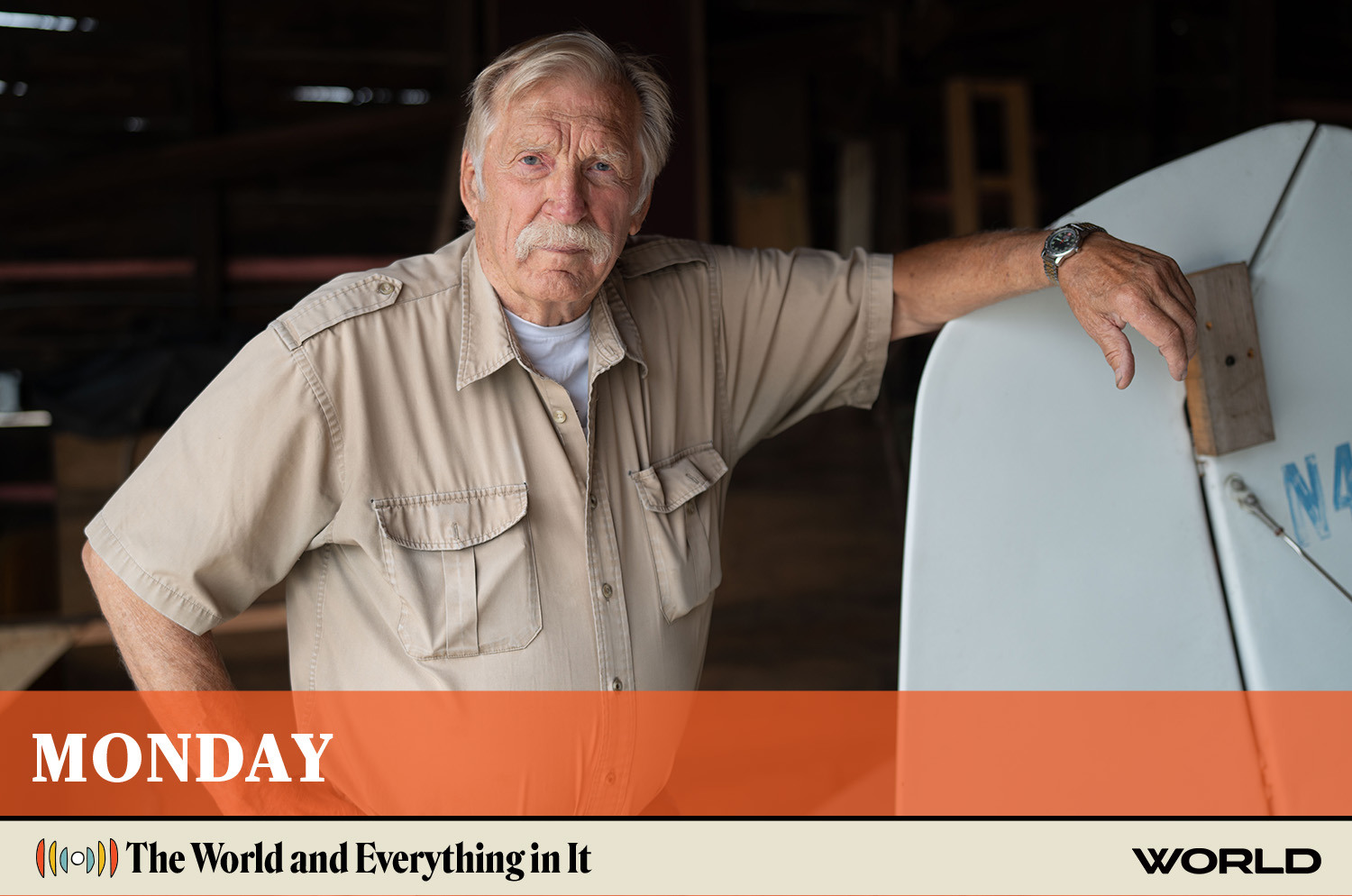
Ken Jouppi Courtesy of Institute for Justice
Editor's note: The following text is a transcript of a podcast story. To listen to the story, click on the arrow beneath the headline above.
MARY REICHARD, HOST: Good morning!
Today on Legal Docket: A state seizes a man’s airplane for transporting a passenger carrying three cases of beer. At the Supreme Court the question is how much punishment is too much?
JOUPPI: Well, it pretty much put me out of business. That was my main source of income was that airplane.
NICK EICHER, HOST: Also today the Monday Moneybeat with economist David Bahnsen.
And the WORLD History Book, how the first Congress filled in some constitutional blanks.
HALL: So the Judiciary Act of 1789 said there will be six Supreme Court justices.
REICHARD: It’s Monday, September 21st. This is The World and Everything in It from listener-supported WORLD Radio. I’m Mary Reichard.
EICHER: And I’m Nick Eicher. Good morning!
REICHARD: Now news with Kent Covington.
KENT COVINGTON, NEWS ANCHOR: Trump in ‘deciding mode’ on Iran war » President Trump is reportedly weighing renewed strikes against Iran.
According to Fox News, Trump says he is in “deciding mode” on the war with Iran, adding the “very big things” are going to happen in the near future regarding the war.
Reuters reports Iran's military says it's been told the U.S. is preparing to attack again, and it’s threatening American bases in the region.
Trump says letting Iran rot economically is an option. And U.S. Ambassador to the U.N. Mike Waltz says that’s because economic pressure is working.
WALTZ: And we're seeing the results of Operation Economic Outcast, led by Scott Bessent, our treasury secretary. The Iranian rial, their currency, just tanked below two million rials to the dollar. Inflation is spiking. Their foreign currency reserves are down.
Meantime in the Middle East, Saudi Arabia says it shot down a missile over Riyadh Saturday, fired by the Iran-backed Houthi rebels in Yemen.
Waltz says President Trump takes Houthi attacks against Saudi Arabia, a U.S. ally, very seriously. But he wouldn’t comment on any potential U.S. strike against the Houthis.
WALTZ: I won't get ahead of him in terms of our response, but this is not something new necessarily. As you know, the first Trump administration declared the Houthis a foreign terrorist organization, uh, and we took decisive action against the Houthis last year.
Trump says the Houthis have promised not to fight Americans. He turned down a Saudi request for strikes earlier this month.
Ukraine latest » Ukraine launched scores of drones into Russia in a massive weekend strike. WORLD’s Benjamin Eicher reports.
BENJAMIN EICHER: Russia says its air defenses shot down more than 1600 drones since Saturday, including 450 aimed at Moscow.
The city’s mayor calls it the biggest drone attack on the capital since the war began.
President Volodymyr Zelenskyy says the strike hit a key oil facility and a military supply depot, dealing a significant blow to Russia’s war machine.
The attack came six days after President Trump said Ukraine and Russia had both agreed to stop hitting energy targets. But Ukraine never confirmed that deal. Trump blames the refinery strikes for triggering a global shortage of diesel fuel.
For WORLD, I’m Benjamin Eicher.
Greenland reaction » Denmark's leaders say they're cautiously optimistic about an agreement with the United States over Greenland that President Trump announced on Friday.
The deal would let the U.S. build up its military on the island, but it won’t be a takeover.
For many months, Trump insisted that the US must acquire Greenland. That’s not happening. It will remain a self-governing territory within the Kingdom of Denmark.
Danish Foreign Minister Lars Løkke Rasmussen says the waiting is nearly over.
And some Greenland residents are hopeful too:
AUDIO MONTAGE: And I hope it's, uh, a good agreement and that it's, uh, a sustainable agreement.
I feel that it's, we have been looking forward to, to that, uh, conclusion, uh, decision for a long time now.
I think it's always a relief whenever we are, are able, you know, to settle things in a friendly manner.
The three governments are expected to sign the deal tomorrow, in New York. But lawmakers in Denmark and Greenland still have to vote to approve it.
Details are scarce. One U.S. official reportedly said it keeps Chinese and Russian troops off the island, and their money out of anything sensitive.
Trump called it an “infinite life agreement” with no end, at no cost to the United States.
CNN, Politico, MS Now » Three major left-leaning news organizations are covering the White House from the sidewalk this morning.
That, after President Trump barred CNN, Politico and MS NOW—formerly MSNBC— from the grounds. Akayla Gardner covers the White House for MS NOW:
GARDNER: Inside where we have magnetometers, I attempted to scan my badge, which we have to do, uh, enabled to get into the White House grounds. It did not work. There was a red beeping light, and so the officer asked me to hand over my badge.
Trump named no single story. He calls the three outlets' coverage, his words, fiction and lies, and says others could be next.
Democratic Senator Cory Booker told NBC's Meet the Press Sunday:
BOOKER: This president has no regard for the First Amendment. He's going after reporters, and this ban just doubles down on it.
But Republican Senator John Barrasso of Wyoming, on the same program, disagreed and said he sees a Democrat double standard:
BARRASSO: The president, remember in his first term, he was banned from Twitter. He was banned from Facebook. And I didn't see people come to, to his defense. So it go, it goes both ways. The press has an obligation to report fairly, and the president doesn't see it happening that way.
All three news outlets say they'll fight the ban. The Associated Press sued over a similar ban last year, that case is still ongoing.
Congo healthcare worker vaccinations » Congo has started vaccinating health workers against Ebola. But the shot wasn’t made for the strain driving this outbreak, called Bundibugyo. There is no approved vaccine for that strain yet.
So officials are using one made for the strain that drove an Ebola outbreak a decade ago in West Africa. Experts say the two strains are related, and the shot gave lab animals some protection. In people, nobody knows.
So it's going to health workers, the most exposed, inside a research study they consented to.
The U.N. said last month about 160 health workers had been infected, more than 40 killed. More than 3,600 have died so far in the fastest-growing Ebola outbreak on record.
I'm Kent Covington.
Coming up, the Federal Reserve raises its target interest rate. David Bahnsen will be here to talk about it. And later on History Book: the creation of the U.S. Judiciary.
This is The World and Everything in It.
NICK EICHER, HOST: Fifteen years of The World and Everything in It—and after all those mornings, there’s still only one way to do this: One day at a time.
So, today is Monday, September 21st. Good morning, I’m Nick Eicher.
MARY REICHARD, HOST: And I’m Mary Reichard. Time now for Legal Docket. Today, you’ll meet a man whose case is before the U.S. Supreme Court.
His case began with beer packed among a passenger’s groceries. The woman had chartered a flight with him to a remote village in Alaska. One six-pack that was visible among the grocery bags would eventually become the center of a constitutional fight.
EICHER: The state sought forfeiture of the bush pilot’s 95-thousand-dollar Cessna. The case is Jouppi v Alaska. And the question now before the Supreme Court is how judges decide when a fine becomes excessive under the Eighth Amendment.
Do they judge the offense in general? Or do they judge a defendant’s actual wrongdoing?
REICHARD: Long before that flight, Ken Jouppi was just a little boy in northern Minnesota, obsessed with airplanes.
JOUPPI: My dad was a logger in northern Minnesota, so I grew up around equipment and logging basically. And he had a plane. I would have been like three years old. He bought right after the war ended, and he could buy small planes again, and learn to fly,… But I don't think that was such a big factor. It's something that I think you're born with. Most, you know, professional pilots that I know have been interested in airplanes as long as they can remember, and I was one of those. If I saw a picture of an airplane in a magazine, I'd get a thrill out of it. And it just never goes away.
Jouppi joined the Air Force and worked on bombers. He had a few flying lessons, but the real learning started when he got back home.
JOUPPI: I went back to work for my dad logging. I just kind of borrowed his airplane and having very little experience—it was on floats. And I had a book “How to Fly Floats’ and I read that book and I'd fire up his airplane and taxi around the lake and just practice on the water. One day I got a little bit fast and took off accidentally. But I pulled the throttle back and landed, and I thought, hmm, that wasn't so bad. So I taxied back to the other end of the lake. This time I took off on purpose, flew across the lake and landed on the other end, and I thought I can do this, so I just started flying. Never, never quit. Eventually, got my license,.
EICHER: Throughout his life, Alaska captured his imagination. He read books about bush pilots. He tracked bears and wolves by radio from the air.
And then he saw an ad for pilots in southeast Alaska.
JOUPPI: And I talked to the fellow, and they hired me. And I thought, okay, we're going to Alaska.
He worked in Ketchikan, then moved to Fairbanks. Flying jobs were hard to come by once the Alaska pipeline was finished. Jouppi worked as a mechanic for a contractor who owned an airplane and a gold mine. On weekends, they’d fly to the mine.
JOUPPI: Especially when I began to fly, you know, you kind of divorced from the problems on the ground,
REICHARD: Eventually, though, problems on the ground caught up, and Jouppi realized he wouldn’t make much money flying somebody else’s plane. So he earned an air-taxi certificate and started a one-man company called KenAir. The workhorse was a six-seater 1969 Cessna 206. He had a smaller plane on floats as well, flying hunters and fishermen, carrying supplies to remote Alaskan villages, and taking on whatever charter work he could find.
EICHER: Running a one-man air taxi service business in Alaska’s interior meant Jouppi had to develop other skills besides being a pilot and mechanic. He needed to be a businessman … not to mention a diplomat.
JOUPPI: You have to be able to work on your own equipment and maintain it, and then you have to be a businessman. You have to get along with people. People have to like you. So I'm pretty proud of that. And the years that I spent flying were probably the best years of my life. It was like being on vacation every day.
Then one day in April 20-12, Jouppi had a full day of jobs on the calendar. First, he was to fly a passenger named Helen up to the village of Beaver, Alaska, with her groceries.
After that, he’d fly a coffin to another village so a family could bury a loved one. Later, another supply run.
REICHARD: Beaver was a “dry” village. Alaska allows local villages to ban alcohol, and knowingly transporting it into one is a crime. Jouppi knew that.
But he says he would not search the baggage of his passengers.
JOUPPI: It's so invasive, you know. How would anybody feel if somebody said, "Okay, let me, let me see what you got in your purse. I think you might have something in your purse that's not right.” … I'm just a private citizen, I don't think I have the right to invade people's privacy in that way.
Jouppi says Alaska state troopers were waiting behind a hangar as he and his passenger loaded up the plane.
They already had a warrant to search Jouppi’s aircraft, issued in connection with a separate investigation involving suspected alcohol importation.
They watched him load the cargo. Then Jouppi started the engine. The troopers approached, and he shut it down.
Troopers went through the plane and found 72 beers aboard. But the later constitutional fight centered on one six-pack the courts found was plainly visible in a grocery bag.
EICHER: Jouppi remembered picking up that bag. He could see the tops of the cans but he knew his passenger didn’t drink alcohol. So he assumed she had soft drinks.
JOUPPI: It never even occurred to me that it might be anything other than that. Anyway… they were able to convince the jury that I should have seen it. … which I didn't.
A jury convicted Jouppi of a misdemeanor. He was a first-time offender. The plane never left Fairbanks. But Alaska law defines the offense to include an attempted delivery, and the jury found that Jouppi acted knowingly.
The judge sentenced him to three days behind bars and 15-hundred dollars to pay in fines.
REICHARD: If you were listening carefully early, though, you’d remember that was not all. Alaska law calls for forfeiture of an aircraft used in an offense—so the state seized it. Jouppi’s Cessna was worth around $95,000.
JOUPPI: Well, it pretty much put me out of business. That was my main source of income was that airplane. I had another airplane, but it was different. It'd be like taking somebody's dump truck and saying, "Well, you got a wheelbarrow,"…but that was their reasoning.
Jouppi says he managed for a while with the smaller plane but eventually closed the business. He moved to Idaho, nearer two of his three daughters.
EICHER: The state held the Cessna for roughly two years before Jouppi regained possession while the litigation continued. He says the engine had been damaged by neglect. Later, he lost his medical clearance and could no longer fly.
The plane —now parked at a friend’s place in Fairbanks—remains at the center of the legal fight.
REICHARD: The Eighth Amendment is only sixteen words long and it says: “Excessive bail shall not be required, nor excessive fines imposed, nor cruel and unusual punishments inflicted.” This case is about those four words in the middle: “nor excessive fines imposed.”
And back in 2019, a Supreme Court decision called Timbs v Indiana said that protection also applies to state and local governments. The wrinkle is, the justices in that ruling didn’t say what is meant by “grossly disproportionate” in a forfeiture.
EICHER: And that’s the question in the Jouppi case. Alaska’s Supreme Court looked at the forfeiture through the lens of the harm of bringing alcohol into dry villages.
But Jouppi argues the courts have to look at the particular offense and the particular offender. Three cases of beer belonging to a passenger, a first offender, a plane that never left the ground … and the loss of a $95,000 plane along with a much smaller criminal fine.
REICHARD: That is the question the Supreme Court agreed to hear: May a court measure the seriousness of an offense in the abstract—or must it measure the defendant’s own wrongdoing?
Jouppi sees the stakes plainly.
JOUPPI: You know, going back to the Magna Carta, one of the things in the Magna Carta is you cannot take a man's tools away that he needs to make a living. That's pretty basic, and that's exactly what they did. And the excessive fines clause in our constitution, what is excessive? 10 times the maximum fine? I'd say that's pretty excessive.
EICHER: Jouppi credits his Finnish ancestry for giving him the mindset to endure 14 years of battling it out in the courts.
JOUPPI: …and Finns have a word called sisu, which means guts, and more than that, it's a grim determination to get a job done and stick with it. Anyway, I inherited a lot of that. I will not give up, and I said early on that if I have to, I'll get this to the Supreme Court. Not thinking, not even realizing that I would be able to, but just by sticking it out and not giving up. I'm 83, and I won't give up. I'll see it through. And if I don't live to see it through, my daughters will, so the fight will continue.
REICHARD: Oral argument is scheduled for December 1st.
And the little boy who once got a thrill from a picture of an airplane? Now his own airplane has carried him all the way to the Supreme Court.
I asked how he reacted when he learned the high court accepted the case.
JOUPPI: I was absolutely elated. It'd been a long fight, and I feel that even if it doesn't go any further than it is right now, we've accomplished something, and it's made it all worthwhile. I have no regrets…and I will continue. I won't give up.
And that’s this week’s Legal Docket!
MARY REICHARD, HOST: Coming up next on The World and Everything in It: The Monday Moneybeat.
NICK EICHER, HOST: Time now to talk business, markets, and the economy with financial analyst and advisor David Bahnsen. David heads up the wealth management firm, the Bahnsen Group, and he’s here now. Good morning, David.
DAVID BAHNSEN: Well, good morning, Nick. Good to be with you.
EICHER: Well, David, the Federal Reserve, as expected, raised its target interest rate by a quarter point this week, the first increase since 2023.
Now, we’ve spent quite a bit of time talking about whether this rate hike was coming, and now that it has, I’d like to back up and just make sure we all understand the mechanism here.
How is it that raising that short-term interest rate is supposed to work its way through the economy and bring inflation down? How is it intended to work?
BAHNSEN:Well, in theory, Nick, the idea is that a higher federal funds rate leads to financial conditions tightening, banks lending, people borrowing, people spending, and that aggregate demand would then weaken.
That’s why the trade-off is in the dual mandate. Theoretically, what they want is price stability and full employment, and so they’re trying to find the right potion to have these two things blend together.
Now, the problem, of course, is that there’s a gazillion factors that play into both of those things—price stability and full employment—that aren’t related to the Fed at all.
But the instrument that the Fed is trying to use to control inflation is the federal funds rate, which is the overnight rate the banks charge that then has a domino effect into what overall lending may be.
And in theory, a higher interest rate makes saving more attractive. A lower interest rate makes borrowing and spending more attractive, and so that will impact demand and therefore be used as a knob to either cool the economy or warm it up.
EICHER: So let’s use that, then, and apply it to what happened this week. In your Dividend Cafe, you called this rate hike a performative rate hike.
Why do you think this quarter-point increase won’t do much to bring down the inflation we’ve been seeing?
BAHNSEN: Well, by the way, I’m not saying that negatively or pejoratively. I don’t believe that if Chairman Warsh joined us here on Moneybeat, he would disagree with any of what I’m saying.
I mean it as performative in that it had already happened in financial markets—the very domino effect I just described for you, and the transmission mechanism for tightening monetary policy, already played out in financial markets over the last several months, wherein the interest rates, both short and long term, had moved up when the Fed had not hiked rates.
And so this rate hike was the Fed catching up to the market. So now, in doing so, it doesn’t do any new tightening because the financial markets had already done that tightening.
Now, that’s not perfectly linear, and there are certain elements that still end up affecting borrowing cost. But the lion’s share of what I’m referring to was already reflected in the short end of the yield curve. It had moved up, in fact, about 50 basis points.
So there were some who argued that to catch up to markets, the Fed needed to do two quarter-point rate hikes, not just one.
What they ended up doing is more or less telling you, “We’re going to do another rate hike by the end of the year.” They announced the dot plots, which is the Fed’s governors predicting where rates would be.
But when you’re the one voting on it and you’re predicting what it will be in two months, it’s the same as more or less telling you what you will be doing.
The dot plots are less such when you’re talking a year out or whatnot. They’re making a prediction, and it can change. But when you’re talking about such a short period of time, the Fed more or less telegraphed what they intend to do.
And my view of it is that they won’t hike at the late October meeting, six days before the midterms. But the perception of it, the optics, allowing various politicos and media to say things, I just think they’ll avoid the headache and wait till the December meeting to do one more rate hike.
EICHER: David, something occurred to me as you were talking about the dot plot. We’ve talked quite a bit about the fact that Kevin Warsh wants to move the Fed away from forward guidance, but really nothing says forward guidance quite like the dot plot—the Fed literally publishing where policymakers think that interest rates are headed.
So, I mean, how do those two things fit together? Is the dot plot just part of the way the Fed operates, or is that something that Warsh would like to move the Fed away from, too?
BAHNSEN: But remember, Kevin Warsh did not reveal his dot this week or in either of the prior two meetings, which is the first time in Fed history. The chairman is not revealing his vote.
I believe he wants to pull that back as well, and he’s waiting for some of the findings of the various task forces. But in the meantime, he’s already bucked what is at least a tradition because he is not revealing his own dot, which is really very much in line with what you just said about his repudiation of forward guidance.
EICHER: David, I was also interested in something you wrote about this very difficult dance the Fed is attempting. It’s, on the one hand, raising the short-term rate that it controls, with the hope that the longer-term rates come down.
So how does that work? How can raising the Fed’s short-term rate help to bring down the 10- and 30-year rates that feed into mortgages and other long-term borrowing costs that most people are dealing with, or are familiar with, at least?
BAHNSEN:Well, there’s a sense in which raising the short-term rate is a great way to raise the long-term rate.
If you look at the long-term rate as the sum of the short-term rate plus what’s called term premium—the amount that markets want for the extra time between the short-term rate and the long-term rate—and so the math of that means that, in theory, the higher the long-term—excuse me—the higher the short-term rate, the higher the long-term rate.
All things—that assumes that all things are equal with term premium.
What the Fed’s hoping is that they bring term premium down, that they bring the amount of extra yield that borrowers want to be long-term versus short-term, that it comes down.
So the view is that the market was already saying, “We think you need to do this,” and now the market can reward the Fed for doing it, therefore bring 30-year and 10-year borrowing costs down.
They didn’t come down a bunch yet, but they didn’t move higher. So what that tells you is that the short-term rate went higher, the long-term didn’t. So, by math, that means term premium came down a little bit.
So they have, but the Fed wants the longer-term rates lower. The Treasury Department certainly does. We’ve already talked about that in the past few weeks, and that’s really what mortgage rates are much more connected to, is 10- and 30-year borrowing cost versus the short term.
EICHER: Well, let me get this before you go. There was another economic number that caught my attention this week: the Census Bureau saying that inflation-adjusted median household income in the U.S. rose almost 3%—2.6%—last year, up to 87,500.
That’s the highest on record, which sounds like straightforwardly good news. But what is included in that household-income number that makes you cautious about treating it as a verdict on how Americans are doing, and what measure would you rather look at?
BAHNSEN:Well, the annual growth of that since 2019 is very, very small, adjusted for inflation. But remember, since 2022, we’ve had higher inflation.
But this number is the highest it’s been, and 2019 was the highest number. So you now have a higher inflation-adjusted household income, which is good news. You have a very low growth of that since 2019, which is bad news.
But the thing you have to remember, Nick, is that the Census Bureau’s calculation of household income includes transfer payments from the government, which is way higher, and interest income, investment income.
Interest rates are now much higher. So the Social Security payments, because of their huge annual ratcheting up, is more. The amount that savers are getting—people hold Treasury bonds and CDs—that number is up because of higher interest rates.
They’re trying to push interest rates lower, not higher. But higher interest rates are a big factor in why household income has gone up.
So I want people to understand why I do not consider this data point the kind of final jury, because it includes both positive and negative things in it together, where real earned wages don’t lie. That’s what I obsess over.
Real meaning net of inflation. Earned wages meaning it doesn’t include transfer payments, or passive investment income, or saving interest.
And real adjusted wages are really ultimately, I think, the best way to judge an economy. Now, they’re also positive, but they’re not—they’re not at record levels of growth or anything.
But they’re, I think, where you’re going to get much better data than just simply the headline of what the household-income number is, because you could get a higher household income with real wages going lower if the government starts giving out more money, and that happens all the time.
EICHER: All right. David Bahnsen is founder, managing partner, and chief investment officer of the Bahnsen Group. He writes regularly at DividendCafe.com and for WORLD Opinions.
I hope you have a great week, David.
BAHNSEN:Thanks so much, Nick.
MARY REICHARD, HOST: Good morning! This is The World and Everything in It from listener-supported WORLD Radio. I’m Mary Reichard.
NICK EICHER, HOST: And I’m Nick Eicher.
Up next: The WORLD History Book.
More than two centuries ago, President George Washington signed the Judiciary Act of 1789. That turned one sentence in the U.S. Constitution into an operational third branch of the government.
MARY REICHARD: When the Framers drafted the Constitution, they used roughly 2,000 words to establish Congress in Article 1. They used about half that for the presidency in Article 2. Then a mere 377 words for the entire federal judiciary in Article 3.
The main sentence used to establish the Supreme Court is this:
“The judicial Power of the United States, shall be vested in one supreme Court, and in such inferior Courts as the Congress may from time to time ordain and establish.”
More of a Post-it note than a true blueprint. How many justices? Where should they meet? What courts sit below? How’s this supposed to work?
Mark David Hall is a professor at Regent University and a leading scholar on America’s founding.
HALL: So this is one of the most important pieces of legislation that Congress has ever passed.
The Judiciary Act of 1789 created what the Constitution loosely authorized: a three-tiered system:
HALL: it also then said, okay, we need inferior courts, and so…let's have federal district court judges. Each state will have one federal district court judge. A couple of states will have two, Virginia, Massachusetts. But then we need a level of courts in between the district courts and the Supreme Court. And so what they said is we'll call these circuit courts.
The act also created the office of attorney general and authorized federal prosecutors and marshals.
Predictably, some of this created controversy. Anti-Federalists worried that federal courts would overpower state courts. Federalists countered that without federal courts, federal law might mean one thing in Connecticut and something else entirely in North Carolina. “United” States in name only.
Still, the Supreme Court was on its way!
Congress initially decided on a Court with six members: One chief justice and five associate justices. President Washington nominated John Jay as the first chief.
Turns out, though, the job description included something today’s justices don’t have to do: travel on horseback. You see, the justices didn’t just meet to decide Supreme Court cases; they “rode circuit.”
HALL: And so what these poor justices would have to do is they would meet together as a Supreme Court and do Supreme Court business, but then they would go off and have to ride around New England or ride around Pennsylvania or ride around Virginia, and they would sit as a circuit court with the district court judge, say in South Carolina. So you'd have two Supreme Court justices and the district court judge for South Carolina who would sit as a circuit court. And so that was very, very onerous.
Roads back then were primitive; hotels didn’t exist. Travelers stayed at inns and sometimes even had to share a bed with a stranger.
That was so unappealing that one of Washington’s first appointees declined the job. Another justice—John Rutledge—resigned after two years.
HALL: And so many of the early Supreme Court justices only lasted a couple of years.
Eventually, Congress created separate appellate judgeships, which freed Supreme Court justices from most of their circuit-riding.
But the real test came 14 years later with the famous case of Marbury v Madison. As President John Adams prepared to leave office, he nominated a man named William Marbury to be justice of the peace. But the official commission paper wasn’t physically delivered before Thomas Jefferson took office. Jefferson stopped the delivery out of frustration. He believed Adams wrongly appointed Federalist allies.
So Marbury went right to the Supreme Court and asked for an order to require Madison to deliver that commission.
HALL: Now, John Marshall is in a bit of a pickle here because if the U.S. Supreme Court orders Jefferson to deliver the commission and he doesn't, then this would show that the court has no teeth. And yet he does want to duck from the issue. He doesn't want to rule in favor of Jefferson, certainly, because that would again look like he's kowtowing.
And so, Chief Justice Marshall came up with a solution:
HALL: ….And what John Marshall said is, instead…..is this section of the Judiciary Act of 1789 unconstitutionally expands the jurisdiction of the court. And so therefore it's void.
The court agreed that Marbury was entitled to his commission … but couldn’t order Madison to deliver the paperwork because the statute giving the Supreme Court that authority was unconstitutional.
Case dismissed, and Marbury lost his office.
But that established the principle of judicial review. That principle allows the High Court to declare an act of Congress unconstitutional!
Those first justices probably wouldn’t recognize the high court today.
HALL: They yeah, they would be blown away by the power and prestige of the contemporary Supreme Court and of each and every individual justice.
The Judiciary Act of 1789 didn’t solve every dispute over the power of the federal judiciary. In some ways, it started other disputes. Still, the structure endures to this day.
The Constitution sketched it; Congress built it; and Chief Justice John Marshall figured out how much authority to fill it.
And that’s this week’s History Book!
MARY REICHARD, HOST: Tomorrow: we’ll go deeper into what the Greenland deal means for national security. And, all aboard for a trip on the world’s highest cog railway. That and more tomorrow.
I’m Mary Reichard.
NICK EICHER, HOST: And I’m Nick Eicher.
The World and Everything in It comes to you from WORLD Radio. WORLD’s mission is biblically objective journalism that informs, educates, and inspires.
The Bible says, “For everything there is a season, and a time for every matter under heaven:
a time to be born, and a time to die; a time to plant, and a time to pluck up what is planted; a time to kill, and a time to heal; a time to break down, and a time to build up; a time to weep, and a time to laugh; a time to mourn, and a time to dance; a time to cast away stones, and a time to gather stones together; a time to embrace, and a time to refrain from embracing; a time to seek, and a time to lose; a time to keep, and a time to cast away; a time to tear, and a time to sew; a time to keep silence, and a time to speak; a time to love, and a time to hate; a time for war, and a time for peace.” —Ecclesiastes 3:1–8
Go now in grace and peace.
WORLD Radio transcripts are created on a rush deadline. This text may not be in its final form and may be updated or revised in the future. Accuracy and availability may vary. The authoritative record of WORLD Radio programming is the audio record.
Please wait while we load the latest comments...
Comments
Please register, subscribe, or log in to comment on this article.