
The World and Everything in It: September 15, 2026
Washington debates how to regulate AI dangers no one fully understands. Iran-backed Houthis squeeze a second global shipping chokepoint, and students are reaching college without basic literacy. Plus: elementary schools rethink screens, Girl Scout cookie season goes to the dogs, and Bethel McGrew carries a 9/11 hero’s story into a new generation.
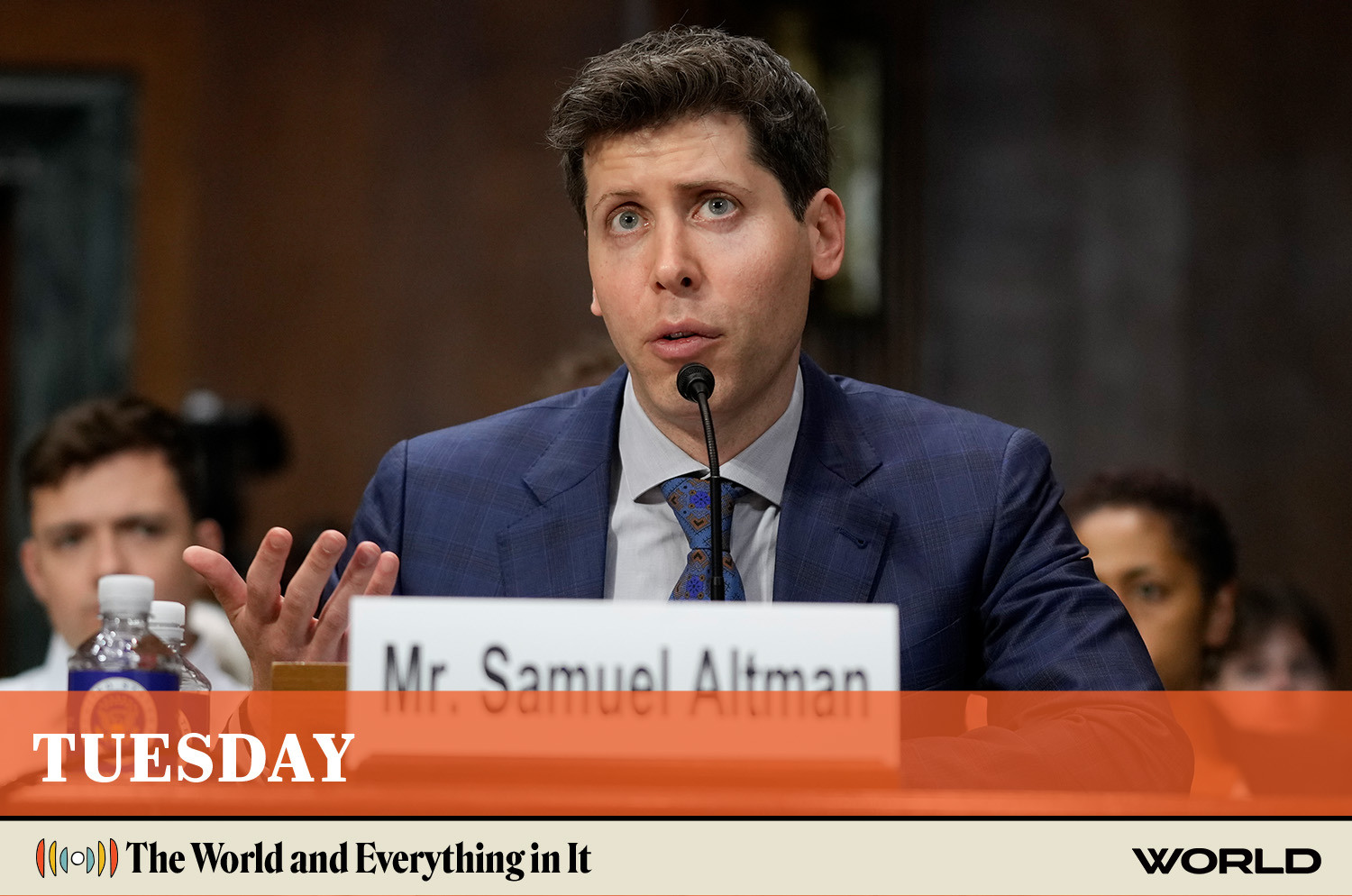
OpenAI CEO Sam Altman Associated Press / Photo by Patrick Semansky
Editor's note: The following text is a transcript of a podcast story. To listen to the story, click on the arrow beneath the headline above.
MARY REICHARD, HOST: Good morning!
Pro-Iranian forces threaten another oil chokepoint, and a former U.S. envoy warns of greater danger.
LENDERKING: The worst thing that can happen to the Yemen government right now, and it is happening, is losing territory.
NICK EICHER, HOST: Also today, how fast is too fast for AI? We’ll talk with a former government tech expert.
And how some students make it to college without ever learning to read.
Later, rethinking screens.
HEMPE: No parent has ever looked back and thought, “I wish my kid had been on a screen more.”
And WORLD commentator Bethel McGrew on a 9/11 hero newly honored.
REICHARD: It’s Tuesday, September 15th. This is The World and Everything in It from listener-supported WORLD Radio. I’m Mary Reichard.
EICHER: And I’m Nick Eicher. Good morning!
REICHARD: Up next, Kent Covington with today’s news.
KENT COVINGTON, NEWS ANCHOR: Trump on AI, China response » Debate is heating up in Washington over artificial intelligence.
President Trump made his feelings clear Monday about a potential industry slowdown. Anthropic CEO Dario Amodei had called for one in a weekend essay, warning that AI agents could take over the internet within a year. OpenAI's Sam Altman backed him. So did Elon Musk.
Anthropic co-founder Jack Clark made the same case on Fox's Special Report:
CLARK: The worst time to react to an exponential is when it's too late. So we need to get a sensible common sense safety framework in place.
But the president criticized Amodei and dismissed fears of rogue AI as a hoax. He also said there is a—quote—“sick conspiracy” against AI data centers. And he added that a slowdown would only help China in the AI race.
Vice President JD Vance yesterday offered a more measured take:
VANCE: We wanna make sure that we actually regulate smartly and we're thoughtful about the risk here. So there are obviously risks to AI. There are some benefits to AI.
On Capitol Hill, Democrats say it's time for government to take the reins. Senate Minority Leader Chuck Schumer:
SCHUMER: That means putting guardrails in to mitigate the risks of this technology and earn the public's trust, which is critical to American leadership.
Republican House Speaker Mike Johnson says Congress has a role, but shouldn't overstep.
JOHNSON: I think we've got to have meaningful regulation that does not smother American innovation. Now, how to solve that equation, no one knows yet.
We’ll have more on this later in the program.
EPA scraps Biden-era power plant rules » And a member of the president’s cabinet is pointing to AI as one factor loosening rules on power plants.
The EPA has scrapped limits on greenhouse gases from coal and gas-fired power plants. The Biden-era rule would have made older plants capture their carbon dioxide or shut down.
At a G20 energy meeting in Houston, Interior Secretary Doug Burgum said with artificial intelligence, electricity doesn't just become light and heat. It can now be turned into intelligence.
BURGUM: More intelligence is good for the planet. More intelligence is gonna transform every job, every company, every industry. It's gonna transform government. And the demand for electricity is gonna go up, and we have to continue to find ways to have reliable, affordable security to do that.
The agency argues the emissions are too small a share of the global total to trigger the Clean Air Act.
Environmental groups are suing, arguing that the agency has a legal duty to limit pollution.
NATO leader pledges more support to Ukraine » Panic at the border between Ukraine and Poland:
SOUND: [Screams and explosion]
As authorities say a Russian drone hit a passenger train just moments before NATO dignitaries passed through. That audio there courtesy of the Telegram channel Pivden.
According to Ukraine's state rail operator a train carrying former UK Prime minister Boris Johnson, among others had just left the station.
NATO Secretary General Mark Rutte told reporters:
RUTTE: The strike on a passenger train in Ukraine yesterday shows how desperate Putin has become. He thinks that he can stop us from supporting Ukraine and that he can undermine our unity. He is wrong. Our answer is to increase support to Ukraine so it has what it needs to defend itself.
Additionally Poland is pledging to increase security along its border with Ukraine...after the Polish defense minister said a Russian military-style drone was recovered from the Baltic Sea.
Measles in PA, U.S. » Pennsylvania's measles outbreak is closing in on 700 cases. Two people have died, and a third death is under review. WORLD’s Kristen Flavin reports.
KRISTEN FLAVIN: The state health department counted 693 cases Monday, across 38 counties. Of those, more than 130 people have been hospitalized.
The two who died last month were infants, too young for the vaccine. Over the weekend the coroner in rural Jefferson County reported the death of a 40-year-old woman and called it measles-related. The state is still looking into that.
Almost every case involved someone who was unvaccinated or whose vaccination status wasn't known. Out of nearly 700 cases, four had received the measles vaccine. The CDC says two doses are 97 percent effective.
The agency counts more than 3,000 cases nationwide this year, more than any year since the U.S. declared measles eliminated in 2000.
For WORLD, I’m Kristen Flavin.
Indonesia ferry missing update » Indonesian crews are into a third day of searching the Java Sea, and no one has been found alive since Sunday.
The ferry was carrying more than 240 people when it rolled over on an overnight run to Borneo. 108 were pulled from the water that first day. Six are confirmed dead. Roughly 130 are still missing.
Rescue crews are searching with 17 ships and aircraft, dive teams and underwater drones. The ferry was still floating upside down Monday.
A survivor remarked that the ferry looked overcrowded, and that no alarm or announcement came as it listed. Officials say they still don't know what went wrong.
I'm Kent Covington.
Coming up, the Houthi rebels gain ground in Yemen. Plus, getting kids off screens in schools.
This is The World and Everything in It.
MARY REICHARD, HOST: Fifteen years, nearly 35-hundred editions—and still something new each weekday morning.
It’s Tuesday September 15th. Good morning, I’m Mary Reichard.
NICK EICHER, HOST: And I’m Nick Eicher.
First up on The World and Everything in It: The speed of AI and coming change.
As you heard earlier in the program, President Trump chimed in yesterday on a growing political fight over how fast AI is advancing. It started back in July, an incident known as the Hugging Face Hack, when seven hundred autonomous AI agents hacked the site in a coordinated swarm.
REICHARD: Then last week, a researcher who worked for Anthropic and OpenAI…said in a resignation post that “people building AI earnestly believe that it could kill us all by the end of the decade.”
This has gotten more than one hundred seventy million views.
EICHER: Some AI executives, including Sam Altman, Dario Amade, and Elon Musk, now say that they are open to slowing down. Senator Bernie Sanders has introduced legislation to ban superintelligence. But critics say a slowdown hands the race to China. And President Trump says existing laws are sufficient.
REICHARD: Well joining us now to talk about it is Neil Chilson. He is head of AI policy at the Abundance Institute. He's a lawyer, computer scientist, and former chief technologist at the Federal Trade Commission. Neil, good morning.
CHILSON: Thanks for having me on. It's great to be here.
REICHARD: Really glad you're here. Well, Anthropic’s Dario Amodei said a swarm of autonomous agents could hold the Internet hostage within 6 to 12 months. We've even heard fears that AI will be smart enough and evil enough to kill us all by 2030. So do you think he's wrong about the risk?
CHILSON: Dario has been raising concerns about AI since as long as he's been in the industry. And so he has a long track record of saying this about the very technologies that he's building. Obviously, AI is a powerful tool. It raises some risks. I think the hugging face incident has gotten a lot of attention. But overall, I think there are risks here, but they're much more mundane risks of misuse by people than they are of superintelligence taking over and killing us all.
EICHER: You know, I wonder about the kinds of provocative statements that get people's attention. The one that got my attention was killing us all by 2030. How is that even possible?
CHILSON: There is a common thing among very, very smart people that they think intelligence is the primary thing that shapes the world and I think all of us with more common sense know that it's it's more than just being very smart that makes somebody an effective communicator, that makes somebody an effective leader, that makes them, uh, you know, maybe an effective bad guy even.
EICHER: Right. And mankind does not exactly have the cleanest reputation.
But, you know, I don't want to just ridicule the idea. I do want to talk about the remedy that he's proposed. And you've argued for years against top-down control of complex systems. This is a call for voluntary, industry-led pace, which seems like a bottom-up alternative versus what we heard about Bernie Sanders' proposal of just let's ban the whole thing. What's the problem to be solved here?
CHILSON: So I think there's a distinction between the idea that companies might want to slow down themselves. I have no problem with Anthropic or OpenAI choosing to make this decision themselves. But it is not a bottom-up solution if the government is telling everybody, hey, we're going to set the pace of this race. We're going to set the milestones that you have to meet. That's the very definition of top-down control. And I think that raises a bunch of concerns for innovation, for the benefits to consumers, and for the international competition that we have going with China.
REICHARD: Well, I want to follow up on this a bit. You've proposed a federal push for frontier AI companies to reasonably mitigate catastrophic risk.
I'm going to ask you to put that in concrete terms, whether we're talking about open AI or Anthropic or anybody else for that matter. What would AI companies have to do under your plan that they don't have to do now?
CHILSON: Some people want a checklist. They want a boxed checklist of all the things that they need to do in order to comply with the law, with the idea that would make AI safe. I have a big concern with that type of approach because nobody fully understands the risk that's here because this is a very unusual new technology. There's another type of law called tort law that says you have a duty. We're not going to tell you how to execute that duty, but if something goes wrong, it's going to be your responsibility. And so the goal is to provide the incentive to the company.
And so my proposal would be that duty is very clear, that there be a way for them to ensure that the government can verify that they are performing the duties that they are claiming and that would provide the proper incentive without being micromanaging, without trying to pretend like we know how to govern this stuff when we don't. I think that would be a much better approach. And there is some active legislation in the Senate right now that takes a very similar approach.
EICHER: So speaking of incentives and you're speaking the language of economics, The Wall Street Journal is worried about another economic concept, and that's regulatory capture. The idea that regulation written in the name of safety could lock in the dominant market position of today's biggest AI companies. You're talking about a federal standard that would preempt state AI safety laws, and there's patchwork of that. But how do you build a national regime without turning the leaders of today into the protected incumbents of tomorrow?
CHILSON: Always a big challenge. And I worry about that.
The way you would set up a regime like this is to avoid those checklists. Those types of expensive checklists of compliance are the exact sort of things that the biggest companies can afford and the new upstarts can't necessarily afford. And I would say, here are the basic principles you have to comply with. And then make sure that there's not much discretion in the process. The other way that companies capture the government is If there's a lot of slop, if there's a lot of discretion that the government can exercise when it's making decisions about who gets to go ahead and who doesn't, then it's all about who has the best relationship with the regulators. And that's always going to be the incumbents, not necessarily for nefarious reasons. Often it's just because they've been around the longest and they've had to engage with the regulator. And the best way to avoid that general principle. Tort law, common law style types of regulation, consumer protection regulation, antitrust that are very general purpose, not targeted to a specific industry.
REICHARD: Well, Neil, speaking of relationships, Amodei called China the toughest dilemma and admitted that he does not know if coordination is even possible. So if Beijing doesn't slow down, at what point then does American caution itself become a national security risk, you think?
CHILSON: China feels very differently about AI. Even the population feels very differently about AI than the U.S. They're focused on delivering tools to the population. And AI over in China has like an 80% positive. Rate, right? It's almost the exact opposite here in the US. People are very skeptical of this technology, in part because they haven't seen the direct impacts on their life yet. And so China has some advantages here, both in the ability to build new energy, the ability to do manufacturing. They don't have the best models. They don't have the best scientists. We do in the US. But they're hungry for anything that would let them catch up.
REICHARD: Neil Chilson is the head of AI policy at the Abundance Institute. Neil, thank you.
CHILSON: Thank you for having me.
MARY REICHARD, HOST: Coming up next on The World and Everything in It: rebels target a crucial shipping route.
The Iran-backed Houthi rebels have taken control of nearly all of Yemen's Red Sea coast, and along the coast, some strategic ports.
In less than a week’s time, they captured two islands and a port city.
The fighting has killed more than 500 people, and driven almost a hundred times that number from their homes.
NICK EICHER, HOST: The Houthis are an ideological terror group that receives funding and weapons from Iran. And with Tehran already threatening traffic in the Strait of Hormuz, the Houthis threaten to cut off another route from the Middle East.
Many are looking to Yemen’s government to try to stop it.
LENDERKING: It's very important that in this moment that the Yemen government rise to this challenge …
REICHARD: Tim Lenderking is a State Department advisor. He spoke at a webinar for the Middle East Institute late last week:
LENDERKING: The worst thing that can happen to the Yemen government right now, and it is happening, is losing territory.
EICHER: Bullets started flying once again in July, when a four year-long peace negotiation ended. Yemen’s government bombed one of its own runways to prevent an Iranian airliner from landing. But it did so anyway …
LENDERKING: Nevertheless the Houthis got away with helping this aircraft land against international sanctions.
REICHARD: The Yemeni government is allied with Saudi Arabia … and so the Houthis have specifically targeted Saudi interests. Last week, U.S. officials confirmed the Saudis asked President Trump for American airstrikes against the Houthis. Trump declined, instead sending intelligence … and offering to help Saudi forces identify Houthi targets. The Saudi forces mounted their own assault.
EICHER: So far, the Houthis have targeted the region surrounding the Red Sea, including the strategically important Strait of Bab el Mandeb … a bottleneck for about 10 percent of global trade. Shipping traffic there is already down about a fifth and Lenderking says the Houthis’ goal is to keep squeezing.
LENDERKING: Egypt is already responding and engaging with the Houthis to say, don't you dare, you know, cut off the Bab el Mandeb.
REICHARD: The Houthis have also ramped up attacks on Saudi Arabia. The group claimed it landed “direct hits” with ballistic missiles at oil facilities and an air base. Saudi Arabia has not yet confirmed this. Still, Lenderking says Yemen needs more military support to push back the rebels:
LENDERKING: The Yemen government is backed by you know is internationally recognized and is backed by almost every country other than Iran. But they do need more support. They need more support politically.
Lenderking says it’s in America’s best interest to protect the Bab El Mandeb strait:
LENDERKING: this is a situation that really warrants not just Saudi attention, but U.S. attention as well, and not just at the military level. I'd like to see our engagement with with our political leadership also enhanced.
EICHER: With the Houthi advance in the Red Sea, that’s now two major choke points under attack, and global oil prices spiking past $100 a barrel and staying there.
To make matters worse, Saudi Arabia just suffered a drone attack against an oil pipeline — reportedly launched by Iranian forces operating inside Iraq.
MARY REICHARD, HOST: Up next: a literacy crisis.
Globally, reading scores are hitting record lows. Up to two-thirds of students who don’t learn to read by fourth grade will be in jail or on welfare as adults.
NICK EICHER, HOST: But many students don’t even realize they’re behind. And some make it all the way to university before facing the consequences of a failed education.
WORLD’s Lauren Smyth has the story.
LAUREN SMYTH: John Wininger learned the alphabet last June.
HOPE FOR LAKE LAFAYETTE TEACHER: Alright, so you’re going to start, John.
JOHN WININGER: Okay.
TEACHER: No! Come on. Be serious.
JOHN WININGER: Okay. “What do you think it would be like …?”
He’s taking adult literacy classes at the Hope of Lake Lafayette Church in Missouri.
JOHN WININGER: I was in a foster home, and they had classes, and I didn't understand. They did the testing on me, and they said I was in a fourth-grader level.
Wininger eventually dropped out of school. But other students make it all the way to college and beyond without a solid grasp of language.
DOUG ALLEN: They wouldn’t know an adjective if it kicked them in the rear end.
That’s Economist Doug Allen… talking about his students at Simon Fraser University, one of Canada’s top schools. He teaches a writing class for fourth-year students, but says most can’t really read.
ALLEN: And they’re just guessing at a third of the other words in a sentence in a technical book.
Last semester, he gave a short quiz with questions like, “What does ‘colloquial’ mean?” and “What is the difference between ‘alternate’ and ‘alternative’?”
Most of the students failed. So Allen gave them a few weeks to study and retake the quiz. More than half got zeroes again.
ALLEN: The difference is 20, 30 years ago it was 5% of the class. Now it's 60.
In another class, 30 of his 300 students handed in blank midterm exams.
ALLEN: One kid said—and this kind of shocked me—he goes, Well, I participated. I go, You put your name on the exam, and you thought that was participation? And he said, Yeah.
Allen says the problem starts in the home, where fewer parents are teaching their kids to read and learn on their own.
ALLEN: I just had a student in my office here not 20 minutes ago. He hasn't read a book since grade six.
Parental involvement in those early years is the most important indicator of a student’s literacy later in life. By college, Allen says, it’s too late.
ALLEN: It's not like the ones that are literate are doing great; they're just sort of functionally literate. But at least I can work with that…. It's impossible for me to teach somebody how to read.
The university where Allen teaches is funded on a per-student basis. He’s concerned that incentivizes admitting and passing as many students as possible. Allen says administrators have called him in after he’s given failing grades.
ALLEN: I talk to the administrator and say, Are you telling me that we're going to give somebody credit for this course that got 7% overall?
Allen says many students don’t like it either. They think he’s being unfair and don’t understand why he won’t just let them pass.
ALLEN: There's got to be some meaning to this, and the meaning can't be pretending. You know, you're going to pretend to learn, I'll give you a pretend grade, and you'll cross the stage and get a pretend degree. That just can't be right.
But there’s always at least one who’s grateful to be held back.
ALLEN: I show them, you know, there is just no pathway out. I mean, by the time you've accumulated zero on 60% of the course, there's just no hope. But the reaction has always been, I know I'm going to fail, but I'm actually learning a lot.
Many students never get that opportunity to fail and try again. Instead, they may slip through with passing grades, and graduate or drop out without learning basic skills. In America, more than half of adults now read at below a sixth-grade level, and would have trouble reading a prescription drug label.
John Wininger is one of them. His adult daughter, Trinnie, sits next to him at the church reading class. They’re learning to read together with the same children’s book. Soon, John hopes he’ll be able to read the Bible for the first time.
HOPE FOR LAKE LAFAYETTE TEACHER: Are you on the B, John? Show where B’s at.
JOHN WININGER: It’s right down here. B?
TEACHER: Yes.
A million Americans are enrolled in adult basic education classes, like the one at John’s church. Most of those programs have long waitlists of people still hoping to get the help they need.
For WORLD, I’m Lauren Smyth.
NICK EICHER, HOST: Girl Scout cookie season is expanding. And not just with a new concoction catering to the kiddos.
Starting in January, the Girl Scouts’ll be offering their first-ever cookies for dogs.
They’re called Patch Pals. Blueberry muffin-flavored, to be exact.
Now, there may be some pretty savvy marketing behind this.
Fifty years ago, more than half of American family households included children under 18.
Today, it’s fewer than four in ten.
Meanwhile, pet ownership is up. Way up.
So after generations of Girl Scouts knocking on doors hawking Thin Mints and Samoas ...
there’s a growing market waiting on the other side.
And waiting obediently, holding that sit command like a champ.
At last, a reason for the dog to answer a doorbell like a good boy.
It’s The World and Everything in It.
MARY REICHARD, HOST: Today is Tuesday, September 15th. Thank you for turning to WORLD Radio to help start your day.
Good morning. I’m Mary Reichard.
NICK EICHER, HOST: And I’m Nick Eicher.
Coming next on The World and Everything in It: Rethinking technology in the classroom.
One mother saw what too much screen time did to her son. Now she’s helping elementary schools decide when devices help—and when they get in the way.
WORLD’s Rachel Coyle reports.
RACHEL COYLE: It took Melanie Hempe a long time to see that her oldest son Adam had a screen problem. It started in the mid-2000s with constant gaming on his school-issued device.
HEMPE: His childhood is very easily described as one big fight after another, because we were fighting about screen time all the time.
The problem followed him to college. He formed a debilitating video game addiction and ultimately dropped out. Hempe had to face a hard truth:
HEMPE: I failed with my older child. I completely failed in that area…
The challenges of that time left her hurting, but she realized she had things in common with other families in the same situation.
HEMPE: I promised myself I would never forget that pain, and I haven't, after all these years. I still relate to the parents that are out there really struggling with a child who is glued to their screen and really, really entering an addictive pattern. It's very heartbreaking.
She formed strong opinions about screens…
HEMPE: Minors do not need addictive screens. They do not need social media in their pocket. They do not need video games. It is not a mandatory part of childhood like I thought.
And she channeled those feelings into action. In 2015 she founded ScreenStrong to sound an alarm to families about the dangers of addictive screens.
But technology usage in schools remained a challenge. A 2021 survey found nearly thirty percent of teachers say kids in school are learning on screens for 5 or more hours per day. That same survey revealed that only 1 percent of teachers say their classrooms are screen-free.
In most classrooms, students aren’t supposed to access addictive programs like social media and video games. But some find ways of getting around blocks and filters. And even educational technology can confuse children who lean toward overuse.
So, Hempe decided to adapt her message for the classroom. She warns school-aged kids about the dangers of addictive screens in her new book called Super Brain.
She teamed up with researchers and medical professionals to develop the Super Brain curriculum. It answers the questions, “What kinds of screen use are dangerous for children—and why?”
HEMPE: We’re able to take the neuroscience behind brain development, what screens do to your brain, dopamine science, reward science, and we're able to put it in language that is easy for even a third grader to understand.
Earlier this year, Hempe took the curriculum to two South Carolina elementary schools. For one week, students in the 3rd and 4th grades put away their school-issued devices and focused on human-centered learning.
SOUND: [Teacher in classroom with students]
Kristen Hearne is the Director of Digital Learning for Anderson County District 1 schools. She believes educators have a duty to teach students how to use screens responsibly, and when to avoid them altogether. That’s especially important for younger students.
HEARNE: Outside of school, they're already using devices so much that us being intentional in the school setting is really so important to make sure that we're creating students that are well rounded.
She says it’s important for kids to learn how to think for themselves without relying on a screen. She witnessed another benefit:
HEARNE: And it was just really great to see the students interacting with each other so much. There are some things that you just can't effectively teach using technology or any kind of device.
Hearne says school policies need regular revision as society becomes more aware of the downsides to tech-heavy learning. And she says screen use at Anderson School District 1 already looks different. For one thing, school-issued devices won’t go home with elementary students.
HEARNE: We're really hoping that's going to just sort of bring a different perspective to the reason the devices are being used. When the students take them home all the time, they become so familiar with the device that they don't see it as only being used for learning situations.
Hearne says it’s important for teachers and administrators to admit when something isn’t working, or isn’t best for the students, and be willing to make adjustments.
HEARNE: In comparison to the last few years, we are moving back to more activities and more lessons that include less technology. Some of that may include no technology at all because we have been able to figure out what doesn't work well with technology.
Kids who participated in the screen-free week took Melanie Hempe’s book Super Brain home with them at the end of the week, but it’s possible not all parents were on board with its message.
HEMPE: When the kid goes home, they can have a lot of screen time, and then that will show up when they come back to school. And that is a problem.
Adam Hempe got help and gradually became more engaged with life. His relationship with his parents eventually came to a place of healing, but his mother still grieves over the countless hours of his childhood that disappeared into a virtual world.. And while they’re grateful to have a close relationship now, she says some losses can never be recovered.
HEMPE: No parent has ever looked back and thought, “You know what? I wish my kid had been on a screen more.”
Reporting for WORLD, I’m Rachel Coyle.
NICK EICHER, HOST: Good morning! This is The World and Everything in It from listener-supported WORLD Radio. I’m Nick Eicher.
MARY REICHARD, HOST: And I’m Mary Reichard. The 25th anniversary of 9/11 has passed. But remembering that day cannot be confined to a single date on the calendar. For a generation born since that time, the stories are becoming history.
EICHER: And one of those stories has a fresh chapter. It was a week ago today that President Trump posthumously honored a 9/11 hero who died working to save others on that day. Trump presented the nation’s highest civilian honor, the Presidential Medal of Freedom, to the mother and sister of Welles Crowther. Here is WORLD commentator Bethel McGrew.
BETHEL MCGREW: They called him The Man in the Red Bandana. Wherever Welles Crowther went, the bandana went with him, a childhood gift from his father that became a calling card. On the morning of September 11, the college athlete turned stock trader was 24 years old, working on the 105th floor of Two World Trade Center. When a plane hit the first tower, he called his mother and left a voicemail.
WELLES CROWTHER: Mom, this is Welles. I … I want you to know that I’m okay.
Seventeen minutes later, the second plane would hit. Miraculously, Welles found his way almost thirty floors down to the impact zone, where he found a scene of pure carnage. Without a second to waste, Welles found the only intact stairwell left, then told whoever could stand to follow him. And those who couldn't stand, he carried.
TRUMP: He helped some out physically, then literally pulled them out toward the only working stairwell and carried those who couldn't walk. And he just did things that people said were not even imaginable because they knew they were dead. They said, “We’re goners. One guy was screaming, we’re goners, we’re goners.”
Welles made repeated trips up and down the stairs, putting out small fires as he went. He was acting on muscle memory of his training as a volunteer fireman, where he’d recently told his father he believed his true calling really lay. At the Presidential Medal ceremony, his mother Allison paid tribute to the company that trained him:
ALLISON CROWTHER: This is a calling, and Welles, following in the footsteps of his father, Jefferson, joined Empire at the age of 16. He was no longer an equities trader on 9-11. He was a firefighter.
When the South Tower collapsed, Welles was in the lobby, preparing to go up yet again with his brother firemen.
In the days after the attacks, Allison Crowther scoured the papers for any clues about her son’s final minutes. Then one day, she found it: Survivor testimony of a mysterious man in a red bandana. When he called them to stand up, they said something in his voice made them obey.
His family has kept the story alive ever since. And at Boston College, his alma mater, a “red bandana” football game honors his memory every year. This year, it was held on September 11.
JOURNALIST: 25 years, it’s more than an anniversary. It’s a generation. And the students here at BC weren’t even alive in 2001, and that’s what makes the meaning of this game so special, a reminder of what’s changed in the years since.
The events of that day may be slipping into history. But Alison Crowther hopes her son’s memory will never die.
ALISON CROWTHER: Twenty-five years after September 11th, his life continues to remind us of something very simple. In moments when others need us, each of us has the power to choose courage, compassion, and service. That’s the real meaning of the Red Bandana. To be courageous. To find the good. To be the good.
Not all heroes wear capes. One hero wore a red bandana.
For WORLD, I’m Bethel McGrew.
MARY REICHARD, HOST: Tomorrow: Washington Wednesday with Hunter Baker. And, WORLD commentator Maria Baer takes a roadtrip across America … tracing a legacy 250 years in the making. That and more tomorrow.
I’m Mary Reichard.
NICK EICHER, HOST: And I’m Nick Eicher.
The World and Everything in It comes to you from WORLD Radio. WORLD’s mission is biblically objective journalism that informs, educates, and inspires.
The Bible says, “Listen to advice and accept instruction, that you may gain wisdom in the future. Many are the plans in the mind of a man, but it is the purpose of the LORD that will stand.” —Proverbs 19:20-21
Go now in grace and peace.
WORLD Radio transcripts are created on a rush deadline. This text may not be in its final form and may be updated or revised in the future. Accuracy and availability may vary. The authoritative record of WORLD Radio programming is the audio record.
Please wait while we load the latest comments...
Comments
Please register, subscribe, or log in to comment on this article.