
The World and Everything in It: September 14, 2026
A university that endorsed land acknowledgments winds up paying after punishing a professor’s parody, while David Bahnsen asks whether a pro-family subsidy can avoid becoming another welfare-state expansion with Washington already spilling $2 trillion more in red ink. Then Muhammad Ali gets one last chance to prove the doubters wrong—and does.
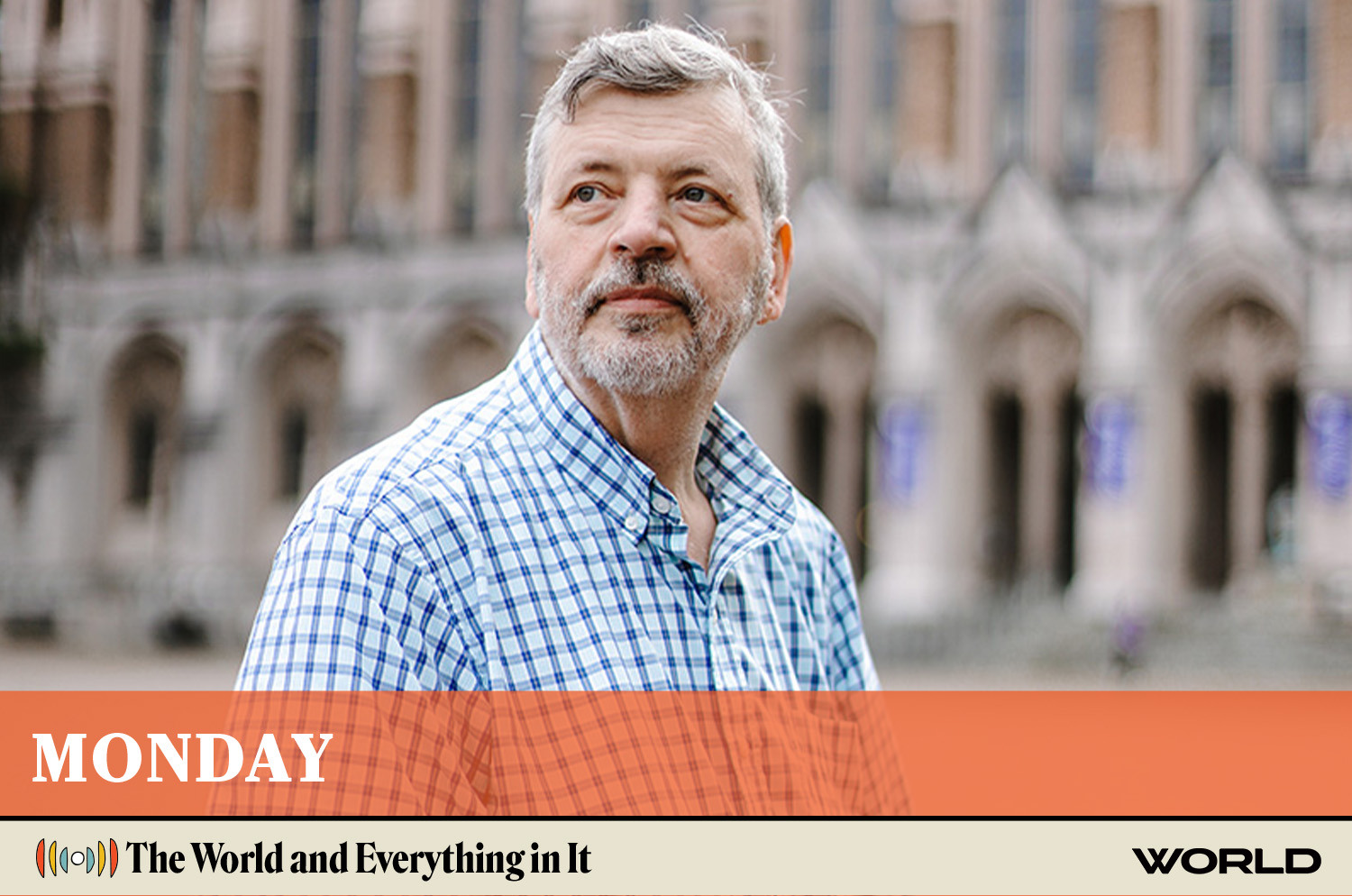
Stuart Reges Photo courtesy of Twinkle Don't Blink
Editor's note: The following text is a transcript of a podcast story. To listen to the story, click on the arrow beneath the headline above.
MARY REICHARD, HOST: All right, we’re getting very close now. We’re in our 15th anniversary year of The World and Everything in It—and sometime this week, we think we’ve got a great shot at crossing the 100 million download mark.
NICK EICHER, HOST: And we’d really like you to be part of the celebration. We designed a commemorative The World and Everything in It sticker, and we want to send you one—with our compliments.
REICHARD: Just go to theworldandeverythinginit.org/sticker and tell us where to send it.
EICHER: There’s a link in the show notes. Make sure you get your order in by September 30th. The printer’s standing by—he really wants to know how many gallons of stickum he’s gonna need
MARY REICHARD, HOST: Good morning!
A university professor mocks his school’s land acknowledgment template—and finds out how much dissent is too much in the modern academic environment.
WALTERS: If we can't do it there, as Americans, you know, where really can we do it? Like that's the point of an education.
NICK EICHER, HOST: That’s ahead on Legal Docket.
Also today, the Monday Moneybeat. Economist David Bahnsen is standing by. We’ll talk about two new Republican spending programs.
And later, the WORLD History Book: a legendary comeback.
EIG: His story was about so much more than boxing.
Muhammad Ali’s last big win.
REICHARD: It’s Monday, September 14th. This is The World and Everything in It from listener-supported WORLD Radio. I’m Mary Reichard.
EICHER: And I’m Nick Eicher. Good morning!
REICHARD: Now news. Here’s Kent Covington.
KENT COVINGTON, NEWS ANCHOR: Gulf state leaders trying to get oil flowing again » Gulf state leaders are talking with Iran and trying to get oil flowing again in the Middle East. But the Iranian foreign minister Tehran won’t cooperate until Washington agrees to Iran’s terms.
In the meantime, it continues to choke traffic in the Strait of Hormuz. And Saudi Arabia lost its main backup route Friday, when drones knocked out a pipeline around the strait.
And last week the Iran-backed Houthi rebels took a Yemeni port and an island at the gate to the Red Sea.
That’s three ways to move oil out of Saudi Arabia, all squeezed.
MARIB: [Speaking Arabic]
A senior official with Yemen’s government says Yemeni forces will return to Red Sea coast and fight back against Houthi rebels.
Meanwhile, American forces destroyed another Iranian tanker on Sunday, the eighth in ten days. President Trump told reporters:
TRUMP: Iran wants to make a deal so badly. They are calling constantly. They wanna make a deal. Mr. President, they gotta make the right deal. I'm not gonna make a deal that's no good.
No one has claimed the Saudi pipeline attack, U.S. and Saudi officials believe the drones came out of Iraq in an area where Iran-backed forces operate.
The Saudis are holding fire there, at Baghdad's request. But according to the Houthis, that’s not the case in Yemen, where they say Saudi jets hit them well over 100 times in two days. Riyadh has not confirmed it.
Diesel / Trump-Ukraine » Diesel set another record in the U.S. Sunday, $6.20 a gallon. But President Trump says the Middle East turmoil is not the main cause of that. In Ireland Sunday, he said he told Ukrainian President Volodymyr Zelenskyy:
TRUMP: Stop knocking out diesel fuel in Russia. Let him go after targets, but not diesel fuel, 'cause he's causing a shortage of diesel fuel. This isn't done by the Middle East, this is done by what's happening with Russia and Ukraine. So, uh, we spoke to Mr. Zelensky about it. There are plenty of other targets. Don't hit diesel fuel.
The International Energy Agency says Gulf and Russian refineries supplied almost half the world's seaborne diesel in February. Ukraine hit two more Russian refineries over the weekend.
AI warning » The CEO of a major artificial intelligence company says his own industry is moving too fast.
Dario Amodei runs the AI company Anthropic, the makers of the Claude AI platform. He’s calling on companies to slow down and let safety catch up.
He warns that within six to 12 months, AI could be capable of leading a swarm of programs capable of taking over much or even all of the internet.
Amodei wants outside reviewers inside the big AI companies, with the right to publish their findings. OpenAI's Sam Altman says his company is on board.
White House Economic Council Director Kevin Hassett says he thinks industry leaders are stepping up.
HASSET: And I think that, uh, if you look at the movement that the private sector is making, the fact that, uh, Elon a- and, uh, OpenAI folks have already supported the actually pretty, uh, sensible moves that D- Dario's advising, I think that that's a good, a good movement forward.
But a number of governors and lawmakers in Washington say the plan doesn't go far enough.
And other critics argue the review plan could give already-established major AI players a tighter grip on the market.
Cyber crimes task force » Federal prosecutors have moved against an online marketplace where criminals shop for the tools to rob Americans. It's called Xinbi Guarantee, a Chinese-language operation on the messaging app Telegram.
Prosecutors say vendors there sold fake investment websites, money laundering, and recruiting for scam compounds in Southeast Asia.
The Secret Service froze $52 million in cryptocurrency. Jeanine Pirro, the U.S. Attorney for the District of Columbia:
PIRRO: Americans are losing, according to the State Department, up to $12 billion a year to cyber fraud and these scam centers, which are mainly in Southeast Asia. It is on an industrial scale.
Pirro started the Scam Center Strike Force last fall. It's now restrained well over $900 million dollars, though restrained means locked in place, not recovered. Prosecutors seized cryptocurrency from two Xinbi-linked digital wallets and asked a court to freeze 47 more.
PIRRO: These are not basement scammers who are like going after one guy or another guy. This is a huge operation.
Treasury sanctioned Xinbi the same day. But the marketplace is still running.
Indonesian ferry » Rescuers in Indonesia are into a second day of searching for about 130 people missing in the Java Sea. WORLD’s Benjamin Eicher reports:
BENJAMIN EICHER: A ferry rolled over Sunday in heavy seas, on a run from Java to Borneo.
Indonesian officials say crews pulled 107 people from the water Sunday and recovered six bodies.
The ship did not sink. It was still afloat Sunday, upside down, and rescuers have concentrated on the hull itself.
Waves over eight feet are slowing the search. The local search chief says even his own rescue ship is in danger amid the rough seas.
For WORLD, I’m Benjamin Eicher.
I'm Kent Covington.
Coming up, David Banhsen is here for the Monday Moneybeat.
This is The World and Everything in It.
MARY REICHARD, HOST: Fifteen years in, and there’s lots more where that came from!
It’s Monday, September 14th. Thank you for spending another morning with us on The World and Everything in It.
Good morning, I’m Mary Reichard.
NICK EICHER, HOST: And I’m Nick Eicher.
It’s time for Legal Docket.
If you’ve scrolled social media, you’ve likely come across clips of Texas congressman Brandon Gill. He’s the youngest member of the GOP caucus in the House. And yet he’s outshone members twice his age in Capitol Hill hearing rooms—pairing his Dartmouth-trained smarts … with the bone-dry deadpan delivery of a West Texas ranch hand.
REICHARD: Stepping to the podium at the Republican midterm convention in Dallas last week, Gill kicked off his remarks with something you’re more likely to hear in the Ivy League.
GILL: With a land acknowledgment! [laughter]
EICHER: … a tribute to a different roster of ancestors …
GILL: I'd like to acknowledge that we stand here today in the great state of Texas in the United States of America, the ancestral homeland of great American patriots, pioneers, and explorers who put down roots, fought for freedom all over the globe, and bled and died
Gill’s parody brought down the house.
But four years ago, when a computer-science professor posted a remarkably similar land acknowledgment parody on his course syllabus, the university wasn’t laughing. Instead, it was opening an investigation into Professor Stuart Reges, and provoking a First Amendment showdown.
REGES: I sued the university for a violation of my free speech rights.
REICHARD: In 2022, the University of Washington removed the professor’s parody and the resulting probe wound up in federal court. The case ended this month with the university backing down, and agreeing to pay $600,000 in damages and legal fees to Professor Reges and his lawyers.
It followed an appeals court ruling that the university violated his First Amendment rights through retaliation and viewpoint discrimination. Reges is still teaching computer programming at the school.
EICHER: Back in early 2022, the diversity committee sent around examples of what it called “inclusive teaching.” One recommended that professors include an indigenous land acknowledgment in their course syllabi.
Reges objected.
REGES: Now I don't like land acknowledgments. I think they're performative. They're you know, if they aren't paired with action, then I think they're useless. And so I decided to protest this by doing a parody version of it on my class syllabus, and they freaked out.
REICHARD: I talked with both Reges and his lawyer Gabe Walters of the Foundation for Individual Rights and Expression. Walters reads his client’s parody:
WALTERS: “I acknowledge that by the labor theory of property, the Coast Salish people can claim historical ownership of almost none of the land currently occupied by the University of Washington.”
So he really touched the third rail.
That theory traces back to 17th Century English philosopher John Locke, who famously argued that working the land is what creates property rights. Reges used that logic to challenge the premise of the university’s preferred statement.
WALTER: … in his view, that statement is a sort of quasi-religious reverential statement of ideological purity or conformity… And so he thought that was ripe for parody.
The parody spread onto Reddit. Some students complained and called for Reges to be fired.
Reges told me things escalated quickly, outside his own class:
REGES: My own students did not really notice it. So this was kind of other students on campus. Once they heard about it, they were like, Reges has to be punished. And our own administrators, you know, tweeted almost immediately that they were horrified. That was their word, “horrified” at what I had done.
EICHER: Administrators removed the statement from Reges’s online syllabus, and replaced it. The director of the computer science school apologized for what she termed an “offensive statement” and told students where to lodge complaints.
The school took even further steps. Here’s lawyer Walters:
WALTERS: And they opened up a competing section of his intro to computer science class that winter quarter. This was back in 2022, in January, which had never been done in his nearly 20 years of teaching at the university. There had only ever been one section of intro offered per quarter.
REICHARD: Throughout the investigation, the university withheld Reges’s merit-pay increase. He faced the potential of a salary reduction, a long suspension, even termination.
Reges’s lawyer warned the school that its response violated the First Amendment. That didn’t change anything, so Reges sued in federal court. The trial judge ruled for the university, finding its interest in tamping down disruption outweighed Reges’s right to speak.
EICHER: So, Reges went to the appeals court, and won there, two judges to one. Judge Daniel Bress writing for the majority:
“Student discomfort with a professor’s views can prompt discussion and disapproval. But this discomfort is not grounds for the university retaliating against the professor. We hold that the university’s actions toward the professor violated his First Amendment rights.”
REICHARD: This part is key: The university made the syllabus open to faculty comments on a matter of public concern. So, it couldn’t permit the school’s favored view to go forward while it punished disfavored ones.
WALTERS: And that we're talking about a university campus where disagreement with views is not only par for the course, I mean it's to be expected and even encouraged, right? We're supposed to test the truth of ideas, the validity or value of ideas, we're supposed to engage in debates on all sorts of public issues on our college and university campuses. And if we can't do it there, as Americans, you know, where really can we do it? Like that's the point of an education.
The dissenting judge saw things the university’s way: that the reported harm—the disruption—to Native students’ learning outweighed Reges’s speech interest. But the majority held that the anger that normally accompanies controversial campus speech cannot by itself justify gagging a professor. Walters draws the line between protest and actual disruption.
WALTERS: What you can't do is actually disrupt university operations. That becomes an appropriate time for the university to step in and say, no, we've got to actually do something here so we can continue to meet, continue to offer classes. And nothing like that happened in Professor Reges's case. There was no, not even a walkout from his classes when he included this statement.
EICHER: The case returned to the trial court to determine damages and other relief. But that’s when the university acknowledged the legal reality and settled. The 600-K covers Reges’s damages and legal fees.
REICHARD: To be clear, the university admits no wrongdoing. In an email to me, the assistant VP for communications Victor Balta wrote that the university maintains it acted appropriately. He wrote in part: “… a settlement agreement was the most reasonable option due to the attorney fees and costs that would have resulted from the Ninth Circuit’s decision …”
Given that, I asked Walters what keeps the school from doing this again?
WALTERS: …even though the university is saying it did nothing wrong, I think the money that it's paying to Professor Reges speaks a lot louder. In addition to the money, the university has agreed not to take further adverse action against Professor Reges for his land acknowledgment parody or for reactions to it. So Professor Reges remains free to do this again.
EICHER: For Reges, all this is part of a bigger battle over ideological conformity in academia, and guidance to others in his situation:
REGES: You should do what you think is the right thing to do. And I think you should not let…the university silence you ... .So, you know, go for it is what I would say. Otherwise we're not gonna see a change on campus. … So let's stop. Let's stop doing that.
REICHARD: And that’s this week’s Legal Docket!
MARY REICHARD, HOST: Coming up next on The World and Everything in It: The Monday Moneybeat.
NICK EICHER, HOST: Time now to talk business, markets, and the economy with financial analyst and advisor David Bahnsen. David heads up the wealth management firm, the Bahnsen Group, and he is here now. Good morning, David.
DAVID BAHNSEN: Well, good morning, Nick. Good to be with you.
EICHER: Well, David, you’ve spent much of your career in and around Wall Street, and I thought your Dividend Cafe reflection on 9/11 deserves a mention today, making a point I’d like the WORLD listener to hear. And it’s not just a reflection on the resilience of the human spirit or the durability of American free enterprise.
What we remembered last week was an attack on America’s power centers, our government, our ability to wage war, but also on a symbol of our financial strength. And that’s where I’d like for you to go. What does the human response to a catastrophe like the 9/11 attacks say to an investor about why economies and markets come back?
BAHNSEN: Well, the focus in terms of investors was on the human spirit, and the point I wanted to make is that I think there are some people who accept the premise that the human spirit is indomitable, that it was made by God to do great things, but they accept that premise in periods of normalcy.
If you look at this rather unsettling new millennium that we began over 26 years ago, the 9/11 event, the financial crisis, the COVID pandemic are the three big ones. Those are three doozies to fit into 25 years.
The stock market is now at all-time highs, and company profits are now at all-time highs, not by magic through these three major events. Humans don’t want to give up; they want to do things. They want to do things, by the way, that are profitable because it advances self-interest. It promotes objectives that they care about. It drives progress.
There’s all these embedded motivations that exist, and they do exist on days like September 12th. And I expect the response to those events to be much like it was after 9/11, after financial crisis, after COVID pandemic, and that is humans doing what God made them to do, which is to restore profitable endeavors, and those things create investable opportunities in any economy.
EICHER: Well, David, let’s turn briefly to the Fed. There’s a big rate policy meeting coming up this week. The CME FedWatch tool about a week ago had the odds of a quarter-point rate increase at about 60 percent. It’s now at about 90. Big jump.
And in between, the Consumer Price Index, the CPI, came in roughly as it was expected to come in. So why did the likelihood increase so much?
BAHNSEN: What happened was the CPI report came, and it isn’t that the CPI report pushed it up to 90; it’s that the lack of a CPI report was holding it down to 60. Then the CPI report came; it was in line with expectations. Actually, the core rate was 0.1 higher, so the Fed could very well decide, no, we’re still not going to do it, and here’s our reason why.
But the CPI didn’t give them any cover. And I will say this: If markets expect a quarter-point rate hike in September, they have to expect another one at either the late October or December meeting.
But if you really believe you have to raise rates to bring down the activity and velocity of money that is putting upward pressure on prices, then you can’t possibly believe one quarter-point hike is going to do that. It’s an interesting week we have ahead here.
EICHER: All right, David. Just one more market story. The Wall Street Journal reporting that Anthropic is preparing its IPO, its initial public offering, in a way that could value the company at around $2 trillion, and investors still haven’t seen the financials.
In principle, what would you say would have to be true about future earnings and cash flow to justify that kind of valuation?
BAHNSEN: Well, I can’t justify it because I believe that valuations are a byproduct of future expected earnings and cash flows, and nobody in their right mind thinks that Anthropic or SpaceX are being valued off of that.
Now, in fairness to Anthropic—which is not words you’re gonna really ever hear come out of my mouth again, and I’m upset you made me say it this time—but I think their annualized revenues are 60, 65 billion, and SpaceX’s were 18 billion, and they IPO’d at about a one-and-a-half-trillion valuation.
So relative to SpaceX on a revenue basis, the Anthropic IPO is cheap, but it’s all speculation. Anthropic has what is effectively a couple trillion dollars of liabilities, of commitments out there, and the assumptions you have about what their future revenues will be do not right now help explain how they’re going to pay their bills, let alone be worth a couple trillion dollars.
And no one’s buying it for $2 trillion now, thinking let’s hope it’s worth $2 trillion in seven years. They want it to be worth $5 trillion in seven years. If you’re trying to go get a 10, 15, 20 percent a year return based on the level of risk you’re taking, the whole thing is madness. It’s speculative. It’s not new. It’s been going on a very long time.
But there are—I have to say, I was a child of the excesses of the ’90s, and I thought that they were radical then. But I will say, for my young Gen X counterparts, we had many less zeros and commas in our excess than they seem to have now.
EICHER: Well, David, speaking of excesses, before we go, I think you know where we’re headed. A couple of policy announcements from the administration this week.
Vice President Vance’s proposal: It involves roughly $9,000 for married families with one spouse at home, and then there is President Trump’s call for a $5,000 dividend for every American. Now, you object to both of these, but not for the same reason. Tell us the distinction.
BAHNSEN: Look, two major policy things were announced in administration this week. One is more serious than the other.
I think that the vice president’s announcement is serious. They intend to not go to Congress and by executive branch try to offer a reshuffling from funds in place, of $9,000 to married families where the one spouse stays home.
And, by the way, that’s within a program that’s total funding is about $10 billion and right now has hundreds of thousands of poor single women taking from it, so they have to expand that program if they are to do something like this.
Then the other announcement was what President Trump said, not with Congress, not with any particular executive order or authority, but just as a quasi-campaign speech at this rally that the Republicans held in the middle of last week, announcing that they were going to give $5,000 to every American as a dividend, something that would cost in the range of $1.3 trillion.
Okay, well, that one is far more reckless because of the zeros and commas, but it’s never ever going to happen. It’s very upsetting that the administration could say it, because then one day another administration might say something that can get done and use this to rationalize it. Well, why not go throw something huge out there and say you guys wanted to give rich people $5,000 with money that doesn’t exist?
And I will add, it’s very disappointing to see people that should know better. I’m not referring here to the White House, but I’m saying defenders saying, “Oh, well, they’re just doing it from profits from the tariffs,” which, soaking wet, are a couple hundred billion and aren’t profits at all. We are running $2 trillion deficits after the tariff revenue is considered. So that to me is appalling.
The other one, I freely acknowledge, has some people—and I would put Vice President Vance in this list—that are well-intentioned in believing, hey, we’re just reshuffling monies that already exist to something that we don’t like, which is single women that are poor getting support, to married women who are less poor getting support.
First of all, it’s as naive as anything I’ve ever heard in my adult life to believe that that’s what we’re going to do. That we’re going to have the political ability to pull from poor people to give to less poor people just because we socially like the outcome better. It will not happen.
And it is flat-out welfare with money that doesn’t exist to give to married families of under, let’s call it, $76,000 of income because it’s a little complicated how it works.
But the other lie going on—and, by the way, in a lot of cases is not a lie; people just don’t know—and then they’re coming to me saying, “Okay, now I didn’t understand that.”
A lot of people are saying this money is already apportioned; it has to be spent. We may as well try to channel it to families rather than where it’s going now. But it is not apportioned. Thirty percent is out of the Social Security Act. Seventy-one percent of this expired in 2020 and has not been extended.
And Congress is just having to year by year re-apportion it without legislation, and that’s totally at a discretionary basis. So this is a huge expansion of the welfare state. It is totally contrary to my view of family values, which is not that we believe in having children because the government will pay us to do it. And I’ve never heard that argument from any Christian in my life.
EICHER: Well, David Bahnsen is founder, managing partner, and chief investment officer of the Bahnsen Group. He writes regularly at dividendcafe.com and at WORLD Opinions. David, have a terrific week.
BAHNSEN: Thanks so much, Nick
NICK EICHER, HOST: Good morning! This is The World and Everything in It from listener-supported WORLD Radio. I’m Nick Eicher.
MARY REICHARD, HOST: And I’m Mary Reichard. Up next: The WORLD History Book.
Forty-eight years ago, world-famous boxer Muhammad Ali stepped back into the ring for a rematch. Ali faced off against Leon Spinks for a chance to reclaim his title as world heavyweight champion.
WORLD Associate Correspondent Abigail Johnson reports.
COMMENTATOR: The round is almost over, seconds to go. There is the bell…
ABIGAIL JOHNSON: It was September 15, 1978. The Louisiana Superdome in New Orleans was packed. More than 63,000 people had gathered to watch Muhammad Ali and Leon Spinks box for the second time that year.
Worldwide, another 2 billion viewers tuned in.
Jonathan Eig remembers the excitement of watching those fights.
EIG: When I was a kid, boxing was bigger than the super bowl like an Ali fight was bigger than the super bowl by 10 times. Everybody was talking about it. Everybody was either listening on the radio or watching it.
Eig has studied Ali more than the average boxing fan. In 2018, his biography of Ali, titled simply Ali: A Life, was named Time’s Biography of the Year. Eig calls him one of the great American heroes of the 20th century.
EIG: His story was about so much more than boxing. It was about race in America and religion all over the world and about rebellion, about standing up to authority.
Ali was born Cassius Clay Jr. in 1942 in Louisville, Kentucky. Racial segregation still governed the South.
Clay’s boxing career began at age 12 when someone stole his new red-and-white bicycle. Enraged, Clay found a police officer named Joe Martin and told him he planned to beat up the thief. Martin told him he better learn how to fight first and invited him to take boxing classes at his gym. Within six weeks, Clay won his first fight. Within six years, Clay won a gold medal in Rome at the 1960 Olympic Games.
MUSIC: “Cassius Clay the winner for the USA”
EIG: It was a massive cultural event. Every single person knew what Muhammad Ali looked like, what he sounded like. Ali used to say that he could drop out of a plane randomly anywhere on Earth and walk to the nearest village hut apartment building and everyone there would recognize him. And he loved that.
And Clay knew how to make the most of the media attention.
EIG: He's taunting his opponents, he's mocking them and all of this makes for great theater, but it has sort of a dark side in that he can be really cruel.
Clay remained undefeated for his first 31 professional fights. In 1964, he defeated the reigning champion Sonny Liston winning his first heavyweight championship.
EIG: He's getting a shot at the heavyweight title probably before he's earned it because he's so controversial because he's so good with the media…
That same year, Clay publicly announced his conversion to Islam and adopted the name Muhammad Ali.
EIG: He's one of the most beautiful fighters we've ever seen. He uses that great boxing talent to become a social activist, a rebel, and to become probably the most prominent opponent of the American war in Vietnam.
Ali was drafted in 1967, but he refused to go. He claimed his religious convictions and belief in non-violence gave him grounds as a conscientious objector. He was found guilty of draft evasion and was stripped of his boxing titles.
Ali was banned from boxing for three years before the Supreme Court overturned his conviction in 1971.
Three years later, Ali traveled to Zaire to fight against George Foreman. True to style, Ali had a lot to say about Foreman before he even got in the ring.
MUHAMMAD ALI: He's a bully, he's slow, he has no skill, no footwork, he's awkward and I have been given him a name. I named Floy Patterson the rabbit, I named Sunny Liston the bear and he shall be known officially as the mummy. [Laughter]
Ali won that fight with an eighth-round knockout, handing Foreman his first professional loss and taking the heavyweight title again.
EIG: There's this very interesting dichotomy within Ali. He'll do anything to win, including using racist tropes, even though he's built much of his persona around fighting racism. So Ali is full of strange conflict within himself that make for an interesting character.
In February 1978, he faced Leon Spinks in Las Vegas. At the time, Spinks had only seven professional fights to his credit.
But Ali had slowed down and was out of shape. He lost his title as heavyweight champion in a split decision from the judges.
EIG: Ali's humiliated. People are saying his career's over, he's too old, he's too slow. And he hadn't been training very hard, he was getting lazy. But he gets back in shape, and he really works hard to beat Spinks in the rematch.
Six months later, Ali faced Spinks again:
COMMENTATOR: This is a highlight of any career to do this. He has once again done the impossible.
And he won, setting the pace and trading blows with the younger boxer for all fifteen rounds before the final bell.
COMMENTATOR: [Bell dings] Ali is the World Heavyweight Champion for the third time and here comes the Ali circle.
That night marked Ali’s last victory in the ring. He retired a few years later and is still widely considered the greatest boxer of all time.
That’s this week’s WORLD History Book. I’m Abigail Johnson.
MARY REICHARD, HOST: Tomorrow: The Houthis gain territory on the Red Sea. We’ll have a report. And, screens are everywhere. One woman wants kids to understand the downsides. That and more tomorrow.
I’m Mary Reichard.
NICK EICHARD, HOST: And I’m Nick Eicher.
The World and Everything in It comes to you from WORLD Radio. WORLD’s mission is biblically objective journalism that informs, educates, and inspires.
The Bible says, “I will praise the name of God with a song; I will magnify him with thanksgiving. This will please the LORD more than an ox or a bull with horns and hoofs. When the humble see it they will be glad; you who seek God, let your hearts revive. For the LORD hears the needy and does not despise his own people who are prisoners.” —Psalm 69:30–33
Go now in grace and peace.
WORLD Radio transcripts are created on a rush deadline. This text may not be in its final form and may be updated or revised in the future. Accuracy and availability may vary. The authoritative record of WORLD Radio programming is the audio record.
Please wait while we load the latest comments...
Comments
Please register, subscribe, or log in to comment on this article.