
The World and Everything in It: September 10, 2026
Russian drone incursions test how far NATO can be pushed without open war, while Canada keeps military chaplains on the platform but tells them not to pray. Mississippi shows what can happen when struggling readers aren’t written off, and a photographer remembers the grace she saw in a chapel serving Ground Zero workers after 9/11. Plus: Royals fans salvage a moral victory, and Daniel Suhr considers what Charlie Kirk taught freedom was for.
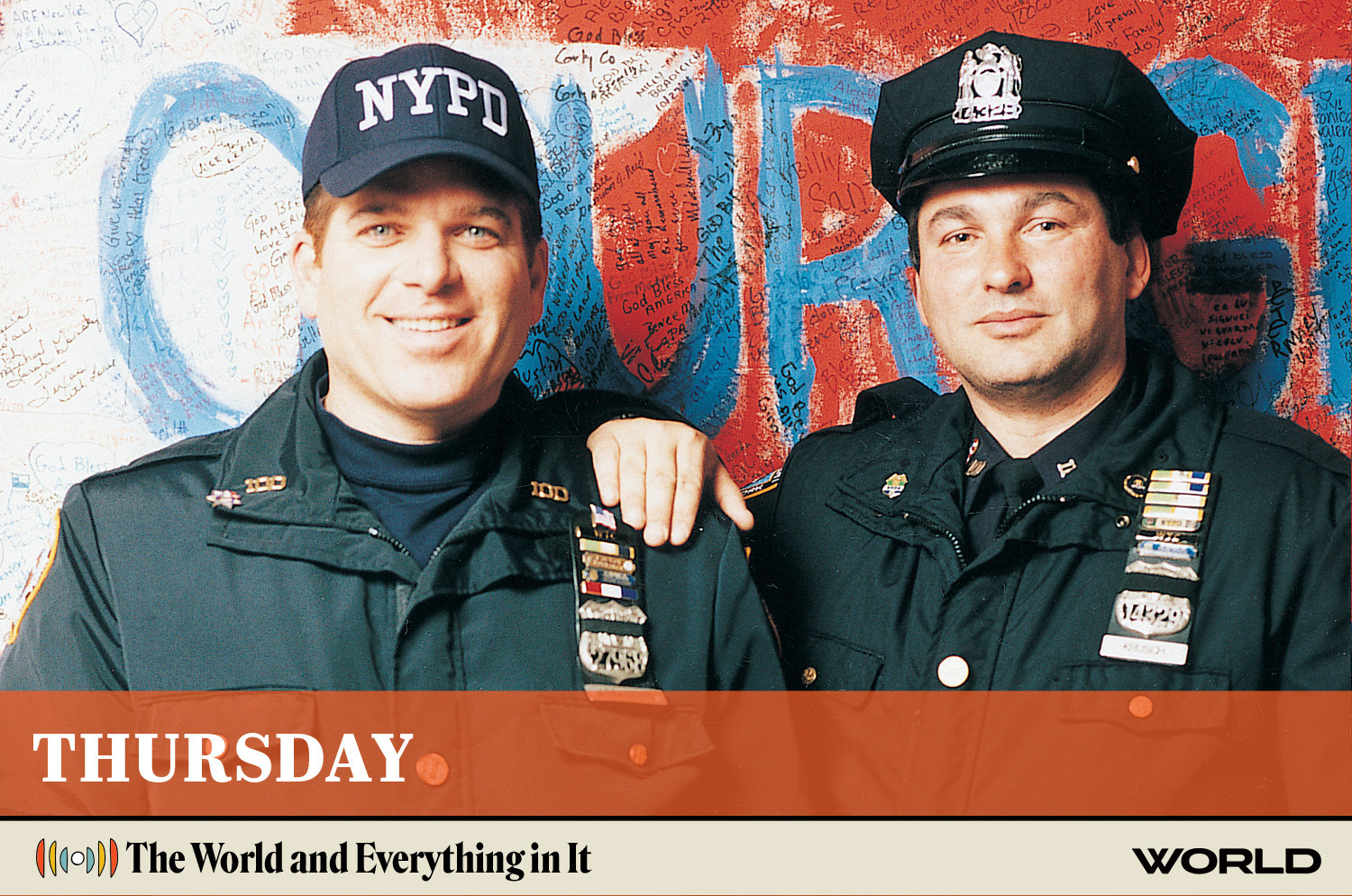
Inside St. Paul's Chapel, Ground Zero workers received relief and encouragement. Krystyna Sanderson
Editor's note: The following text is a transcript of a podcast story. To listen to the story, click on the arrow beneath the headline above.
MARY REICHARD, HOST: Fifteen years of weekday mornings—and now The World and Everything in It is probably about two weeks away from hitting 100 million downloads.
MYRNA BROWN, HOST: That’s because you listen. These programs don’t download themselves, y’all!
REICHARD: Ha-ha, exactly. So to celebrate, we had a special commemorative sticker designed—and we’d love to send you one as a way of saying thanks.
BROWN: Request yours by September 30th at theworldandeverythinginit.org/sticker.
REICHARD: Just tell us where to send it. Link’s in the show notes.
MYRNA BROWN, HOST: Good morning!
Canadian military chaplains are being told: no prayers, no mention of God at public ceremonies.
CLEMENGER: It's reducing religious language, pushing it out of the public square.
MARY REICHARD, HOST:
Also today, NATO’s growing drone problem.
And Mississippi’s remarkable reading turnaround—from near the bottom to near the top.
And at Ground Zero: the church that became a refuge.
SANDERSON: It was God’s grace shining through this trauma and bringing us some solace.
And WORLD Commentator Daniel Suhr on Charlie Kirk’s legacy, one year after his assassination.
BROWN: It’s Thursday, September 10th. This is The World and Everything in It from listener-supported WORLD Radio. I’m Myrna Brown.
REICHARD: And I’m Mary Reichard. Good morning!
BROWN: Up next, Kent Covington with today’s news.
KENT COVINGTON, NEWS ANCHOR: » Iran latest » Brent crude, the world's benchmark oil price, closed above $100 a barrel Wednesday for the first time since May.
The U.S. and Iran are in their seventh month of war. Central Command says American forces destroyed five Iranian tankers Tuesday, after Iran twice tried and failed to hit a Navy warship.
President Trump says Iran's leaders are hanging by a thread… trying to leverage the November midterms.
TRUMP: The war will end immediately after the election. Because? Because they can't hold out any longer. They're desperate to try and affect the election so that we can get a nice weak group of people in there and leave them alone and let them have their nuclear weapons.
AAA put the national average for regular gas at $4.22 Wednesday.
The president also predicted those prices will come down substantially not long after Election Day … which is now less than eight weeks away.
Democrats, though, predict drivers will continue to feel pain at the pump from what they call a war of choice in Iran.
RNC Midterm Convention » And President Trump headlined a gathering of Republicans Wednesday in Texas … at the Republican National Committee Midterm convention. WORLD’s Mary Muncy reports now from Dallas.
TRUMP: Friends, distinguished guests, Vice President Vance, and the proud citizens of the United States of America, welcome to the first ever midterm convention of any party.
MARY MUNCY: President Trump says the government will give out $5,000 dollar dividends to every US adult… IF the GOP wins the midterms. He called it the Trump Dividend.
He spoke for nearly two hours to an energetic crowd… saying he would visit every state with a Republican running for Congress to drum up support for the midterms.
He touted substantial drops in illegal immigrants and fentanyl coming across the border….and called men in women’s sports “demeaning.”
The GOP also got an unexpected boost from Pennsylvania Senator John Fetterman. He appeared in a video saying he’s a “common-sense” democrat against socialism.
New Yorker Rusat Rampogal says maintaining a GOP majority would mean the President can further his agenda.
RUSAT RAMGOPAL: People understandably may have frustrations with a party in power at different points in time. But the case needs to be made that if the midterms are lost… that is basically the end of enacting the Trump agenda come the beginning of next year.
MUNCY: Vice President JD Vance will wrap up the convention tonight with his keynote address.
Reporting for WORLD, I’m Mary Muncy in Dallas, Texas.
U.K. vs. West Bank settlers » Israel is facing growing international pressure over the expansion of Jewish settlements in the West Bank.
Earlier this week...the United Kingdom banned trade with those Israeli settlements and imposed sanctions… singling out what it called settler terrorists.
U.K. Foreign Secretary Ed Miliband says he believes a so-called “two-state solution” is the only path forward.
MILIBAND: Two viable and secure states alongside each other, and that prospect is being destroyed by the facts on the ground. The creation of all of these settlements which have been with increasing pace and we weren't willing to stand by in the face of that.
France and Canada announced that they plan to take similar actions.
But Israeli President Isaac Herzog warned that those measures would only backfire.
HERZOG: It will serve no one. It will directly harm, unfortunately, Palestinians, robbing them of business and employment. And, ultimately, it will undermine the interests and national security of freedom-loving nations.
He said dialogue is the solution, not sanctions.
Israel also responded by saying it would close the British consulate in Jerusalem.
Ex-missionary pleads guilty to molesting kids » A former missionary from Ohio has admitted to sexually abusing boys during mission trips to Haiti. WORLD’s Benjamin Eicher reports.
BENJAMIN EICHER: Jeriah Mast pleaded guilty this week in federal court in Cleveland to two counts of sexually abusing children overseas. Prosecutors had charged him over four boys. The 45-year-old made mission trips there over a span of more than 15 years.
In 2019, Mast confessed to his church, and then to police … that he had molested more than 30 boys in Haiti.
An Ohio judge granted him early release last year … where he had been serving time for molesting boys in Ohio. But federal agents arrested him weeks later.
His plea agreement with prosecutors calls for at least 25 years behind bars, but a federal judge will have the final say at sentencing in December.
For WORLD, I’m Benjamin Eicher.
TSA Pre-check gate access » That, of course, changed after 9/11, but … just ahead of the 25th anniversary of those attacks … TSA is once again letting some people walk to the gate without tickets.
A new program called Gateside started this month. It's free, but you have to have TSA PreCheck or another trusted traveler clearance. And you have to apply in advance … one to three days is recommended.
Right now, the program is running at 13 U.S. airports, including LA, Dallas-Fort Worth, and Las Vegas. But TSA says more will follow.
I’m Kent Covington.
Still ahead… Mississippi’s remarkable reading turnaround. And later… Charlie Kirk’s legacy, one year after his assassination.
This is The World and Everything in It.
MYRNA BROWN, HOST: It’s Thursday the 10th of September.
Glad to have you along for today’s edition of The World and Everything in It. Good morning, I’m Myrna Brown.
MARY REICHARD, HOST: And I’m Mary Reichard.
First up: drones menacing NATO.
The Wall Street Journal this week called European NATO airspace an “active front line” after a rise in drone incursions. It says 16 countries belonging to the North Atlantic Treaty Organization have reported violations of their airspace or found drone remnants over the last two years.
BROWN: In August, Germany blamed Russia after the discovery of an explosive drone at Leipzig airport.
NATO has beefed up policing on its eastern flank. But the number of incursions remains too low to warrant a collective NATO response.
Peter Rough is director of the Center on Europe and Eurasia at Hudson Institute, and he’s been following this story. WORLD’s Lindsay Mast has Rough on the line to talk about it.
LINDSAY MAST: Peter, good morning.
PETER ROUGH: What a pleasure to be with you. Thanks for having me.
MAST: Thanks for joining us. You've said these incursions are a portion of Russia's larger campaign against NATO. It's important to note Russia has denied all of this, but what are the markers you see that point to Russia?
ROUGH: Well, for one, the German government just undertook an exhaustive investigation, and it's known to be rather careful when it comes to attribution before announcing recently through the foreign minister and the interior minister that the most spectacular of these recent incursions, namely a Russian drone at the Leipzig airport, is attributed to the Russians. And so that's, I think, a pretty strong determinative factor, a strong indicator. There are other actors across Europe, intelligence agencies and officials who've said with a fair amount of clarity and known to be cautious that they think it's the Russians. So I don't think there's a lot of doubt about this at this point.
MAST: What do you think then Russia is trying to accomplish by sending drones into NATO airspace? Is this to test defenses? Is it for intimidation or something else?
ROUGH: A couple of factors. For one, the Ukrainians have been striking deep into the Russian hinterland, taking on petrochemical installations, refineries, even warehouses where dual use items are produced. And the Russians, in return, can hit Ukraine, but they can't really hit Ukrainian resupply in NATO countries because that would be what amounts to a dramatic act of war and could potentially pull in all of the NATO alliance, including the United States.
So I think they are walking right up to the red line of trying to coerce, cajole, intimidate the NATO allies away from supporting Ukraine so they can isolate it in a one on one matchup where its superior size and weight can be brought to bear without crossing that red line. And this form of gray zone warfare, whether it be the drones or assassinations, sabotage operations, arson, any number of techniques that the Russians have utilized in recent months and years are part and parcel of that campaign.
MAST: You alluded to NATO's Article 5, basically, that says that an armed attack against one member is considered an attack against all members. Russia seems to be exploiting the space between peace and an armed attack that would be serious enough to trigger Article 5.
So does NATO need to fine-tune its definition of collective response for these repeated gray zone attacks, as you said?
ROUGH: That's a great point. And I think the alliance is basically seized on two response mechanisms. The first is to try to build up defenses. A drone wall is something that's been much in conversation, which the Baltic states and northeastern Europe and Poland have thought about. There's also a so-called drone sentinel project that's ongoing and project operation Eastern Century, which is to guard the eastern flank against these hybrid incursions. So all of that is part of resilience and defending and hardening.
Perhaps the Germans, as they've seemingly decided in the wake of this drone attack I referenced earlier at Leipzig Airport, are gonna send their IRS T interceptors and attack drones to Ukraine. So there's a way of I think escalating horizontally or responding asymmetrically or even symmetrically that would allow the Allies to push back against Russia and make clear that there are going to be costs for this sort of behavior.
MAST: If you take the premise that every action sends a message, what has Russia learned about NATO from how the alliance has responded so far?
ROUGH: I think that's a great question because the Russian mode of war is really to probe, observe, react and withdraw, and then fine-tune their own operational concepts and how far they're willing to take an issue politically. So I do think that these drones are one method for the Russians to gain intelligence, to gain information, also to increase the costs of defenses and increase the costs of responding. I mean, the the Allies are using very expensive missiles or F-35 jets that are scrambled to take down some of these styrofoam and wood observation drones that the Russians send in. And it's a way to test the defenses and concepts in NATO, in the NATO alliance. So I think all of that is kind of a combination.
MAST: You had mentioned the drone wall earlier. What does an effective drone wall consist of and how fast can it be up and running?
ROUGH: These are really high technology sensors and systems that are stitched together to create what amounts to not an impenetrable wall, but a great early warning system with response mechanisms connected to them. The Eastern Front allies are really eager and working with a lot of athleticism and speed to get this drone wall completed, but it will be some time. And the earliest date really is 2027 for this drone wall being in decent shape and for it to be entirely completed might even take much longer. So it'll take some time, but this is an ambition and it's tied with and to Eastern Century, the NATO operation to try to buy time and knock down some of these drone incursions in the meanwhile.
MAST: You know, Peter, the administration has been telling Europe for two years to carry its own weight. Isn't this exactly the kind of threat Europeans should be able to handle without American help?
ROUGH: I suppose these are new forms of not warfare, but it's certainly new technologies. And the Russians have the advantage of in warfare being forced to innovate at the speed of conflict. They're being killed on the front lines and they are also doing a lot of killing. And that really puts a lot of urgency into Russian innovation and Russian development. They're also sharing with their partners and allies technology and receiving technological inputs in return.
So the Europeans are just like the United States playing catch up here. I wouldn't say that the US is dramatically ahead in all aspects of drone warfare. We've seen in the Straits of Hormuz and elsewhere that we have our own challenges. But Europe is acutely aware of this problem and I think they're working on it as we speak.
MAST: Peter Rough is director of the Europe and Eurasia Center at the Hudson Institute. Peter, I appreciate your time.
ROUGH: Thank you.
MYRNA BROWN, HOST: Coming up next on The World and Everything in It: Religious censorship in Canada.
People in military, political, and faith communities are warning against a new policy that limits the speech of military chaplains.
MARY REICHARD, HOST: At ceremonies like this Day of Remembrance for fallen soldiers in the Canadian capital of Ottawa, you’ll hear music, words of tribute, and cannons fired in salute:
SOUND: (Canadian ceremony)
But what you won’t hear anymore are references to God.
Last year, a rabbi recited the words of former Canadian Prime Minister John Diefenbaker:
AUDIO: I am Canadian. Free to speak without fear, free to worship God in my own way, free to stand for what I think right. Freedom, the right to be oneself
BROWN: But this summer, the Canadian Armed Forces rolled out new instructions that banned chaplains from praying or mentioning God at public events. Instead, the policy tells chaplains to offer “inclusive” spiritual reflections. Religion-specific language is off-limits.
REICHARD: That means chaplains can’t pray at historical parades, change-of-command ceremonies, mess dinners, or commissioning of ships. And if event organizers or attendees ask for a prayer? Chaplains can only give a vague spiritual reflection.
The rules don’t apply to funeral or voluntary worship services.
CLEMENGER: I see it as kind of a secularist gag order.
BROWN: Bruce Clemenger is the president emeritus of the Evangelical Fellowship of Canada and a member of the Interfaith Committee for Canadian Military Chaplaincy. He says the policy bans chaplains from freely sharing their beliefs.
CLEMENGER: They're basically being told that they can't even, it's not just, they can't invoke God, as you would in a prayer. They can't even mention God in their remarks.
SOUND: Oh Canada
Clemenger says it's ironic that the national anthem can reference God at events, but not chaplains.
The policy says chaplains have to stay neutral about religion when they speak in public. It claims that makes them more welcoming to people of every belief.
But Clemenger says this actually excludes religion.
CLEMENGER: How can we come together as Canadians from diverse backgrounds when the beliefs of some are precluded from even being mentioned?
REICHARD: Clemenger hopes the lawsuits, the pressure from religious leaders, and the news coverage will get the policy changed.
Derek Abma is the spokesman for Canada’s Department of National Defence. He told WORLD over email that the policy “respects the dignity of all” by avoiding religion-specific language.
Abma says the change traces back to a 2015 ruling from Canada's Supreme Court. The court found a city council violated religious neutrality by opening its meetings with a Catholic prayer.
BROWN: Reverend Terry Cherwick is a Ukrainian Catholic priest who served as a military chaplain for more than 30 years. To him, the new policy erases the purpose of a chaplain speaking at a parade.
CHERWICK: They hired me to come into the Canadian forces as a Catholic priest. So, if you wanted some just generic chaplain who’s just going to care for people and not really bring in the charisms that I bring to the table as a Catholic priest, then why have diverse chaplains?
He says respecting different beliefs goes both ways.
CHERWICK: I can respect to make sure that I'm not giving a completely Catholic prayer only, that the integrity of all those on parade. Likewise, they need to respect on who I am, as a Catholic priest, and for those people on parade, who have a faith and believe in a theistic God.
REICHARD: Major General Douglas Carver is a retired U.S. Army chaplain who now leads chaplaincy for the North American Mission Board. He’s critical of the ban on praying. But he’s grateful that no U.S. regulations bar chaplains from praying.
CARVER: We have this unbroken blessing, a gift, a privilege of freedom, to express our faith beliefs and practices without coercion, without punishment, without prejudice, and I hope Americans realize that that's, I mean, the gift that we have.
BROWN: The Roman Catholic Military Ordinariate of Canada’s bishop published a statement in August criticizing Canada’s new policy. Several other groups have voiced objection as well. A member of Parliament and the conservative advocacy group have also called for it to be amended.
MYRNA BROWN, HOST: Fifteen years of The World and Everything in It adds up to a lot of stories! It sure is nice when we have stories about things getting better. And coming next: a reading revival.
For many years, Mississippi students ranked near the bottom for reading achievement. Then that started to change.
The turnaround was so dramatic, people started calling it The Mississippi Miracle.
Back in 20-13, the state was 49th among the 50 states in fourth-grade reading. Six years later, it had climbed to 29th and eclipsed the national average for the first time.
Mississippi also ranked number one in the nation for gains in fourth-grade reading and math.
So what changed?
MARY REICHARD, HOST: Myrna, I talked with Dr. Carey Wright, and she told me the transformation began after making one very important shift in the classroom.
By way of background, Carey is the former state superintendent of education in Mississippi. She now holds the same role in Maryland.
The problem, she told me, was the way teachers were teaching reading to kids. At the time they were using a concept called “balanced literacy.”
That method leans on books and meaning with phonics taught only as needed. When kids get stuck on a word, teachers may tell them to use pictures and sentence context to guess.
CAREY WRIGHT: There’s no research that supports balanced literacy. And there are decades of research that support the science of reading.
MARY REICHARD: The alternative method, called the science of reading … teaches children directly, that letters make sounds, and sounds make words.
C-A-T spells “cat.” Speed, vocabulary and understanding build from there.
WRIGHT: It's a very explicit, structured way to teach children how to read. And so we decided we were gonna lean in where the research supported it and that's what we did.
But few Mississippi teachers knew how to teach that way.
Dr. Tenette Smith helped lead the state’s reading program. The state needed 75 literacy coaches to work in struggling schools, so it interviewed more than 600 teachers, administrators, even college professors.
TENETTE SMITH: Of those six hundred, very few could tell the interview panel what the components of reading were. Even fewer of them could identify a strategy that you would use to support a kiddo who was struggling in one of those components.
Only 24 made the cut!
SMITH: We only have these 24 people. That told us we had a capacity issue.
So to start, the state had to teach the teachers. It provided training in the science of reading and deployed the new literacy coaches to some of the lowest-performing schools.
They got some pushback from teachers anxious about the state watching them.
The coaches had to show they were there to listen–not judge.
SMITH: We wanted them to focus on observing and then building that psychological safety that is needed to have a true coach, coachy relationship.
Coaches worked with teachers, not students. They looked at student test scores, taught sample lessons, sat in on classes, and told teachers what they saw.
SOUND: [CLASSROOM ACTIVITY]
Wright deliberately had the state hire the coaches instead of handing money to local districts to hire on their own. She wanted teachers to know the person in their classrooms had already met a high standard. Smith describes the system as a three-legged stool: Train the teachers. Find the children falling behind and help them right away. And give teachers materials that match what the research says works.
The law put teeth behind the effort. Third graders who couldn't read well enough would repeat the year.
But Wright says the emphasis was elsewhere:
WRIGHT: We need to talk about prevention and intervention. Because if we can intervene and we can prevent children from failing, then we don't need to be worried about third grade, right?
The state also refused to blame poverty for low scores.
WRIGHT: Poverty cannot be an excuse. Because you've got buckets of poverty around that state. But if you take a look at the success that many of these students are having now in Mississippi,... being poor did not inhibit their learning, but it may have required additional intervention.
Researchers observed classrooms to make sure instruction changed. Then they compared coached schools against schools with no coach.
WRIGHT: And every year, without a doubt, our coach-supported schools outperformed our non-coach-supported schools. So we knew that coaching was also making a difference.
The national numbers also changed. Mississippi went from 49th in fourth-grade to 29th in six years.
No surprise that other states wanted Mississippi’s playbook.
But Elise Brown, who helped develop Mississippi’s digital coaching program, says the bigger lesson is consistency.
ELISE BROWN: The districts know exactly what our expectations are for them. This is what we’re going to focus on. This is how we’re going to get there. Give them the roadmap. Stay on task.
So the lesson from Mississippi may not be phonics alone. It’s the system: Train teachers, track progress, catch struggling readers early, and keep standards high.
As for that catchy phrase, “The Mississippi Miracle?” Smith doesn’t care for it.
SMITH: Miraculous? No. Hard work? Yes. A marathon, of course, because they’re still running that marathon.
Today, Mississippi's fourth graders read above the national average. And when reading scores fell across most of the country after the pandemic, Mississippi's held.
MARY REICHARD, HOST: Fans of the Kansas City Royals had something to cheer about after a long, hot summer of having very little to cheer about.
Last weekend, between innings at Kauffman Stadium, workers tossed a giant inflatable hot dog into one section of the stands and a giant inflatable bun into another.
Fans had 35 seconds to crowd-surf the two together.
And they did it!
As for the ballgame itself, yeah, the Royals fell to the Blue Jays, 4-to-3. But who cares? Kansas City’s out of it anyway.
And nice consolation for the fans: everybody got a free hot dog and a day closer to football season.
It’s The World and Everything in It.
MYRNA BROWN, HOST: Today is Thursday, September 10th. Thank you for turning to WORLD Radio to help start your day.
Good morning. I’m Myrna Brown.
MARY REICHARD, HOST: And I’m Mary Reichard.
Coming next on The World and Everything in It: the aftermath of 9/11.
It took just one hour and 42 minutes between the time the first plane hit the North Tower and the time it came crumbling down.
But the recovery and cleanup lasted nine months.
BROWN: One New York City photographer documented how volunteers at a nearby chapel turned the sanctuary into a place of refuge.
WORLD’s Jenny Rough reports.
JENNY ROUGH: On the morning of September 11th, 2001, Krystyna Sanderson stood at the bedroom window of her 12th floor apartment building.
KRYSTYNA SANDERSON: I live in East Village. So, I had direct views of the World Trade Center.
She watched the smoke and fire in shock. Weeks later, a reverend she knew from church called her up.
SANDERSON: And I remember exactly what he said: “Krystyna, something extraordinary is happening in St. Paul’s Chapel. Come over and bring your camera.”
St. Paul’s Chapel is an 18th century episcopal church with crystal chandeliers. It’s been around so long, George Washington prayed there. It sits 100 yards from the World Trade Center site. Sanderson made her way past barricades, jackhammers, and dump trucks. She saw the spire of the church still standing.
Outside the church, workers searched for bodies and cleared debris. Inside, volunteers filled the sanctuary. Those volunteers offered the next layer of care: relief to the relief workers.
SANDERSON: Firefighters, police officers, construction workers, sanitary workers, who were working at Ground Zero—they started to come to St. Paul’s Chapel. And it became like a spontaneous relief center.
Volunteers cooked meals. Spiritual counselors prayed. Doctors bandaged weary and injured feet. Massage therapists kneaded muscles to release the knots out of tense shoulders.
SANDERSON: So for 24/7, the workers from Ground Zero were coming here, and the church became really a living church. Because there was a kitchen here, cots here when they were sleeping. They were also sleeping in pews, there were pews here. It was something about this sanctuary that was conducive to people not only to rest, but to pray, and to get not only physical nourishment but spiritual nourishment, and emotional nourishment.
Sanderson documented all of it. She captured a violinist playing music to soothe hurting souls. She photographed thank you letters that school children sent to the recovery workers. And she took pictures of the banners that hung on the church’s wall. One in particular caught her eye. It said: To New York City and all the rescuers, keep your spirits up. Oklahoma loves you!
SANDERSON: It’s alluding to the 1995 attack of Oklahoma. So it was just so moving to see because what happened was that people from all over the world were grieving for us.
The banner still hangs in the church today.
Twenty-five years ago, Sanderson knew the importance of recording such hospitality through visual images. She was the only photographer allowed in St. Paul’s Chapel.
SANDERSON: I felt this responsibility to document it. Otherwise, it would be lost. I felt like I was a seeing eye dog, because people could not see what was here, and I was seeing things here for them.
Sanderson is from Poland. She moved to New York City in the hopes of becoming a famous photographer by her own wits, willpower, and hard work.
SANDERSON: And it didn’t happen. Instead, I found God. I need a Savior to save me from myself. I’m powerless to do it on my own. It was God’s calling. I was struck like St. Paul on the road to Damascus.
Eventually, she switched fields. But photography remained close to her heart.
Sanderson returned to the chapel dozens of times over the nine months following 9/11. During that time, thousands of people came to volunteer.
SANDERSON: Like the diamonds that are made under pressure, I feel the diamonds of the human spirit just shining here through the tremendous pressure of trauma and death and the evil that happened. I just see that it was God’s grace that was shining through this trauma and bringing us love and peace and some solace.
Sanderson took 2,500 photos. Including photos of posters pleading for information on the missing.
SANDERSON: And we knew what happened, but they were still thinking somehow they’ll find them. And it was very painful to see those mothers and fathers and husbands missing their loved ones. Every time they found a body part, they rang a bell. And they came here to bless it.
Since 9/11, Sanderson’s thought a lot about suffering.
SANDERSON: It goes to the fallen world, you know? This has been going on for thousands of years.
Still, she says it’s possible to find meaning in suffering. We can suffer well by drawing close to God and turning our pain into work that helps others, like the work of those in the chapel.
Sanderson returned to the chapel last week. She remembers:
SANDERSON: When we were here 25 years ago, we were very aware, very cognizant, that we were walking on holy ground. Because the ashes of those who had perished were on our shoes, on our clothes, and in the air we breathed. So there was something very holy about this place.
One year after the relief work, a Christian publisher asked Sanderson to choose 100 photos to appear in a book called Light at Ground Zero. A prayer or Bible verse accompanies each picture. This year, some of those photos will be on display Friday, at the Hephzibah House in Manhattan.
Reporting for WORLD, I’m Jenny Rough in New York City.
MYRNA BROWN, HOST: Good morning! This is The World and Everything in It from listener-supported WORLD Radio. I’m Myrna Brown.
MARY REICHARD, HOST: And I’m Mary Reichard. September 10th, 2025, on that date, on the campus of Utah Valley University, Charlie Kirk was cut down by an assassin’s bullet.
BROWN: One year later, WORLD commentator Daniel Suhr reflects on the influence of Kirk—and what he was trying to offer the young people who came to hear him.
DANIEL SUHR: I stopped last week at a local bike shop—not exactly a hotbed of right-wing activism.
The employee who helped me wore a red T-shirt. Across the front, one word: FREEDOM. Underneath was Charlie Kirk’s signature.
A year after Kirk was killed, people still wear his name. Why?
Part of the answer was his manner. Kirk loved debate. But he also understood that many young people at those microphones were asking a question bigger than politics.
KIRK: Because I listen as much as I talk. Almost all of them are like, “Charlie, I don’t know what to do.” “What can we do?”
Sure, Kirk could be combative—sometimes sharp. But his signature format gave opponents the microphone. And it treated young men’s drift as a serious problem, not a punchline.
Another part of Kirk’s appeal was his intellect. He never earned a college degree. But he did not treat that as the end of his education.
Hillsdale College president Larry Arnn asked the 19-year-old Kirk questions he could not answer. Kirk asked what he should do. Arnn challenged him to study the Bible, the classics, and the American founding.
ARNN: I thought I'd never hear from him again. Within a month, he got hold of my cell phone number and he texted me a copy of a certificate of completion of a Hillsdale College online course. He would go on to do that 31 times.
Kirk was self-educated, but not self-satisfied. His arguments could be somewhat unrefined. But they were also alive—less constrained by academic fashion or career calculation.
Still, personality and intellect do not fully explain the shirt.
Kirk connected because he offered a vision. He gave the Trump formula Make America Great Again a younger voice.
For Kirk, American greatness began with freedom. But freedom was not the end of the sentence.
By the end of his life, Kirk had been increasingly explicit about what came next: Christian faith, marriage, children, responsibility, and moral truth. He was not saying every American must be a Christian and not every adult a parent. His point was that a free civilization depends on institutions that form character and carry life forward.
In a long interview that summer, Kirk was asked how he hoped to be remembered.
KIRK: … if I die?! [ …if you could be associated with one thing, how would you want to be remembered?] I want to be remembered for courage, for my faith. That would be the most important thing. The most important thing is my faith in my life.
That may explain the bike shop shirt better than any campaign slogan. Freedom was the word. Kirk increasingly gave it content: faith, family, truth, and courage.
Charlie Kirk did not merely tell young men what to oppose. He tried to tell them what freedom is for.
One year later, people still wear his name. Rightly so.
For WORLD, I’m Daniel Suhr.
MARY REICHARD, HOST: Tomorrow: John Stonestreet will be here for Culture Friday. And, we’ll have a review of the new action film, The Runner. That and more tomorrow.
I’m Mary Reichard.
MYRNA BROWN, HOST: And I’m Myrna Brown.
The World and Everything in It comes to you from WORLD Radio. WORLD’s mission is biblically objective journalism that informs, educates, and inspires.
The Bible says, “…which is why I suffer as I do. But I am not ashamed, for I know whom I have believed, and I am convinced that he is able to guard until that day what has been entrusted to me. Follow the pattern of the sound words that you have heard from me, in the faith and love that are in Christ Jesus. By the Holy Spirit who dwells within us, guard the good deposit entrusted to you.” —Timothy 1:12–14
Go now in grace and peace.
WORLD Radio transcripts are created on a rush deadline. This text may not be in its final form and may be updated or revised in the future. Accuracy and availability may vary. The authoritative record of WORLD Radio programming is the audio record.
Please wait while we load the latest comments...
Comments
Please register, subscribe, or log in to comment on this article.