
The World and Everything in It: October 9, 2026
Consent is supposed to settle the question. But Katie McCoy says the disturbing allegations at Cornell University expose how much that leaves unanswered. On Culture Friday, a new women’s movement questions the ideal of independence, and a Canadian grandmother faces a heartbreaking decision about her own life. Plus: a gunman gets another shot at redemption, and the ancient gods still have their days.
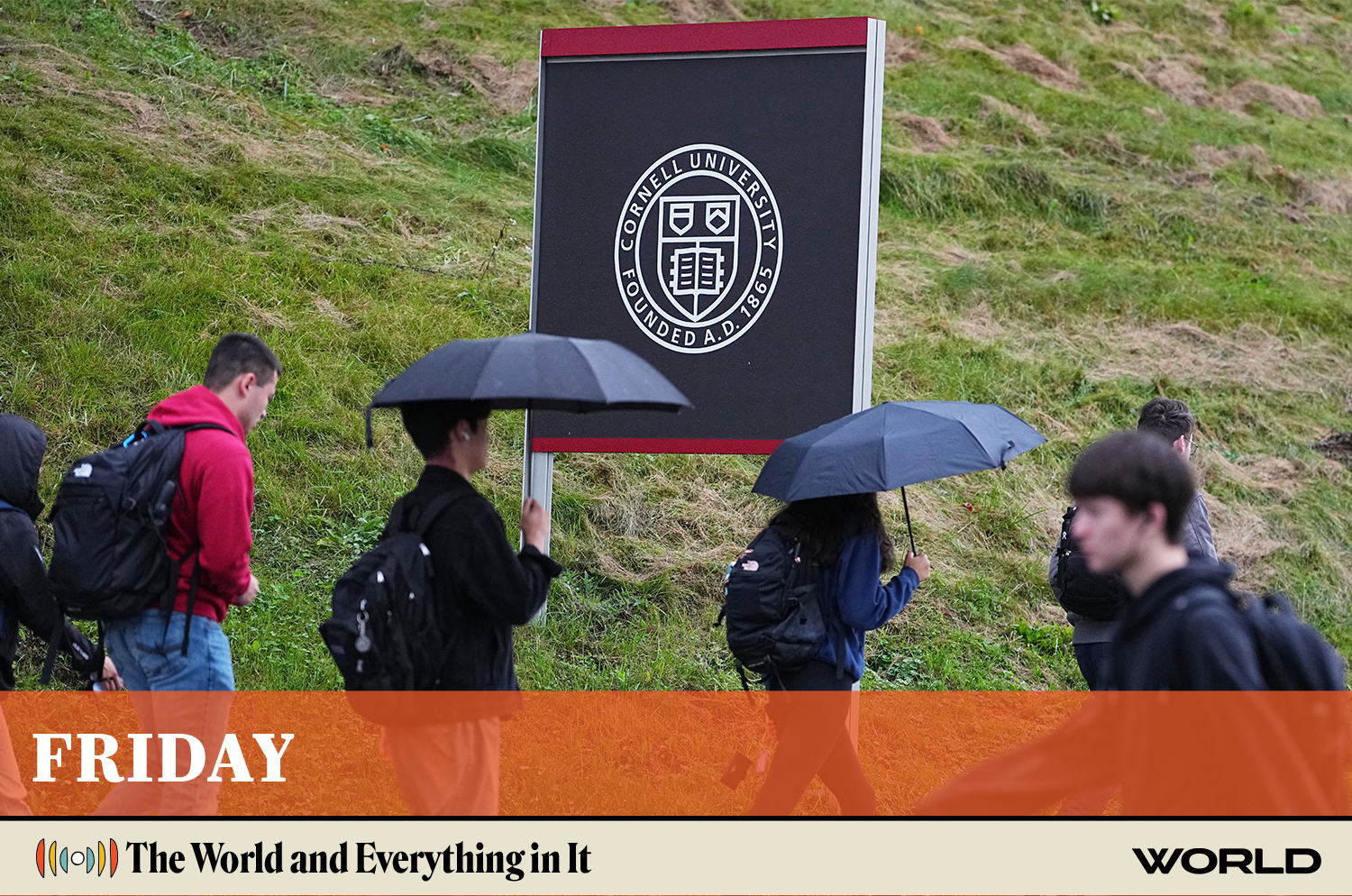
Students walk across the campus of Cornell University in Ithaca, N.Y. Associated Press / Photo by Matt Rourke
Editor's note: The following text is a transcript of a podcast story. To listen to the story, click on the arrow beneath the headline above.
MYRNA BROWN, HOST: Good morning! Today, sexual assault allegations at Cornell University raise questions about the culture that made it possible.
NICK EICHER, HOST: Katie McCoy sitting in once again for John Stonestreet; Culture Friday coming up.
And if you like Westerns:
OUTLAW: I’m looking for someone.
MADAME: A lot of fellas come through here. You’re going to have to be more specific.
OUTLAW: This one has a bullet in him.
WORLD’s Joseph Holmes reviews the remake of a John Wayne classic Angel and the Badman.
Later, a little language history. George Grant on why we call the days of the week what we do. Wordplay for this month.
BROWN: It’s Friday, October 9th. This is The World and Everything in It from listener-supported WORLD Radio. I’m Myrna Brown.
EICHER: And I’m Nick Eicher. Good morning!
BROWN: Up next, Kent Covington with today’s news.
KENT COVINGTON, NEWS ANCHOR: Hurricane » Hurricane Isaias is expected to lash the Gulf Coast with powerful winds, driving rain, and dangerous storm surge today.
National Hurricane Center Director Michael Brennan said he expects landfall somewhere along the north-central Gulf Coast late tonight into early Saturday morning.
BRENNAN: Uh, we are expecting Isaias to be a, a dangerous hurricane when it makes landfall. We have hurricane warnings in effect for portions of the Mississippi, Alabama, and Florida Gulf Coast.
Officials in Alabama’s Gulf Shores and Orange Beach have urged visitors to leave. Nearby Foley warns bridges could close as early as noon today.
And Florida Governor Ron DeSantis warned:
DESANTIS: You are gonna see potential for storm surge all the way down the Florida Panhandle. You will start to see a risk of tornadoes prior to the eye of the storm, uh, reaching landfall.
Forecasters also warn of isolated rainfall totals reaching 15 inches in parts of northern Florida, threatening flash floods.
Work Visa fraud » The Trump administration is accusing Microsoft and Adobe, among others, of abusing foreign-worker programs. WORLD’s Harrison Watters has more from the nation’s capital.
HARRISON WATTERS: The PERM program, as it’s known, allows companies to put foreign workers on a pathway to permanent residency in the United States.
Vice President JD Vance says the program was designed to give companies access to foreign talent they can’t find in America, but he asserts that Microsoft and Adobe are using the program to cut costs.
VANCE: Microsoft laid off last year 6000, 6000 American workers. At the same time, the company benefited from 6300 H-1B visas and almost 3000 green cards. In other words, if you do the math, for every worker that Microsoft laid off, they replaced that worker with one and a half foreign indentured servants.
WATTERS: And Labor Secretary Keith Sonderling says those two tech giants can no longer use the PERM program.
SONDERLING: I am hereby suspending from the Permanent Labor Certification Program some of the largest IT outsourcing firms in the world…
WATTERS: Six other IT companies were on the list as well.
The Labor Department is also looking into alleged abuse in higher education related to visas and possible foreign influence in federally funded research.
For WORLD, I’m Harrison Watters, in Washington.
Russian strike kills at least 30 » A bloody day in Ukraine:
SOUND: [Aftermath of bus attack]
Rescue crews pick through debris after a Russian strike hitting two public buses in eastern Ukraine killed more than 30 people.
United Nations High Commissioner for Human Rights Volker Turk reacted:
TURK: The scale and manner of these attacks, killing and injuring people on buses, at their homes and work in different areas of the country is reprehensible.
Meanwhile, Moscow is stepping up attacks on Ukrainian energy infrastructure, with power outages worsening in Kyiv.
Ukrainian President Volodymyr Zelenskyy publicly urged the United States Thursday to intensify economic pressure against Moscow.
ZELENSKYY: The Americans can do more. I think President Trump can do more. And he has, between us, has to do more, because of so many losses.
His comments came during a visit by the British foreign minister, who arrived in Kyiv to announce new sanctions against Russia.
New U.S. indictment charges Maduro w/torture » Venezuela’s ousted dictator Nicolás Maduro is facing a new charge in U.S. federal court.
U.S. Attorney Jamie McDonald announced that his office in the Southern District of New York:
MCDONALD: …unsealed a superseding indictment charging Nicolás Maduro and his wife, Cilia Flores de Maduro, with a broad conspiracy to commit torture.
McDonald says the indictment charges that Maduro and other Venezuelan leaders worked to silence political opposition:
MCDONALD: Through murder and threats to murder victims’ families, electric shock, asphyxiation, starvation, beatings, and rape.
Prosecutors say Maduro approved torture methods, and his wife helped build the system used to crush dissent.
U.S. forces captured the couple in Venezuela in January. Both remain jailed in New York and have pleaded not guilty to the earlier drug charges.
The case is set for trial June first of next year.
Mifepristone update » Pro-life groups are accusing the FDA of dragging out its promised review of an abortion drug. WORLD’s Benjamin Eicher reports.
BENJAMIN EICHER: The Food and Drug Administration says its safety review of mifepristone will stretch into next year.
In a court filing Wednesday, officials said they expect to finish a safety study by mid-December and then publish a report on the findings by March.
Americans United for Life says President Trump’s administration promised the review more than a year ago, but has shown no public proof of any real progress.
The filing comes in Louisiana’s lawsuit challenging the FDA’s decision to allow the drug through the mail.
Susan B. Anthony Pro-Life America wants the administration to immediately restore a safety rule requiring women to obtain the drug in person instead of waiting for the study to end.
For WORLD, I’m Benjamin Eicher.
NASA crew-12 returns » Off the coast of Los Angeles Thursday:
AUDIO: Visual confirmation of splashdown. Dragon Freedom has returned home and Jessica, Jack, Sophie, and Andre- Copy, splashdown. On behalf of SpaceX, welcome home, Crew-12.
NASA says the four astronauts spent nearly eight months aboard the International Space Station.
Recovery crews hoisted their SpaceX capsule onto a ship. The two Americans, one French astronaut and one Russian emerged waving and pumping their fists.
NASA says the crew’s research helps prepare for future moon landings. And some of that work continues back on Earth.
Liz Warren is deputy chief scientist for NASA’s Low Earth Orbit Program. She says their experiments include:
WARREN: And a study called Manual Piloting, uh, that evaluates astronaut performance during simulated lunar landings.
Researchers want to see how adjusting to gravity after floating in space affects an astronaut’s ability to steer and land a spacecraft.
NASA tests those skills with laptop simulations before, during, and after space missions to help future moon crews land safely.
I'm Kent Covington.
Coming up, a remake of a classic Western. We’ll have a review. Plus, George Grant with Wordplay.
This is The World and Everything in It.
MYRNA BROWN, HOST: It’s Friday, October 9, 2026.
This is The World and Everything in It from listener-supported WORLD Radio, celebrating 15 years.
Good morning. I’m Myrna Brown.
NICK EICHER, HOST: And I’m Nick Eicher. It’s Culture Friday.
Joining us now, author, speaker, and co-host of Reality Check on WORLD Watch, Katie McCoy.
Katie, good morning to you.
KATIE MCCOY: Good morning, Nick and Myrna.
EICHER: Well, Katie, we need to begin with a really difficult story. This has to do with disturbing allegations out of Cornell University. A former student says that seven fraternity members sexually assaulted her in 2024 after she became heavily intoxicated with alcohol and drugs. Cornell expelled or suspended some of the students, but no criminal charges followed that. Well, now there is a lawsuit, a reopened criminal investigation, and tremendous pressure on the leadership of Cornell. The allegations, of course, contested. There are legal questions still to resolve.
But I want to get at something deeper, Katie. We have built a sexual ethic around a single word. The single word being consent. If consenting adults are involved, that’s all that matters. But how did we get there, and what does it leave out?
MCCOY: This story is so disturbing on so many levels. We won’t get into the legal issues of it. Obviously, it’s so entangled legally, but we can speak concretely about the moral issues. Broadly speaking, our culture views sex only as a physical act; that there is no intrinsic meaning to it, that there is nothing higher than satisfying a biological urge, and what we see is that sex has been disconnected from any type of responsibility, and that freedom means complete freedom from obligation.
As a result, the only thing that is determining whether an act is legal or not, or even moral or not, is simply whether the people involved consented. But you can have situations where people have consented, and yet it is still violating their dignity. It’s still a situation where a person was used as a sexual object, or perhaps the person didn’t feel free to leave.
Louise Perry, before she professed Christ, wrote an incredible book called The Case Against the Sexual Revolution, and she described how consent is not enough. Consent and honor are different categories, so consent may help as a legal defense, but it’s not a moral defense.
She says there are a few other aspects to this, Nick, that I think the story is bringing up to our cultural consciousness. One particular aspect for me is what I think about this in relationship to all of Christian history, and here’s what I mean by that: the reason that we find this so reprehensible, the reason that you saw protests on Cornell University’s campus, is because of the influence of Christianity on our own cultural history.
What we’re seeing come out of this story, it is reminiscent to me of classical Rome, a culture that viewed whether something is right as whether you had the power and status to do it, and the culture into which the church was born believed that the bodies of the physically and socially weaker people, they just existed to serve the urges of more powerful people, and that the intrinsic vulnerability of the female body is just a tool to serve the more physically powerful.
At base level, people were just commodities, and we hear some of the things coming out about this story. We see the texts that refer to this woman as “a shop that was open.” That is a distinctly pagan view of sexuality. I don’t just mean that it’s not religious or not Christian or not godless. I mean pagan in the sense that it is all about power.
The reality is, had the Cornell Seven case happened in ancient Rome, no one would have batted an eye. It wouldn’t have even registered on the scale of social outrage because sexual objectification in a pagan mindset is what women are for. It is only because of the influence of Christianity that people are outraged, and here is where this rubber meets the road for us, Nick, is that we cannot have Christianity’s effects on society without Christianity’s claims on reality.
You cannot have the influence of the Christian faith without the moral framework that produces it and the obligations that that plays. If we try that, we just end up with what Os Guinness and others have called that cut-flower situation. You’ve severed it from your roots, and it’s just dying a slow death. And that’s what we’re seeing.
BROWN: Katie, I want to ask something that I think we’ve become—I don’t know—almost afraid to say. Here it is: Women have agency too. We make choices, and some choices carry terrible risks: alcohol, drugs, putting yourself in a vulnerable situation.
Now, hear me. None of that excuses sexual assault. Absolutely not. But Katie, how do we talk honestly to young women about prudence and personal responsibility without being accused of blaming the victim?
MCCOY: Such a great question and a very delicate one because, as you said, these young men had agency as well. None of them stopped what they witnessed happening. In fact, they allegedly encouraged it among each other.
I saw a fascinating article in The Free Press to that very question, Myrna, is that apparently women are actually more difficult on other women for putting themselves in those situations, and it’s because we understand our intrinsic physical vulnerability. That is something that is by God’s design, that we are physically more vulnerable, and also by God’s design is that men who are physically stronger would protect the vulnerability of women.
Some of what we are seeing is the result of a very sex-positive culture, and you can go online and read how Cornell University was encouraging these things among their students. I don’t mean encouraging sexual assault, but I mean encouraging just total license, free from obligation.
And it is as though it is so disconnected from reality to think: Do we not believe that has consequences when we hear about the alarming number of young girls who report being choked during sexual activity because of a results of pornography? When we hear about a 2020 study done on the heterosexual content on Pornhub found that 45% of it included sexual aggression, some type of sexual violence?
We live in what some secular people are calling a pornocracy. We are being ruled by pornography as a political and cultural force, and this has massive effects on our view of human dignity. It certainly reinforces the idea that sex is just sex; it’s just satisfying a bodily urge. That there’s no innate dignity to human bodies, and so this question of agency, we cannot separate it from how pornified our culture has become, how normalized it is to accept sexual violence, and then how our culture has told women that even putting themselves in a situation like this can still somehow, as long as they consent to it, not be a violation of their dignity.
The reality is, even if she had consented, it still would not only be wrong, but it would have been dehumanizing and degrading to her.
BROWN: Well, Katie, last month, women from around the country gathered in Rochester, New York, to launch what they’re calling a new women’s movement. Scholar Erika Bachiochi helped organize it, and you mentioned Louise Perry. I’m pretty sure she was one of the speakers at this event.
They signed something called a Declaration of Interdependence, deliberately echoing the women’s rights movement that began at Seneca Falls in 1848. Here’s their argument: Modern feminism has gone badly wrong in treating independence as the highest good, and they want to recover a view of women, men, marriage, children, and family obligations as goods worth protecting.
Katie, you know feminist history. Is this an effort to recover something the original women’s movement understood, but later feminism lost, or is it really something new here?
MCCOY: When I read the statement, I was very impressed. It’s incredibly scholarly, philosophically grounded. What the argument of interdependence has to rest on, however, is something that we find exclusively in Genesis one and two. Now we know it from common sense and human nature. Human beings are sexually reproducing species; they are interdependent upon each other.
However, the connection between interdependence and design, the fact that we are made to be interdependent, not just to produce children, that is something that is deeply ingrained in us at the cellular level, and it is established in the creation narrative.
I have to tell you, Myrna, I wasn’t able to make it to the conference that led—that was this event, but it’s probably good. I would have embarrassed myself fangirling over all of the female scholars there. It was a who’s who of conservative women scholars, an incredible lineup.
The one thing I would say, and I think many of them would probably agree, is that you cannot have the moral claims that that statement rests upon without transcendent theological truths to ground them in. Secularism will not produce the view of humanity that their declaration espouses.
Now, the good thing about it, I think we can learn from history, is back in 1995, a group of individuals created something called the International Bill of Gender Rights, and it was some 25 years later that their assertions became mainstream. And so, one thing that I think we could find with this declaration is it might take about a generation. It could take decades before we see advocacy and publishing follow suit.
But it could signal a concerted cultural effort, one that we have certainly seen in secular issues, things that normalized transgenderism, transsexualism, and all of the so-called rights for gender identity. Could we be seeing that in a different direction with this particular declaration? Time will tell, but it’s a really good step.
EICHER: Katie, before we go, I want to talk about a story out of Canada that really caught my attention. It had to do with a woman in her 70s. She was the matriarch of the family, and you can imagine this—presiding over these great Sunday dinners, and that was one of the great joys of her life: cooking Sunday dinner for everyone.
But she got sick, and illness took away her ability to do that, and with it, she began to lose her sense of worth. Now, the medical condition she had qualified her, and I use that term advisedly, qualified her for assisted death under Canadian law. But after conversations with her family and doctors, she decided to postpone the assisted death.
But that detail about Sunday dinner, I couldn’t shake it. Katie, what happens to our understanding of human dignity when someone can no longer do the things that have given meaning to their lives?
MCCOY: Yeah, this was a heartbreaking story. First, I’m really glad that her family helped reinforce to her that she mattered more than her ability to cook Sunday dinners. Without dismissing the importance of that, it’s a beautiful legacy to leave for your family.
But when I heard this story, I thought, what a picture of the difference between utility and contribution. We are all made for contribution, but the substance and worth of our lives is not in utility. This woman’s utility may have changed as she aged, as she developed an illness, but her ability to contribute to the lives of her family and to others did not.
She is still, regardless of her condition, as Psalm eight says, made a little lower than the angels, and regardless of her ability, she still has the ability to contribute to the lives of others. How? Well, this gets down to the question of what is life for? What are we here for? And we are all here to contribute, but how we are able to do that in different seasons of life can change.
What we are ultimately all here for is to know, love, and serve God and others. Is there a way that she can do that, even though it changes in terms of her ability to fulfill the things that she used to love? Of course, she can find that. We can all find that in the season that God has placed us.
The sense of helplessness, the decline in our bodies. Ultimately, it is preparation for our souls because our bodies weren’t designed to go on forever in this life. They were designed to be resurrected and with the Lord, and I also think it’s a great opportunity for us to recognize, as we all have aging parents, that what an opportunity to honor those who cared for us when we had no utility, when we had no ability to add something or fill some type of responsibility, and yet our lives had value because of the relationship that we had to our family.
And so I’m just so happy to know that her family intervened and clearly helped persuade her to realize that the substance and meaning of her life was not in her utility; it was in her relationship that she had with others.
BROWN: Author, speaker, and co-host of Reality Check on WORLD Watch, Katie McCoy. Katie, thank you. We will talk again soon, but in the meantime, best wishes on season two of Reality Check.
MCCOY: Thank you. Always good to be with you.
NICK EICHER, HOST: Today is Friday, October 9th. Thank you for turning to WORLD Radio to help start your day.
Good morning. I’m Nick Eicher.
MYRNA BROWN, HOST: And I’m Myrna Brown.
Coming next on The World and Everything in It: Angel Studios and Hollywood star Zachary Levi are teaming up for a remake of a classic 1947 John Wayne Western.
Here’s WORLD film reviewer Joseph Holmes.
JOSEPH HOLMES: Westerns have long gone hand-in-hand with stories about faith. Both, with faithful believers ever-present and themes of sin and redemption. So it’s no surprise when Christians or those courting faith-based audiences dip their toes in the genre. The latest example is Angel and the Badman. It’s a movie with no real surprises for fans of Westerns, but one that might scratch the itch for those looking for an enjoyable redemption story.
QUIRT: Who are you? And where am I?
PENNY: I’m Penny, um, Penelope. You’ve been asleep for a week. You almost died.
QUIRT: I suppose that makes you my lucky penny.
Angel and the Badman is a remake of the 1947 film starring John Wayne. In it a wounded outlaw named Quirt on the run from both the law and rival criminals is taken in by a local Christian family. The outlaw falls in love with the daughter and warms to the family’s kind ways. But he has to decide if he can protect them better by staying or leaving.
The film hits all the beats you would expect from a story like this and does so enjoyably. It’s fun to watch the outlaw with a heart of gold find redemption and love with a good family. Christian families will be happy with how the family lives out their faith in sincere ways that are validated throughout the story. The cast is also solid and a reminder of how good Angel Studios is getting at putting out movies that attract real talent. Zachary Levi is charming as Quirt. Tommy Lee Jones has an easy, wholesome gravitas as the sheriff. Neal McDonough is reliably good as the bad guy.
MARSHALL: I don’t know what you’re up to playing house with these good people. Best thing you can do is ride off because sooner or later they will regret the day they ever met you.
This version of the story mostly sticks to the same characters and beats as the original film, but the changes it does make are a mixed bag. In the original film the family are Quakers. So rejecting violence wholesale is a strong part of Quirt’s redemption, even as Quirt’s and the sheriff’s capacity for violence is necessary to save everyone from the bad guys. The new version makes the family just Christians, bypassing that interesting tension. The upshot is Quirt’s arc is less clear and the emotional payoff less satisfying.
You also see this with the changes they made to the church scene. In the original, the teaching is on the ethics of Jesus. Quirt is confronted with the fact that he’s not living up to the ethics of his new community. In the new version, the sermon is on accepting God’s grace, and Quirt walks out, feeling guilt over his own sin. The problem is we never see Quirt struggling with that guilt anywhere else. Forgiveness of sins wasn’t a big theme in the original, and the new movie doesn’t change enough elsewhere to make it a consistent theme here.
PENNY: I suppose you think it was your gun who changed his heart?
QUIRT: Honey, I haven’t used my gun in days. You ought to have more faith in people.
There’s nothing in this film that really makes it distinctive. The characters repeatedly tell you exactly who they are and what they want and feel without subtlety. The original film, although clearly of its time, leaned into telling its story with style.
OUTLAW: I’m looking for someone.
MADAM: A lot of fellas come through here. You’re going to have to be more specific.
OUTLAW: This one has a bullet in him. And our gold. His name is Quirt Evans.
There are some scenes of PG-13 violence that you’d expect in a Western. But very little of it is graphic. People get shot but typically from a distance with little blood. We first meet Quirt nursing a wound in his side, evident by a blood stain on his shirt. The villain at the end gets a stake through his shoulder, but we only see before and after. This makes it a tad more violent than the original film, which was totally bloodless.
MOTHER: Marshall, will you be joining us for church?
MARSHALL: Church?
QUIRT: That’s right.
Angel and the Badman is enjoyable for families or fans of Western-genre redemption arcs. For those who simply want to return to that well, this film will more than suffice. But given that the original is better and more family-friendly, many might decide to revisit that one instead.
I’m Joseph Holmes.
MYRNA BROWN, HOST: Good morning! This is The World and Everything in It from listener-supported WORLD Radio. I’m Myrna Brown.
NICK EICHER, HOST: And I’m Nick Eicher. Producer Lindsay Mast is here now with a quick note about our next WORLD Journalism Institute course.
LINDSAY MAST: Our next Mid-Career Course is at the end of February—but we’re talking about it now, because applications are still open, the deadline is just weeks away, and this fills up fast.
Mid-Career runs from February 28th to March 6th. It’s for writers, journalists, and wanna-be journalists in their mid-30’s and up. As far as experience, we usually have a range of experience in the class from true novices to some with a lot more experience. The course is built for that range.
Myrna, you came to the course with a long career in journalism.
BROWN: I did. Thirty years in TV before I attended WJI Mid-Career in 2018. It was a wonderful chance to sharpen my skills and learn to report from a Biblical worldview. And I’m here! Good for us!!!!
MAST: And it’s also a way to explore a new calling or return to work after raising a family. I attended in 2023 after thinking I’d left journalism behind. It was a challenging, exhilarating week, and my favorite teacher was Nick Eicher. I made great friends and wound up back in journalism.
EICHER: And the price is right, you just have to trade a week of your time and cover your transportation. But WORLD donors get the rest. Successful admission means you’ve locked in a scholarship that covers most meals, plus housing and tuition. And the goal is for students to have a chance to publish something with WORLD.
MAST: All journalists work on deadline so here’s your first one: Applications are due on Monday, November 2. That’s just over three weeks and it’s a lengthy application so get started! Visit wji.world and look for the blue Mid-career information icon to submit your application. Again, that’s wji.world.
EICHER: Time now for Wordplay for October. Here is our resident logophile George Grant.
GEORGE GRANT: In linguistics calquing is the technical name for the process of creating loan words–words that are translated or transliterated and then borrowed from another tongue to fill a gap in the vocabulary necessary to describe emerging ideas, circumstances, or objects. An example of calquing is the long and winding linguistic road that gave us names for the days of the week.
I learned in elementary school that these names came from the Romans who dubbed the days using Latin terms for the Sun, the Moon, and the five known planetary spheres. But it is a little more complicated than that—involving a great deal of calquing.
Sometime during the second century AD, the Roman Empire began replacing the old Republic’s eight-day Nundinal calendar with the Hellenistic Hebdomas calendar. The Greeks had borrowed the system from the Babylonian Magi who linked the seven days to the seven visible astronomical luminaries. The days of the week were thus named for the Hellenistic mythological pantheon: Helios, Selene, Ares, Hermes, Zeus, Aphrodite, and Cronos.
The Romans then calqued each of those names. Thus, the first day of the week became Dies Solis or Sol’s Day, named for the Roman sun god. The second day became Dies Lunae, named for Luna the moon goddess. The third day was dubbed Dies Martis, for Mars the god of war. The fourth day was called Dies Mercurii, named for Mercury the messenger of the gods. The fifth day became Dies Jovis or Jove’s Day to honor Jupiter, the god of sky and thunder. The sixth day was Dies Veneris or Venus’ Day, for the goddess of love. And the seventh day was called Dies Saturni, named for Saturn, the god of agriculture.
When barbarian tribes like the Franks, Danes, Normans, Angles, and Saxons, swept down from the steppes of the Caucuses and the fjords of Scandinavia, they migrated to northern and eastern Europe and adopted the seven-day week. But predictably, they too calqued the names, replacing the Roman gods with deities in their own mythic pantheon who had similar traits.
Thus, the first day of the week was named Sunnandæg, Anglo Saxon for the Day of the Sun, or Sunday. The second day was named Monandaeg, Anglo Saxon for the Moon Day, or Monday. Tuesday came from Týr, the Norse god of war. Wednesday was named after Woden, the chief of the Danish pantheon. Thursday came from Thor, the mythic god of thunder. Friday was named for Freya, the goddess of love. Because these nomadic peoples had no god of agriculture in their own mythology, Dies Saturni merely morphed to Saeterndaeg, or Saturday.
Layer upon layer of calquing, makes the task of tracking down the etymological snippets, scraps, and snatches of our everyday vocabulary something of a scavenger hunt. Perhaps that is why the Language Learning Institute has called English the “archetypal magpie language.” Just like the unkempt nests of its black and white aviary counterpart, English is a bit of a ragtag jumble of words that are begged, borrowed, stolen, and calqued from a myriad of arcane sources.
I’m George Grant.
NICK EICHER, HOST: Now it’s time to name the crew who helped with this week’s programs:
Mary Reichard, Steve West, Jenny Rough, David Bahnsen, Max Belz, Addie Offereins, Janie B. Cheaney, Hunter Baker, Lauren Smyth, Mary Muncy, Koryn Koch, Cal Thomas, Lauren Dunn,Daniel Suhr, Katie McCoy, Joseph Holmes, and George Grant.
Thanks also to our breaking news crew: Kent Covington, Steve Kloosterman, Travis Kircher, Daniel Devine, and Christina Grube.
And thanks to the technical production team: Benj Eicher, Carl Peetz and Josh Goniea.
Harrison Watters is Washington producer, Kristen Flavin is features editor, Emma Eicher is assistant producer, Lindsay Mast is Producer. I’m Executive Producer Nick Eicher.
MYRNA BROWN, HOST: And I’m Myrna Brown.
This is episode 35-05 of The World and Everything in It, from WORLD Radio. WORLD’s mission is biblically objective journalism that informs, educates, and inspires.
The Bible says, “Count it all joy, my brothers, when you meet trials of various kinds, for you know that the testing of your faith produces steadfastness. And let steadfastness have its full effect, that you may be perfect and complete, lacking in nothing.” —James 1:2-4
There is no greater joy than spending the Lord’s day in His house. So, find a Bible-believing church this weekend and meet Him there.
And Lord willing, we’ll meet you back here on Monday.
Go now in grace and peace.
WORLD Radio transcripts are created on a rush deadline. This text may not be in its final form and may be updated or revised in the future. Accuracy and availability may vary. The authoritative record of WORLD Radio programming is the audio record.
Please wait while we load the latest comments...
Comments
Please register, subscribe, or log in to comment on this article.