
The World and Everything in It: October 6, 2026
Pete Hegseth wants a more modern military—and a different leadership culture to go with it. Brazil’s right enters the presidential runoff with momentum, while a Virginia family finds what happens when the kids take on real work. Plus: Samuel Alito in his own words, and a six-carat American Dream in Arkansas.
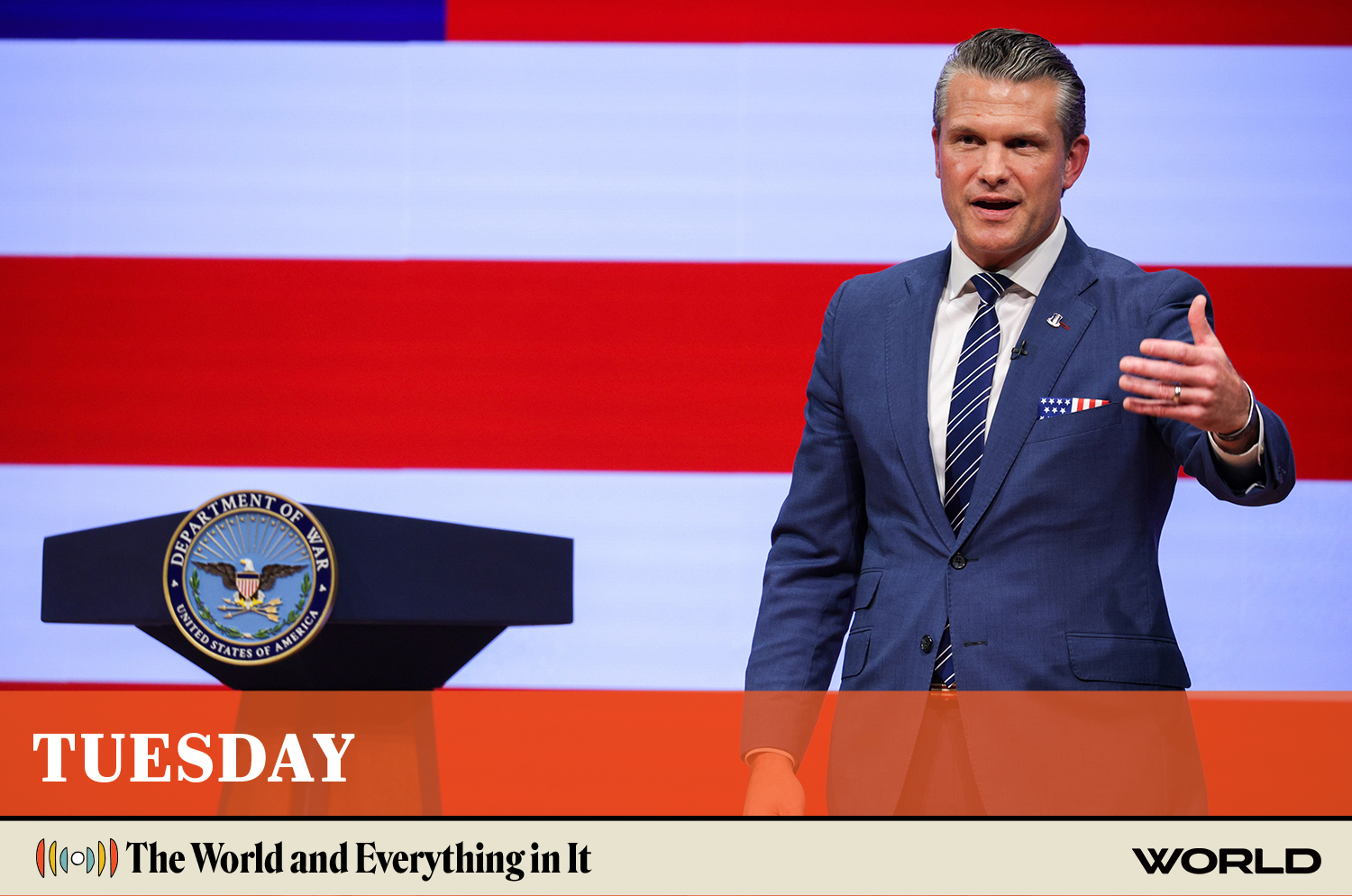
Secretary of Defense Pete Hegseth gives a State of the Force address at Marine Corps Base Quantico, Wednesday. Associated Press / Alex Wong / Pool Photo
Editor's note: The following text is a transcript of a podcast story. To listen to the story, click on the arrow beneath the headline above.
LINDSAY MAST, HOST: Good morning!
Pentagon chief Pete Hegseth wants a different kind of military, and that means a different kind of leadership.
HEGSETH: You can’t change a culture with the same people who enabled it. Personnel is policy at every level.
NICK EICHER, HOST: Also today a surprise in Brazil’s presidential election, Justice Samuel Alito has a new book, and, later, what happens when kids carry more of the family load?
STONE: Parents who make more conscious choices about their kids' child rearing often actually want to have more kids.
And WORLD Commentator Janie B. Cheaney on those days when work just feels like work.
MAST: It’s Tuesday, October 6th. This is The World and Everything in It from listener-supported WORLD Radio. I’m Lindsay Mast.
EICHER: And I’m Nick Eicher. Good morning!
MAST: Up next, Kent Covington with today’s news.
KENT COVINGTON, NEWS ANCHOR: Yemeni forces expel Houthis from several areas » New developments in the Middle East with possible implications for the world’s oil supply.
Yemen’s government says its troops have pushed Houthi rebels out of several towns near the Red Sea.
They say jets from a Saudi-led coalition helped the troops advance Monday.
The gains put them near a strait at the Red Sea’s southern entrance, a key route for cargo ships and oil tankers.
U.S. Secretary of State Marco Rubio:
RUBIO: The Saudis and the Yemeni forces clearly are not in favor of the Houthis controlling that territory close to the, to the strait there. And, uh, it's territory that was gained as a result of a Houthi offensive, and this is the counter to it. We expected that would happen, and that's what's happening.
Asked whether Washington coordinated the push, Rubio pointed to a defense pact with Saudi Arabia but gave no details. The Associated Press reports that the US provided intelligence to the Saudis.
The Iran-backed Houthis claim they launched missiles and drones at Saudi airports, military bases and an oil refinery.
And fighting continues. A government source told Reuters troops were still battling Houthis near the strait Monday.
Russia plague report » Secretary Rubio also commented on reports that a worker at a Russian plague research lab has died.
Russian health officials say she had pneumonia but haven’t identified what caused it.
RUBIO: There's very limited travel between the US and Russia, obviously. Uh, but like anything else, something like that gets out, it could quickly spread. So we're watching and monitoring it closely. I, I don't think it's cause for alarm, but it is cause for focus and a cause, uh, to just keep an eye on, and we're doing that
Local state TV reports the woman died last week in Siberia.
Authorities say they quarantined the hospital where she died and are keeping a close eye on people who had contact with her.
Reports that she had plague remain unconfirmed. Russia’s public health agency says it found no sign of the germs she worked with, and no evidence of a lab accident involving those germs.
U.S. deploys troops to Middle East » A third U.S. aircraft carrier is heading for the Middle East, as President Trump weighs new strikes in the war with Iran. WORLD’s Kristen Flavin reports.
KRISTEN FLAVIN: The USS Theodore Roosevelt carrier strike group is en route to the region. The deployment also includes the Makin Island amphibious group — together carrying more than 7,000 sailors and 2,000 Marines.
Trump has suggested there are early indications linking Iran to a co-pilot who attempted to crash an Israel-bound flight last Wednesday. And he warned of retaliation if the link is confirmed.
The buildup also follows Trump's remark last month that he's in—his words—"deciding mode" on Iran. He predicted "very big things" in the not-so-distant future, and he's said stepped-up bombing is possible.
However, Trump has also predicted a deal with Iran after next month’s midterm election.
For WORLD, I’m Kristen Flavin.
Missing medical jet update » Officials with an air ambulance company say they now have to face the “heartbreaking reality”, that all six people aboard a medical jet that went down near the Massachusetts coast are presumed dead.
Searchers found wreckage near Nantucket island, but no survivors. The Coast Guard has called off its search after nearly three days covering more than 4,000 square miles.
The jet vanished early Saturday on a flight from Bermuda to Boston. It carried a patient and a relative from Bermuda, plus four Canadian crew members.
Investigators are trying to determine what went wrong.
Ukraine: We've taken out over half of Russia’s oil ref capacity » Russia's war with Ukraine is expanding, and it's putting lives across Europe at risk.
That was the message from European Union foreign policy chief Kaja Kallas on Monday:
KALLAS: Europe has seen a spike in the Russian hybrid attacks and sabotage attempts, and airspace violations in recent weeks. Russian missiles and drones violated Moldovan airspace again over the weekend, and this is completely unacceptable.
Meanwhile in Ukraine:
SOUND: [Body recovery]
Rescue crews recovered a body Monday in Kharkiv, in northeastern Ukraine. Authorities say Russian bombs hit a clothing workshop there. Russian attacks killed at least four other people.
But Ukraine is hitting back, its defense ministry says Ukrainian strikes have knocked out more than half of Russia’s oil-refining capacity. If that’s true, Russia could have a much harder time getting fuel to its troops.
I'm Kent Covington.
Straight ahead: A closer look at some big changes at the Pentagon. And later, parents challenging the growing trend away from childhood chores.
This is The World and Everything in It.
LINDSAY MAST, HOST: It’s Tuesday the 6th of October.
Glad to have you along for today’s edition of The World and Everything in It. Good morning, I’m Lindsay Mast.
NICK EICHER, HOST: And I’m Nick Eicher.
First up on The World and Everything in It: Big changes at the Pentagon.
War Secretary Pete Hegseth is pushing new investments in drones, weapons, and base security. Along with that … plans to cut the number of generals and admirals by a fifth, 20 percent.
HEGSETH: Now the media calls that a purge. I call it accountability, and long overdue, and frankly, the bare minimum.
MAST: But can the Pentagon modernize while cutting senior ranks? WORLD’s Harrison Watters reports from the nation’s capital.
HARRISON WATTERS: At Quantico in Virginia, Secretary Hegseth laid out plans to put more drones into troops’ hands.
HEGSETH: …we are announcing the creation of Autonomous Warfare Command, or AutoWarCom.
A four-star commander will lead the effort. Retired Navy Rear Admiral Mark Montgomery says the war with Iran has revealed the need for the U.S. to improve its drone technology.
MONTGOMERY: We stopped the 40-day air combat, I think largely because we couldn't stop drones hitting close aboard targets, targets close to Iran.
Montgomery once commanded an aircraft carrier strike group. He is now senior fellow at the Foundation for Defense of Democracies in Washington.
He says two of Hegseth’s announcements stand out: the drone command, and an initiative called FORTRESS America to shield US bases from attacks against energy supplies. Here’s Hegseth.
HEGSETH: Every major military installation in America is going to generate its own power independent of the civilian grid.
A new Pentagon team will work to secure supply chains and keep hackers out of military bases. Hegseth calls the plan a national insurance policy.
And Montgomery says recent cyberattacks on civilian water systems and power grids drive home the urgency.
MONTGOMERY: We've got to address these probably in that order: national security, economic prosperity, public health, and safety.
But Hegseth wants to change more than the military’s weapons and bases. He’s also
HEGSETH: You can't change a culture with the same people who enabled it. Personnel is policy at every single level.
Last year, the Pentagon announced a 10% cut in general and flag officer positions. Montgomery says some cuts are needed, as the number of officers nears limits set by Congress.
MONTGOMERY: Whenever we have a really wicked problem, we say let's create a general officer and put it against that, and we did that recently for the for the addressing of how do you build a golden dome for America.
But Hegseth said the cuts would rise to 20% by January. He added many generals who disagree with his vision for the War Department have already left.
Montgomery has some misgivings about the cuts.
MONTGOMERY: This could be too much, and what worries me even more is if it's done by Secretary Hegseth as a way for him to address what he perceives as pre-existing DEI or diversity equity issues.
More than a dozen top officers have either been fired or resigned since last year. Some were responsible for carrying out Biden-era DEI policies, as well as the disastrous military withdrawal from Afghanistan.
The New York Times reports that Hegseth has also blocked promotions for some officers. The Pentagon says those decisions are based on merit.
Montgomery says the commander cutbacks may hurt one of the newly-announced programs.
MONTGOMERY: The general officer that is most equipped to lead this new autonomous warfare command is General Chris Donahue.
Donahue led U.S. Army troops in Europe and Africa, including a unit testing lessons from Ukraine’s drone war. He retired in July… as the Pentagon moved to turn his four-star command into a three-star post.
Montgomery suspects Hegseth closed the door to Donahue’s long term advancement to make room for his preferred candidate for Army Secretary.
MONTGOMERY: We literally got rid of the one general officer I felt was really operationally and procurement-wise ready to lead something like an autonomous warfare command, and the secretary I think used bad judgment in getting rid of him.
Hegseth wants the new drone command up and running by next October. Montgomery supports that goal. His concern is whether the Pentagon is losing the people best equipped to get it there.
Reporting for WORLD, I’m Harrison Watters.
NICK EICHER, HOST: Coming up next on The World and Everything in It: a surprise in Brazil’s presidential election.
Conservative Senator Flávio Bolsonaro finished two points ahead of leftist President Luiz Inácio Lula da Silva on Sunday. Neither won a majority, so the two meet again in an October 25th runoff.
The presidential race wasn’t the only shift to the right. Conservative candidates also made major gains in Brazil’s Congress and Senate.
LINDSAY MAST: Joining us now to talk about it is Gil Guerra. He's a fellow at the Hudson Institute with a focus on Latin America. Gil, good morning.
GIL GUERRA: Good morning, Lindsay.
MAST: I want to start just with some national context. Just briefly, what do you see as the main issue at play for voters in Brazil this election?
GUERRA: What we see time and time again in various polls, it is security, crime, and violence. If it's anywhere from twenty-nine to thirty percent of Brazilian voters say that that is their top issue. Corruption is usually a little bit behind, and then the economy comes in third. but for most Brazilian voters, even if some crime statistics have improved in the past years, ninety-four percent say that they have felt insecurity when they leave their homes in the past year.
So for them it is overwhelmingly an issue that is important to them and also an issue that they trust the candidate Flavio Bolsonaro more with than the candidate Lula de Silva.
MAST: You know, neither candidate here is a political newcomer. Flavio Bolsonaro's father is a former president. And incumbent president Lula, of course, is seeking a historic fourth term. Can you go through just a few of the main differences between the candidates and their platforms?
GUERRA: They represent sort of the two poles of the Brazilian electorates and of Brazilian politics. And it is perhaps because they are such fixtures that we have seen an estimated twenty-one percent abstention rates in the first round. And for context, that is the highest abstention rate that we have had in Brazil since 1998.
It seems that what Brazilian voters want is something new and something different. And that may be why Flavio, who is not the incumbent, has the advantage. But they represent, broadly speaking, very different approaches towards the United States. Flavio is far more aligned with the United States. Lula has spent his career trying to build more of a third world approach based on alliances through a block known as BRICS, which is an alliance with other middle powers such as Russia, India, China, and South Africa.
But really, one of the main differences is on crime, where Flavio is promising much more of a Bukele, El Salvador style approach to crime. Whereas Lula, even though we can see 61% of his voters actually approve of trying minors as adults. So his voters themselves are actually also fairly hard on crime. For various ideological reasons, that just has not been one of his main priorities, in part because he's the incumbent and so he doesn't want it to seem like crime is actually that big of a problem. So that's part of the trap that he has there.
MAST: Let's talk a little bit about U.S.-Brazil relations. President Trump has become something of a factor in the race. Lula has accused Washington of interfering in Brazilian politics. Do you think Trump's involvement helps Bolsonaro or could it provoke some nationalist backlash?
GUERRA: I think that one of the excuses if Flavio wins is going to be what we've seen in other elections, which is that U.S. interference led to the ultimate victory of the candidate of the right or the candidate who is more aligned with the United States. But I actually think that the opposite is true. I think that this administration obviously really wants Flavio to win because relations with the United States would be much better than they are now. But you can look through the polling and virtually every step that the administration has taken that could influence the election has actually backfired and has actually hurt Flavio.
If you look at the tariffs that we've placed on Brazil recently, the majority of Brazilian voters say that it has actually made them less likely to support Flavio for it. So I think it is overall more accurate to say that if Flavio wins, it will actually be despite some of the actions the administration has taken to try to weigh on the election and not because of them.
MAST: So watching the returns coming in on Sunday night, you could see some of the congressional elections inside Brazil. This is more than a presidential race—I mean if Lula were to win the runoff, do you think that the political center of gravity in Brazil has already moved to the right just with what's happened in their legislature?
GUERRA: I would say so, and I think that we've already seen this happen in Brazilian politics where there has already been the rejection of an appointment of Supreme Court Justice. That's the first time that has happened since the late eighteen hundreds in Brazil. It already seems like whoever comes in, obviously Lula will be very constrained. But from what we've also been able to see, the Partido Liberal, the party that Bolsonaro is tied to, they have a majority, but do not have such an absolute majority that they can just pass things without having to work with some of the more center right parties, some of the center parties for some of their really major reforms. But obviously if Lula does make even a stunning comeback in the next few weeks, he is going to be especially backlogged and blocked by this Congress.
MAST: Gil, I wanna ask about the math behind the runoff. Bolsonaro finished with 47% to Lula's 45. There are millions of voters who backed other right of center candidates. Is there a realistic path for Lula here to make up the difference in the runoff? And where would those votes come from?
GUERRA: His votes would have to come from the twenty-one percent of voters who abstained in this round. So he would have to motivate people who did not show up in the first round by basically convincing them that the stakes are so high that they have to come out and do this. I think that is especially challenging for him for a number of reasons. It is far easier to get voters from other aligned candidates. And from what we've been able to see, with one exception, the majority of the candidates who were in the low single digits.
Most of their voters say that they are probably going to go to Flavio instead. So he's already facing also some momentum from Flavio. And another factor in all of this is that Lula's age, Lula is fairly old. He's 80. He is very much associated with again, if you are already the incumbent and if voters already think, I don't like how things are going, we think you've been around too long, we want change, it's very hard to convince people to give you even more time when you are so visibly aged. We've seen that here in the United States but it is something that is obviously taking form in Brazil as well.
MAST: Gil Guerra is a fellow at the Hudson Institute. Gil, thank you so much.
GUERRA: Thank you, Lindsay.
LINDSAY MAST, HOST: Coming up next, Supreme Court Justice Samuel Alito has a new book out today. It’s called So Ordered.
NICK EICHER, HOST: The book pulls together 19 speeches from Justice Alito’s years on the court—on judging, religious liberty, and threats to the Constitution.
Here’s WORLD Legal Affairs Correspondent Jenny Rough.
JENNY ROUGH: Justice Alito subtitled his book An Originalist's View of the Constitution, the Court, and Our Country.
Originalists believe the Constitution has a fixed meaning. Its words should be interpreted to mean what the terms were understood to mean when it was adopted. You can hear him apply it during oral argument in the 2021 case, Dobbs v Jackson Women’s Health Organization. It went on to overrule Roe v Wade.
JUSTICE SAMUEL ALITO: Let me ask you a couple questions about history. Did any state constitutional provision recognize that abortion was a right, liberty, or immunity in 1868 when the 14th Amendment was adopted? … Can it be said that the right to an abortion is deeply rooted in the history and traditions of the American people?
Earlier this week, Alito expanded on how that philosophy influenced Dobbs. Audio from Fox News:
ALITO: I thought it was perfectly clear that the reference to liberty in the 14th Amendment adopted in 1868 did not mean that there is a constitutional right to abortion. In 1986 abortion was illegal in most of the states.
Alito says the unprecedented breach that leaked an early draft of the decision made the majority justices a target for assassination.
Six of the book’s speeches fall under the role of judges. Here he is giving a 2010 talk called “Let Judges Be Judges”, pointing out that the U.S. Constitution is a lean document.
ALITO: If I were to read the entire text to you tonight, it would take about 30 minutes. … By contrast, if I were to read to you the unratified constitution of Europe, it would take 17 hours.
He says the brevity–especially on the judicial branch– means many aspects about the proper role of judges must be inferred.
ALITO: Article III says federal judges are to decide “cases and controversies,” but it doesn’t define those terms. … As originally ratified, the Constitution was largely mum on court procedures.
Still, that does not mean a judge’s role is to be a crowd-pleaser, a rubber stamp, or a reformer. The Constitution means something, as do statutes. The judge’s role is to apply the law as written.
Alito can trace the influence on some of his philosophies to his childhood.
Alito played and coached youth baseball. In one speech he compares judges to umpires. An umpire cannot call a strike because he wants to, he has to follow the rules the way judges must follow the law. But close calls are tough. Experience and discernment help. Alito admits AI will change a justice’s work, the way computers have changed line calls. And it’s leading to an emerging human right in the law: the right to a human decision.
He also speaks of his admiration for the craftsmanship of Judge Learned Hand, as well as Hand’s warnings about the need for a love of liberty. And speaking of liberty, the chapter I couldn’t wait to read? “The Pandemic Stress Test for Constitutional Rights.” It’s from a speech Alito gave in 2020, over the internet, because COVID had shut down some gatherings but not others. Audio again from Fox:
ALITO: And so people came back to Las Vegas, and there were pictures of them in the casinos, and they were not wearing masks, not all of them were wearing masks. But at the same time the state had a very severe limit on the number of people who could attend a house of worship no matter how big that house of worship was.
Justice Alito has become known for his opinions protecting freedom of religion.
Alito dedicated his book to his wife, Martha-Ann. After they began dating, they realized they’d met years earlier. Sort of.
The story goes like this: Martha-Ann had come to D.C. to watch Alito argue a case. She sat next to his parents who told her Alito and his sister were the only girl-boy debate team in South New Jersey back in the day. Here’s Martha-Ann:
MARTHA-ANN ALITO: At which point, I nearly fell on the floor. Because when I was a freshman in high school—
—a girl-boy debate team visited her school. The boy was cute. Twenty five years later, she asked about that day.
MARTHA-ANN: And I said, Sam, did you have a green wool jacket in high school? And he said to me, yeah! I said, And did your team debate at my high school? … He goes, yes. … I said was that May 1968 when you were a senior? And he said, yes.
ROUGH: And you thought he was cute way back then?
MARTHA-ANN: I did. I did.
The book does a wonderful job of bringing out his sense of humor, a subtlety that occasionally shows up on the bench. Here he is poking fun at one of the problems of originalism in a case about the First Amendment and modern technologies.
ALITO: Well, I think what Justice Scalia wants to know is what James Madison thought about video games. [Laughter] Did he enjoy them?
Alito is 76 years old. He says he’s at an age where he thinks about retiring every year. But for the 2026-27 term that started yesterday, he decided to stay.
Reporting for WORLD, I’m Jenny Rough.
NICK EICHER, HOST: For 15 bucks, an Arkansas state park will let you dig for diamonds and carry home whatever you find. So yes, finders-keepers, but most of the time it’s more like finders-weepers.
Jack Pearadin has been at it for more than 12 years, and he’s found about 300 diamonds—mostly little ones. Enough to keep him digging, but never enough to make the hobby pay.
Then this year he dumped another bucket out, and there it was! A yellow diamond weighing just over six carats. Paradin says collectors have told him it could be worth a million bucks. An appraiser puts it closer to a quarter million.
Still, that’s a pretty good return on a 15-dollar ticket.
Pearadin calls his stone “The American Dream,” which apparently involves 12 years of digging through Arkansas dirt.
It’s The World and Everything in It.
LINDSAY MAST, HOST: Today is Tuesday, October 6th. Thank you for turning to WORLD Radio to help start your day.
Good morning. I’m Lindsay Mast.
NICK EICHER, HOST: And I’m Nick Eicher.
Coming next on The World and Everything in It: giving kids real work. A decade ago, a national survey revealed more than two in three American parents did not require their children to do regular chores at home, even though most had done chores themselves growing up.
MAST: Yet parents report feeling under strain. Last year, the U.S. Surgeon General warned that parental stress can take a toll on both parents and children.
But some families are finding that having kids carry more of the load around the house can help.
SOUND: [Chickens clucking]
Carrie McCall and her 14-year-old daughter, Lillian, start the morning chores on their 8-acre Virginia farm at 7:30.
SOUND: [Feed dumps into bowls, chickens clucking]
Lillian dumps cat food into two plastic bowls outside by the chicken coop. The family’s kittens and cats come running.
LILLIAN: These cats, some of them are ours, some of them are neighborhood cats, we don't feed all of them. They eat our food.
EICHER: Next, she heads to the barn to feed the cow.
SOUND: [Lillian dumping feed]
LILLIAN: He was born around May 5…He is a red Angus.
The McCalls sell the farm’s flowers, herbs and eggs at their farm stand and local markets. Lillian has helped with farm chores since about age four.
LILLIAN: We had a horse then so I could feed the horse and brush him and help them wash him and then I could feed the cats. Play with the dog.
As she got older, she began to figure out the jobs she liked … and jobs she didn’t.
LILLIAN: I don't like the flower farming part. So It's just work that I'm not interested in, I guess. I hate weeding. I just don't like the heat. And I'd rather do inside jobs.
MAST: She enjoys housekeeping and stays on top of vacuuming and dusting while her mom works outside. She also taught herself how to manage the farm’s social media account.
While the McCalls sometimes ask their children to stick with hard tasks, they also want them to do things they enjoy.
CARRIE: So what we wanted to do with our kids is to teach them that work is a responsibility, but it's a God given gift of responsibility. So, when they begin to go with their interest in a certain thing, then they get more of that kind of job.
EICHER: The McCalls began giving their kids responsibilities long before the farm entered the picture.
CARRIE: We taught them once you moved into a toddler bed, one of the big things about that is that you have to make your bed. Every night for bedtime we'd go into their room like a half hour before and I'd like okay, we got to clean it up.
They started a job system. Each kid chose five jobs listed out on small cards stuck to the fridge.
CARRIE: Librarian? you were responsible at the end of the day to go through the house and anybody's books that were left out you had to go lay them on the bookshelf…
MAST: The family increased the children' s responsibilities as they got older. Carrie said she had to accept they might not always do it her way. But started to see them experience the satisfaction of a job well done. And they started to see hard work had other benefits.
CARRIE: So it was kind of humorous. They began to realize that you could use your work to get rid of aggression sometimes.
EICHER: At 15, her eldest son knew how to take out his frustrations on the woodpile.
CARRIE: I was not about to stop the kid. We got a wood stove, dude. I'm sorry that you're angry at me right now, but that's just the way life goes.
That kind of independence is increasingly unusual. The Institute for Family Studies surveyed more than 65-thousand parents and children … and asked about the kinds of things parents let children do.
Researcher Lyman Stone:
STONE: The big takeaway was, wow, kids today really have very little autonomy, freedom, very few experiences.
Stone believes this affects how much parents enjoy their children and whether they decide to have more. That could affect America’s fertility rate, which recently hit an all-time record low.
STONE: Parents who are more intensive, that is who make more conscious choices about their kids' child rearing, who maybe have stricter discipline or involve their kids in more activities and things. Often actually want to have more kids. They often report greater happiness with their parenting.
MAST: Aimee Seckman says giving her children more responsibility changed how she thought about having more.
SECKMAN: These first three were all young and close in age at that time and you're kind of just surviving.
But her attitude about the difficulty of having more kids improved as she watched her own take responsibility for household chores and for one another.
SOUND: [Seckman children unloading the dishwasher]
Today her three oldest children unload the dishwasher independently—expertly scaling the kitchen counters to reach the higher shelves.
SECKMAN: Experiencing that made me realize…why a lot of people have more children…because it just becomes a cycle.
SOUND: [Dogs barking, people yelling]
EICHER: Back at the McCall farm, Lillian prepares for a Thursday evening market in nearby Rustburg, Va.
LILLIAN: I have to write down the inventory for the markets. So how much of this tomato is going and how much pepper is going.
She loads tables and a pop-up canopy into the back of the family’s SUV and then heads back inside for schoolwork. It didn’t happen overnight, but the McCalls have found that household jobs have produced more capable kids and a more joyful family.
LINDSAY MAST, HOST: Good morning! This is The World and Everything in It. Well, speaking of work, not every day is a happy one.
NICK EICHER, HOST: No, and WORLD commentator Janie B. Cheaney considers the days that are not—especially those when work can feel like just plain drudgery.
JANIE B. CHEANEY: Do you remember “The Office,” the situation comedy regarded as one of the greatest of all time? In one early episode, the mis-managing manager Michael Scott herds all the male office employees of Dunder-Mifflin paper company down to the warehouse to see how the blue-collar half lives. As they load a truck--literally pushing paper--with bumbling inefficiency, Ryan the temp makes a suggestion to Stanley the jaded sales rep:
RYAN: You know what, we could get this done a lot quicker if we formed a type of assembly line.
STANLEY: This is a run-out-the-clock situation. Just like upstairs.
Though exaggerated for laughs, “The Office” resonated with cubicle-dwellers whose highest calling was running out the clock while clearing the desk so it could pile up again and gathering in the conference room on the boss's latest whim. Why does this year's motivational seminar look suspiciously like last year's? Aren't we motivated yet?
Thanks to our father Adam, every job, no matter how rewarding, is subject to what we might call the four F's: frustration, failure, futility, and false starts. To lose a six-figure client in air-conditioned comfort is as maddening as losing a crop by the sweat of one's brow. None of this is new; as the Preacher of Ecclesiastes lamented, “I hated all my toil in which I toil under the sun, seeing that I must leave it to the man who will come after me, and who knows whether he will be wise or a fool?”
Even a great job has its running-out-the-clock days, especially when we feel the clock running out on us. At my stage in life the muscles have lost a lot of their spring; the bones have mysteriously taken on weight during the night. The morning alarm goes off, and I'm Lazarus in the tomb, edging toward decay, thinking "What the heck . . . ? when he hears his name called. After all, nobody asked Lazarus if he wanted to come forth.
Here’s the thing, though: work is not our curse, but our calling. Faith without work is dead, for work is the arena where faith proves itself true. I know from experience that rewards lie on the other side of getting up, working out sleepy muscles, cracking open the Bible, and talking to my Father before sitting down at my desk. These are things not seen, for which faith is the assurance for getting out of bed. I'm not dead yet--God is calling me in the buzz of the alarm. My vocation is his hammer, keyboard, mixing bowl, and broom.
Because while we work, invisible walls and gateways are rising around us. God is also at work, and for our four F's he substitutes his three R’s: restoration, renewal, resurrection. Whether we push paper or dig ditches, He builds His kingdom with our labor. In that kingdom, there are no false starts, no futility; what looks like failure here may be treasure in heaven. No one is sidelined, no one takes a sick day, no one retires, and there is no running out the clock. “Everybody's working for the weekend” in the secular world. In the spiritual world, there's another weekend. For our six days on Earth we labor for an invisible kingdom; on the seventh, the shining gates appear, and we enter our rest.
For WORLD, I’m Janie B. Cheaney.
LINDSAY MAST, HOST: Tomorrow: it’s Washington Wednesday with Hunter Baker. And, a synagogue finds joy in a sobering Jewish holiday. That and more tomorrow.
I’m Lindsay Mast.
NICK EICHER, HOST: And I’m Nick Eicher.
This is episode 3502 of The World and Everything in It, from WORLD Radio.
WORLD’s mission is biblically objective journalism that informs, educates, and inspires.
The Bible says, “Therefore let us be grateful for receiving a kingdom that cannot be shaken, and thus let us offer to God acceptable worship, with reverence and awe, for our God is a consuming fire.” Hebrews 12:28-29
Go now in grace and peace.
WORLD Radio transcripts are created on a rush deadline. This text may not be in its final form and may be updated or revised in the future. Accuracy and availability may vary. The authoritative record of WORLD Radio programming is the audio record.
Please wait while we load the latest comments...
Comments
Please register, subscribe, or log in to comment on this article.