
The World and Everything in It: October 30, 2026
John Stonestreet says Christians can vote to lessen evil without expecting salvation—or apocalypse—from politics. A documentary about skiing Everest is visually stunning, but Collin Garbarino asks, “At what point do the risks become too risky?” Plus: listeners recall a college payphone, defend a mother’s school choice, and explain why scuba goggles won’t do.
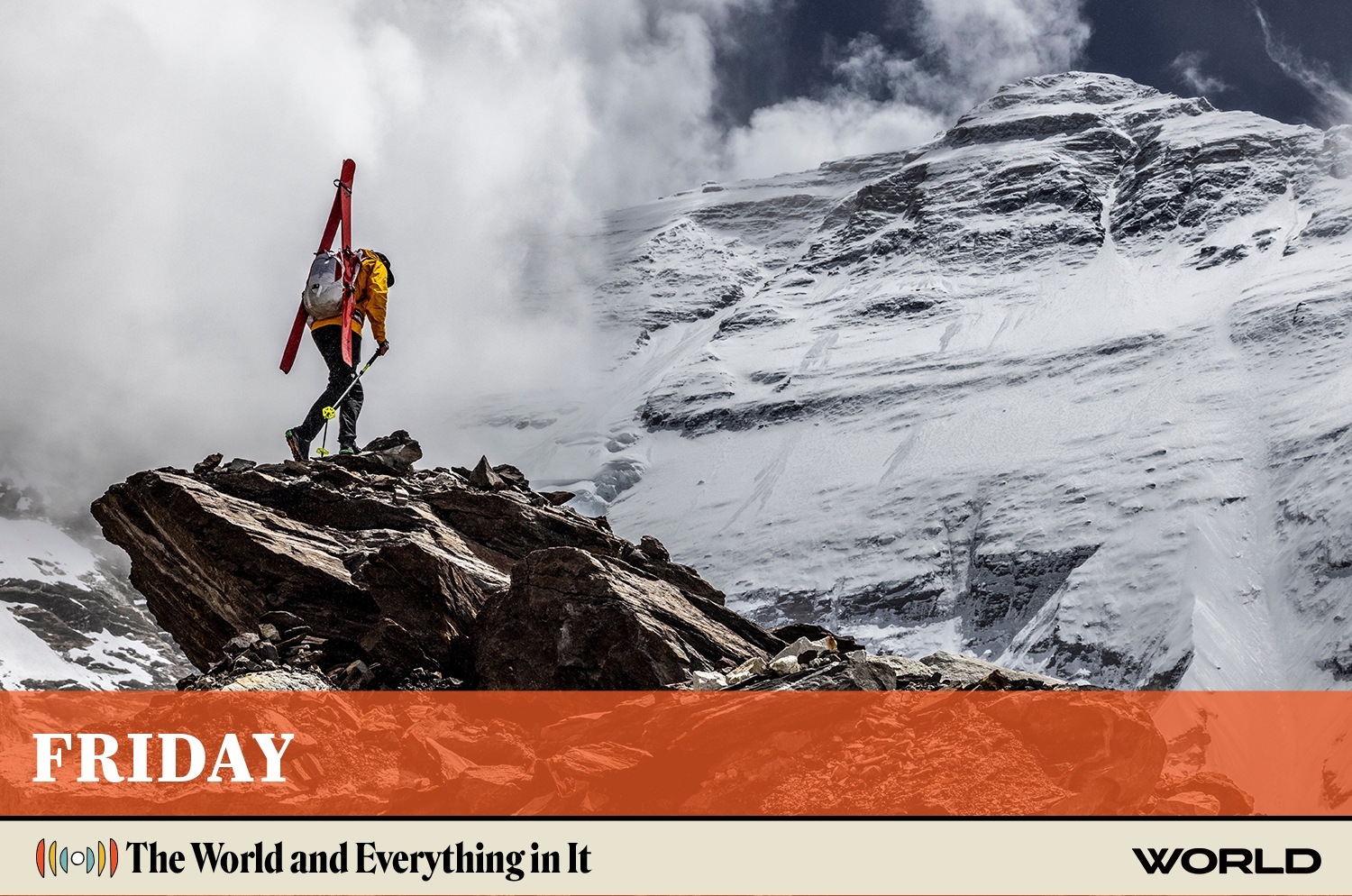
Jim Morrison climbs the north face of Mount Everest in a scene from Everest: The Other Side. Associated Press / Jimmy Chin / National Geographic
Editor's note: The following text is a transcript of a podcast story. To listen to the story, click on the arrow beneath the headline above.
MYRNA BROWN, HOST: Good morning!
Elections and Halloween, two scary subjects for a Friday. How shall we then vote? And have Halloween decorations gotten a little too comfortable with death and evil?
NICK EICHER, HOST: We will talk it over with John Stonestreet. He joins us in just a few minutes for Culture Friday.
Also today: A new documentary follows a daring ski descent of Mount Everest—and the cost of life on the mountain.
CLIP: How many people who’ve eaten at our dinner table have died? That might take awhile.
WORLD’s Collin Garbarino has our review.
And your listener feedback.
BROWN: It’s Friday, October 30th. This is The World and Everything in It from listener-supported WORLD Radio. I’m Myrna Brown.
EICHER: And I’m Nick Eicher. Good morning!
BROWN: Up next, Kent Covington with today’s news.
KENT COVINGTON, NEWS ANCHOR: Campaign stuff » Candidates are gearing up for one final weekend of campaigning before Tuesday’s election.
On Thursday, President Trump campaigned for Sen. Darline Graham and told a crowd in South Carolina:
TRUMP: If you elect a Republican House and a Republican Senate on November 3rd, we will continue to put America first. Every single day, we will do that
While former Vice President Kamala Harris told Democrats in Georgia:
HARRIS: Folks feeling like, I’m watching all this happen, but I can’t do anything about it. Well that moment has passed.
Democrats are widely expected to claim a majority in the House while the Senate remains up for grabs.
All eyes will be on several very tight races in particular that could tip the balance of power in the Senate. Those include Texas, Kansas, Iowa, Ohio, Maine, and Alaska.
Alaska Governor orders probe of ballot controversy » And speaking of Alaska, Gov. Mike Dunleavy has ordered an investigation into the Democratic candidate running for the U.S. Senate over an alleged scheme to trick voters. That, after a new report, revealing that her campaign appeared to be involved in recruiting another candidate with the same name as Republican incumbent Dan Sullivan to confuse voters.
WORLD’s Harrison Watters has more.
HARRISON WATTERS: The New York Times says it obtained texts, documents and interviews showing Democrat Mary Peltola’s team worked with people trying to recruit potential spoiler candidates with the same name as Senator Sullivan.
Peltola side-stepped questions about the Times report on Wednesday.
PELTOLA: This is just another distraction, it’s another diversion.
WATTERS: Alaska courts earlier this year ruled retired teacher Daniel J. Sullivan Jr. could appear on the same ranked choice ballot as incumbent Senator Dan S. Sullivan. The Justice Department sued Alaska last week, arguing the two Sullivans will confuse voters. President Trump told reporters:
TRUMP: Nobody knows. They have no idea who the Dan Sullivan is.
WATTERS: Governor Mike Dunleavy said Wednesday the state is checking to see if Peltola’s campaign broke the law in recruiting the second Sullivan.
Reporting for WORLD, I’m Harrison Watters
Economic growth and inflation » Meantime, new economic data gives voters a mixed picture ahead of Election Day.
The Commerce Department says the economy grew at a strong 3.4 percent annual rate in the third quarter, beating economists’ expectations.
Higher consumer spending and the AI investment boom helped drive that growth. Business investment surged nearly 13 percent, the strongest since 2020.
But Americans were dipping into their savings to spend more. The savings rate fell to 3.8 percent in September.
And consumer prices were still climbing, up 3.6 percent from a year ago.
Israel latest » Israeli Prime Minister Benjamin Netanyahu claims Tuesday's election was stolen amid allegations of bribery and outside influence. WORLD’s Travis Kircher is in Israel and has the story.
TRAVIS KIRCHER: High Arab voter turnout helped Arab-led parties make historic gains .The completed count gives them 19 seats, up from 10.
Israel’s domestic security agency is investigating suspected foreign interference. Israeli media say the allegations involve Qatar, which denies interfering.
NETANYAHU: [Speaking Hebrew]
KIRCHER: Netanyahu pointed to arrests in a suspected vote-buying scheme involving members of the Arab-led Ra-am Party, who were allegedly caught with envelopes full of cash.
The party denies wrongdoing. And Arab Knesset member Ahmad Tibi told reporters:
TIBI: Netanyahu is very much afraid because of the results of the election and the high turnout of the Arab community and the Arab voters. We acted in a very democratic way in order to change the reality and to bring down the Netanyahu government.
KIRCHER: Meanwhile:
EISENKOT: [Speaking Hebrew]
KIRCHER: Netanyahu challenger Gadi Eisenkot is also calling for a thorough investigation. But he accused the prime minister and his party of a coordinated campaign to discredit the election results.
Those 19 seats could help Eisenkot form a government if he can win the Arab parties’ backing and keep his other allies on board.
Reporting for WORLD, I’m Travis Kircher in Jerusalem.
DHS data breach » A massive data breach at the Department of Homeland Security may have exposed more than 40,000 current and former DHS employees and contractors, including undercover federal agents.
A left-wing hacking group that says it is anti-ICE claims it stole the records. Another group published them online.
Reports say they include names, phone numbers, email addresses and information that could reveal sensitive assignments and put agents at risk.
Patrick Stewart obituary » Hollywood is mourning the loss of an actor who added a dash of Shakespere to Star Trek.
CLIP (Star Trek TNG intro): Space, the final frontier …
Patrick Stewart has died at the age of 86. He portrayed Captain Jean-Luc Picard on Star Trek: The Next Generation. He also played Professor Charles Xavier in numerous "X-Men" films.
CLIP (X-Men): You’re in my school for the gifted, for mutants. You’ll be safe here from Magneto.
Stewart was a classically trained Shakespearian stage actor long before he became known for his iconic sci-fi roles.
He died Wednesday after a brief illness. He had been diagnosed with Alzheimer's disease and Lewy body dementia.
Tributes have poured in, including from another former captain of the Starship Enterprise, William Shatner, who called Stewart a “friend, a colleague, and a magnificent actor.”
And Stewart’s X-men co-star Hugh Jackman called him “one of the greats of stage and screen.”
I'm Kent Covington.
Straight ahead, John Stonestree joins us for Culture Friday. And later, your listener feedback.
This is The World and Everything in It.
NICK EICHER, HOST: It’s The World and Everything in It from WORLD Radio celebrating 15 years. Today is October 30th. Thank you for making us part of your morning routine. Good morning. I’m Nick Eicher.
MYRNA BROWN, HOST: And I’m Myrna Brown. It’s Culture Friday. John Stonestreet is here. He’s president of the Colson Center and host of the Breakpoint Podcast. Good morning, John.
STONESTREET: Good morning.
BROWN: You have made a distinction over the years between choosing the lesser of two evils and voting to lessen evil, and we’re just days from the midterms. And some Christians are finding those choices increasingly difficult. How does that distinction, John, help us make a responsible decision when we find serious moral objections to the candidates before us?
STONESTREET: I think it does at least in a couple ways, and one is to help us actually make a distinction morally. One is to help us to remember what a moral objection should be. In other words, many people have an objection to a particular candidate’s character that’s been reflected in bad behavior, but bad character can also be reflected in really bad ideas, particularly when those ideas are going to have consequences for more people as they’re enacted in policy.
Look, if you believe that sexual autonomy should trump the rights of preborn children to live, or if you think the state owns children and not parents, these are not just bad ideas; they’re also personal character flaws. And how do you measure that? Well, I think voting to lessen evil can help put some of that into framing.
I think it also helps us remember that a lot of voting isn’t between candidates at all. Increasingly, it has to do with things like ballot initiatives, and of course, I say that as a citizen of Colorado having to vote on a ridiculously and may I just say stupid long list of ballot initiatives. Some of them over completely bizarre things. Now that says a lot about any culture, right? That tells you that our state’s getting really close to mob rule by majority, which is why our founders wanted a constitutional republic and not a democracy.
But at the same time, I need to be engaged and put a stop to a ballot initiative, if I have the ability to do so, especially when so much is at stake, as is the case on a couple ballot initiatives, certainly in my state, and I know in Missouri and other places around the country.
And then finally, I think it helps us remember the scope of politics. We put way too much weight on it. We think that everything is ultimate. Chuck Colson used to say that salvation will never come in Air Force One, and I always add a postscript on that that I think is appropriate for our moment, which is, and neither will the apocalypse. When we start thinking that way, that it all rests on this election, then we are putting way too many eggs in that basket, and the political basket just can’t handle that much weight, as we’ve seen.
So I think this is a way to keep our own perspectives straight. It helps us distinguish character on a deeper level, and I think it actually helps us stay involved and fulfill our civic duty as Christians to vote, which I do believe we all have.
EICHER: And it does keep us from slouching toward the ballot box. I really like that idea of voting to lessen evil. That’s incredibly practical.
John, I’ve got a story in The Wall Street Journal. We’ve talked a lot about delayed marriage and delayed childbearing. There’s a piece in The Wall Street Journal that talks about a different kind of outworking of that phenomenon, and that has to do with the grandparents. The median age of becoming a grandmother has gone up from 44 to about 57 since the year 1960, and what that means, just doing the math, is that the healthy years with grandchildren fall from about 28 to about 15 by that measure. Now, have we underestimated how far these consequences of delayed family formation have really extended here, John?
STONESTREET: Yeah, we certainly have. Obviously, they would, I think, extend beyond just one generation to multiple generations, and that’s the reality here. Of course, we have to remember that in 1960, the average life expectancy was below 70, and today it’s basically 80. So you’re talking about an extension of 10 years there, and it pretty much closes much of the gap.
And you’re also talking about incredible improvements in our healthcare, and people are healthier longer, both because they’re eating better, and that fitness craze, and so on. But I don’t want to underestimate here how ideology affects this, and it’s the delayed birth rates. And the delayed birth rates is just one expression of what you might call an anti-natal or an anti-family worldview. One of them affects grandparents directly.
I’m a big, big fan of a ministry called the Legacy Coalition, which reaches out to grandparents and helps them be intentional as Christian grandparents, caring for the next generation. It’s really appropriate today when some people in the boomer generation are being canceled by their kids for not going along with transgender ideology or voting for Trump or something like that.
But it’s also appropriate because of a lie that grandparents believe, which is, in America, what do you do? You move to Florida, and then your responsibility to your grandchildren is to send money and leave an inheritance, and that’s pretty much it. And I think the loss of that extended family, not just the immediate mom and dad, but if you think about the experience that so many had in a family-centered culture with aunts and uncles, and grandma and grandfather, and how important that is.
I think about how important my son’s grandparents are to him, and also my daughters—for all my children—and I’m so grateful for that. But a lot of people don’t have that experience. I remember, man, if you wanted to get Chuck Colson mad, you should tell him that you were going to move to Florida and play golf for the rest of your life. But a lot of people have bought.
EICHER: I can only imagine.
STONESTREET: He just didn’t think retirement was in the Bible, and not just retirement from work and certainly ministry, but retirement from your responsibility as leading a family, and so I think there’s a lot of factors here, and we’ve lost something really, really significant in the experience for childhood.
EICHER: Now this may touch a little bit on politics, but I think you’ll find this one interesting, John. Of course, you know about the unrest that France has been experiencing lately. But Bill McGurn was writing in The Wall Street Journal about one particular problem in France. There is a French word for it, which I will attempt: laïcité, the commitment of France to laïcité, the idea that religion belongs outside public life. His argument is that the French rejected religion without finding much of anything to replace it. Now, that’s a totally separate conversation. But can a society really hold together without some shared understanding of truth that is pre-political, that goes beyond politics?
STONESTREET: No, it cannot. And of course, for the kind of society we’re talking about, what matters the most is the kind of truth around which it’s orienting itself. But listen, I thought McGurn’s piece was exactly right. I think what we’re seeing there—to try to explain it like, “Oh, there’s some school kids who want to read more books”—it just didn’t make sense from the beginning.
We certainly have the opportunism of the far left and radical Islamic protesters that are joining forces. They don’t agree on very much, but they do agree that the West needs to be torn down. And of course, that in and of itself is an expression of something deeper, and it’s the consequence of pushing religion further and further out of the center of life and reorienting life around something else. Which, of course, in the case of modernism, is the promise of progress, either through economics or science or technology.
That’s not the same thing as giving someone meaning, and the crisis of meaning has been deep, and the angst that comes with that, and the anger that comes with that, I think is being reflected here. And at the risk of being self-serving, I just want to say, our good friend Oz Guinness did a darn good job of explaining all this in the first half of the Truth Rising documentary. I was watching some of these videos and looking at some of these protests and thinking, boy, his analysis of this really has aged well.
And so I would point people to that as a way of understanding this, because look, civilizations take a long time to decline, and when they’re detached from their roots, as he put it, it doesn’t happen overnight. When we’re thinking about that, we’re typically thinking about a civilization that long ago died. And other than those brackets that might tell us that it took decades or centuries, it seems to us that this is what happened here, as if it were immediate. But it was a really, really long time of decline, and yet throughout that, you can point to flare-ups, really significant crises that reflect the fact that a civilization has lost its way.
That’s the question when it comes to what we’re seeing in France. That’s the question for what we saw, I think, in the 2020s in the United States. I think we’re seeing, in other places, “Is this a flare-up that is caused by the same forces that are leading to this widespread decline?” And my take is the answer is yes.
BROWN: John, before we let you go, let’s talk about Halloween. I was taking my little granddaughter for a walk. By the way, thinking about Nick’s question, I was 59 when she was born. But let me tell you, I see that little one practically every day. I make sure of that.
I was taking her on a walk, and we came across some pretty disturbing Halloween decorations. Enormous skeletons and demonic-looking figures in front of people’s yards, and retailers keep coming up with bigger, more grotesque displays. So I’m wondering, John, is this just harmless seasonal fun, or should Christians be troubled by how casually we’re turning images of death and evil into neighborhood entertainment?
STONESTREET: So, at the risk of being doubly self-serving in this one episode, I’m tempted to just point people to, I think, the Breakpoint commentary that had the greatest title in all of history, which is “To Boo or Not to Boo.”
EICHER: That is the question—
STONESTREET: —and which we wrestle with some of these things. Look, how a culture thinks about evil is really, really important, and that’s going to be reflected in the cultural artifacts, both the big ones, the significant ones, and also the silly ones that we put in our front yards.
And I think, as I was having the same conversation with my son just last night, as we were talking about this and thinking it through together, that there’s two possibilities where we can get this wrong. Number one is to actually not distinguish between good and evil, and there is a difference between those stories, those movies, those tales that talk about evil as if it’s evil and portray evil as if it’s evil, and those that do not, that just treat it as something to revel in, something to titillate your senses and to get spooky about, and that sort of stuff. And I think in that case you’re underestimating the seriousness of evil.
The Bible talks about the seriousness of evil as a force. It talks about the seriousness of evil in terms of the evil figure, the fallen angel Satan, and it talks really seriously about the danger of the evil that’s in every human heart and that needs redemption.
But I think the other mistake that Christians can make is to give evil too much credit. If you go back to the early church fathers, there’s times they mock evil. They mock Satan. That was a part of it. If you think about the age of the witch hunts and trying to find the demonic everywhere, which of course those stories have been overblown. But there were cases here and there that they worried that we were giving evil too much due because what the Bible does now, in light of the death and resurrection and enthronement of Jesus Christ after the ascension, is talk about evil as if it’s defeated.
Doesn’t mean it’s not real. Doesn’t mean it’s not dangerous. But it does not have the last say. We’re not waiting with bated breath to see who wins this fight. Christ has won. Satan has lost. Good has conquered evil, and we actually have access to that. And so, I never want to give evil more due than it should have.
And I think those things at least give us the theological grounding for talking about something like Halloween, and of course you always have the option of Christianizing it, right? Which is nailing 95 Reese’s cups instead of 95 theses on the door, or remembering that it’s Reformation Day, so that’s your other option.
EICHER: Oh my goodness, John Stonestreet is president of the Colson Center and host of the Breakpoint Podcast. John, great to talk with you. We will see you next week after the election.
STONESTREET: Thank you both.
MYRNA BROWN, HOST: Today is Friday, October 30th. Thank you for turning to WORLD Radio to help start your day.
Good morning. I’m Myrna Brown.
NICK EICHER, HOST: And I’m Nick Eicher.
Coming next on The World and Everything in It: A new National Geographic documentary follows a daring attempt to ski the north face of Mt. Everest.
The documentary hits IMAX screens this weekend. WORLD’s arts and culture editor Collin Garbarino has our review.
COLLIN GARBARINO: Everest: The Other Side recounts the story of how in October of last year, mountaineer Jim Morrison completed one of the most daring ski expeditions in history.
MORRISON: The north face of Mount Everest. It’s the ultimate ski run on planet Earth.
Thousands of people have climbed Everest over the last 73 years, but most approach the summit from the south side of the mountain in Nepal. Only a handful of climbers have braved the punishing direct route on the Chinese side where the weather is worse and the climbing more difficult. Morrison’s plan was to take that more difficult path to Everest’s summit. And then ski back down over 9,000 feet of treacherous terrain that contains sustained slopes of 50 degrees.
MORRISON: From a really young age, I was dreaming about going to these mountains. It always involved climbing big mountains, and it always involved skiing back down.
In this documentary, we see Morrison attempt to make those dreams a reality.
Everest: The Other Side is a visually stunning movie that doesn’t shy away from the peril of the mountain as it captures its beauty. Director Jimmy Chin accompanies Morrison on this expedition, becoming a secondary subject in the film. Chin’s previous work includes the Academy Award–winning documentary Free Solo.
I saw Everest on an IMAX screen. It has the kind of shots that deserve the big screen treatment. The mountain’s landscapes feel otherworldly, and the high altitude images capture pristine icy expanses that give the impression they ought not be touched.
MORRISON: Everest is usually climbed when there’s the least amount of snow in the spring. To ski it, we have to go after the monsoon in the fall. More snow means more danger.
The film is rated PG-13 for brief strong language and “thematic elements.” As to what those thematic elements are, I have to in good conscience spoil some of Morrison’s story for the sake of some viewers.
The documentary begins in 2018, when Morrison and his girlfriend Hilaree Nelson skied down the fourth tallest mountain in the world. During the COVID lockdowns they start planning their next big adventure of skiing down Everest’s north face. In the beginning, the film focuses on Nelson’s story. She’s the mother of a couple of young boys, but she’s captivated by her mountaineering lifestyle.
NELSON: It’s all about survival, and in that rawness there’s this—I don’t know—connection that I don’t feel anywhere else.
About thirty minutes into the film, Morrison and Nelson are skiing down a different peak in Nepal as part of their training for Everest, and a sudden avalanche sweeps Nelson away to her death. It’s a shocking moment, and it’s captured on film and included in the documentary.
Though he’s devastated, Morrison decides not to give up on their shared dream and ski Everest in honor of Nelson.
At this point, a sort of cognitive dissonance enters the audience’s mind as they watch. Sure, these feats of mountaineering are impressive. But are they worth it?
Chin’s wife serves as co-director for the documentary, and she voices her own concerns over the climbing mentality that she and her husband have been steeped in.
VASARHELYI: How many people who’ve eaten at our dinner table have died?
CHIN: Hmmm… that might take a while.
The couple counts at least a half dozen names before they quit. Chin’s wife is visibly uncomfortable with his decision to accompany Morrison up the north face, saying she had thought her husband was done with Everest.
At what point do the risks become too risky? When do the costs become too high? Everyone we meet in this movie has sacrificed for their life on the mountain. Some have broken bones and sustained serious injury. Some have sacrificed their marriages in order to top the next summit. They’ve all lost family and friends in avalanches. Morrison’s No. 1 Nepalese guide even died a few months ago on a mountain in Pakistan after the documentary was finished.
CHIN: Was there a part of this that was supposed to be fun?
MORRISON: It’s the part when you get down and tell the stories.
CHIN: Oh.
MORRISON: Kind of like, it was so awesome, the views were so beautiful.
CHIN: Oh right.
MORRISON: And so hard.
I think documentaries about people testing their limits in extreme situations are valuable. They can challenge and inspire us. Earlier this year, I saw Learning To Fly, which is currently streaming on Prime Video. In that movie, trail runners attempt to set records as they race over 100 miles through the mountains. I liked that movie a lot. Any extreme endeavor requires sacrifices and tradeoffs. But the incredible risks we see people take in Everest: The Other Side cross the line into recklessness. And to be honest, they feel quite selfish. I wasn’t inspired at the end. If anything I was a little sad.
However, I think Everest: The Other Side is worth seeing. It reminds us how desperately some people in this lost world want to feel something. And how much they’re willing to trade for fleeting glory.
I’m Collin Garbarino.
NICK EICHER, HOST: Good morning! This is The World and Everything in It from listener-supported WORLD Radio. I’m Nick Eicher.
MYRNA BROWN, HOST: And I’m Myrna Brown. Time now for Listener Feedback for the month of October.
Jim Richardson of Oro Valley, Arizona, responded to a story by Juliana Chan Erikson. On October 21st, Juliana reported on adult children becoming estranged from their parents—going quote-unquote NO CONTACT.
JIM RICHARDSON: I remember back when I went to college; there were no cell phones back then, and long-distance calls cost a lot of money. So, in my generation, and I'm 81 years old, we were already separated, and my parents had no expectation of hearing from me very often from college, and I really didn't expect to hear from them very often either. Now it's completely different. Parents and children are communicating with each other every day on cell phones, sometimes multiple times during the day. When my grandchildren were in elementary school, the teachers were putting the test grades on the website, so the parent, in those cases the mom, knew the grade that the child got on the test before the child even got home from school.
So I can understand how kids now want some separation because they're just tired of constantly interacting with their parents, and parents need to give their kids some separation. My wife and I know grandparents who even now, as adults, track all of their children's and grandchildren's locations using the cell phone tracking feature. There is another reason, though, that's causing parent-child separation, and that's the LGBTQ+ issue. As one Christian mother told me, when your child comes out of the closet and declares that he or she is gay, the child puts the parents in the closet. What are the parents supposed to do? Are the parents supposed to support the child, or cut off all contact with the child, or what? We have friends that do both. Anyway, you did a very good job on this topic. Thank you very much.
EICHER: We also received a lot of feedback on Mary Reichard’s interviews with two Jewish intellectuals, Dennis Prager and Joel Alperson. Lee Alsterlund of Minneapolis had this to say:
LEE ALSTERLUND: I used to listen frequently to Dennis, and also read his book Happiness is a serious problem. I kind of stopped listening to talk radio though after I switched to The World and Everything in It, and also working from home and not spending time in my car anymore. But so I just listened to the interview on the 17th of Dennis, and I didn't know about his fall from two years ago. That was very sad. But thank you for these interviews. God has given Dennis so much wisdom.
One I took to heart from your interview about the book, "If There Is No God," is that we judge others by their actions, but we judge ourselves by our intentions. To me, that was, that was humbling. A number of times, Alperson referred to God as his judge, and he is, and he strives to keep the law. But we know that no one can keep the law on their own, and it points to our need for our Passover Lamb to take away our sins, and so I, I pray for Dennis and Joel and all Jewish people that they would see their Messiah prophesied in their books of the law and the prophets. It was heartbreaking to hear what Joel said when when he said, "We'll have to wait and see, and I'll have to live with the consequences.” It's just, it's so sad when I hear someone say that. I, I just pray that God will, will not only be His judge but His Savior and Redeemer, and that the Lord would call them by name.
And listener Dawn Sparks disagreed with something John Stonestreet said on Culture Friday about a mom who sent her daughter to a struggling public school for the sake of the common good.
DAWN SPARKS: His comments about that to me sounded like he thought that was a completely wrong decision. That she was choosing society or some greater good over the best needs of her child.
While I can understand that reasoning, I do not think that that is always the wrong choice. I have been around many, many missionaries and other people in ministry whose call on their lives affects their family and involves their children's educational options, and they may not always be the same kind of options that you would get if you stayed in the U.S. or if you lived in a certain neighborhood rather than a different neighborhood.
So I believe that for Christians and non-Christians alike, this is a valid choice that is not necessarily wrong. That does sometimes affect your children, and we pray that God redeems this, and we pray that you know He works in our children like He is working in us in whatever situation He's placed us. But I think that this woman made a decision that I would not consider objectively wrong.
I love the program, and I've been listening since the beginning. Thank you for all that you do.
BROWN: We got a detail wrong in Grace Snell’s diving feature from October 13th. A crucial detail: the difference between goggles and a mask. It’s quite a big difference when you go scuba diving. Aspiring young journalist and experienced scuba diver Lily Roepnack explains the rest:
LILY ROEPNACK I am currently pursuing journalism in college, thanks to listening to The World and Everything in It. I absolutely loved Grace Snell's story about the 1000 Island Divers Alliance. I am a scuba diver and a former high school swimmer. I did notice one like equipment misnaming, and at the beginning of the story, Grace calls the thing that divers wear on their heads to see underwater goggles, while in fact those are masks. Goggles are really different, and they only cover your inner eye, and you should not wear those while diving because you'll get an eye injury. While masks are made with tempered glass and are much larger to prevent injuries from the water pressure. Overall, it was an amazing story, and keep up the good work world. Thank you.
Good advice to end on:
EICHER: No scuba diving in goggles!
And that’s this month’s Listener Feedback.
NICK EICHER, HOST: Now it’s time to name the crew who helped with this week’s programs:
Mary Reichard, David Bahnsen, Ray Hacke (HACK-key), Emma Freire, Daniel Suhr, Hunter Baker, Amy Lewis, Todd Vician, Cal Thomas, Lauren Canterberry, Claire Wilkerson, Jenny Rough, David Closson, John Stonestreet, and Collin Garbarino.
Thanks also to our breaking news crew: Kent Covington, Steve Kloosterman, Travis Kircher, Daniel Devine, and Christina Grube.
And thanks to the technical production team: Benj Eicher, Carl Peetz and Josh Goniea.
Harrison Watters is Washington producer, Kristen Flavin is features editor, Emma Eicher is assistant producer, Lindsay Mast is Producer. I’m Executive Producer Nick Eicher.
MYRNA BROWN, HOST: And I’m Myrna Brown.
This is episode 3520 of The World and Everything in It, from WORLD Radio.
WORLD’s mission is biblically objective journalism that informs, educates, and inspires.
The Bible says … “See what kind of love the Father has given to us, that we should be called children of God; and so we are. The reason why the world does not know us is that it did not know him. Beloved, we are God’s children now, and what we will be has not yet appeared; but we know that when he appears we shall be like him, because we shall see him as he is. And everyone who thus hopes in him purifies himself as he is pure.” — 1 John 3:1–3
Find a church, faithful to God’s Word and meet your brothers and sisters in Christ there.
And Lord willing we’ll meet you back here on Monday.
Go now in grace and peace.
WORLD Radio transcripts are created on a rush deadline. This text may not be in its final form and may be updated or revised in the future. Accuracy and availability may vary. The authoritative record of WORLD Radio programming is the audio record.
Please wait while we load the latest comments...
Comments
Please register, subscribe, or log in to comment on this article.