
The World and Everything in It: October 28, 2026
The president’s party usually takes a beating in the midterms. On Washington Wednesday, Hunter Baker looks to history for how bad it can be—and might be. Australia welcomes U.S. submarines in hopes of deterring China, at the risk of becoming a target itself. And Bible translators are producing Scripture without writing a word. Plus: rescuers in need of rescue and Cal Thomas on voters’ misplaced trust.
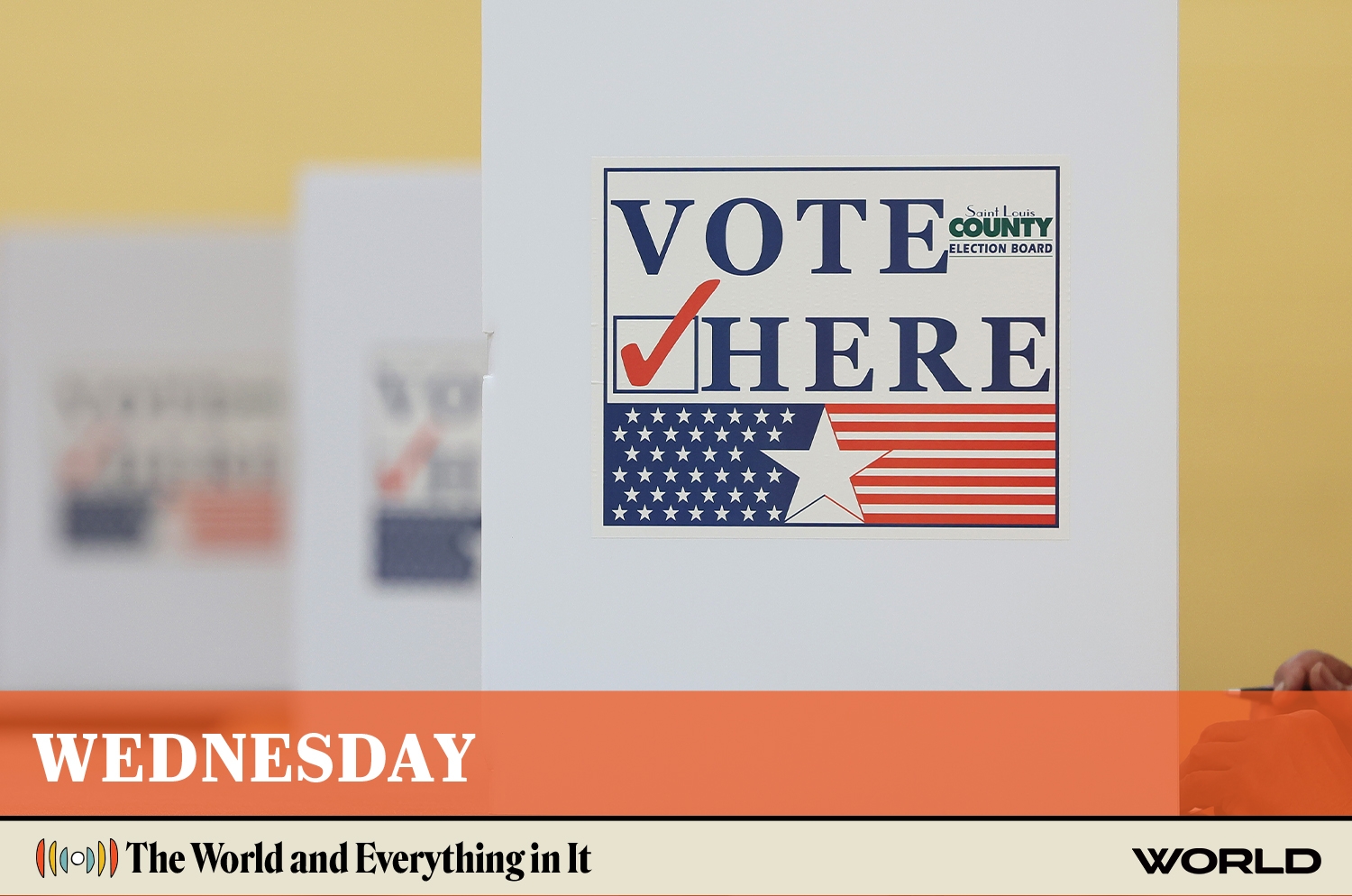
People vote at Barack Obama Elementary School in St Louis, Missouri. Getty Images / Photo by Michael M. Santiago
Editor's note: The following text is a transcript of a podcast story. To listen to the story, click on the arrow beneath the headline above.
LINDSAY MAST, HOST: Good morning!
Will President Trump help Republicans or help Democrats in the midterms?
NICK EICHER, HOST: We’ll talk about that, and a Washington Wednesday Election Prediction Lightning Round: Hunter Baker standing by.
MAST: Also today World Tour: Australia prepares to host more US submarines as tensions rise in the Indo-Pacific.
EICHER: Later, a new English Bible, translated entirely by word of mouth.
PARKER: We want the only stumbling block to the gospel to be the gospel.
And commentary from WORLD’s Cal Thomas on the danger of putting our hope in politicians.
MAST: It’s Wednesday, October 28th. This is The World and Everything in It from listener-supported WORLD Radio. I’m Lindsay Mast.
EICHER: And I’m Nick Eicher. Good morning!
MAST: Up next, Kent Covington with today’s news.
KENT COVINGTON, NEWS ANCHOR: Trump in Texas » President Trump traveled to Corpus Christi, Texas on Tuesday where he rallied Republican voters. But he told backers there was another reason he trekked to the Texas coast:
TRUMP: And one of the many reasons we did it here, we have a little breaking news. You have a little ship. See that little ship out there? It's got one million barrels of oil on it from Venezuela (cheers)
The shipment follows an oil deal Washington struck with Venezuela, after ousting former dictator Nicolás Maduro. Trump says refineries in Texas will process the oil.
He also urged Texans to send Republican Ken Paxton to the U.S. Senate and defeat Democrat James Talarico.
TRUMP: He's never gonna love oil and gas, and he's never gonna love your Second Amendment, and he's never gonna love, uh, your children the way you do. It's a different kind of love. You can't put this guy... You can't have a vote like that. It's too close
An average of the latest polls in Texas give Talarico a slight edge of less than 2 points over Paxton.
Venezuela » Secretary of State Marco Rubio joined Trump in Texas to welcome the arrival of that tanker, an oil deal he helped broker.
And Rubio this week said he intends to see Venezuela transition to democracy before he leaves office. But he also cautioned that—his words … "You're not going to street-protest your way into a democracy.”
SOUND: [Machado welcome]
That came just hours after opposition leader María Corina Machado returned home to Venezuela after months abroad, as cheering supporters flooded the streets.
SOUND: [Machado welcome]
Machado promptly called for new elections. But Rubio says Venezuela first needs a new Supreme Court and election council to replace a system designed to allow rigged votes.
Rubio also says Washington told Venezuela’s interim authorities weeks ago to let Machado return without harassing her and they agreed.
Interim leader Delcy Rodríguez, though, criticized Machado, but she added that she hopes:
RODRIGUEZ (translated): … the program for democratic coexistence and peace can provide a space where all voices can be heard.
Critics of the current regime question her sincerity, and say … whether coexistence is now truly possible remains to be seen.
Israel election update » Voters in Israel have cast their ballots and the unofficial exit polls are in. WORLD’s Travis Kircher was on the ground in Tel Aviv, and has the latest on who could be Israel’s next prime minister:
TRAVIS KIRCHER: Analysts were still sorting through the exit poll numbers last night. Some exit polls give Benjamin Netanyahu's Likud party a narrow lead over Eisenkot's Yashar Party, though it’s still too close to call.
That means Netanyahu may remain prime minister if he can bring enough parties together to form a 61-seat coalition. But if he fails, there's another outcome.
Strategic consultant and political commentator Udi Tenne:
TENNE: The second way is—it's not very, very good for everybody—but it will be a second election. And if we have a second election in Israel, who will be the prime minister in this month, it will be Benjamin Netanyahu.
If neither Netanyahu nor another candidate can form a government, Israel could face another election about three months after parliament is dissolved.
And building a government may be a challenge for Netanyahu if exit polling proves accurate. Major polls project 70 seats for opposition and Arab parties combined against 50 for Netanyahu's current coalition.
Reporting for WORLD, I'm Travis Kircher in Jerusalem.
Ukraine limited ceasefire » Russia and Ukraine paused fighting Tuesday around one southern Ukrainian city to let food and medicine in, and let civilians out.
First lady Melania Trump helped broker the truce around Russian-occupied Oleshky, where supplies are running dangerously low.
Ukraine’s human rights chief reported no violations by Tuesday evening. The ceasefire is due to last until Sunday night.
But Russia continued missile attacks elsewhere in Ukraine.
This comes as negotiators from Ukraine, Russia and the United States are expected to meet for preliminary peace talks next month either in Abu Dhabi or Switzerland though no exact date has been announced.
Consumer confidence » Americans feel a little better about the economy according to new numbers. WORLD’s Benjamin Eicher has more:
BENJAMIN EICHER: The Conference Board's “confidence index” climbed to 91.7 in October. That was up from just over 84 in September.
The improvement comes as gas prices fall. According to AAA, regular gas now averages $4.27 a gallon nationwide, down more than 20 cents from a month ago.
But several factors continue to weigh on the economy. The Labor Department says consumer prices rose 3.7 percent in September compared to the same month last year.
Employers did not hire as much as expected. And average hourly pay rose just 3% in September compared with a year earlier.
For WORLD, I’m Benjamin Eicher
I'm Kent Covington.
Straight ahead: Hunter Baker joins us for our final pre-election Washington Wednesday. And later, a new English Bible, translated entirely by word of mouth.
This is The World and Everything in It.
LINDSAY MAST, HOST: It’s The World and Everything in It from WORLD Radio, celebrating 15 years. Today is Wednesday, the 28th of October. Thanks for making us part of your morning routine. Good morning. I’m Lindsay Mast.
NICK EICHER, HOST: And I’m Nick Eicher. It’s Washington Wednesday, our last one before Election Day. I am especially excited about this one. We will be putting our expert on the hot seat for a lightning round of election day predictions. So hang on.
And joining us now is that expert Hunter Baker, political scientist and senior fellow at the First Liberty Institute. Good morning to you, Hunter.
HUNTER BAKER: Good morning.
MAST: All right, Hunter. Issue one: What kind of midterm is this? Let’s begin with some history. The president’s party. We’ve been hearing this over and over all summer long. The party in the White House usually loses ground in the midterms, but the losses are considerably uneven. So you can think of 1994, 2010, and 2018 on the one hand, and the much smaller Republican gains in 2022. Hunter, looking back at those elections, what separates an ordinary midterm correction from a major backlash against the party in the White House?
BAKER: First of all, I think that the polling situation is far more difficult than it was in the past. In the past, people had landlines. They would answer the phone, and they would participate in these polls. Now, most of us we think about we receive a call from an unfamiliar number, we don’t pick it up. So the question is, who is actually participating in these polls? We don’t know. So I think it’s. I think first of all, it’s just difficult to get a randomized poll in the way it was in the past. Second, then you have to ask, what is the mood of the country? What is driving things?
In 1998, Republicans thought they would win because of the Monica Lewinsky scandal that had kind of gathered up Bill Clinton’s presidency. But actually, they were surprised they didn’t do all that well, and people seemed to be kind of sick of it, whereas you look at the 2022 midterm. Biden was facing a lot of uphill stuff in terms of terrible withdrawal from Afghanistan, the Russia-Ukraine business, oil prices through the roof, and he dealt with it in a very transactional way.
He drew down the strategic oil reserve in a big way to lower the prices, and was promising everybody with student loan debt, which is a whole lot of people, that he was ready to spend a half a trillion dollars without even getting Congress’s approval to improve their situation. So all of that was designed to diminish the losses in the midterms, and it worked. The Republicans, I think, have not been able to come up with a similar sort of a pitch, and I think that’s why a lot of people on the Republican side are worried about what’s going to happen.
EICHER: Okay, so let’s apply that to what’s about to happen. The history that you just gave us, apply it to 2026. We’ve got high gasoline prices. We’ve got an unpopular war with Iran. We’ve got the growing prominence of the Democratic Socialists energizing that side. Take your pick of issues. Now, some of these factors, of course, work against Republicans. Others work against Democrats. Do you think that this election is more about dissatisfaction with the party in power or doubts about the alternative?
BAKER: I think it’s both. I think that the war and the oil prices are going to work strongly against Trump. In addition, just general inability to get prices down. I think that Trump underestimated the degree to which tariffs would probably prevent inflation from coming down. So all of those things go against the Republicans. On the other side are the Democratic Socialists, and if you survey voters, we always talked about the doubts about that. But I think that one of the words that people would increasingly associate with the Democratic Party is socialist, and I think that word is still not a great word in American retail politics, and so that may help the Republicans a little bit in this midterm.
EICHER: Well, another word that kind of is a double-edged sword there too is President Trump and all of the campaigning that he’s doing. The Wall Street Journal followed him around for seven rallies in seven states just last week. Republicans are counting on him to energize the base, turn out the MAGA voters. But as we say, he is an equal opportunity motivator. He turns out his supporters, but he also turns out his opponents. So how does how does that fit in the midterm equation.
BAKER: His popularity is not very high right now, and so some Republicans have kind of run away from him or held him at arm’s length, and so that would suggest that at least in some places they don’t want the big Trump push. I was just in a meeting with a fairly significant. Center left type of political observer, and he was very optimistic about their chances because he noted that some of the places that Trump is speaking are very red places, indicating that Republicans could be worried that even in some of their strongest sort of battlegrounds, that there may be trouble. So that’s the question: Is are these places being chosen strategically? Are they being chosen because Trump likes an enthusiastic audience? What’s going on?
MAST: All right, Hunter. Moving on to issue two: party loyalty and political character. Wall Street Journal columnist Gerard Baker argues this week that some Republican candidates could actually help their party by losing. You may remember the other baker, no relation, saying a few weeks ago, "Help me! I feel a bad case of TDS coming on." TDS being Trump derangement syndrome, as it’s known. He’s now openly suggesting it would be better for Republicans if Paxton loses in Texas, and not just Paxton, Ken Paxton in the Texas Senate race, but Vivek Ramaswamy in the Ohio Governor’s race.
Baker argues that character ought to matter even when a candidate’s policy positions are more appealing to party voters. And in Ohio, we’ve seen that extraordinary campaign ad featuring Democratic candidate Amy Acton’s strange mother attacking her own daughter, and we’ve spoken quite a bit about the character issues around Paxton. So, Hunter, where does party loyalty end and accountability for a nominee’s character and conduct begin? It’s a question at least as old as the initial Trump candidacy.
BAKER: I think that the Republican Party may end up learning a lesson on this, I think it was a big mistake for Trump to go with Paxton over Cornyn, who would have walked to re-election. I believe the big question, though, when you talk about this character issue, at least in parliamentary positions, right? We’re talking about representatives and senators. I think that is different than electing executives who are really guiding and running things. When it comes to people in legislative positions, you could just imagine them as wearing an R or a D on their jersey.
Generally speaking, they’re going to vote with the party and they’re going to be part of a block, and if you vote for somebody of the party with which you disagree, what’s going to happen is we’re going to go forward two years. That party may elect the next president, and then you have made that president stronger, and you may receive a public policy with which you very strenuously disagree, but that’s a leftover from the decision you made two years ago. So I just I think that in terms of just practical impact, it may be expensive to make this choice based on character.
EICHER: All right, issue three: the data center revolt. Here’s an election issue, Hunter, that doesn’t follow the usual partisan divide. Washington wants the U.S. to lead the world in AI, artificial intelligence, but the facilities needed to power that ambition, they are running into opposition from local voters. Concerns about electricity prices, the use of water, tax incentives, development. Wall Street Journal reporting these disputes are becoming campaign issues in Texas, in Ohio, Michigan, and Georgia. The city of Nashville has already imposed a moratorium on new projects. So, Hunter, what happens to a national priority like American leadership and AI when the political resistance comes from the local communities being asked to host all of this infrastructure.
BAKER: Let me just say that the United States currently has about 1/3 of all the data centers in the world. So we need to not act like we haven’t had data centers. We have a whole lot of data centers in the United States, and I think that it is clear to me that this kind of technology is where the world is going, and we don’t want to be left behind. Now, with regard to sort of the local consequences, I’ve done some reading about it. I suspect that the resistance may be more emotional than rational.
It seems to me that the problems regarding water and cooling and the energy grid are being solved, but when it comes to a big emotional political issue like this, the politicians tend to know that they can’t try to attack it with a rational case, and so you’re seeing them just respond. The polls are telling them that people are worried about data centers, and they’re acting accordingly.
MAST: All right, Hunter. This is the moment we’ve all been waiting for. You’ve given—
BAKER: Painful!
MAST: Well—
BAKER: Difficult!
MAST: Sure, but you’ve given us the historical framework, and we’ve talked about the forces at work in this election.
EICHER: Okay, so here comes the pain, the cumulonimbus clouds they have gathered. It is. Time for the lightning round. This is our last Wednesday in October, election prediction lightning round special. I think we should trademark it. Three questions. No penalty for being wrong. No prize for being right. But we do want some home run cuts here, Hunter.
MAST: All right. So first up, the Senate. The 270 to win consensus map has Democrats and their independent allies at 49, Republicans at 46 with five toss ups. Hunter, your prediction: Who controls the Senate in January?
BAKER: Just remember that only 1/3 of the Senate is up at any one time, and the playing field differs. This is sort of a Republican playing field, so even though I think that there will be a Democratic wave, I suspect that we will be left with a 50-50 tie with the Vice President breaking the vote. Because I just think that we’re going to get one or two surprises, maybe in Michigan, something like that, that helps the Republicans to hold on.
EICHER: All right, here is where it plays out: the House, the consensus map that Lindsey just mentioned, that has Democrats at 220. They already win. Okay, so the consensus has them at 220 before assigning any of the 19 toss-ups. So it could be really big. The consensus view, as I say, it’s got the gavel in Hakeem Jeffries' hand. Your prediction. Does anything change?
BAKER: 2024 was a great year for the Republicans, and they only ended up with bare control of the House. This is not going to be a good year for the Republicans. They are absolutely going to lose control of the House. I hope you don’t end up replaying that, and I’m in shame. But they’re going to lose control of the house, and the speaker is going to change.
MAST: All right, then, Hunter. Let’s assume the congressional makeup that you’ve just predicted for the final two years of President Trump’s term. What governing coalition will he have to rely on?
BAKER: It’s going to be an interesting opportunity for the Democrats to make a choice. They can either vent their spleen and investigate Donald Trump and try to impeach Pete Hegseth and do all these different sort of things, or what they can do is they can use the House to pass bills out of the House that they think would be constructive and that they can then say if you elect a Democrat as the next president, we’ll be able to turn into policy and law, so that’s the question they’re going to face. My suspicion is they’re going to do a lot of spleen venting.
EICHER: Well, you remember, of course, 1994 turned out to be great for Bill Clinton. It turned him around, right?
BAKER: It certainly did. That’s right.
EICHER: Could something like that happen with Trump? Yes or no?
BAKER: Would losing help him? It might. I mean, I think that sympathy for him increased significantly while he was in the wilderness as people watched all the lawfare, and if the Democrats do a lot of impeaching of him and constantly trying to take him down, the sympathy for him may go up again.
EICHER: All right. Well, we’ve got your predictions on tape now, Hunter. No turning back. We will revisit next week once the voters have had a chance to weigh in. Hunter Baker, political scientist and senior fellow at the First Liberty Institute. Hunter, thank you as always.
MAST: Thanks, Hunter.
BAKER: Thank you.
LINDSAY MAST, HOST: Coming up next on The World and Everything in It: World Tour.
American troops and contractors are heading to Western Australia as part of AUKUS, the security partnership of Australia, the UK and the United States.
NICK EICHER, HOST: The goal is to strengthen allied defenses in the Indo-Pacific. But how much military muscle will that actually provide?
WORLD’s Amy Lewis reports.
AMY LEWIS: As part of AUKUS, Australia will buy eight Virginia-class nuclear powered subs to add to its fleet of six conventional diesel submarines. For comparison, the United States navy operates 71 submarines–40 of them Virginia-class and all of them nuclear powered.
Nine News: Confirmation this morning that the US will send 2300 Americans to be based at HMAS Stirling, just south of Perth.
The U.S. troops and contractors heading to Australia will train Australian troops to run and maintain nuclear-powered Virginia-class submarines. The first submarine Australia has purchased won’t arrive until 2032. And all eight won’t be in place before 2065.
Until then, one British Royal navy sub and five U.S. subs will operate out of Australia’s HMAS Stirling base. Its location in the Indian Ocean is strategically important.
GARY SLATER: The Indo-Pacific is the largest, most populated, and most military capable region in the world.
Gary Slater is a retired U.S. Marine officer and works for two defense consulting firms in Australia’s capital of Canberra.
SLATER: And it's the focus of the preponderance of U.S. strategic effort, because the primary adversary is China, but it also is home to North Korea and Russia, and also significant terrorist organizations and activity.
China continues to insist on its own version of territory in the South China Sea. It recently rejected a maritime chart published in the Philippines, and said its claims over a disputed area are “absolute.”
Against that background, Slater says that a big part of AUKUS is just to be present in the Indo Pacific.
SLATER: It signals resolve and deterrence that the U.S. and Australia in particular are united in their alliance and their strategic outlook.
The new rotational force will station U.S. troops and stealthy, long-range nuclear subs close to the South China Sea. Submarines that can stay underwater longer are harder to detect.
SLATER: They are among the most complicated, complex military hardware ever developed.
But that high tech capability comes with a drawback.
SLATER: If you want to be able to deploy one of any type of high performance, complicated military platform, you need to have three to be able to maintain one in a deployable status.
This is especially true of complex nuclear powered submarines, where the risk is greater and the margin of error is smaller.
MICHAEL SHOEBRIDGE: We call them the apex predator.
Michael Shoebridge is the founder and director of the defense and security think tank, Strategic Analysis Australia.
SHOEBRIDGE: You know, they're like the great white shark, but they've got people in them.
But under the rule of three, Australia’s eight submarines essentially become only two deployable ships.
SHOEBRIDGE: If there are two great white sharks in the ocean, do you worry when you go swimming? You've got to be very unlucky to get eaten by one of those great whites.
And in addition to being a very small fleet, these submarines will only be nuclear powered. That’s because in 1985, Australia signed the Treaty of Rarotonga to establish the South Pacific Nuclear Free Zone.
SHOEBRIDGE: We rely on American nuclear weapons for extended deterrence, but we would prefer a world without nuclear weapons.
China is also a signatory of Rarotonga, but in July it broke the protocol by testing a ballistic missile from a nuclear-powered sub within the designated waters.
That alarmed its neighbors in the region. They condemned the test. But the situation reinforced the AUKUS agreements.
Still, a greater U.S. presence Down Under could attract the very attention Australians hope to avoid.
SLATER: There's an undeniable fact that if the US gets into a conflict in the Indo Pacific with China, that Australia will be involved…All of those US forces, all of those joint US and Australian bases and facilities and all that infrastructure are legitimate military targets for any US adversary.
That’s this week’s World Tour. I’m Amy Lewis in Geelong, Australia.
NICK EICHER, HOST: A home in Fort Lauderdale, Florida, was supposed to get a tent put over it for termite treatment.
Instead, it got something much worse.
Workers were lifting the fumigation tent when their truck-mounted crane tipped over, landing on the roof.
Bad enough.
But then a second crane arrived to remove the one that had fallen. And that crane toppled onto the roof, too.
Thankfully, nobody was home. Thankfully, nobody was hurt.
Crews eventually had to take both cranes apart to get them down.
By then, the least reassuring words anyone could’ve spoken were:
“Don’t worry. We’re sending another crane.”
It’s The World and Everything in It.
LINDSAY MAST, HOST: Today is Wednesday, October 28th. Thanks for joining us.
Good morning. I’m Lindsay Mast.
NICK EICHER, HOST: And I’m Nick Eicher.
Coming next on The World and Everything in It: translating the Bible without writing it down.
Most translations begin with a written text. This one begins with people speaking from memory.
MAST: The translators work directly from the original languages, studying the text carefully before developing a version meant to be heard, rather than read.
WORLD’s Todd Vician has the story.
PARKER: ...Vayalech…Yahweh.
TODD VICIAN: Rett Parker is reciting from the twelfth chapter of Genesis…painstakingly translating the first book of the Pentateuch into the Spoken English Bible. It’s an oral version told from memory after diligent study–not an audio version of an existing Bible translation. This one is spoken, but not read.
HUSBAND: An audio Bible is designed for the eyes and then performed for the ears, whereas an oral translation is from the beginning designed to be performed for the ears.
That’s Mark Husband—an ordained pastor with a master’s degree in linguistics. He’s spent the last four years working with two other theologians to translate the Spoken English Bible through SIL Global. They’re working to serve approximately two-thirds of the world’s population who learn best by listening, watching videos, or talking.
HUSBAND: One of the beautiful things about oral Bible translation is that when you’re hearing it orally it’s a lot easier to listen to for a long longer because the mental processing is so much lighter.
Today the translators are working on the Genesis passage where the Lord directs Abram to take his family and possessions from Canaan to Egypt. God said he would bless Abram and curse those who dishonored him. The translators’ first task is to focus on the intended meaning of the Hebrew Scripture, so they don’t inadvertently force new ideas into the translation.
HUSBAND: Our translation cannot be better than our exegesis was.
Another distinction: the Spoken English Bible is not a paraphrase. The process is the same used for written translations. But it adds a step called internalization. That’s more than memorization. The translators want to be able to explain what happened, who the characters were, and even maintain the original tone while staying true to the ancient text. Parker and Husband spent nearly 40 minutes discussing the meaning and translation for just two words—“bless” and “blessing.”
PARKER: We want the only stumbling block to the gospel to be the gospel. If they’re going to reject God’s Word, we want it to be because they understood it and chose to say ‘no’ to it.
Joy has been working on the oral Bible project since 2023. She goes by a pseudonym to protect her identity when translating in countries that persecute Christians. Joy says internalization is like that story everyone in your family knows, they may tell it a little differently, but the core details always remain the same.
JOY: Once you get to that level of familiarity with a passage of Scripture then you can come up with lots of different ways to communicate the same truths.
Today, the three translators are storyboarding the passage—drawing on a whiteboard and even the conference room windows.
HUSBAND: He’s going to leave all of his people... so I’ve got these little stick figures and like a family tree. The Lord gives him a list of seven things that he’s going to bless Abram with, so I’ve got seven little checkboxes.
They’ve drawn lots of figures around the room. But not a single word.
JOY: We don't write anything down. It's all an audio file. Because the moment you start writing, you lose some of that naturalness in the storytelling.
The Spoken English Bible team is trying to reach more oral learners and the 10% of American adults who say they’ve never read the Bible. But Christian concepts like sin and blessing can be difficult to understand. So before they finalize the translation they run it by people wholly unfamiliar with the Bible. It’s here they sometimes discover translation hiccups.
JOY: We asked someone whether committing genocide could be a sin. And the person said no, because genocide is too serious to be a sin…
That showed them an obstacle to understanding when a single word can’t express several thoughts. So the oral translators come up with ways to draw out information implicit in the text. Instead of sin, they’ve used words like, “failing God,” “evil,” and “needing to be forgiven.”
JOY: If the English word sin was not communicating the full extent of what that concept communicates, then it means that when the translation says Jesus came to save you from your sin, people are misunderstanding the gospel.
Parker recorded the first draft of Genesis 12 near the end of the second day. Husband followed along, scanning the pictures he had drawn on the white board.
PARKER: But when Yahweh appeared to Abram, he told him, "I'm going to give this land to your descendants." When Abram heard that, he was so moved that Yahweh had appeared to him that he built an altar and dedicated it to Yahweh.
The draft that Parker recorded will be peer reviewed, revised, community tested, and checked by a consultant before it’s completed. It can take several months to complete each book. So far, they’ve finished six books and released them in the Spoken English Bible app.
Their latest challenge has been funding after a grant ran out. For now, they’re balancing translation with finding supporters so they can continue their mission to help people hear–and understand–the word of God.
Reporting for WORLD, I’m Todd Vician, in Dallas, Texas.
NICK EICHER, HOST: Good morning! This is The World and Everything in It from listener-supported WORLD Radio. I’m Nick Eicher.
LINDSAY MAST, HOST: And I’m Lindsay Mast.
Well, the political campaign is down to days now instead of weeks ... and we’re seeing candidates making their final sales pitches. The ads, the mailers, the text messages—everybody wants your vote.
WORLD commentator Cal Thomas says he’s seen this movie before.
CAL THOMAS: If you live long enough, you hear the same promises and accusations repeated over and over by politicians of both parties.
Vote for me, they say: I’ll make your life better.
But is your life better—because of a politician? I doubt it. Mine usually gets worse when a politician succeeds in raising my taxes.
Democrats are recycling familiar arguments about the filthy rich versus everybody else. You’re supposed to envy people who make more money and live more extravagantly than you do. Then you’re supposed to elect politicians who promise to take more of their money and give it to you.
The Tenth Commandment says you shall not covet. That’s one commandment you don’t hear much about during election season.
Then there’s healthcare.
Michigan Democratic Senate candidate Abdul El-Sayed wants Medicare for All. He says people could trade the health insurance premiums coming out of their paychecks for higher taxes. Here’s how he explained it on Meet the Press in August. Listen.
ABDUL EL-SAYED: So imagine instead of paying that to your health insurance company, whose CEO makes $20 million a year, instead you paid a little bit more in taxes for health care that you wouldn’t lose if you lost your job or turned 26, or got married or got divorced.
Alright, but how much is “a little bit more”? Details, details. They always come later.
And what about getting an appointment? Canada and Britain have plenty of experience with waiting lists for certain medical procedures. Are we supposed to believe we wouldn’t have similar problems here?
Meanwhile, I hate to beat a dead horse, but why are practically no politicians talking about reducing the national debt?
We’re now more than 40 trillion dollars in debt. Visit the national debt clock and watch those numbers spin.
There’s a reason politicians don’t want to talk about it. Getting serious about the debt means making cuts and reforms.
Republicans aren’t blameless here, either. They’ve been promising smaller government for years. I’d be interested in hearing which parts of government they propose to make smaller, and by how much.
I’m not in the habit of favorably quoting the late Alabama Governor George Wallace. But in his 1968 independent presidential campaign, he said there wasn’t a dime’s worth of difference between the two parties.
Just listen to their campaign promises and tell me he didn’t have at least a point.
Gallup found a record 45 percent of adults calling themselves independents last year. I can see why.
But voters shouldn’t escape responsibility, either.
Politicians keep making these promises because people keep voting for them.
We elect these people. So if they keep failing to solve our problems, whose fault is that?
For WORLD, I’m Cal Thomas.
LINDSAY MAST, HOST: Tomorrow: pro-lifers rush to stop a new abortion law in Massachusetts. We’ll have a report. And, a plant scientist takes a look at seaweed’s superpowers. That and more tomorrow.
I’m Lindsay Mast.
NICK EICHER, HOST: And I’m Nick Eicher.
This is episode 3518 of The World and Everything in It, from WORLD Radio. WORLD’s mission is biblically objective journalism that informs, educates, and inspires.
The Bible says, “But if we walk in the light, as he is in the light, we have fellowship with one another, and the blood of Jesus his Son cleanses us from all sin. If we say we have no sin, we deceive ourselves, and the truth is not in us. If we confess our sins, he is faithful and just to forgive us our sins and to cleanse us from all unrighteousness.” —1 John 1:7-9
Go now in grace and peace.
WORLD Radio transcripts are created on a rush deadline. This text may not be in its final form and may be updated or revised in the future. Accuracy and availability may vary. The authoritative record of WORLD Radio programming is the audio record.
Please wait while we load the latest comments...
Comments
Please register, subscribe, or log in to comment on this article.